From Surf Wiki (app.surf) — the open knowledge base
3-Hydroxy-3-methylglutaryl-CoA lyase
Class of enzymes

Class of enzymes

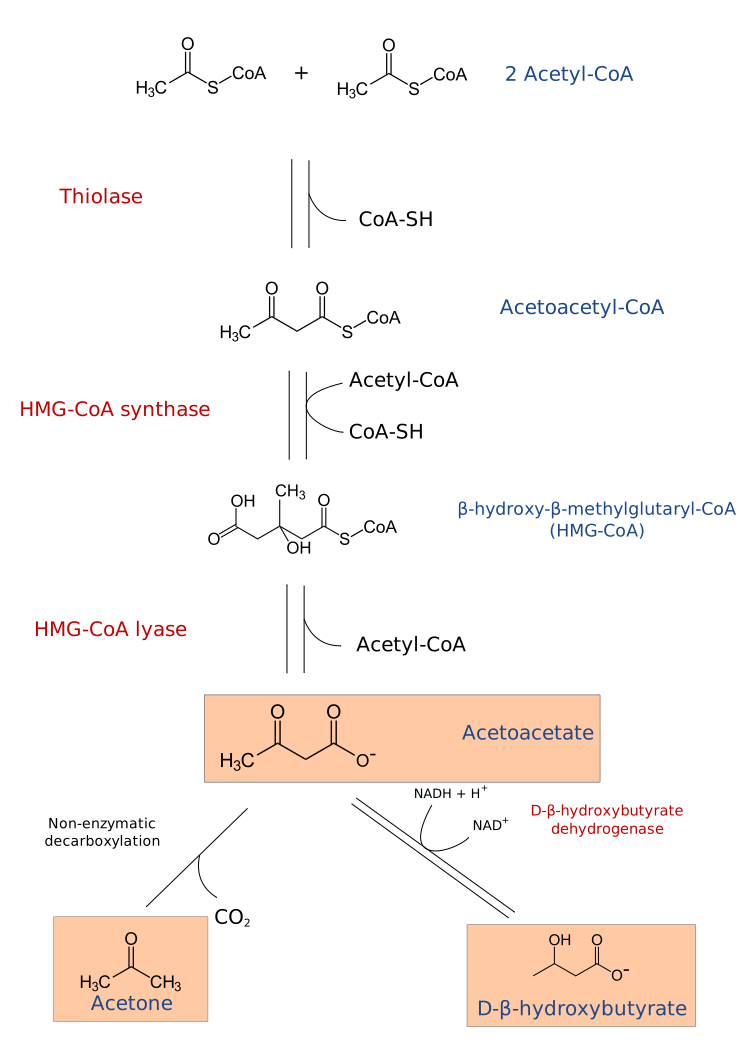
3-Hydroxy-3-methylglutaryl-CoA lyase (or HMG-CoA lyase) is an enzyme ( that in human is encoded by the HMGCL gene located on chromosome 1. It is a key enzyme in ketogenesis (ketone body formation). It is a ketogenic enzyme in the liver that catalyzes the formation of acetoacetate from HMG-CoA within the mitochondria. It also plays a prominent role in the catabolism of the amino acid leucine.
Structure
The HMGCL gene encodes a 34.5-kDa protein that is localized to the mitochondrion and peroxisome. Multible isoforms of the proteins are known due to alternative splicing. The major isoform (isoform 1) is most highly expressed in the liver whereas isoform 2 is found in energy-demanding tissues including the brain, heart, and skeletal muscle.
Structure of the HMGCL protein has been resolved by X-ray crystallography at 2.1-Å resolution, and reveals that the protein may function as a dimer. Substrate access to the active site of the HMGCL enzyme involves substrate binding across a cavity located at the C-terminal end of a beta barrel structure. In addition, the lysine 48 residue which is mutated in patients with 3-hydroxy-3-methylglutaryl-CoA lyase deficiency is also found to be necessary for substrate binding.
Electron density was observed indicating a bound metal ion, presumably Mg2+ due to its inclusion in the crystallization medium. The enzyme activity is dependent on the presence of the metal this was determined by mutating His233 to Ala233 and Asp42 to Asn42 and experiencing catalytic deficiency of 6.4E−3 kcat/kM and 1.3E−5 kcat/kM respectively. The substrate binding site includes arginine 41 making a salt bridge to the carboxylate of the hydroxyglutaric acid closest to metal ion. A mutation in Arg 41 results in a drastic decrease of catalytic activity. The extreme decrease in efficiency suggests the direct involvement in the chemistry of the catalytic reaction. This Arg41 also salt bridges to Glu72 to fold into the correct position and charge balance Arg41 to bind to the substrate.
Function
The HMGCL protein plays an essential role in breaking down dietary proteins and fats for energy. It catalyzes the reaction:
:(S)-3-hydroxy-3-methylglutaryl-CoA = acetyl-CoA + acetoacetate
and requires a divalent metal ion as co-factor.
The enzyme is required for ketogenesis in the liver, and is also responsible for processing the amino acid leucine inside the mitochondrion
Deficiency HMG-CoA lyase deficiency causes hypoketotic hypoglycemia similar to that is caused by HMGCS2 mutations but also leads to organic acid accumulation and metabolic acidosis due to altered leucine metabolism. This disorder can be mistaken for Reye syndrome because of the symptoms of vomiting, lethargy, and convulsions.
Clinical significance
Mutations in the HMGCL gene cause 3-hydroxy-3-methylglutaryl-CoA lyase deficiency (HMGCLD), a rare autosomal recessive inborn error of metabolism characterized by disruption of ketogenesis and L-leucine catabolism. To-date more than 30 different mutations including missense mutations of different residues have been associated with patients with HMGCLD in diverse families and ethnicities. HMGCLD typically presents in the first year of the patient's life after a fasting period. Clinical acute symptoms include vomiting, seizures, metabolic acidosis, hypoketotic hypoglycemia, and lethargy.
Interactions
HMGCL interacts with itself to form homodimers and homotetramers. It is also shown in yeast two-hybrid experiments to interact with DNAJA1.
References
References
- (1996). "Characterization of the hydroxymethylglutaryl-CoA lyase precursor, a protein targeted to peroxisomes and mitochondria". Biochem. J..
- (2012). "Characterization of splice variants of the genes encoding human mitochondrial HMG-CoA lyase and HMG-CoA synthase, the main enzymes of the ketogenesis pathway". Mol. Biol. Rep..
- (2010). "Functional insights into human HMG-CoA lyase from structures of Acyl-CoA-containing ternary complexes". J. Biol. Chem..
- (2007). "C-terminal end and aminoacid Lys48 in HMG-CoA lyase are involved in substrate binding and enzyme activity". Mol. Genet. Metab..
- (2003). "Investigation of conserved acidic residues in 3-hydroxy-3-methylglutaryl-CoA lyase: implications for human disease and for functional roles in a family of related proteins". J. Biol. Chem..
- (2009). "Ten novel HMGCL mutations in 24 patients of different origin with 3-hydroxy-3-methyl-glutaric aciduria". Human Mutation.
- {{OMIM. 246450. 3-hydroxy-3-methylglutaryl-coa lyase deficiency; HMGCLD
This article was imported from Wikipedia and is available under the Creative Commons Attribution-ShareAlike 4.0 License. Content has been adapted to SurfDoc format. Original contributors can be found on the article history page.
Ask Mako anything about 3-Hydroxy-3-methylglutaryl-CoA lyase — get instant answers, deeper analysis, and related topics.
Research with MakoFree with your Surf account
Create a free account to save articles, ask Mako questions, and organize your research.
Sign up freeThis content may have been generated or modified by AI. CloudSurf Software LLC is not responsible for the accuracy, completeness, or reliability of AI-generated content. Always verify important information from primary sources.
Report