From Surf Wiki (app.surf) — the open knowledge base
3-dehydroquinate synthase
Enzyme

Enzyme
| Field | Value |
|---|---|
| Name | 3-dehydroquinate synthase |
| EC_number | 4.2.3.4 |
| CAS_number | 37211-77-1 |
| GO_code | 0003856 |
| image | 3-dehydroquinate synthase 3CLH.png |
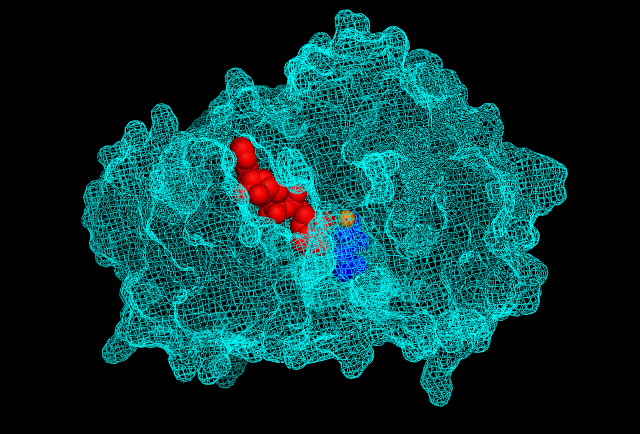
| caption | Ribbon representation of the Helicobacter pylori 3-dehydroquinate synthase. |
The enzyme 3-dehydroquinate synthase (EC 4.2.3.4) catalyzes the chemical reaction
:3-deoxy-D-arabino-hept-2-ulosonate 7-phosphate \rightleftharpoons 3-dehydroquinate + phosphate
The protein uses NAD+ to catalyze the reaction. This reaction is part of the shikimate pathway which is involved in the biosynthesis of aromatic amino acids.
3-Dehydroquinate synthase belongs to the family of lyases, to be specific those carbon-oxygen lyases acting on phosphates. This enzyme participates in phenylalanine, tyrosine, and tryptophan biosynthesis. It employs one cofactor, cobalt (Co2+).
Background
The shikimate pathway is composed of seven steps, each catalyzed by an enzyme. The shikimate pathway is responsible for producing the precursors for aromatic amino acids, which are essential to our diets because we cannot synthesize them in our bodies. Only plants, bacteria, and microbial eukaryotes are capable of producing aromatic amino acids. The pathway ultimately converts phosphoenolpyruvate and 4-erythrose phosphate into chorismate, the precursor to aromatic amino acids. 3-Dehydroquinate synthase is the enzyme that catalyzes reaction in the second step of this pathway. This second step of the reaction eliminates a phosphate from 3-deoxy-D-arabino-heptulosonate 7-phosphate, which results in 3-dehydroquinate. 3-Dehydroquinate synthase is a monomeric enzyme, and has a molecular weight of 39,000. 3-dehydroquinate synthase is activated by inorganic phosphate, and requires NAD+ for activity, although the reaction in total is neutral when catalyzed by an enzyme.
Function
3-Dehydroquinate synthase utilizes a complex multi-step mechanism that includes alcohol oxidation, phosphate β-elimination, carbonyl reduction, ring opening, and intramolecular aldol condensation. Dehydroquinate synthase requires NAD+ and a cobalt cofactor to catalyze the conversion of 3-deoxy-D-arabino-heptulosonate 7-phosphate into 3-dehydroquinate. Dehydroquinate synthase is of particular interest because of its complicated activity relative to its small size. In most bacteria, this enzyme has only one function. However, in fungi and protists, it is part of the pentafunctional AROM complex that comprises steps two, three, four, five and six of the shikimate pathway. Together with 3-dehydroquinate dehydratase, 3-dehydroquinate synthase forms the core of this complex.
Applications
3-Dehydroquinate synthase catalyzes the second step in the shikimate pathway, which is essential for the production of aromatic amino acids in bacteria, plants, and fungi, but not mammals. This makes it an ideal target for new antimicrobial agents, anti-parasitic agents, and herbicides. Other enzymes in the shikimate pathway have already been targeted and put to use as herbicides.


Nomenclature
The systematic name of this enzyme class is 3-deoxy-D-arabino-hept-2-ulosonate-7-phosphate phosphate-lyase (cyclizing; 3-dehydroquinate-forming). Other names in common use include 5-dehydroquinate synthase, 5-dehydroquinic acid synthetase, dehydroquinate synthase, 3-dehydroquinate synthetase, 3-deoxy-arabino-heptulosonate-7-phosphate phosphate-lyase, (cyclizing), and 3-deoxy-arabino-heptulonate-7-phosphate phosphate-lyase (cyclizing).
References
References
- (August 2008). "Structure-based inhibitor discovery of Helicobacter pylori dehydroquinate synthase". Biochemical and Biophysical Research Communications.
- (August 1995). "The molecular biology of multidomain proteins. Selected examples". European Journal of Biochemistry.
- (April 1998). "Cloning and characterisation of the Neisseria gonorrhoeae aroB gene". Molecular & General Genetics.
- (June 1999). "The Shikimate Pathway". Annual Review of Plant Physiology and Plant Molecular Biology.
- (2011). "Expression, Purification, and Characterisation of Dehydroquinate Synthase from Pyrococcus furiosus". Enzyme Research.
- (6 July 2020). "Architecture and functional dynamics of the pentafunctional AROM complex.". Nature Chemical Biology.
This article was imported from Wikipedia and is available under the Creative Commons Attribution-ShareAlike 4.0 License. Content has been adapted to SurfDoc format. Original contributors can be found on the article history page.
Ask Mako anything about 3-dehydroquinate synthase — get instant answers, deeper analysis, and related topics.
Research with MakoFree with your Surf account
Create a free account to save articles, ask Mako questions, and organize your research.
Sign up freeThis content may have been generated or modified by AI. CloudSurf Software LLC is not responsible for the accuracy, completeness, or reliability of AI-generated content. Always verify important information from primary sources.
Report