From Surf Wiki (app.surf) — the open knowledge base
2nd Battalion, Parachute Regiment
| Field | Value | |
|---|---|---|
| image | Parachute Regiment cap badge.jpg | |
| caption | Cap badge of the Parachute Regiment | |
| dates | 1941–1947 | |
| 1948 – present | ||
| country | United Kingdom | |
| branch | ||
| type | Airborne forces | |
| role | Air assault infantry | |
| size | Battalion | |
| 662 personnel | ||
| command_structure | [[File:Logo of the Parachute Regiment.png | 22px]] Parachute Regiment |
| [[File:16AAB new.svg | 18px]] [16 Air Assault Brigade](16-air-assault-brigade) | |
| garrison | Colchester Garrison | |
| colonel_of_the_regiment_label | Colonel Commandant | |
| nickname | *Immaculate Second**Shiny Two* | |
| motto | *Utrinque Paratus* | |
| (Latin for "Ready for Anything") | ||
| identification_symbol | [[File:2nd Para DZF.svg | 100px]] |
| identification_symbol_label | Drop zone flash | |
| identification_symbol_3_label | Abbreviation | |
| battles | ||
| notable_commanders | Maj Gen John Frost CB, DSO & Bar, MC, DL | |
| Lt. Col Herbert 'H' Jones VC, OBE |
1948 – present 662 personnel (Latin for "Ready for Anything")
- World War II
- Falklands War
- Battle of Goose Green Lt. Col Herbert 'H' Jones VC, OBE The Second Battalion, Parachute Regiment (2 PARA), is a formation of the Parachute Regiment, part of the British Army, and subordinate unit within 16th Air Assault Brigade.
2 PARA is an airborne light infantry battalion capable of a wide range of operational tasks, based at Merville Barracks, Colchester Garrison, England. Personnel regularly deploy outside the United Kingdom on operations and training.
History
The 2nd Battalion was formed on 30 September 1941, as the 2nd Parachute Battalion, and later became part of the Army Air Corps. The battalion took part in its first active operation over the night of 27–28 February 1942, Operation Biting, the raid on Bruneval in France. In honour of the operation, C Company of the battalion took the nickname 'C (Bruneval) Company'. On 1 August of the same year, the battalion was renamed the 2nd Battalion, the Parachute Regiment.
The battalion was part of the 1st Parachute Brigade, 1st Airborne Division, and fought in the British airborne operations in North Africa, Operation Fustian in Sicily, Operation Slapstick on the Italian mainland. Most famously, at the Battle of Arnhem in September 1944, it was the only battalion to reach Arnhem Bridge and capture its north side where, having been cut-off, it defended the bridge for several days before finally surrendering to elements of the 9th SS Panzer Division Hohenstaufen.
After the Second World War, the battalion was reformed and served with the 6th Airborne Division in Palestine. It was then amalgamated with the 3rd Parachute Battalion and renamed the 2nd/3rd Battalion and shortly afterwards disbanded. A new 2nd Battalion was formed later the same year by renumbering the 5th (Scottish) Parachute Battalion.
In 1951, the battalion was deployed to Ismaïlia, Egypt, after civil unrest in the region, to protect the Suez Canal. In July 1956, 2 Para went to Cyprus to counter the EOKA insurgency. It then took part in Operation Musketeer in November of the same year as part of 16 Independent Parachute Brigade, landing by sea and occupying El Cap.
In June 1961, as part of an 8,000 strong battle-group, 2 Para was sent to Kuwait to forestall a threatened invasion by Iraq. In early 1965 the battalion was rushed to Singapore in response to a threat of invasion of Borneo by Indonesia. In the following Indonesian Confrontation, B Company repulsed an attack by an Indonesian battalion in the Battle of Plaman Mapu. In March 1969, 2 Para went to the Caribbean island of Anguilla to restore the British administration. The men, who were landed by boat from three Royal Navy frigates (along with 40 police officers) were later awarded the Wilkinson Sword of Peace "for acts of humanity and kindness overseas".
In the 1970s, the battalion was sent to Northern Ireland as part of Operation Banner for the first of many tours.
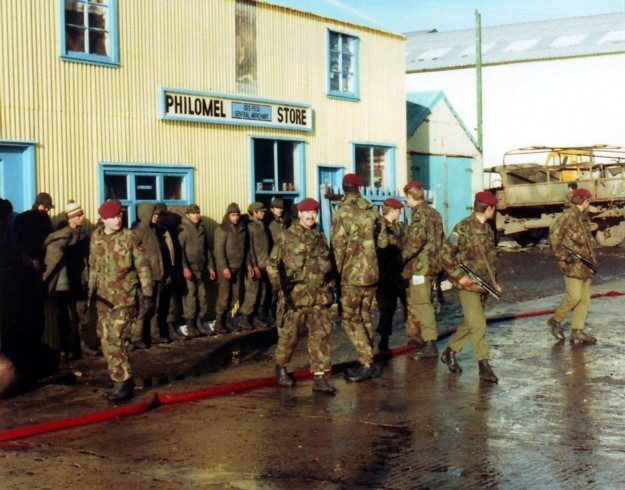
In 1982, the battalion was part of the force sent to the South Atlantic in Operation Corporate, as part of 3 Commando Brigade during the Falklands War. The battalion's men were the first troops from the main assault body to land on the Falkland Islands. The landing was on the shore at San Carlos Water (codename: Blue Beach). The battalion's first battle was the Battle of Goose Green on 28 May. This was followed by the Battle of Wireless Ridge and then the recapture of Port Stanley.

In August 2001, the battalion was part of the NATO Operation Essential Harvest in Macedonia. This was followed in 2002 by Operation Fingal, in Afghanistan. The battalion also took part in UK operations in Iraq and Afghanistan.
Following the Manchester Arena bombing and the enactment of Operation Temperer, 2 PARA were deployed in London to guard key locations, including the Palace of Westminster.
In August 2021, due to the rapid Taliban advancement through the country of Afghanistan, 2 PARA were deployed on Operation Pitting to aid in the extraction of British nationals from the country.
References
Citations
Bibliography
References
- "Army – Question for Ministry of Defence".
- Miller, George. (1975). "The Bruneval Raid". Doubleday & Company, Inc..
- Jess Bracey. (25 July 2018). "Falkland Islands Government Fund Parachute Regiment Statue".
- "2nd Battalion, the Parachute Regiment". Paradata.
- "Battle of Arnhem". Ministry of Defence.
- (16 January 2020). "The 100 Worst Military Disasters in History". Bloomsbury Publishing USA.
- (1959). "Army Aviation and the Airborne". U.S. Government Printing Office.
- (2001). "Magill's Guide to Military History: A-Cor". Salem Press.
- Ferguson, Gregor. (1984). "The Paras 1940-1984: British airborne forces 1940-1984". Osprey Publishing.
- (1951-12-11). "Paras in the Canal Zone". Britains-smallwars.com.
- "Suez (Operation Musketeer)". ParaData.
- "Persian Gulf". ParaData.
- "Borneo". ParaData.
- "Anguilla (Operation Sheepskin)". ParaData.
- "Paras in Northern Ireland". Britains-smallwars.com.
- Smith, Gordon. (2006). "A Battle Atlas of the Falklands War 1982 by Land, Sea and Air". Lulu.com.
- Clapp, Michael. (1996). "Amphibious Assault Falklands: The Battle of San Carlos Water". Naval Institute Press.
- Fitz-Gibbon, Spencer. (1995). "Not Mentioned in Despatches: The History and Mythology of the Battle of Goose Green". James Clarke & Co.
- ["ARCHIVED CONTENT] ISAF: Photo Gallery - on patrol and at HQ". Operations.mod.uk.
- "First Troops Deployed in Operation Temperer". Warfare.Today.
- (12 October 302). "Op Pitting: The British Army's Experience in the Evacuation of Kabul". RUSI.
This article was imported from Wikipedia and is available under the Creative Commons Attribution-ShareAlike 4.0 License. Content has been adapted to SurfDoc format. Original contributors can be found on the article history page.
Ask Mako anything about 2nd Battalion, Parachute Regiment — get instant answers, deeper analysis, and related topics.
Research with MakoFree with your Surf account
Create a free account to save articles, ask Mako questions, and organize your research.
Sign up freeThis content may have been generated or modified by AI. CloudSurf Software LLC is not responsible for the accuracy, completeness, or reliability of AI-generated content. Always verify important information from primary sources.
Report