From Surf Wiki (app.surf) — the open knowledge base
2K12 Kub

| Field | Value | |
|---|---|---|
| name | 2K12 “Kub” | |
| NATO reporting name: SA-6 "Gainful" | ||
| image | 2P25 VS 2.jpg | |
| image_size | 300px | |
| caption | 2P25 TEL with missiles elevated (2K12 Kub SAM of Serbian 250th Air Defence Missile Brigade) | |
| origin | Soviet Union | |
| type | Tracked medium-range surface-to-air missile system | |
| is_vehicle | yes | |
| is_UK | yes | |
| service | 1967–present | |
| used_by | See list of operators | |
| wars | {{collapsible list | |
| designer | {{plainlist | |
| design_date | 1958–1967 | |
| manufacturer | {{plainlist | |
| production_date | 1968–1985 | |
| number | 500 launchers, 10,000 missiles | |
| variants | 2K12 Kub, 2K12E Kvadrat (export version), 2K12M3, 2K12M4 | |
| spec_label | 2K12 Kub | |
| primary_armament | 3 3M9M4(or variants) guided missiles | |
| engine | integral rocket motor/ramjet booster and sustainer motor | |
| guidance | command guidance with terminal semi-active radar homing (SARH) |
NATO reporting name: SA-6 "Gainful"
- Yom Kippur War
- Angolan Civil War
- Chadian Civil War
- Western Sahara War
- Iran–Iraq War
- 1982 Lebanon War
- Gulf War
- Yugoslav wars
- Kosovo War
- Syrian Civil War
- Russo-Ukrainian War
- Russian invasion of Ukraine
- Yemeni Civil War (2014–present)
- 2020 Nagorno-Karabakh war
- NIIP/Vympel
- MMZ (GM chassis)}}
- Ulyanovsk Mechanical Plant (SURNs)
- ZiK (TELs)}}
The **2K12 *"Kub"''''' (; English: 'cube') (NATO reporting name: **SA-6 "Gainful"''') mobile surface-to-air missile system is a Soviet low to medium-level air defence system designed to protect ground forces from air attack. *2К12'' is the GRAU designation of the system.
Each 2K12 battery consists of a number of similar tracked vehicles, one of which carries the 1S91 (SURN vehicle, NATO designation "Straight Flush") 25 kW G/H band radar (with a range of 75 km) equipped with a continuous wave illuminator, in addition to an optical sight. The battery usually also includes four triple-missile transporter erector launchers (TELs), and four trucks, each carrying three spare missiles and a crane. The TEL is based on a GM-578 chassis, while the 1S91 radar vehicle is based on a GM-568 chassis, all developed and produced by Russian manufacturer MMZ.
Development
The development of the 2K12 started after 18 July 1958 at the request of the CPSU Central Committee. The system was set the requirements of being able to engage aerial targets flying at speeds of 420 to(-) at altitudes of 100 to at ranges up to 20 km, with a single shot kill probability of at least 0.7.
The systems design was the responsibility of the now Tikhomirov Scientific Research Institute of Instrument Design (NIIP). In addition to NIIP several other design bureaus were involved in the creation of the Kub missile system including Mytishchi Machine-Building Plant which designed and produced the chassis of the self-propelled components. Many of the design bureaus would later go on to co-operate in the development of the successor to the 2K12 "Kub", the 9K37 "Buk".
First trials of the missile system were started at the end of 1959 to discover a series of problems:
- low power for the missile radar seeker and badly designed nose cone
- missile air inlets design failure
- low quality of heat shield inside the afterburner chamber (titanium was replaced by steel).
In August 1961 Toropov was replaced by Lyapin as the Chief Designer of Vympel and in January 1962 Tikhomirov was replaced by Figurovskiy as the Chief Designer of NIIP. Still, the work was not intensified. Before 1963 only 11 of 83 missiles fired had the seeker head installed; only 3 launches were successful.
Kub downed its first-ever air target on February 18, 1963, during the state trials at Donguz test site, Orenburg Oblast. It was an Ilyushin Il-28 bomber.
The system entered an extended testing period between 1959 and 1966, after overcoming the technical difficulties of producing the 2K12 "Kub" the system was accepted into service on 23 January 1967 and went into production that same year.
It is sometimes claimed that the M-11 Shtorm naval system is a version of the 3M9 but this is not the case, as the M-11 Shtorm is a separate system and, unusually for Russian surface-to-air missiles, has no land-based variant.
The 2K12 "Kub" was recommended for modernisation work in 1967 with the goal of improving combat characteristics (longer range, improved ECCM, reliability and reaction time) established for the new chief designer Ardalion Rastov. A modernised variant underwent trial testing in 1972 eventually being adopted in 1973 as the "Kub-M1". The system underwent another modernisation between 1974 and 1976, again the general combat characteristics of the system were improved with the "Kub-M3" clearing testing and entering service in 1976.
After the Rastov visit to Egypt in 1971 to see Kub in operation he decided upon the development of a new system, called Buk, where each TEL should have its own fire control radar (TELAR) and is able to engage multiple targets from multiple directions at the same time.
The final major development of the Kub missile system was achieved during the development of its successor, the 9K37 "Buk" in 1974. Although the Buk is the successor to Kub it was decided that both systems could share some interoperability, the result of this decision was the "Kub-M4" system. The Kub-M4 used Kub-M3 components which could receive fire control information from the 9А310 transporter erector launcher and radar (TELAR) of the 9K37 Buk. The advantage of interoperability was an increase in the number of fire control channels and available missiles for each system as well as a faster service entry for Buk system components. The Kub-M4 was adopted into service in 1978 following completion of trials.
Some early development implementations of the Buk missile system heavily utilized Kub components, including the 3M9 missile.
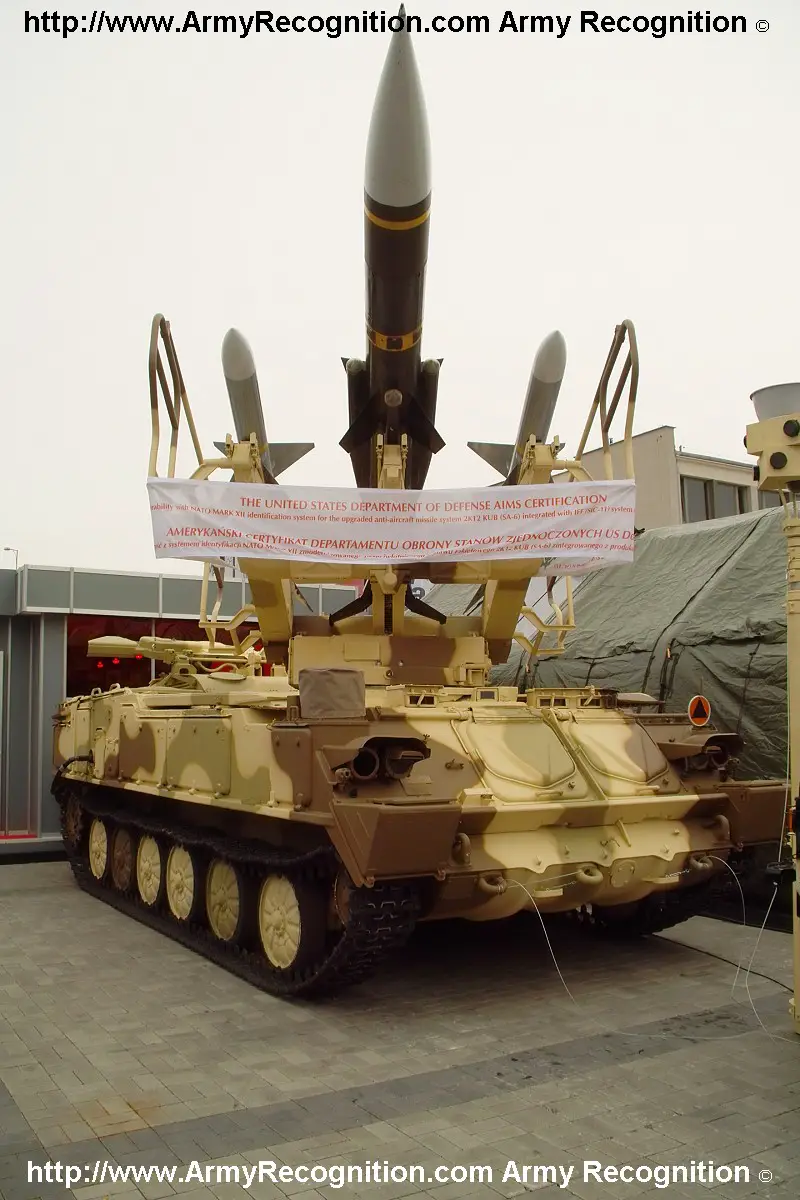
There are several plans to integrate active radar homing missiles into Kub. For instance, Polish WZU of Grudziadz demonstrated a project of a Sparrow-armed Kub at the MSPO 2008 defence exhibition in Kielce. It is reported also that Vympel initiated some work to use its RVV-AE air-to-air missile to modernise the Kvadrat SAM system.
Also, the Czech company RETIA presented a SURN (fire control radar) upgrade featuring an optical channel and new multiple-function color displays as well as the radar upgrade and the IFF system.
In 2011 a Kub upgraded launcher (named "2K12 KUB CZ") with three Aspide 2000 missiles in launch containers was presented at the International Exhibition of Defence and Security Technologies (IDET) exposition in Brno. The modifications were made by Retia.
Description
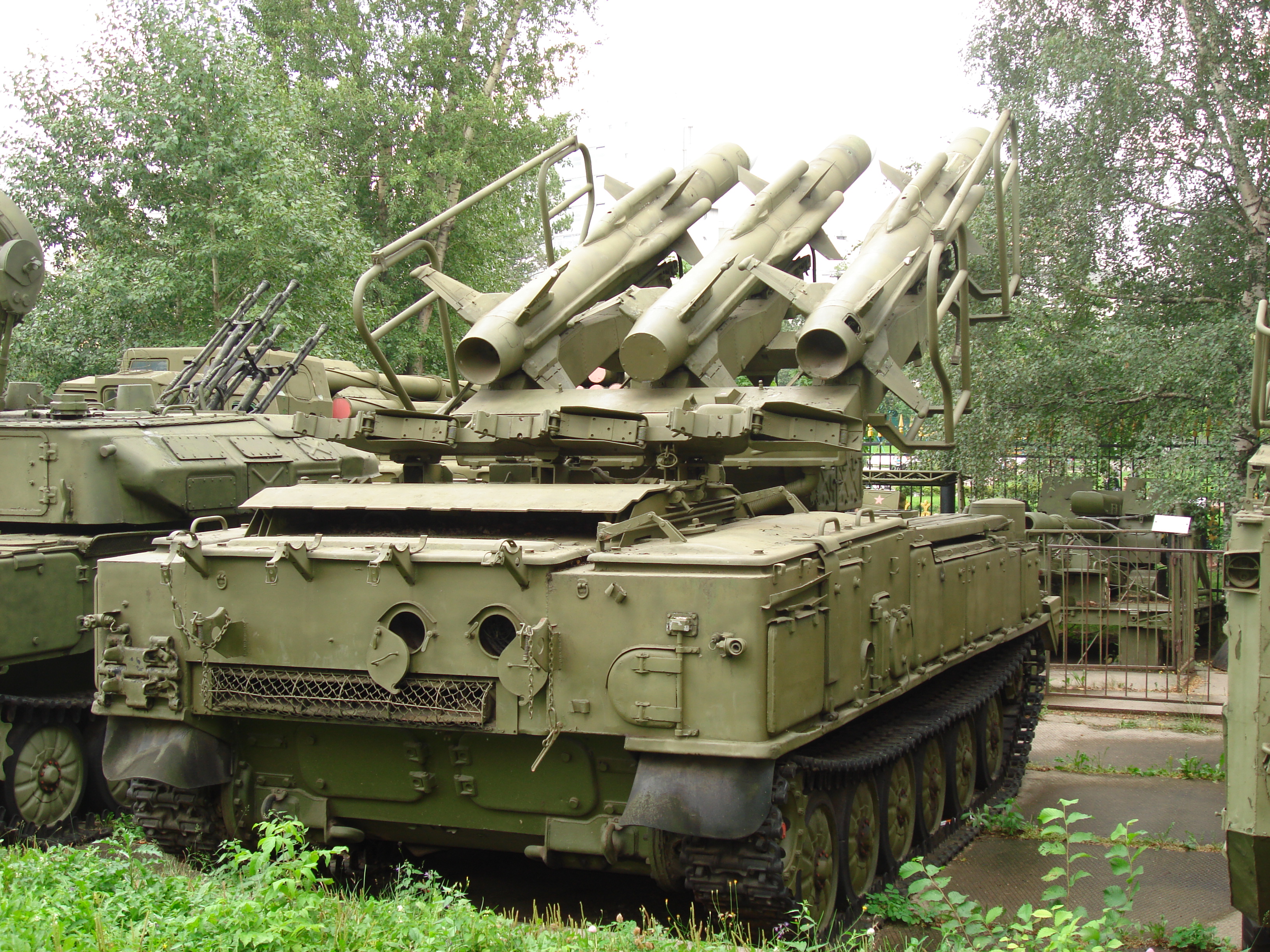
The 2K12 system shares many components with the 2K11 Krug (SA-4) system. In many ways they are designed to complement each other; 2K11 is effective at long ranges and high altitudes, 2K12 at medium ranges and intermediate altitudes.
The system is able to acquire and begin tracking targets using the 1S91 "Самоходная установка разведки и наведения" (SPRGU - "Self-propelled Reconnaissance and Guidance Unit" / NATO: "Straight Flush" radar) at 75 km and begin illumination and guidance at 28 km. IFF is also performed using this radar. It can only guide one or two missiles to a single target at any time. The missile is initially command guided with terminal semi-active radar homing (SARH), with target illumination provided by the "Straight Flush" radar. Detonation is via either the impact or proximity fuze. On the latest models, this vehicle is also fitted with an optical tracking system which allows engagement without the use of the radar (for active RF emissions stealth reasons, or due to heavy ECM jamming) in which case the effective altitude is limited to 14 km/46000 ft. The optical tracking method also allows engagements to altitudes below that where the radar is able to track targets. Maximum target speed is around Mach 2 for head-on engagements and Mach 1 for tail-chase engagements. Top speed of the missile is approximately Mach 2.8.
In contrast to the elaborate Patriot missile or even the simpler Hawk system fielded by US forces, most of the system rides on two tracked self-propelled vehicles, rather than towed or mounted on trucks, and either the launcher or control vehicle can be set to launch in only 15 minutes after changing location.
Min. 100 m
Missiles
Service life – 2–10 h Flight time – up to 70 s G-load during maneuvers – up to 8 ERA (depending on complement) – with metal fairing 0.1–0.3 m^2; with radiotransparent fairing – 1 m^2; with Luneberg lens – 3–5 m^2 Infrared radiation simulation means – T-60 tracking flare Level of heat radiation – in infrared band of 3–5 μ: head-on course 3–100 W/sr; pursuit course 100–300 W/sr Number of heat decoys – 10 Number of decoy firings – 2 (in train or in salvo of two) Number of flight programs – 7 Flight control method – programmable Elimination method – forced
The fairly large missiles have an effective range of 4 – and an effective altitude of 50 –. The missile weighs 599 kg and the warhead weighs 56 kg. Top missile speed is approx. Mach 2.8. The combined propulsion system 9D16K included solid fuel rocket motor which, when burned out, forms the combustion chamber for a ramjet in a pioneering design putting this missile far ahead of its contemporaries in terms of propulsion.
The missile was fitted with a semi-active radar seeker 1SB4, designed by MNII Agat, which was able to track the target by Doppler frequency since the start. Later upgrades (3M9M3 missile) could do this before the start. Chief Designer of the seeker head was Yu.N. Vekhov, since 1960 – I.G. Akopyan.
In 1977 a new version, the 3M9M1 (DoD designation SA-6B) was created with three missiles fitted onto a different chassis (the same as that of the 9K37 "Buk" (NATO reporting name "Gadfly" / DoD SA-11 ), the 2K12 effective replacement) with an integrated "Fire Dome" missile guidance radar. For comparisons between the 2K12, 9K37, see the 9K37 Buk entry.
An earlier incremental upgrade saw the 2K12 missiles replaced with the 2K12E versions and this system was known as Kvadrat ("Квадрат", meaning square). This name was derived from the most common arrangement pattern of the military vehicles of the 2K12 complex, when the 1S91 radar is located at the center and 4x2P25 TELs at the vertices of a square around the radar.
Comparison
| Complex | ||||||||||||
|---|---|---|---|---|---|---|---|---|---|---|---|---|
| (GRAU designation) | Kub | Kub-M1 | Kub-M3 | Kub-M4 | ||||||||
| (Buk-M1) | Introduced | Missiles per TEL | Engagement range | Missile speed | ||||||||
| (Mach) | Maximum target speed | |||||||||||
| (Mach) | Response Time (seconds) | missile Weight, kg | Deployment time (minutes) | |||||||||
| 1967 | 1973 | 1976 | 1978 | |||||||||
| 3 | 3 | 3 | 3 | |||||||||
| 6–22 km | 4–23 km | 4–25 km | 4–24 km | |||||||||
| 100–7,000 m | 80–8,000 m | 20–8,000 m | 30–14,000 m | |||||||||
| 1.75 | 1.75 | 2 | 2 | |||||||||
| 1.75 | 1.75 | 1.75 | 1.75 | |||||||||
| 26–28 | 22–24 | 22–24 | 24 | |||||||||
| 630 kg | 630 kg | 630 kg | 630 kg | |||||||||
| 1 | 1 | 1 | 2 | |||||||||
| 5 | 5 | 5 | 5 |
1S91 radar

SURN 1S91 vehicle included two radar station – a target acquisition and distribution radar 1S11 and a continuous wave illuminator 1S31, in addition to an IFF interrogator and an optical channel.
While 1S31 antenna was installed on the upper section of the superstructure and the 1S11 on the lower, they could turn around independently. To make the height of the vehicle lower the central cylinder was able to hide inside the prime mover.
The acquisition range of the radar was reported as 50 km for an F-4 Phantom II type of target.
Total weight of the 1S91 vehicle with a crew of 4 was 20.3 tonnes and 2P25 vehicle with 3 missiles and a crew of 3 was 19.5 t.
Additional radar
The 2K12 can also be used at a regimental level, if used as such it can be accompanied by a number of additional radar systems for extended air search at longer range and lower altitude, to supplement the 1S91 "Straight Flush". These systems include the:
- P-12 "Spoon Rest", a VHF early warning radar (also used by the S-75 Dvina), with a 200 km range.
- P-40 "Long Track", an E band early warning radar (also used by the 2K11 Krug and 9K33 Osa), with a 370 km range.
- P-15 "Flat Face A", a UHF early warning radar (also used by the S-125 Neva, with a 150 km range.
- PRV-9 ("Thin Skin"), PRV-11 ("Side Net") or PRV-16 E band height finding radar (also used by the S-75, 2K11 Krug and S-200, range 240 km
- NRS-22 ("Score Board") IFF radar
The P-12 and PRV are mounted on a truck, P-40 on a tracked vehicle (a modified AT-T) and P-15 on a van. The NRS-22 IFF radar is mounted on a free standing tripod.
Without the P-40 "Long Track" mobile radar vehicle, the 2K12 is unable to track aircraft at high altitudes.
File:SURN 1S91 vehicle of 2K12 Kub missile system, Open-air military museum in a 35 years Victory Park, Kineshma.jpg|1S91 (or SURN) vehicle in an open-air military museum, Kineshma File:1S91 missile guidance system control station.JPG|1S91 first/second operator console File:Missile guidance system control station of a 1S91 radar.JPG|1S91 third operator console File:Monitor and control equipment 1S91.JPG|1S91 teleconsole File:1S91 Kub main operator console.jpg|1S91 main operator console (after upgrade) File:1S91 Kub third operator console at MAKS Airshow 2011.jpg|1S91 third operator console (after upgrade) File:1S91 Kub Teleoperator console at MAKS Airshow 2011.jpg|1S91 teleconsole (after upgrade) File:P-12 NRS-12.jpg|NRS-12 "Score Board" IFF radar (bottom left - mounted on tri-pod) and P-12 "Spoon Rest" (centre - mounted on a towable generator).
Operational history
Middle East
Yom Kippur War
In the 1973 Yom Kippur War, the Egyptian and Syrian 2K12s surprised the Israeli military, who were accustomed to having air superiority over the battlefield. The highly mobile 2K12 took a heavy toll on the slower A-4 Skyhawk and even the F-4 Phantom, forming a protective umbrella until they could be removed. The radar warning receivers on the Israeli aircraft did not alert the pilot to the fact that he was being illuminated by the radar. The 2K12 performed well according to a conversation between Israeli General Peled and Henry Kissinger, and caused the most Israeli losses of any Egyptian anti-aircraft missile, followed by the 9K32 Strela-2.
The superior low altitude performance of the weapon, and its new CW semi-active missile seeker resulted in a much higher success rate compared to the earlier S-75 Dvina and S-125 Neva systems. While exact losses are disputed, around 40 aircraft are usually cited as lost to SAMs, and the 2K12 Kub proved the most effective of the three weapons. But in subsequent conflicts, its performance declined as captured examples resulted in effective counter-measures being developed.
1982 Lebanon war
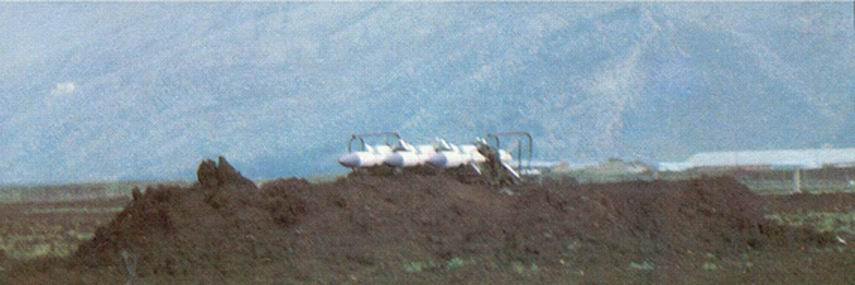
The Syrians also deployed the 2K12 Kub to Lebanon in 1981 after the Israelis shot down Syrian helicopters near Zahlé. The SAM batteries were placed in the Bekaa Valley near the Beirut-Damascus road. They remained close to the existing Syrian air defense system but could not be fully integrated into it. Early in the 1982 Lebanon war, the Israeli Air Force concentrated on suppressing the SAM threat in the Beqaa Valley, launching Operation Mole Cricket 19. The result was a complete success. Several 2K12 Kub batteries, along with S-75s and S-125 systems, were destroyed in a single day. While Syria's own air defenses remained largely intact, its forces in Lebanon were left exposed to attacks by Israeli strike aircraft for the remainder of the war. It has been reported, however, that at least one Israeli F-4 Phantom fighter-bomber was shot down in the area by a 2K12 Kub on July 24, 1982.
South African Border War
The People's Armed Forces for the Liberation of Angola (FAPLA) procured a number of 2K12 Kub systems from the Soviet Union in 1981. According to the Central Intelligence Agency, Angola had obtained sixteen TEL launchers for the 2K12 Kub systems, which were deployed in the Moçâmedes District.{{cite web|title=SA-6 Equipment: Moccamedes SAM Support Facility, Angola|author=|url=https://www.cia.gov/library/readingroom/docs/CIA-RDP91T00712R000100270006-8.pdf|location=Langley
2K12 Kub missile sites were also operated by Cuban expeditionary forces in Angola during Operation Excite/Hilti. On 26 June 1988, six 3M9M3 missiles launched from a Cuban 2K12 Kub battery were fired at a South African weather balloon being used as a radar decoy over Tchipa. South African observers used the firing data to plot the location of the 2K12 Kub launchers and destroyed them in a concentrated bombardment with G5 howitzers.
Western Sahara War
Forces of the Polisario Front acquired two full batteries of 2K12 Kub missiles from Algeria during the Western Sahara War, which they used effectively against the fighters of the Royal Moroccan Air Force, including shooting down two Mirage F1 fighters in 1981 during a major battle in Guelta Zemmur.
Poland
On 19 August 2003, a Polish Air Force Su-22M4K was accidentally shot down by friendly fire during an exercise by a Polish 2K12 Kub battery. The aircraft was flying 21 km from the coast over the Baltic Sea near Ustka. The pilot, General Andrzej Andrzejewski, ejected and was rescued after two hours in the water.
Libya
The system was deployed by Libya during the border dispute with Chad and proved a threat for French aircraft. On 16 February 1986, the system failed in detecting low flying French jets which were attacking the Ouadi Doum airbase. On January 7, 1987, the French Air Force were successful in destroying a 2K12 Kub radar site in the Faya Largeau area with SEPECAT Jaguars armed with Martel anti-radiation missiles.
In March, the Chadian rebels captured Ouadi Doum air base, seizing virtually all heavy equipment used for the defense of this airfield, intact. Most of this equipment was transported to France and the United States in the following days, but some 2K12 Kub systems remained in Chad.
With this catastrophe, the Libyan occupation of northern Chad – and the annexation of the Aouzou Strip – was over: by 30 March, the bases at Faya Largeau and Aouzou had to be abandoned. The LARAF now had a completely different task: its Tu-22Bs were to attack the abandoned bases and destroy as much equipment left there as possible. The first strikes were flown in April, and they continued until 8 August 1987, when two Tu-22Bs tasked to strike Aouzou were ambushed by a captured 2K12 Kub battery used by the Chadian Army. One of the bombers was shot down.
Libyan air defense, including 2K12 Kub batteries, was active during the 2011 military intervention in Libya.
Iraq
Several 2K12 Kub batteries, along with other SAM systems and military equipment, were supplied to Iraq before and during the Iran–Iraq War as part of large military packages from the Soviet Union. The batteries were active since the start of the war in September 1980, scoring kills against U.S-supplied Iranian F-4 Phantoms and Northrop F-5s.
The SA-6/Kub was also used during the 1991 Gulf War. The threat posed by these SAMs led to the US Navy outfitting the ALQ-167 Bullwinkle Jamming pod on their F-14A/A+ Tomcats and A-6E TRAM/SWIP Intruder aircraft. On the opening night of Desert Storm, on 17 January 1991, a B-52G was damaged by a missile. Different versions of this engagement are told. It could have been an S-125 or a 2K12 Kub while other versions report a MiG-29 hit the bomber with a R-27R missile. However, the U.S. Air Force disputes these claims, stating the bomber was actually hit by friendly fire, an AGM-88 High-speed, Anti-Radiation Missile (HARM) that homed on the fire-control radar of the B-52's tail gun; the jet was subsequently renamed In HARM's Way. Shortly following this incident, General George Lee Butler announced that the gunner position on B-52 crews would be eliminated, and the gun turrets permanently deactivated, commencing on 1 October 1991.
On January 19, 1991, a USAF F-16 (serial 87-228) was shot down by a 2K12 Kub during the massive (though ill-fated) Package Q Strike against a heavily defended Baghdad. It was the tenth coalition aircraft lost in combat in Operation Desert Storm. The pilot, Captain Harry 'Mike' Roberts, ejected safely but was taken prisoner and freed in March 1991. The aircraft was on a mission to attack the Air Defense Headquarters Building. It had flown 4 combat missions before being lost.
The 2K12 Kub threat was largely controlled by Allied EW assets together with the older S-75s and S-125 missile systems. Most of the losses were due to IR guided SAMs.
Kubs continued to be used by the Iraqi military, along with other SAM systems, to challenge the Western imposed no-fly zones during the 1990s and early 2000s. They were not able to shoot down any Coalition aircraft though several sites were destroyed as retaliation. In one incident, on September 11, 1996, during Operation Provide Comfort II, one missile was fired against two USAF F-16 in northern Iraq but missed. On December 30, 1998, a 2K12 Kub site near Talil fired 6-8 missiles at aircraft enforcing the Southern Watch component of the NFZ. American F-16s responded by dropping six GBU-12 laser-guided bombs on the site and also launching two HARMs "as a preemptive measure" to warn Iraqi radar operators against carrying out more firings.
Bosnia and Yugoslavia
Army of Republika Srpska forces, using modified 2K12 Kub systems were successful in shooting down Scott O'Grady's F-16 in 1995
One Mi-17 was shot down by a Kub on May 28, 1995, killing the Bosniak Minister Irfan Ljubijankić, and 6 other crew and passengers.
During the Kosovo War in 1999, on the first night of the war (March 24/25), a Yugoslav Air Force MiG-29 flown by Maj. Predrag Milutinović was downed by a Kub battery in a friendly fire incident, while approaching Niš Airport after an unsuccessful engagement with NATO aircraft.
The Yugoslav Air Defence had 22 2K12 Kub batteries. Using shoot and scoot tactics, the self-propelled ground system demonstrated a good survivability with only three radars lost in the face of nearly four-hundred AGM-88 shots. As comparison the fixed S-75 and S-125 sites suffered losses to around 66 to 80 percent. According to the then-commander of Air force and air defense General Spasoje Smiljanić, during the 78 day campaign, 2K12 Kub had 46 shooting with 70 missiles.
Syrian Civil War
On April 14, 2018, American, British, and French forces launched 103 air-to-surface and cruise missiles targeting sites in Syria. According to the Russian military, twenty-one Kub missiles launched in response allegedly destroyed eleven incoming missiles, However, the American Department of Defense claimed no Allied missiles were shot down.
Yemen Civil War
South Yemen formerly operated these systems in the South Yemeni air defense forces. Later, United Yemen purchased a large number of these systems in the 1990s and they entered service with the Yemeni air defense forces in 1999. On 6 June 2019, Houthi forces successfully shot down a USAF MQ-9. CENTCOM officials blamed the shoot down on a Houthi-operated and domestically made Fater-1 missile – a SAM system upgraded from a Soviet 2K12 Kub air defence system.
War in Ukraine
Ukraine retired its Kub batteries in the early 2000s to focus on the more modern Buk systems, but with the outbreak of the Russo-Ukrainian war in 2014, Ukraine's Aerotekhnika company begun repairing some of the 89 Kub units in storage and modernize them to the Kub M3/2D standard. According to Ukrainian media, two units were operational in 2021, while the Pentagon estimated that only one was operational prior to the Russian invasion in 2022.
On 17 March 2023, the Slovak government approved the transfer of two Kub missile launchers, one Kub radar, spare parts, 52 pieces of 3M9ME missiles and 148 pieces of 3M9M3E missiles to Ukraine.
On 10 May 2023, the President of Czech Republic, Petr Pavel, has announced that his country will send two "2K12 Kub' missile systems to Ukraine with a "relatively large number" of missiles. On late August 2023, photos of Czech 2K12M2 Kub-M2 systems in Ukrainian service appeared on social media.
Operators


Current
- − Unknown number of 2K12 Kvadrat in service as of 2024.
- − 16 2K12-ML Kvadrat-ML in service as of 2024.
- − Unknown number in service as of 2024.
- − 20 as of 2024.
- − Unknown number in service as of 2024.
- − 4 as of 2024.
- − Unknown number in service as of 2024.
- − 8 2K12M2 Kub-M2 as of 2024.
- − 56+ as of 2024.
-
- At least 1 operational system retained from East German stocks for threat simulation.
- − 16 as of 2024.
- − 180 as of 2024.
- − Unknown number in service as of 2024.
- − Unknown number of 2K12 Kvadrat-M in service as of 2024.
- − 20 as of 2024.
- − 32 as of 2024.
- − 12 batteries in service with the Serbian Air Force and Air Defence as of 2024.
- − Unknown number in service as of 2024.
- − Unknown number in service prior to the fall of the Assad regime.
- − Unknown number in service as of 2024. Serviceability doubtful
- − Unknown number in service as of 2024.
- − Two batteries donated by the Czech Republic and two launchers donated by Slovakia in 2023.
- − Unknown number in service as of 2024.
Non-state
- Libya Libyan National Army − Unknown number of 2K12 Kvadrat in service as of 2024.
- SADR Polisario Front − At least 4.
Former
- Artsakh − Operated an unknown number in 2016.
- − Passed on to successor states.
- − Passed on to the unified German state.
- Ba'athist Iraq
- Libyan Arab Jamahiriya
- − 400 in 2002
- − 800 in 1989. Passed on to successor states.
- North Yemen − Passed on to the unified Yemeni state.
- South Yemen − Passed on to the unified Yemeni state.
- − Passed on to successor states.
File:PRV-11 "Side Net" radar.jpg|"Side Net" height finding radar. Photo by Nellis AFB. File:Polish Military Hardware (2856800211).jpg|P-40 "Long Track" early warning radar. Photo by Nellis AFB. File:1S91 in Polish service.jpg|An 1S91 (Straight Flush) radar of the Hungarian Army's 2K12 Kub missile system
References
Sources
References
- "ЗРК "Куб"". Pvo.guns.ru.
- (2004-04-11). "САМОХОДНЫЙ ЗЕНИТНЫЙ РАКЕТНЫЙ КОМПЛЕКС 2К12 "КУБ" (SA-6 GAINFUL)". pvo.guns.ru.
- (1998-08-31). "Chief Designer Ardalion Rastov".
- {{in lang. ru [http://www.arms-expo.ru/site.xp/049051048057124051054054.html Buk (9K37, SA-11, Gadfly)] {{webarchive. link. (4 May 2009 , ARMS-EXPO website)
- "Sparrow missile integration with SA-6".
- (February 2018). "Jane's- Surface to Air".
- "2K12 Kub modernisation for Polish Army at MSPO 2007 Defence Exhibition".
- [http://www.janes.com/articles/Janes-Missiles-And-Rockets-2006/RV-77-could-create-a-smarter-Kub.html RV-77 could create a smarter Kub] {{Webarchive. link. (26 February 2009 at Jane's Information Group website)
- [http://www.military-retia.cz/en/SAM-system-modernization/ SAM system modernization] {{Webarchive. link. (1 November 2009 at RETIA, a.s.)
- [https://archive.today/20130210025117/http://www.military-retia.cz/en/news/1519-odstavec-the-czech-company-retia-a-s-is-replacing-three-deadly-fingers-of-the-surface-to-air-missile-sam-system-2k12-kub/%234f506b930dfc2 The Czech company RETIA, a.s. is replacing – three deadly fingers – of the Surface to Air Missile (SAM) system 2K12 KUB] at RETIA, a.s.
- "The White House Memorandum of Conversation".
- C Kopp. (6 July 2009). "3M9ME Gainful SAM launch from TEL".
- "Israelis Bomb Lebanese Sites, Lose One Plane - The Washington Post". [[The Washington Post]].
- Vanneman, Peter. (1990). "Soviet Strategy in Southern Africa: Gorbachev's Pragmatic Approach". Hoover Institution Press.
- Jaster, Robert Scott. (1997). "The Defence of White Power: South African Foreign Policy under Pressure". Palgrave-Macmillan.
- George, Edward. (2005). "The Cuban intervention in Angola". Frank Cass Publishers.
- Cooper, Tom. "Morocco, Mauritania & West Sahara since 1972". ACIG.org.
- "Poland's Black Wednesday".
- (2 January 2017). "In 1987, the French Air Force Staged a Daring Raid on Libyan Defenses".
- (25 March 1987). "Chad Victory over Libyans a Major Setback for Kadafi".
- "Online.de".
- Burns, John F.. (2011-06-21). "Cameron Rebuts Commanders' Concerns About Libya Campaign". New York Times.
- Cordesman, Anthony. (2003-09-26). "The Lessons of Modern War: Volume II, The Iran–Iraq War". Center for Strategic and International Studies.
- "Iranian_F_5_LOSSES any ejections". Ejection-history.org.uk.
- "Chronological Listing of Iranian Air Force McDonnell-Douglas F-4 Phantom II Losses & Ejections". Ejection-history.org.uk.
- Morgan, Rick. (2017). "A-6E Intruder Units: 1975-1996". Osprey Publishing.
- Lake 2004, p. 48.
- Lake 2004, pp. 47–48.
- Condor 1994, p. 44.
- "Airframe Details for F-16 #87-0228". f-16.net.
- "Coalition Aircraft Combat Attrition". Rjlee.org.
- "Operation Provide Comfort II". Globalsecurity.org.
- John Pike. "Operation Southern Watch". Globalsecurity.org.
- [http://www.time.com/time/magazine/article/0,9171,983055,00.html "All For One"] {{Webarchive. link. (12 August 2013 , June 19, 1995, Kevin Fedarko and Mark Thompson, [[Time (magazine)). ''Time'']]
- "Airframe details for 89-2032". f-16.net.
- Roger Cohen, [https://www.nytimes.com/1995/05/29/world/serbs-kill-bosnian-leader-take-more-hostages-copter-downed-33-britons-are-seized.html Serbs Kill a Bosnian Leader and Take More Hostages; Copter Downed - 33 Britons Are Seized], ''The New York Times'', 29 May 1995.
- Andrew, Martin. (14 June 2009). "Revisiting the Lessons of Operation Allied Force". Ausairpower.net.
- Spasoje Smiljanić. "Borba Davida i Golijata | Ostali članci". [[Večernje novosti]].
- "Briefing by Russian Defence Ministry official Major General Igor Konashenkov (April 16, 2018)".
- "Department of Defense Press Briefing by Pentagon Chief Spokesperson".
- "Statement from US Central Command on attacks against U.S. observation aircraft".
- (30 August 2023). "The Three Fingers of Death Have Arrived in Ukraine".
- (17 March 2023). "Slovakia will donate jet fighter to Ukraine".
- (11 May 2023). "Czech Republic supplies Ukraine with two Kub air defence systems – Czech President".
- "Flugabwehrraketensystem SA-6".
- (30 August 2023). "The Three Fingers of Death Have Arrived in Ukraine". Popular Mechanics.
This article was imported from Wikipedia and is available under the Creative Commons Attribution-ShareAlike 4.0 License. Content has been adapted to SurfDoc format. Original contributors can be found on the article history page.
Ask Mako anything about 2K12 Kub — get instant answers, deeper analysis, and related topics.
Research with MakoFree with your Surf account
Create a free account to save articles, ask Mako questions, and organize your research.
Sign up freeThis content may have been generated or modified by AI. CloudSurf Software LLC is not responsible for the accuracy, completeness, or reliability of AI-generated content. Always verify important information from primary sources.
Report