From Surf Wiki (app.surf) — the open knowledge base
253 Mathilde
Asteroid
Asteroid
| Field | Value | |||
|---|---|---|---|---|
| minorplanet | yes | |||
| background | #D6D6D5 | |||
| name | 253 Mathilde | |||
| image | (253) mathilde crop.jpg | |||
| caption | ||||
| discovery_ref | ||||
| discoverer | J. Palisa | |||
| discovery_site | Vienna Obs. | |||
| discovered | 12 November 1885 | |||
| mpc_name | (253) Mathilde | |||
| alt_names | A885 VA, 1915 TN | |||
| pronounced | ||||
| named_after | Mathilde Loewy | |||
| mp_category | Main belt | |||
| epoch | 31 July 2016 (JD 2457600.5) | |||
| orbit_ref | Unless otherwise noted, parameters are per: {{cite web | |||
| last | Yeomans | first=Donald K. | date=August 29, 2003 | |
| url | https://ssd.jpl.nasa.gov/sbdb.cgi?sstr=253 | |||
| title | 253 Mathilde | |||
| work | JPL Small-Body Database Browser | |||
| publisher | NASA | access-date=12 May 2016 }} | ||
| aphelion | 3.35003411 AU | |||
| perihelion | 1.9467702 AU | |||
| semimajor | 2.648402147 AU | |||
| eccentricity | 0.26492652 | |||
| period | 4.31 yr (1574.3 d) | |||
| mean_anomaly | 170.584348° | |||
| inclination | 6.7427122° | |||
| asc_node | 179.58936° | |||
| arg_peri | 157.39642° | |||
| avg_speed | 17.98 km/sFor semi-major axis *a*, orbital period *T* and eccentricity *e*, the average orbital speed is given by: | |||
| v_o & | \frac{2\pi a}{T}\left[1-\frac{e^2}{4}-\frac{3e^4}{64} - \dots \right] \\ | |||
| & | 18.31\ \mbox{km/s} \left[ 1 - 0.0177 - 0.00008 - \cdots \right] \\ | |||
| author | H. St̀eocker | |||
| author2 | J. Harris | |||
| date | 1998 | |||
| title | Handbook of Mathematics and Computational Science | |||
| pages | [386](https://archive.org/details/handbookofmathem00harr/page/386) | |||
| publisher | Springer | |||
| isbn | 0-387-94746-9 | |||
| url-access | registration | |||
| url | https://archive.org/details/handbookofmathem00harr/page/386 | |||
| dimensions | 52.8 km | |||
| (66×48×46 km) | ||||
| mass | ||||
| density | 1.3 g/cm3 | |||
| surface_grav | m/s2 | |||
| escape_velocity | 22.9 m/s | |||
| rotation | 417.7 h | |||
| 17.406 ± 0.010 d{{cite journal | ||||
| author | Stefano Mottola | title=The slow rotation of 253 Mathilde | ||
| journal | Planetary and Space Science | |||
| date | 1995 | volume=43 | issue=12 | pages=1609–1613 |
| bibcode | 1995P&SS...43.1609M | |||
| doi | 10.1016/0032-0633(95)00127-1 | display-authors=etal}} | ||
| (17 d 9 h 45 min) | ||||
| spectral_type | Cb | |||
| abs_magnitude | 10.3 | |||
| albedo | ||||
| single_temperature | ≈ 174For asteroid albedo *α*, semimajor axis *a*, solar luminosity *L_0*, Stefan–Boltzmann constant *σ* and the asteroid's infrared emissivity *ε* (≈ 0.9), the approximate mean temperature *T* is given by: | |||
| T & | \left ( \frac{(1 - \alpha) L_0}{\epsilon \sigma 16 \pi a^2} \right )^{\frac{1}{4 |
:\begin{align} v_o & = \frac{2\pi a}{T}\left[1-\frac{e^2}{4}-\frac{3e^4}{64} - \dots \right] \ & = 18.31\ \mbox{km/s} \left[ 1 - 0.0177 - 0.00008 - \cdots \right] \ & \approx 17.98\ \mbox {km/s} \ \end{align}!, For the circumference of an ellipse, see: | url-access=registration (66×48×46 km) 17.406 ± 0.010 d{{cite journal (17 d 9 h 45 min) :\begin{align} T & = \left ( \frac{(1 - \alpha) L_0}{\epsilon \sigma 16 \pi a^2} \right )^{\frac{1}{4}} \ & = \left ( \frac{(1 - 0.0436) (3.827 \times 10^{26}\ \mbox{W})} {0.9 (5.670 \times 10^{-8}\ \mbox{W/m}^2\mbox{K}^4) 16 \cdot 3.142 (3.959 \times 10^{11}\ \mbox{m})^2} \right )^{\frac{1}{4}} \ & = 173.7\ \mbox{K} \end{align}
See: {{cite book
253 Mathilde is an asteroid in the intermediate asteroid belt, approximately 50 kilometers in diameter, that was discovered by Austrian astronomer Johann Palisa at Vienna Observatory on 12 November 1885. It has a relatively elliptical orbit that requires more than four years to circle the Sun. This tumbling asteroid has an unusually slow rate of rotation, requiring 17.4 days to complete a 360° revolution about its axis. It is a primitive C-type asteroid, which means the surface has a high proportion of carbon; giving it a dark surface that reflects only 4% of the light that falls on it.
Mathilde was visited by the NEAR Shoemaker spacecraft during June 1997, on its way to asteroid 433 Eros. During the short flyby, the spacecraft imaged a hemisphere of the asteroid, revealing many large craters that had gouged out depressions in the surface. It was the first carbonaceous asteroid to be explored and, until 21 Lutetia was visited in 2010, it was the largest asteroid to be visited by a spacecraft.
Observation history
In 1880, Johann Palisa, the director of the Austrian Naval Observatory , was offered a position as an assistant at the newly completed Vienna Observatory. Although the job represented a demotion for Johann, it gave him access to the new 27 in refractor, the largest telescope in the world at that time. By this point Johann had already discovered 27 asteroids, and he would employ the Vienna 27 in and 12 in instruments to find an additional 94 asteroids before he retired. | access-date=2007-08-27 | archive-url=https://web.archive.org/web/20070928170558/http://www.astrometrica.at/Papers/Palisa.pdf | archive-date=28 September 2007 | url-status=dead
Among his discoveries was the asteroid 253 Mathilde, found on 12 November 1885. The initial orbital elements of the asteroid were then computed by V. A. Lebeuf, another Austrian astronomer working at the Paris Observatory. The name of the asteroid was suggested by Lebeuf, after Mathilde, the wife of Moritz Loewy—who was the vice director of the observatory in Paris.{{cite web | access-date=2007-08-29 | archive-date=19 March 2012 | archive-url=https://web.archive.org/web/20120319075326/http://www.nasa.gov/home/hqnews/presskit/1996/NEAR_Press_Kit/NEARpk.txt | url-status=dead
In 1995, ground-based observations determined that Mathilde is a C-type asteroid. It was also found to have an unusually long period of rotation of 418 hours.
On 27 June 1997, the NEAR Shoemaker spacecraft passed within 1,212 km of Mathilde while moving at a velocity of 9.93 km/s. This close approach allowed the spacecraft to capture over 500 images of the surface, and provided data for more accurate determinations of the asteroid's dimensions and mass (based on gravitational perturbation of the spacecraft). However, only one hemisphere of Mathilde was imaged during the fly-by.{{cite journal
Characteristics
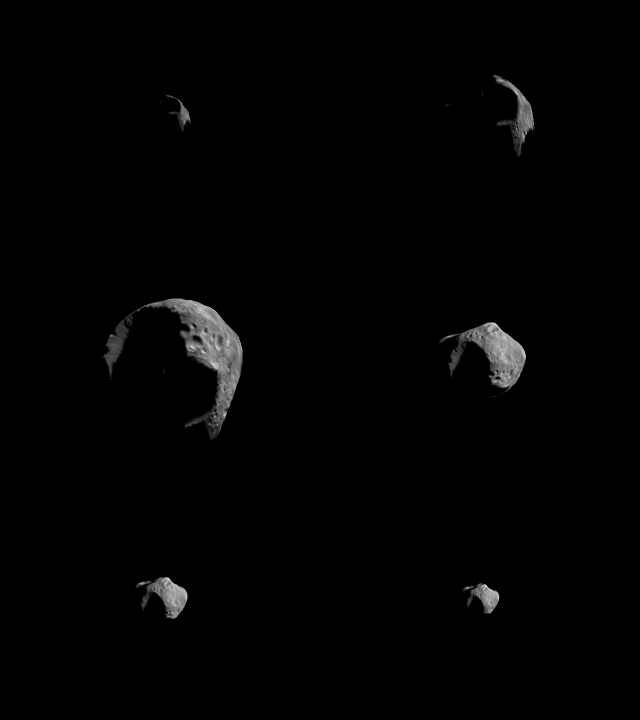
Mathilde is very dark, with an albedo comparable to fresh asphalt,{{cite web |access-date=2007-08-27 |archive-url=https://web.archive.org/web/20070829153207/http://eetd.lbl.gov/HeatIsland/Pavements/Albedo/ |archive-date=29 August 2007 |url-status=dead | book-title=38th Lunar and Planetary Science Conference |display-authors=etal| doi-access=free}} The impacts appear to have spalled large volumes off the asteroid, as suggested by the angular edges of the craters.{{cite web
The density measured by NEAR Shoemaker, 1,300 kg/m3, is less than half that of a typical carbonaceous chondrite; this may indicate that the asteroid is very loosely packed rubble pile.{{cite journal
Mathilde's orbit is eccentric, taking it to the outer reaches of the belt. Nonetheless, the orbit lies entirely between the orbits of Mars and Jupiter; it does not cross the planetary orbits. It also has one of the slowest rotation periods of the known asteroids—most asteroids have a rotation period in the range of 2–24 hours.{{cite web | access-date=2007-08-29 | archive-date=26 May 2024 | archive-url=https://archive.today/20240526031853/https://www.webcitation.org/69io1CLu5?url=http://ase.tufts.edu/cosmos/view_chapter.asp%3Fid=15 | url-status=dead |display-authors=etal| doi-access=free
References
References
- Moore, Sir Patrick. (1999). "The Wandering Astronomer". CRC Press.
This article was imported from Wikipedia and is available under the Creative Commons Attribution-ShareAlike 4.0 License. Content has been adapted to SurfDoc format. Original contributors can be found on the article history page.
Ask Mako anything about 253 Mathilde — get instant answers, deeper analysis, and related topics.
Research with MakoFree with your Surf account
Create a free account to save articles, ask Mako questions, and organize your research.
Sign up freeThis content may have been generated or modified by AI. CloudSurf Software LLC is not responsible for the accuracy, completeness, or reliability of AI-generated content. Always verify important information from primary sources.
Report