From Surf Wiki (app.surf) — the open knowledge base
25 de Abril Bridge
Suspension bridge in Lisbon, Portugal
.jpg)
Suspension bridge in Lisbon, Portugal
| Field | Value | |
|---|---|---|
| bridge_name | Ponte 25 de Abril | |
| other_name | Ponte Salazar (before 1974) | |
| Tagus River Bridge | ||
| image | 25 De Abril Bridge (226290561).jpeg | |
| caption | Aerial view of the bridge | |
| official_name | *Ponte 25 de Abril* | |
| carries | Six road lanes of IP 7 | |
| [[A2 motorway (Portugal) | <span style | "background-color:blue;color:white" A 2 ]] |
| Two railway tracks of Linha do Sul | ||
| crosses | Tagus River | |
| locale | Lisbon (right/North bank) | |
| Pragal (left/South bank) | ||
| maint | Lusoponte | |
| design | Suspension | |
| mainspan | 1,012.9 m | |
| length | 3,173 m | |
| width | 24.5 m | |
| height | 180 m | |
| below | 70 m at mean high water | |
| traffic | 150,000 cars | |
| 157 trains | ||
| open | 6 August 1966 | |
| builder | American Bridge Company | |
| toll | 2.15 € (northbound only) | |
| coordinates |
Tagus River Bridge A 2 Two railway tracks of Linha do Sul Pragal (left/South bank) 157 trains
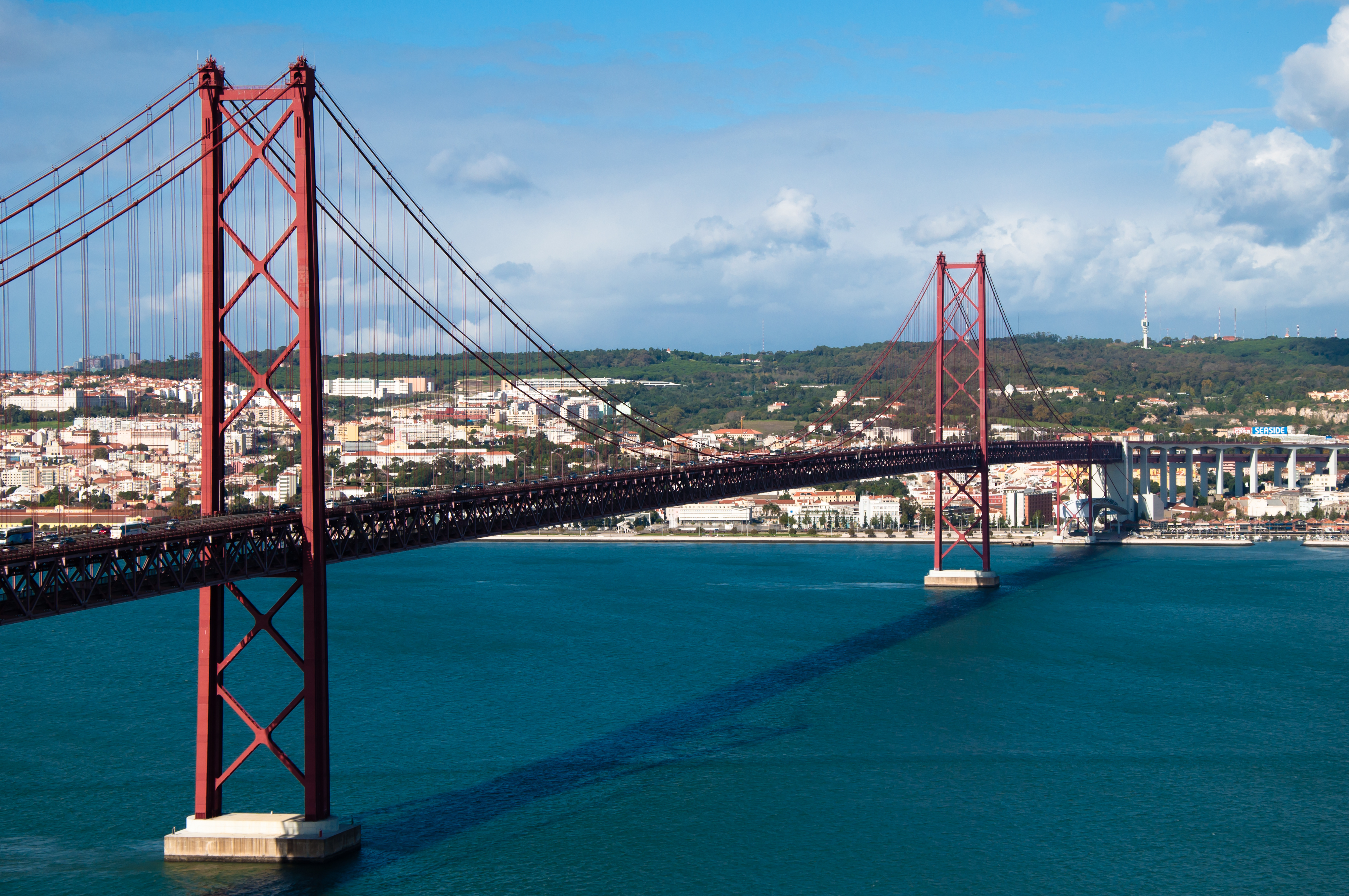
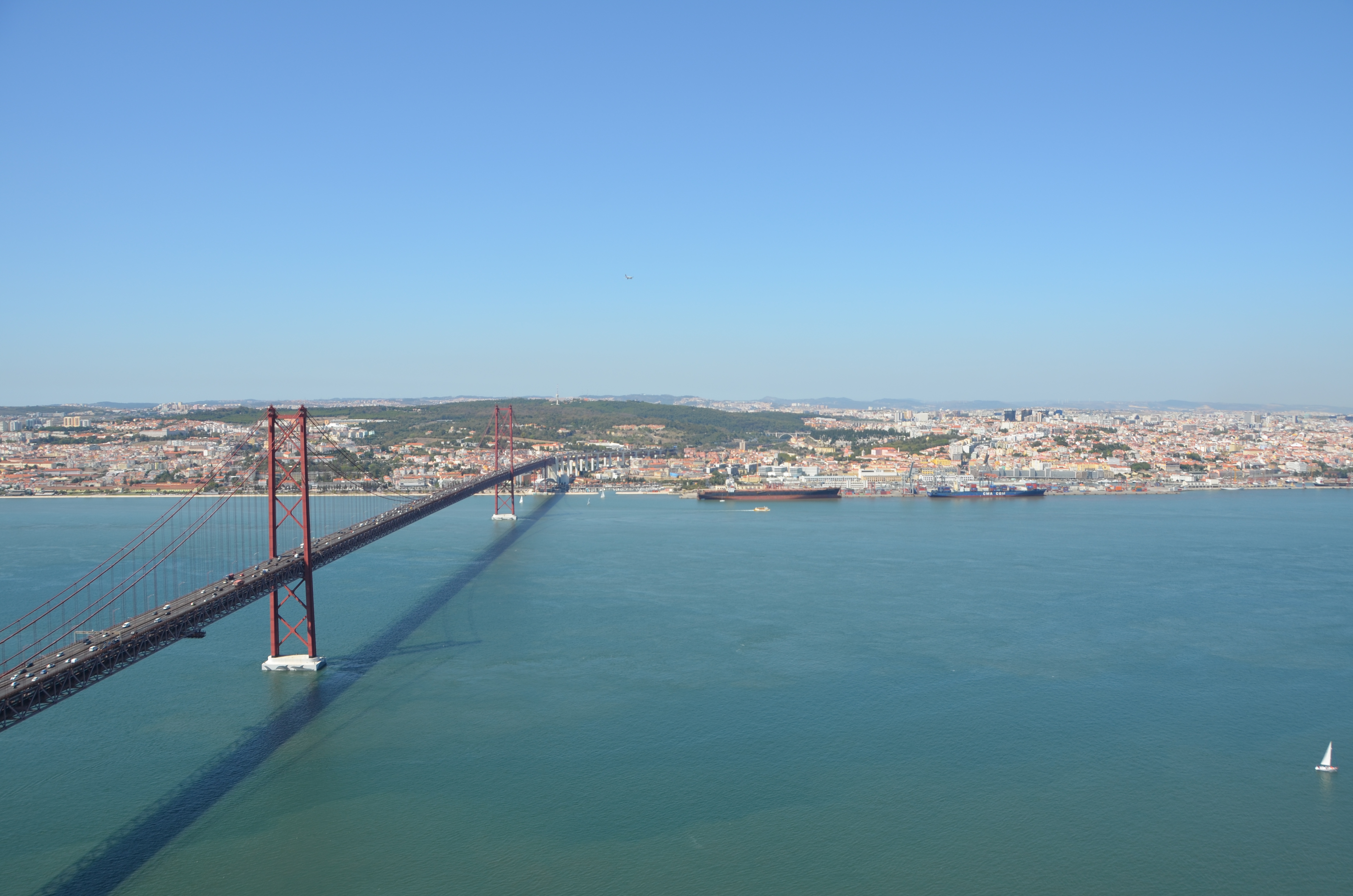
The 25 de Abril Bridge (, 25th of April Bridge, ) is a suspension bridge connecting the city of Lisbon, capital of Portugal, to the municipality of Almada on the left (south) bank of the Tagus River. It has a main span length of 1,013 m, making it the 48th longest suspension bridge in the world.
At the time of its inauguration in 1966, the bridge was named Salazar Bridge (Ponte Salazar), after the Portuguese dictator António de Oliveira Salazar, who ordered its construction. After the Carnation Revolution in 1974, which overthrew the remnants of Salazar's Estado Novo regime, the bridge was renamed for April 25, the date of the revolution. It is also commonly called the Tagus River Bridge (in Portuguese: Ponte sobre o Tejo, "bridge over the Tagus").
Later changes had to be made due to the rapid increase in population. In the 1990s, a fifth car lane was added, and in 1999, a lower deck, used as a railway track, which was planned since the beginning, was finally built. Today, the upper deck carries six car lanes while the lower deck carries a double track railway, electrified at 25 kV AC.
History
Construction
From the late 19th century, there had been proposals to build a bridge across the Tagus. In 1929, the idea advanced when the Portuguese engineer and entrepreneur, António Bello, requested a government concession for a railway crossing between Lisbon and Montijo (where the Vasco da Gama Bridge, the second bridge serving Lisbon, was later built in 1998). As a result, the Minister of Public Works, Duarte Pacheco, created a commission in 1933 to analyse the request. The commission reported in 1934, and proposed building a road and rail bridge. Bids were obtained, but the proposal was subsequently put aside in favor of a bridge crossing the river at Vila Franca de Xira, 35 km north of Lisbon.
In 1953, a new government commission started work and, in 1958, recommended building the bridge, choosing the southern anchor point adjacent to the recently built Christ the King monument (Cristo-Rei). In 1959, the international invitation to tender for the project received four bids. In 1960, the winner was announced as a consortium headed by the United States Steel Export Company, which had also submitted a bid in 1935. The American School of Lisbon was founded largely to educate the children of the American engineers brought to Portugal to work on the construction of the bridge.
Construction began on 5 November 1962. Forty-five months later, six months ahead of schedule, the bridge was inaugurated on 6 August 1966. Presiding at the ceremony was the President of Portugal, Admiral Américo Thomaz. Also present were the Prime-Minister, António de Oliveira Salazar, and the Patriarch of Lisbon, Cardinal Manuel Gonçalves Cerejeira. The bridge was named Salazar Bridge (Ponte Salazar), after Prime Minister Salazar.
United States Steel International Inc., based in New York, was prime contractor for the bridge. Morrison-Knudsen of Portugal Ltd., an American firm based in Boise, Idaho, was U.S. Steel's principal associate. Morrison-Knudsen had previously worked on the San Francisco Bay Bridge. The bridge was designed by Steinman, Boynton, Gronquist and London of New York, and Tudor Engineering Company of San Francisco. The steel was imported from the US. Four workers died, out of a total of 3,000 who worked on the site. Construction took a total of 2,185,000 man-hours of work. The total cost of the bridge came to 2.2 billion Portuguese escudos, or US$32 million (US$225 million in 2011 adjusted for inflation).
Soon after the Carnation Revolution in 1974, the bridge was renamed the 25 de Abril Bridge, the day the revolution had occurred. A symbol of those times was captured on film, with citizens removing the large brass letters spelling "Salazar" from one of the main pillars of the bridge and painting a provisional "25 de Abril" in its place.
Expansion
The upper platform, running 70 m above water, had four car lanes, two in each direction, with a dividing guardrail. On 23 July 1990, the guardrail was removed and a fifth, reversible lane was created. On 6 November 1998, the side walls were extended and reinforced to make space for the present six lanes. Cars crossing the bridge make a peculiar hum - [//upload.wikimedia.org/wikipedia/commons/7/7b/Under_Bridge_25_April_Lisbon.ogg listen (59s)] - because the two inner lanes are made of metallic grating rather than asphalt to minimize aerodynamic forces by means of pressure equalization.
Since 30 June 1999, the lower platform has carried a double track railway. To accommodate that, the bridge underwent extensive structural reinforcements, including a second set of main cables, placed above the original set, and the main towers were increased in height. The railway had been part of the initial design, but was eliminated for economy, so the initial structure was lightened. The original builder American Bridge Company was called again for the job, performing the first aerial spinning of additional main cables on a loaded, fully operational suspension bridge.
Traffic soon increased well beyond predictions, and has remained at maximum capacity despite the enlargement from four to six lanes, the addition of the railway, and the building of a second bridge serving Lisbon, the Vasco da Gama Bridge.
A third bridge has been on and off government plans for some time, but in May 2024 the government announced to prioritize building this new bridge as part of the new Lisbon-Madrid high-speed rail line, to be finalized in 2034.
Popular culture
Several movies have been filmed on the bridge, including some scenes in the 1969 James Bond film On Her Majesty's Secret Service when James Bond is in a car driving across a bridge with Marc Ange Draco's henchmen, and it is also featured near the end of the movie when Bond marries Tracy and drives across the bridge with her in Bond's Aston Martin.
Normally, pedestrians cannot walk across the bridge, but every year there is a half-marathon that starts on the south bank and finishes in the north bank (Belem).
In September 2017, an observation deck was built allowing people to go to the platform.
Tolls
Using the bridge has always incurred a toll, first in both directions and then, from 1993, while travelling northbound only. The toll plaza situated on the south bank of the Tagus River. The tolls have become a source of political dispute in recent years. The bridge was projected to have paid all debt in 20 years, and to become toll-free (or have a reduced toll) after that period. However, the Government kept charging tolls well beyond the 20-year period, until it gave the concession to Lusoponte, creating a monopoly of the Tagus crossing in Lisbon.
When opened, people had to park their car and walk to buy a toll ticket costing 20 escudos. On 14 June 1994, the government, which ran the bridge at the time, raised the toll by 50%, from 100 to 150 escudos, to prepare to give the bridge into private concession for 40 years from 1 January 1996. The concessionaire was Lusoponte, a private consortium formed to build the Vasco da Gama Bridge at no cost to the public finances in exchange for tolls from both bridges. As a result, a popular uprising led to road blockades of the bridge and consequent police charges, an event which made the right-wing Government highly unpopular and which many believe led to a centre-left win in the 1995 general elections. The toll is set at €2.15 for passenger cars (), northbound (into Lisbon). There is no toll southbound, and until 2010, no tolls were collected during the month of August. From 2011 on, the Portuguese Government abolished that exception, in order to help the efforts to reduce the budget deficit.
Assuming that no legal changes happen, the concession will end on 24 March 2030, after which the bridge will again be state-managed.
Design
.jpg)
The 25 de Abril Bridge is based in part on two San Francisco Bay Area bridges. Its paint is the same International Orange color as the famous Golden Gate Bridge, and the design is similar as well to the San Francisco–Oakland Bay Bridge. Both the Bay Bridge and the 25 de Abril Bridge were built by the same company. The American Society of Civil Engineers says: "Like its sister bridge, the SFOBB in San Francisco, the Tagus River Bridge is located in an area with a long history of earthquakes" and seismic data had to be taken into account in its construction. Another sister bridge is the Forth Road Bridge in Edinburgh.
Upon completion, the bridge had the longest suspended span and the longest main span in Continental Europe, the world's longest continuous truss, and the world's deepest bridge foundation. It was the fifth-longest suspension bridge in the world, and the longest outside the US.
Numbers
, a daily average of 150,000 cars cross the bridge, including 7,000 during the peak hour. Rail traffic is also heavy, with a daily average of 157 trains. In all, around 380,000 people cross the bridge daily.
Other numbers:
- 1012.9 m – length of main span
- 3173 m – length of truss
- 70 m – height from water to upper platform
- 190.47 m – height of main towers (seventh tallest structure in Portugal)
- 58.6 cm – diameter of each of the two sets of main cables
- 11,248 – number of steel wire strand cables, each 4.87 mm in diameter, in each set of main cables
- 54,196 km – length of steel wire strand cables making up the two sets of main cables
- 79.3 m – depth (below water-level) of the foundation of the south pillar
- 30 km – length of access roads
- 32 – viaducts in the access roads
References
Bibliography
RODRIGUES, Luís Ferreira (2016). A ponte inevitável: a história da Ponte 25 de Abril. Lisboa: Guerra e Paz
References
- "Lusoponte".
- (November 2020). "Structural Health Monitoring of a long-span suspended bridge". Portuguese Journal of Structural Engineering.
- (12 January 2021). "El barrio de Belém: ¿qué ver en Belém y dónde comer?".
- "Tagus River Bridge (Lisbon, 1966)".
- "Tagus River Bridge diary / 1962-1967.".
- "De Lisboa a Almada: a história de uma ponte no Tejo". [[Rádio e Televisão de Portugal]].
- "Carlucci American International School of Lisbon: St. Columban's Era".
- "Use of Special Techniques in Refurbishment", by J-P. Muzeau, in ''Refurbishment of Buildings and Bridges'' (Springer, 2014) p305
- Morrison, H.W. “Chairman’s Memo: Bridge Opens New Vistas for Portugal.” The Em Kayan, October 1966.
- (2024-05-15). "Novo Aeroporto, Terceira Travessia do Tejo e ligação ferroviária a Madrid: as três decisões do Governo".
- Lima Lobo, Renata. (22 September 2017). "Experiência Pilar 7: a nova vida da Ponte 25 de Abril começa quarta-feira".
- "Vasco da Gama Bridge — Funding". Lusoponte.
- "Infraestruturas Rodoviárias > Rede Rodoviária > Concessões". Instituto da Mobilidade e dos Transportes.
- "Frequently Asked Questions about the Golden Gate Bridge".
This article was imported from Wikipedia and is available under the Creative Commons Attribution-ShareAlike 4.0 License. Content has been adapted to SurfDoc format. Original contributors can be found on the article history page.
Ask Mako anything about 25 de Abril Bridge — get instant answers, deeper analysis, and related topics.
Research with MakoFree with your Surf account
Create a free account to save articles, ask Mako questions, and organize your research.
Sign up freeThis content may have been generated or modified by AI. CloudSurf Software LLC is not responsible for the accuracy, completeness, or reliability of AI-generated content. Always verify important information from primary sources.
Report