From Surf Wiki (app.surf) — the open knowledge base
.243 Winchester
Rifle cartridge

Rifle cartridge
| Field | Value |
|---|---|
| name | .243 Winchester |
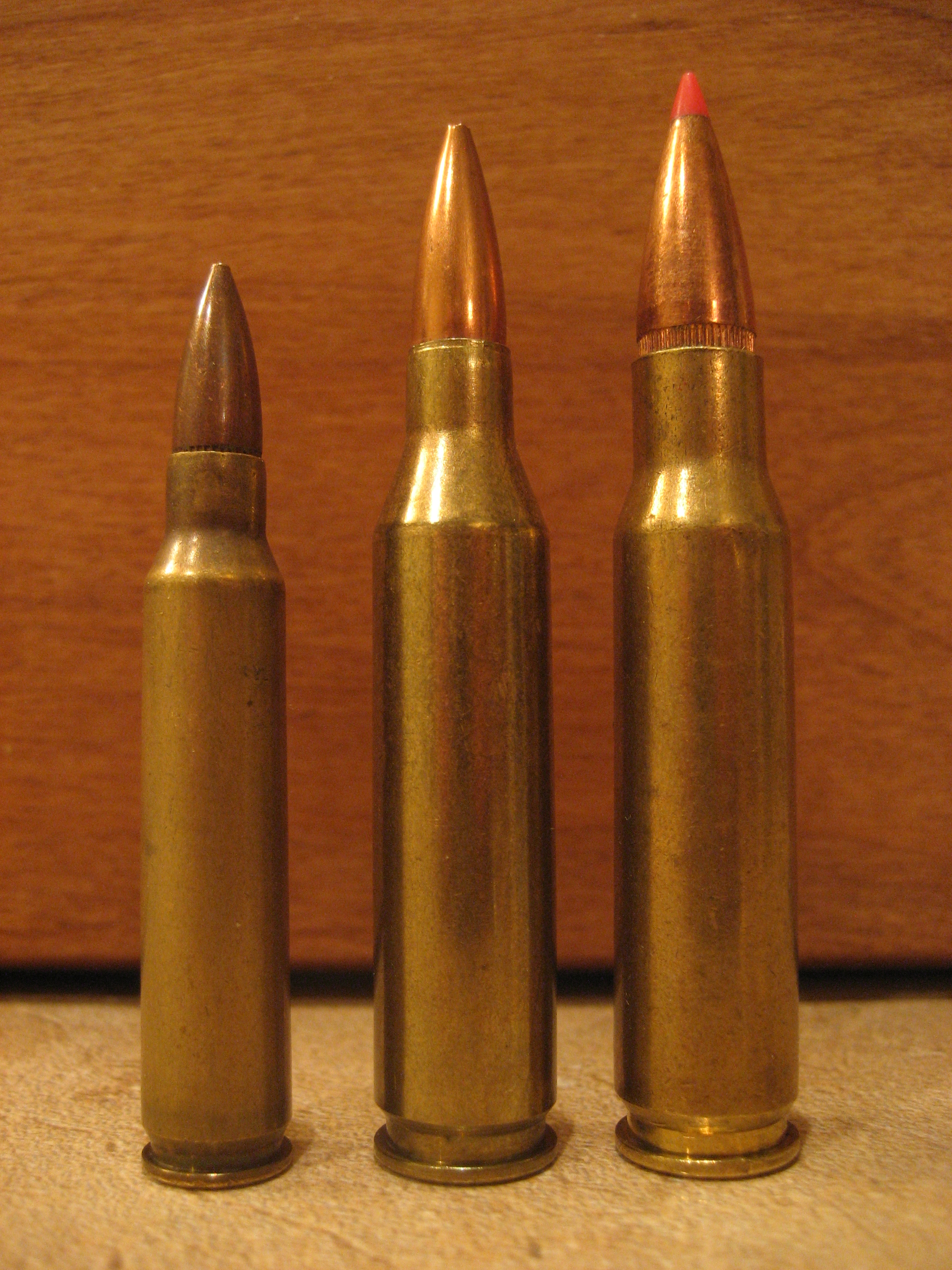
| image | .223, .243, .308.JPG |
| caption | A .243 Winchester cartridge (middle) next to a [.223 Remington](223-remington) (left) and [.308 Winchester](308-winchester) (right) |
| origin | United States |
| type | Rifle |
| designer | Winchester |
| design_date | 1952–1955 |
| manufacturer | Winchester |
| production_date | 1955–present |
| variants | .243 Winchester Improved (Ackley) |
| parent | [.308 Winchester](308-winchester) |
| case_type | Bottlenecked |
| bullet | .243 |
| land | .237 |
| neck | .276 |
| shoulder | .454 |
| base | .471 |
| rim_dia | .473 |
| case_length | 2.045 |
| length | 2.7098 |
| case_capacity | 53.7–54.8 |
| max_pressure | 60191 |
| pressure_method | C.I.P. |
| max_pressure2 | 60000 |
| pressure_method2 | SAAMI |
| rifling | 1-10 in to 1-8 in |
| primer | Large Rifle |
| bw1 | 58 |
| btype1 | V-MAX |
| vel1 | 3925 |
| en1 | 1984 |
| bw2 | 80 |
| btype2 | TTSX |
| vel2 | 3350 |
| en2 | 1994 |
| bw3 | 85 |
| btype3 | TSX |
| vel3 | 3200 |
| en3 | 1933 |
| bw4 | 95 |
| btype4 | SP |
| vel4 | 2980 |
| en4 | 1873 |
| bw5 | 100 |
| btype5 | BTSP |
| vel5 | 2960 |
| en5 | 1945 |
| test_barrel_length | 24 in |
| balsrc | Barnes, Federal, Hornady factory specifications, AccurateShooter.com |
The .243 Winchester (6×52mm) is a popular sporting rifle cartridge. Developed as a versatile short action cartridge to hunt both medium game and small game alike, it "took whitetail hunting by storm" when introduced in 1955, and remains one of the most popular whitetail deer cartridges. It is also commonly used for harvesting blacktail deer, pronghorns and mule deer with heavier rounds, and is equally suited to varmint hunting with lighter rounds. The .243 is based on a necked down .308 Winchester, introduced only three years earlier. Expanding monolithic copper bullets of approximately 80 to 85 grains or traditional lead rounds of 90 to 105 grains with controlled expansion designs are best suited for hunting medium game, while lighter rounds are intended for varmints.
In at least ten U.S. states and the United Kingdom, the .243 or similar cartridges are the smallest bore cartridges that are legal for hunting deer; this has been revised in the UK to allow Muntjac and Chinese Water Deer to be taken with .22 (5.56mm) chambered weapons. The cartridge can be extremely accurate to 300 yds and beyond, but may not retain enough terminal energy to reliably drop medium game at that distance. Highly experienced hunters use the .243 Winchester to routinely drop bucks up to 250 lbs, Besides hunting applications, the cartridge is popular with target and metallic silhouette shooters for those same recoil and velocity properties, with superb accuracy.
The .243 Winchester has regularly made the top five of rankings for "Best Whitetail Deer Hunting Cartridges" from sources such as Field and Stream and Outdoor Life, and its widespread popularity (called the "whitetail hunter's favorite" by the Browning Arms Company and "American favorite" by American Rifleman
History
Field and Stream editor and Harvard-educated technical gun enthusiast Warren Page began experimenting with wildcatting a .243 caliber (6.2mm) round in the 1940s sometime after the 6mm Lee Navy was discontinued. When the .308 Winchester was introduced in 1952, Page started necking down the .308 design into a new .243 wildcat cartridge.
It was a ground-breaking development with at first only two factory loads, combining a versatile and effective combination of 80-grain bullets optimized for high-velocity, long-range performance for varmint hunters (e.g., groundhogs, coyotes, prairie dogs) and 100-grain bullets suitable for game up to the size of deer and pronghorn antelope. Its predecessor in the Winchester lineup, the very similar .257 Roberts, could have easily been selected to accomplish the same tasks, but was not available factory loaded with either lighter, varmint-weight bullets or pointed, long range spitzer bullets, so it never achieved the popularity of the newer round.
Remington also saw the 6 mm (.243 in) family as suitable for this dual-purpose use and introduced their version, the .244 Remington, in the same year (1955) based upon the .257 Roberts necked down to accept .243 bullets up to 90 grains in weight. The Winchester round remains available today whereas the .244 Remington, later renamed the 6mm Remington with the introduction of 100-grain bullets, is far less popular even though it can push all bullet weights slightly faster with maximum loads due to the larger capacity case. The fact that the .243 Win was originally offered in a 1 in 10 inch rifling twist rate, a rate better able to stabilize heavier, 100- and 105-grain bullets, versus the .244 Remington's 1 in 12 inch twist (hence the 90-grain factory offering) was also a factor in their popularity.
Since the enactment of the Deer Act 1963 in the United Kingdom, which stipulates a minimum bullet diameter of .240 inches, together with minimum levels of muzzle velocity and bullet energy, the .243 has long been perceived as the entry-level caliber for legal deer-stalking. Firearms that would normally be chambered in .308 Winchester/7.62×51mm NATO are sometimes available in .243 in countries–such as Spain–whose regulations restrict or forbid private ownership of so-called military calibers (restricted to bolt action-repeating rifles). No military is known to currently designate this round for service.
In a non-sporting context, bolt-action rifles chambered for the .243 were utilized by the Los Angeles Police Department's special weapons and tactics (SWAT) unit during its early years. A specialist 115-grain projectile can move up to 3,150 fps from a 28-inch barrel, or over 3,000 fps from a 26-inch barrel.
P. O. Ackley created an improved version of this cartridge called the .243 Winchester Improved (Ackley). Like other improved cartridges, this created a steeper shoulder and blew the sides out, giving about 10% more powder capacity, and some small improvement in velocity.
Performance
Performance-wise, the .243 Winchester closely matches the 6mm Creedmoor but the .243 Win has more bullet and casing options, as well as more factory loadings and firearm options available. The .243 Win also has slightly more powder room, while the 6mm Creedmoor is usually loaded to slightly higher pressures.
With very little recoil, even less than that of the .30-30 Winchester cartridge introduced sixty years earlier, the .243 brought higher chamber pressures, larger powder volumes, and sharply tipped bullets, which all combine to lend the .243 more muzzle energy and far greater downrange energy than the .30-30 is able to achieve. The .243 Winchester has also been found to shoot flatter and more accurately than the 7mm-08 Remington out to 500 yards, with less recoil yet also less terminal energy.
The recoil has been measured to be so light that it "can be shot by anyone that can handle a rifle." Among popular small-bore rifle ammunition the .243 does have approximately three times the recoil factor of the .223 Remington and twice the recoil factor of the .22-250 Remington, but only half the recoil factor of the more powerful long action .25-06 Remington (without muzzle brakes). the .243 has the lowest recoil factor among small bore deer hunting cartridges.
Lack of overpenetration on medium game has traditionally been perceived either as a problem (lack of exit wounds and blood trails) or as a feature ("uses up all the energy in the deer") of traditional lead .243 cartridges versus larger and heavier rounds, but monolithic copper .243 ammunition weighing as little as 80 gr negates this characteristic and causes adequate penetration and blood trails through even larger-bodied medium game like wild hogs.
The .243 produces a velocity of 3,200 ft per second from factory-loaded expanding monolithic copper projectiles weighing 85 gr fired from a 24 in barrel. Other variations of commercially loaded .243 ammunition are available with bullet weights ranging from 55 grains (3.6 g) up to 115 grains (6.8 g). Twist rate of the barrel can sometimes be a factor in deciding which bullets to use, 1:10 being the most popular as it is sufficient to stabilize up to 100 gr bullets. However, for very low drag-profile or bullets heavier than 100 gr, a 1:8 or 1:7 (for 115 gr VLD bullets) is necessary.
| File:Game Class vs 6 inch Maximum Point Blank Range of some 243 cartridges.png|Game class vs 6 in maximum point blank range | File:Sectional Density vs Ballistic Coefficient of some 243 cartridges.png|Sectional density vs ballistic coefficient
Platforms
| Manufacturer | Model | Type | Country | |
|---|---|---|---|---|
| Chattahoochee Munitions | CM10 | Semi-automatic rifle | United States |
References
References
- "[http://bulletin.accurateshooter.com/2008/09/243-winchester-brass-weight-and-capacity-tested/ .243 Winchester Brass Weight and Capacity Tested]". AccurateShooter.com, September 25, 2008. Accessed March 8, 2021.
- Ron Spomer. "[https://www.outdoorlife.com/whitetail-deer-cartridge-shoot-out-30-30-win-vs-243-win-vs-30-06-springfield/ Whitetail Deer Cartridge Shoot-Out: .30-30 Win. vs. .243 Win. vs. .30-06 Springfield]". ''[[Outdoor Life]]'', October 28, 2019. Accessed March 2, 2021.
- "[https://www.ballisticstudies.com/Knowledgebase/Wound+Database/6mm+-+Barnes+TTSX.html 6mm - Barnes TTSX]". Terminal Ballistics Research. Accessed March 8, 2021
- "[https://www.ballisticstudies.com/Knowledgebase/.243+Winchester.html .243 Winchester]". Terminal Ballistics Research. Accessed March 2, 2021
- "[https://www.underwoodammo.com/243-winchester-85-grain-controlled-chaos.html .243 Winchester 85gr. Controlled Chaos Solid Monolithic Hunting & Self Defense Ammo]". Description. Underwood Ammo. Accessed March 6, 2021
- Chuck Hawks. "[http://www.chuckhawks.com/243Win.htm The .243 Winchester]". ChuckHawks.com. 2004. Accessed March 4, 2021.
- John Haviland. "[https://www.americanrifleman.org/articles/2013/11/18/an-american-favorite-the-243-winchester/ An American Favorite: The .243 Winchester]". ''[[American Rifleman]]'', November 18, 2013. Accessed March 2, 2021.
- "[https://info.stagarms.com/blog/bid/381895/Which-AR-15-Can-You-Hunt-With Which AR-15 Can You Hunt With?]". Stag Arms. Accessed March 2, 2021.
- "[https://www.legislation.gov.uk/ukpga/1963/36/enacted Deer Act 1963 Chapter 36]". [[The National Archives (United Kingdom). The National Archives]]. Schedule 2: "Prohibited Firearms and Ammunition". 1963. Accessed March 2, 2021.
- "Deer Stalking Code of Practice".
- Ron Spomer. "[https://www.ronspomeroutdoors.com/blog/243-winchester-versus-7mm-08-remington/ 243 Winchester Versus 7mm-08 Remington]". ''Ron Spomer Outdoors'', November 25, 2019. Accessed March 3, 2021.
- Gary Zinn. "[https://www.chuckhawks.com/243_capabilities_deer.html The .243 Winchester: Its Capabilities as a Deer Cartridge]". Chuckhawks.com. 2017. Accessed March 2, 2021.
- while less experienced hunters can be just as capable with the .243 because of its very low [[recoil]] yet high [[velocity]].William W (Bill) Goddard. "[https://www.mossyoak.com/our-obsession/blogs/deer/best-caliber-for-deer-hunting BEST CALIBER FOR DEER HUNTING]". Mossy Oak, November 13, 2018. Accessed March 6, 2021.
- Jeff Johnston. "[https://www.fieldandstream.com/11-best-cartidges-for-whitetail-deer/ 11 Best Rifle Cartridges for Whitetail Deer]". ''[[Field and Stream]]'', August 22, 2019. Accessed March 3, 2021.
- "[https://www.browning.com/products/firearms/rifles/bar/current-production/bar-mark-3.html BAR Mark III] {{Webarchive. link. (2020-12-25 ". [[Browning Arms Company]]. Accessed March 4, 2021.)
- ) assures chamberings in newly manufactured offerings of not only [[bolt action. bolt-action rifle]]s, but also [[semi-automatic firearm. semiautomatic rifle]]s (e.g., [[Browning BAR]] and [[AR-10]] platforms), [[lever action. lever action rifle]]s (e.g., [[Henry Repeating Arms. Henry Long Ranger]] and [[Browning BLR]]), and even [[pump action. pump action rifle]]s (e.g., [[Remington Model 7600
- "[https://www.nytimes.com/1977/01/24/archives/warren-page-67-exgun-editor-of-field-and-stream-magazine.html Warren Page, 67, Ex-Gun Editor Of Field and Stream Magazine]". ''[[The New York Times]]'', January 24, 1977. Accessed March 6, 2021.
- Mike Ramienta. "[https://gunnewsdaily.com/2506remington_vs_243winchester/ .25-06 Remington vs. .243 Winchester: The Better Overbore]". ''Gun News daily'', August 17, 2020. Accessed March 6, 2021.
- Model 88]] lever-action sporting rifles and quickly gained popularity among sportsmen worldwide.Cartridges of the World 8th Edition, Book by Frank C. Barnes, DBI Books, 1997, {{ISBN. 0-87349-178-5
- Cobb, Kenneth. (June 27, 2009). "The .243 Winchester has been the subject of praise and criticism". The Inter-Mountain.
- "243 Win Cartridge Guide".
- Handbook for Shooters & Reloaders vol I, Book by P.O. Ackley; Plaza Publishing, 1962, {{ISBN. 978-99929-4-881-1 p.305
- Chuck Hawks. "[https://www.chuckhawks.com/compared_243_6mmCreedmor.html Compared: .243 Winchester and 6mm Creedmoor]". ''ChuckHawks.com''. Accessed January 29, 2022.
- "Recoil Energy Calculator".
- "[http://www.accuratereloading.com/recoil.html RECOIL!]'. AccurateReloading.com, April 29, 2000. Accessed March 9, 2021.
- As the .223 and .22-250 are not recommended for deer hunting,''Hornady Handbook of Cartridge Reloading''. Fourth Edition (1996).
- [https://www.federalpremium.com/rifle/premium-centerfire-rifle/barnes-tsx/11-P243K.html Barnes TSX 243 Win]. [[Federal Premium Ammunition]]. Accessed March 9, 2021.
- (15 June 2022). "Twist Rate - Everything You Need To Know!". Fieldsports Press Ltd..
- (2025-03-10). "CM10".
This article was imported from Wikipedia and is available under the Creative Commons Attribution-ShareAlike 4.0 License. Content has been adapted to SurfDoc format. Original contributors can be found on the article history page.
Ask Mako anything about .243 Winchester — get instant answers, deeper analysis, and related topics.
Research with MakoFree with your Surf account
Create a free account to save articles, ask Mako questions, and organize your research.
Sign up freeThis content may have been generated or modified by AI. CloudSurf Software LLC is not responsible for the accuracy, completeness, or reliability of AI-generated content. Always verify important information from primary sources.
Report