From Surf Wiki (app.surf) — the open knowledge base
2241 Alcathous
Jupiter trojan asteroid
Jupiter trojan asteroid
| Field | Value |
|---|---|
| minorplanet | yes |
| name | 2241 Alcathous |
| background | #C2FFFF |
| discovery_ref | |
| discovered | 22 November 1979 |
| discoverer | C. Kowal |
| discovery_site | Palomar Obs. |
| mpc_name | (2241) Alcathous |
| alt_names | 1979 WM1950 NC |
| 1968 WF | |
| adjective | Alcathoian |
| pronounced | |
| named_after | Alcathous |
| (Greek mythology) | |
| mp_category | Jupiter trojan |
| Trojanbackground | |
| orbit_ref | |
| epoch | 23 March 2018 (JD 2458200.5) |
| uncertainty | 0 |
| observation_arc | 67.93 yr (24,811 d) |
| aphelion | 5.5311 AU |
| perihelion | 4.8328 AU |
| semimajor | 5.1820 AU |
| eccentricity | 0.0674 |
| period | 11.80 yr (4,309 d) |
| mean_anomaly | 313.95° |
| mean_motion | / day |
| inclination | 16.627° |
| asc_node | 267.99° |
| arg_peri | 291.80° |
| jupiter_moid | 0.1444 AU |
| tisserand | 2.9120 |
| mean_diameter | |
| rotation | |
| (poor) | |
| albedo | |
| spectral_type | D (Tholen) |
| D0 (Barucci) | |
| D (Tedesco) | |
| U–B 0.226 | |
| B–V | |
| V–R | |
| V–I | |
| abs_magnitude | |
| 8.64 |
1968 WF (Greek mythology) Trojanbackground
(poor)
D0 (Barucci)
D (Tedesco)
U–B 0.226
B–V
V–R
V–I
8.64
2241 Alcathous is a large Jupiter trojan from the Trojan camp, approximately 115 km in diameter. It was discovered on 22 November 1979, by American astronomer Charles Kowal at the Palomar Observatory in southern California, United States. The dark D-type asteroid belongs to the 20 largest Jupiter trojans and has a rotation period of 7.7 hours. It was named after Alcathous from Greek mythology.
Orbit and classification
Alcathous is a dark Jovian asteroid orbiting in the trailing Trojan camp at Jupiter's Lagrangian point, 60° behind its orbit in a 1:1 resonance . It is also a non-family asteroid of the Jovian background population.
It orbits the Sun at a distance of 4.8–5.5 AU once every 11 years and 10 months (4,309 days; semi-major axis of 5.18 AU). Its orbit has an eccentricity of 0.07 and an inclination of 17° with respect to the ecliptic. The body's observation arc begins with a precovery taken at Palomar in June 1950, more than 29 years prior to its official discovery observation.
Physical characteristics
In the Tholen, Barucci and Tedesco taxonomy, Alcathous is classified as a dark D-type asteroid. It is the 8th largest of all 46 D-type asteroids in the Tholen classification.
Rotation period
A large number rotational lightcurves have been obtained since December 1991, when Alcathous was first observed by Stefano Mottola with the Loiano 1.52-meter telescope at Bologna Observatory, Italy. In 1994, the asteroid's rotation period was also measured by Giovanni de Sanctis and collaborators ().
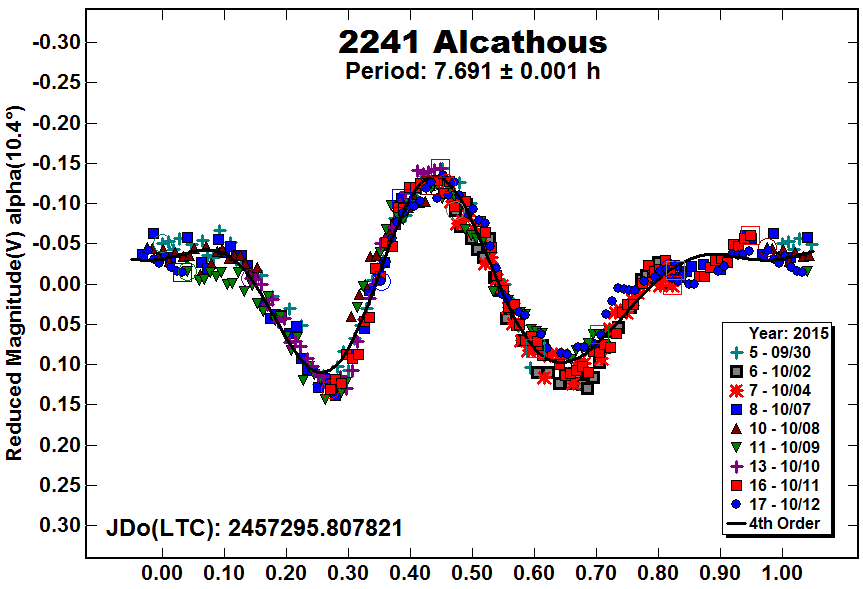
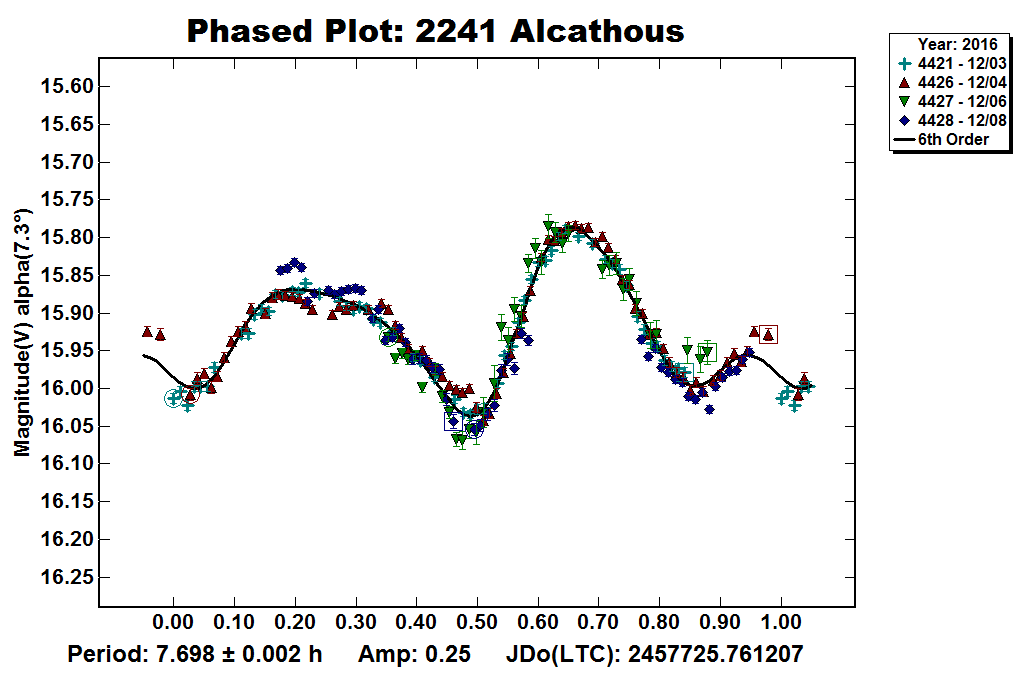
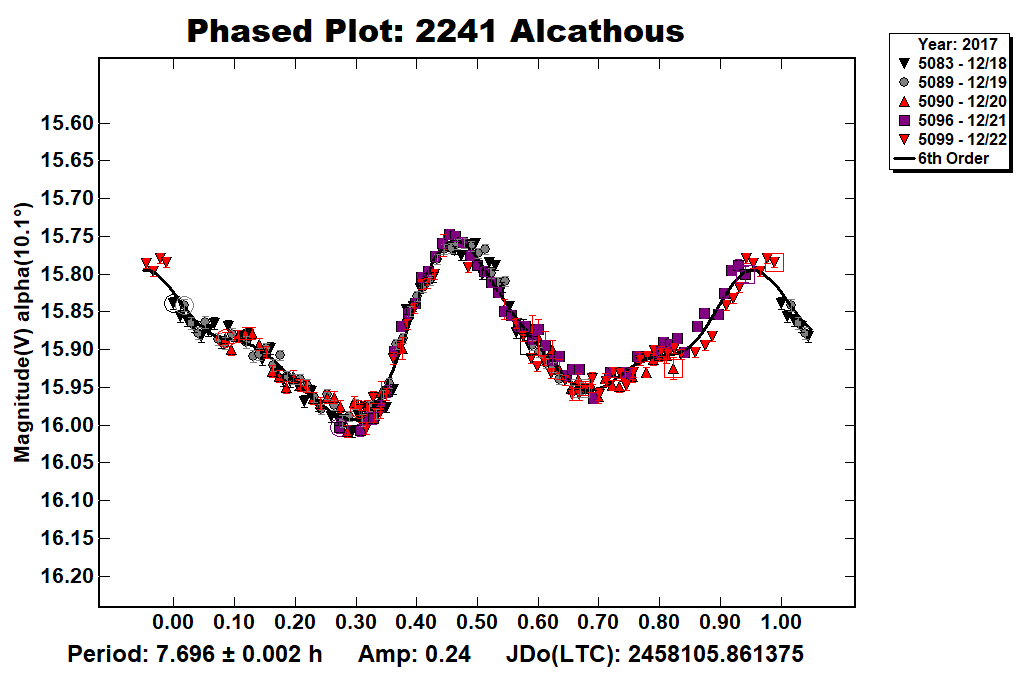
Several photometric observations between 2010 and 2017, by Daniel Coley and Robert Stephens at the Center for Solar System Studies and at GMARS , also include the so-far best-rated period of 7.689 hours with a brightness amplitude of 0.22 magnitude ().
Diameter and albedo
According to the surveys carried out by the Infrared Astronomical Satellite IRAS, the Japanese Akari satellite and the NEOWISE mission of NASA's Wide-field Infrared Survey Explorer, Alcathous measures between 113.68 and 118.87 kilometers in diameter and its surface has an albedo between 0.044 and 0.048. The Collaborative Asteroid Lightcurve Link adopts the results obtained by IRAS, that is, an albedo of 0.0471 and a diameter of 114.63 kilometers based on an absolute magnitude of 8.64.
Naming
This minor planet was named after Alcathous, brave and handsome Trojan leader in Homer's Iliad. Alcathous was the husband of Hippodamia the eldest daughter of Anchises (also see ), who excelled all other girls of her age in beauty, skill and wit. Alcathous, previously uninjured in the Trojan War, was struck by Poseidon (also see ) with blindness and paralysis and was killed easily by a spear thrown by the Greek general and Cretan commander, Idomeneus (also see ). The official naming citation was published by the Minor Planet Center on 10 November 1992 (M.P.C. 21128).
Notes
Sep 2015, Dec 2016 and Dec 2017 by Daniel Coley and Robert Stephens at the Center for Solar System Studies and . Quality code is 2+/3/3/3/3 (lightcurve rating at CS3). Summary figures at the LCDB and CS3.}}
References
References
- Noah Webster (1884) ''A Practical Dictionary of the English Language''
This article was imported from Wikipedia and is available under the Creative Commons Attribution-ShareAlike 4.0 License. Content has been adapted to SurfDoc format. Original contributors can be found on the article history page.
Ask Mako anything about 2241 Alcathous — get instant answers, deeper analysis, and related topics.
Research with MakoFree with your Surf account
Create a free account to save articles, ask Mako questions, and organize your research.
Sign up freeThis content may have been generated or modified by AI. CloudSurf Software LLC is not responsible for the accuracy, completeness, or reliability of AI-generated content. Always verify important information from primary sources.
Report