From Surf Wiki (app.surf) — the open knowledge base
216 Kleopatra
M-type asteroid
M-type asteroid
| Field | Value |
|---|---|
| minorplanet | yes |
| name | 216 Kleopatra |
| background | #D6D6D6 |
| image | 216 Kleopatra VLT (2021), deconvolved.pdf |
| discovery_ref | |
| discoverer | J. Palisa |
| discovery_site | Pola Obs. |
| discovered | 10 April 1880 |
| mpc_name | (216) Kleopatra |
| alt_names | A880 GB1905 OA |
| 1910 RA | |
| pronounced | |
| adjective | Kleopatrian, Kleopatrean |
| named_after | Cleopatra (Egyptian queen) |
| mp_category | main-belt(central) |
| background | |
| orbit_ref | |
| epoch | 23 March 2018 (JD 2458200.5) |
| uncertainty | 0 |
| observation_arc | 137.60 yr (50,259 d) |
| aphelion | 3.4951 AU |
| perihelion | 2.0931 AU |
| semimajor | 2.7941 AU |
| eccentricity | 0.2509 |
| period | 4.67 yr (1,706 d) |
| mean_anomaly | 346.24° |
| mean_motion | / day |
| inclination | 13.113° |
| asc_node | 215.36° |
| arg_peri | 180.11° |
| satellites | 2 (AlexheliosCleoselene) |
| dimensions | () ± 15% km |
| flattening | 0.82 |
| mean_diameter | |
| mass | |
| density | |
| ca. (most likely between for D = 135 km and for D = 109 km) | |
| rotation | |
| albedo | 0.152 (calculated) |
| spectral_type | M (Tholen)Xe (SMASS) |
| M | |
| B–V = 0.713 | |
| U–B = 0.238 | |
| abs_magnitude | 7.30 |
| 7.09 | |
| 7.45 |
1910 RA background
ca. (most likely between for D = 135 km and for D = 109 km)
M B–V = 0.713 U–B = 0.238 7.09
7.45
216 Kleopatra is a large M-type asteroid with a mean diameter of 120 km and is noted for its elongate bone or dumbbell shape. It was discovered on 10 April 1880 by Austrian astronomer Johann Palisa at the Austrian Naval Pola Observatory, in what is now Pula, Croatia, and was named after Cleopatra VII, the famous Egyptian queen. It has two small minor-planet moons which were discovered in 2008 and later named Alexhelios and Cleoselene.
Orbit and classification
216 Kleopatra is a non-family asteroid from the main belt's background population. It orbits the Sun in the central asteroid belt at a distance of 2.1–3.5 AU once every 4 years and 8 months (1,706 days; semi-major axis of 2.79 AU). Its orbit has an eccentricity of 0.25 and an inclination of 13° with respect to the ecliptic. The body's observation arc begins at Leipzig Observatory on 20 April 1880, ten days after its official discovery observation at Pola Observatory.
:[[File:216_Kleopatra-orbit.png|480px]]
Physical characteristics
Size and shape
Kleopatra is a relatively large asteroid, with a mean (volume-equivalent) diameter of and an unusually elongated shape.
The initial mapping of its elongated shape was indicated by stellar occultation observations from eight distinct locations on 19 January 1991. Subsequent observations with the ESO 3.6 m Telescope at La Silla, run by the European Southern Observatory, were interpreted to show a double source with two distinct lobes of similar size. These results were disputed when radar observations at the Arecibo Observatory showed that the two lobes of the asteroid are connected, resembling the shape of a ham-bone. The radar observations provided a detailed shape model that appeared on the cover of Science Magazine. Later models suggested that Kleopatra was more elongate and the most recent models using radar delay-Doppler imaging, adaptive optics, and stellar occultations provide dimensions of 267 × 61 × 48 km.
Satellites ===
In 1988 a search for satellites or dust orbiting this asteroid was performed using the UH88 telescope at the Mauna Kea Observatories, but the effort was fruitless. In September 2008, Franck Marchis and his collaborators announced that by using the Keck Observatory's adaptive optics system, they had discovered two moons orbiting Kleopatra. In February 2011, the minor-planet moons were named Alexhelios (outer) and Cleoselene (inner), after Cleopatra's children Alexander Helios and Cleopatra Selene II. The outer and inner satellites are about 8.9 ± 1.6 and 6.9 ± 1.6 km in diameter, with periods of 2.7 and 1.8 days, respectively.
Mass, density, and composition
The presence of two moons provides a way to estimate Kleopatra's mass, although its irregular shape makes the orbital modeling a challenge. The most recent adaptive-optics observations and modeling provides a mass of Kleopatra of , or , which is significantly lower than previously thought. When combined with the best volume estimate for Kleopatra, this indicates a bulk density of .
These recent bulk density results call into question the canonical view of Kleopatra as a pure metallic object. Kleopatra's radar albedo suggests a high metal content in the southern hemisphere, but is similar to the more common S- and C-class asteroids along the equator. One way to reconcile these observations is to hypothesize that Kleopatra is a rubble-pile asteroid with significant porosity in dynamic equilibrium.
Origin
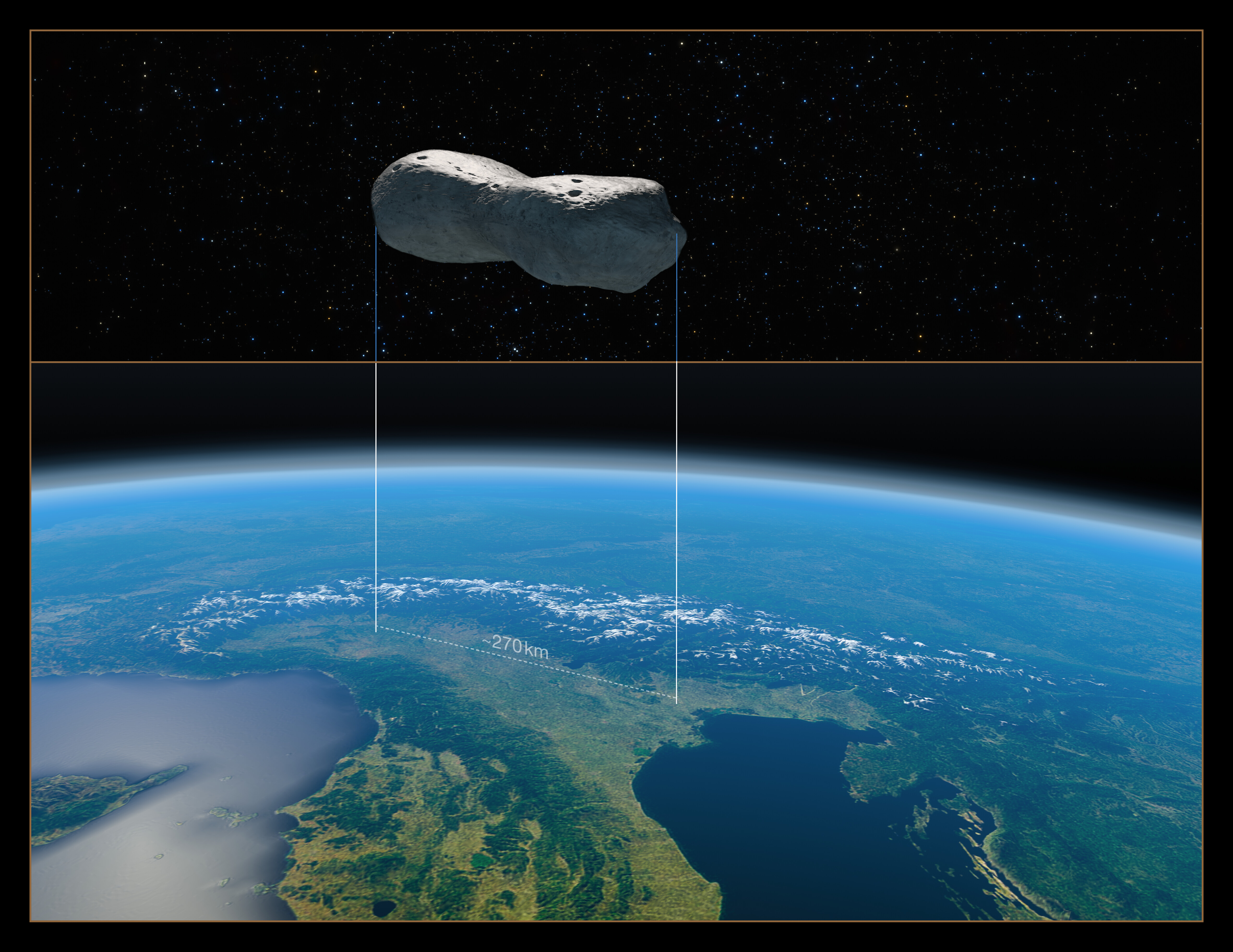
One possible origin that explains Kleopatra's shape, rotation, and moons is that it was created by an oblique impact perhaps 100 million years ago. The increased rotation would have elongated the asteroid and caused Alexhelios to split off. Cleoselene may have split off later, around 10 million years ago. Kleopatra is a contact binary – if it were spinning much faster, the two lobes would separate from each other, making a true binary system.
Notes
References
|access-date = 13 October 2021}}
|access-date = 24 October 2019}}
|access-date= 21 March 2018}}
|display-authors=etal
|access-date= 22 April 2017}}
|access-date= 21 March 2018}}
|archive-url = https://web.archive.org/web/20170423154151/https://ssd.jpl.nasa.gov/sbdb.cgi?sstr=2000216 |url-status = dead |archive-date = 23 April 2017 |access-date = 22 April 2017}}
|access-date = 22 April 2017}}
|access-date = 13 October 2021}}
|display-authors = 6
|access-date = 22 April 2017}}
|display-authors = 6 |access-date= 21 March 2018 |pmid = 10797000}}
|access-date= 22 April 2017}}
|access-date= 22 April 2017}}
|access-date = 22 October 2019}}
|access-date = 20 March 2018}}
|display-authors = 6
References
- "Cleopatra". [[Oxford University Press]].
- P. Vernazza et al. (2021) VLT/SPHERE imaging survey of the largest main-belt asteroids: Final results and synthesis. ''Astronomy & Astrophysics'' 54, A56
- Shepard et al (2018) A revised shape model of asteroid (216) Kleopatra, ''Icarus'' 311, 197-209
This article was imported from Wikipedia and is available under the Creative Commons Attribution-ShareAlike 4.0 License. Content has been adapted to SurfDoc format. Original contributors can be found on the article history page.
Ask Mako anything about 216 Kleopatra — get instant answers, deeper analysis, and related topics.
Research with MakoFree with your Surf account
Create a free account to save articles, ask Mako questions, and organize your research.
Sign up freeThis content may have been generated or modified by AI. CloudSurf Software LLC is not responsible for the accuracy, completeness, or reliability of AI-generated content. Always verify important information from primary sources.
Report