From Surf Wiki (app.surf) — the open knowledge base
2016 Democratic Party presidential primaries
Selection of the Democratic Party nominee
Selection of the Democratic Party nominee
| Field | Value | |||
|---|---|---|---|---|
| election_name | 2016 Democratic Party presidential primaries | |||
| country | United States | |||
| type | primary | |||
| ongoing | no | |||
| previous_election | 2012 Democratic Party presidential primaries | |||
| previous_year | 2012 | |||
| next_election | 2020 Democratic Party presidential primaries | |||
| next_year | 2020 | |||
| election_date | February 1 to June 14, 2016 | |||
| votes_for_election | 4,763 delegate votes to the [Democratic National Convention](2016-democratic-national-convention) | |||
| needed_votes | 2,382 delegate | |||
| party_name | no | |||
| <!-- Before entering any candidates' results, please consult the color table on the talk page prior to making any entries and keys --> | image1 | File:Hillary Clinton by Gage Skidmore 2.jpg | ||
| candidate1 | **Hillary Clinton** | |||
| color1 | d4aa00 | |||
| home_state1 | New York | |||
| states_carried1 | **34** | |||
| delegate_count1 | **2,842** | |||
| popular_vote1 | **16,917,853** | |||
| percentage1 | **55.2%** | |||
| image2 | File:Bernie Sanders September 2015 cropped.jpg | |||
| image_size | 160x160px | |||
| candidate2 | Bernie Sanders | |||
| color2 | 228b22 | |||
| home_state2 | Vermont | |||
| states_carried2 | 23 | |||
| delegate_count2 | 1,865 | |||
| popular_vote2 | 13,210,550 | |||
| percentage2 | 43.1% | |||
| map_image | {{switcher | |||
| default | 1 | |||
| map_size | 350px | |||
| map_caption | **First place by initial pledged delegate allocation** | |||
| {{legend | #D4AA00 | Hillary Clinton | border | 1}} |
| {{legend | #228B22 | Bernie Sanders | border | 1}} |
| {{legend | #D4AA00 | Hillary Clinton | border | 1}} |
| {{legend | #228B22 | Bernie Sanders | border | 1}} |
| {{legend | #6E6E6E | Tie | border | 1}} |
| map2_size | 350px | |||
| title | Democratic nominee | |||
| before_election | Barack Obama | |||
| after_election | Hillary Clinton |
| | First place by initial pledged delegate allocation | [[File:Democratic convention 2016 roll call map.svg|350px]] | First place by convention roll call
Presidential primaries and caucuses were organized by the Democratic Party to select the 4,051 delegates to the 2016 Democratic National Convention held July 25–28 and determine the nominee for President in the 2016 United States presidential election. The elections took place within all fifty U.S. states, the District of Columbia, five U.S. territories, and Democrats Abroad and occurred between February 1 and June 14, 2016. This was the first time the Democratic primary had nominated a woman for president.
Six major candidates entered the race starting April 12, 2015, when former Secretary of State and New York Senator Hillary Clinton formally announced her second bid for the presidency. She was followed by Vermont Senator Bernie Sanders, former Governor of Maryland Martin O'Malley, former Governor of Rhode Island Lincoln Chafee, former Virginia Senator Jim Webb and Harvard Law Professor Lawrence Lessig. A draft movement was started to encourage Massachusetts Senator Elizabeth Warren to seek the presidency. Warren declined to run, as did incumbent Vice President Joe Biden. Webb, Chafee, and Lessig withdrew prior to the February 1, 2016, Iowa caucuses.
Clinton won Iowa by the closest margin in the history of the state's Democratic caucus to date. O'Malley suspended his campaign after a distant third-place finish, leaving Clinton and Sanders as the only two candidates. The race turned out to be more competitive than expected, with Sanders decisively winning New Hampshire, while Clinton subsequently won Nevada and won a landslide victory in South Carolina. Clinton then secured numerous important wins in each of the nine most populous states including California, New York, Florida, and Texas, while Sanders scored various victories in between. He then laid off a majority of staff after the New York primary and Clinton's multi-state sweep on April 26. On June 6, the Associated Press and NBC News stated that Clinton had become the presumptive nominee after reaching the required number of delegates, including both pledged and unpledged delegates (superdelegates), to secure the nomination. In doing so, she became the first woman to ever be the presumptive nominee of any major political party in the United States. On June 7, Clinton secured a majority of pledged delegates after winning in the California and New Jersey primaries. President Barack Obama, Vice President Joe Biden and Senator Elizabeth Warren endorsed Clinton on June 9. Sanders confirmed on June 24 that he would vote for Clinton over Donald Trump in the general election and endorsed Clinton on July 12 in Portsmouth, New Hampshire.
On July 22, WikiLeaks published the Democratic National Committee email leak, in which DNC operatives seemed to deride Bernie Sanders' campaign and discuss ways to advance Clinton's nomination, leading to the resignation of DNC chair Debbie Wasserman Schultz and other implicated officials. The leak was allegedly part of an operation by the Russian government to undermine Hillary Clinton. Although the ensuing controversy initially focused on emails that dated from relatively late in the primary, when Clinton was already close to securing the nomination, the emails cast doubt on the DNC's neutrality and, according to Sanders operatives and multiple media commentators, showed that the DNC had favored Clinton since early on. This was evidenced by alleged bias in the scheduling and conduct of the debates, as well as controversial DNC–Clinton agreements regarding financial arrangements and control over policy and hiring decisions. Other media commentators have disputed the significance of the emails, arguing that the DNC's internal preference for Clinton was not historically unusual and did not affect the primary enough to sway the outcome, as Clinton received over 3 million more popular votes and 359 more pledged delegates than Sanders. The controversies ultimately led to the formation of a DNC "unity" commission to recommend reforms in the party's primary process.
On July 26, 2016, the Democratic National Convention officially nominated Clinton for president and a day later, Virginia Senator Tim Kaine for vice president. Clinton and Kaine went on to lose to the Republican ticket of Donald Trump and Mike Pence in the general election.
Candidates
Main article: 2016 Democratic Party presidential candidates
Nominee
| Candidate | Born | Most recent position | Home state | Campaign | |
|---|---|---|---|---|---|
| Announcement date | Total pledged delegates | Popular vote | Contests won | Running mate | Ref. |
| [[File:Hillary Clinton by Gage Skidmore 2.jpg | 149x149px]] | ||||
| **Hillary Clinton** | |||||
| (age ) | |||||
| Chicago, Illinois | U.S. Secretary of State | ||||
| (2009–2013) | New York | [[File:Hillary for America 2016 logo.svg | frameless | 150x150px]] | |
| Campaign**** | |||||
| [FEC filing](http://docquery.fec.gov/pdf/524/15031411524/15031411524.pdf) | |||||
| **Secured nomination: | |||||
| June 6, 2016** | **2205 / 4051** () | **16,917,853** | **34** | ||
| [[File:Tim Kaine, official 113th Congress photo portrait (cropped 3x4).jpg | alt= | frameless | 125x125px]] Tim Kaine |
Withdrew at the convention
| Candidate | Born | Most recent position | Home state | Campaign announced | Lost Nomination | Campaign | Total pledged delegates | Popular vote | Contests won | Ref. | [[File:Bernie Sanders September 2015 cropped.jpg | 130x130px]] |
|---|---|---|---|---|---|---|---|---|---|---|---|---|
| Bernie Sanders | ||||||||||||
| (age ) | ||||||||||||
| Brooklyn, New York | U.S. Senator from Vermont | |||||||||||
| (2007–present) | Vermont | April 30, 2015 | July 26, 2016 | |||||||||
| *(endorsed Clinton)* | [[File:Bernie Sanders 2016 logo.svg | 120px]] | ||||||||||
| (Campaign • Positions) | ||||||||||||
| [FEC filing](http://docquery.fec.gov/pdf/533/15031422533/15031422533.pdf) | 1846 / 4051 () | 13,210,550 | **23** |
Withdrew during the primaries
| Candidate | Born | Most recent position | Home state | Campaign announced | Campaign suspended | Campaign | Ref | [[File:Governor O'Malley Portrait (cropped).jpg | 130x130px]] |
|---|---|---|---|---|---|---|---|---|---|
| Martin O'Malley | |||||||||
| (age ) | |||||||||
| Washington, D.C. | Governor of Maryland | ||||||||
| (2007–2015) | Maryland | May 31, 2015 | February 1, 2016 | ||||||
| *(endorsed Clinton)* | [[File:O'Malley2016Logo.png | 120px]] | |||||||
| (Campaign • [Website](https://martinomalley.com/) ) | |||||||||
| [FEC filing](http://docquery.fec.gov/pdf/604/15031430604/15031430604.pdf) |
Withdrew before the primaries
| Candidate | Born | Most recent position | Home state | Campaign announced | Campaign suspended | Campaign | Ref | [[File:RI governor Lincoln Chafee in 2007 (cropped).jpg | 130x130px]] |
|---|---|---|---|---|---|---|---|---|---|
| Lincoln Chafee | [[File:Jim Webb official 110th Congress photo (cropped).jpg | 130x130px]] | |||||||
| Jim Webb | [[File:Lessig (cropped) 2.png | 130x130px]] | |||||||
| Lawrence Lessig | |||||||||
| (age ) | |||||||||
| Providence, Rhode Island | Governor of Rhode Island | ||||||||
| (2011–2015) | Rhode Island | June 3, 2015 | October 23, 2015 | ||||||
| *(endorsed Clinton)* | [[File:Chafee for President.png | 90px]] | |||||||
| (Campaign • [Website](http://www.chafee2016.com/)) | |||||||||
| [FEC filing](http://docquery.fec.gov/pdf/737/15951475737/15951475737.pdf) | |||||||||
| (age ) | |||||||||
| Saint Joseph, Missouri | U.S. Senator from Virginia | ||||||||
| (2007–2013) | Virginia | July 7, 2015 | October 20, 2015 | [[File:Webb 2016.png | 90px]] | ||||
| (Campaign • [Website](https://web.archive.org/web/20160422070531/https://www.webb2016.com/)) | |||||||||
| [FEC filing](http://docquery.fec.gov/pdf/062/201507149000111062/201507149000111062.pdf) | |||||||||
| [Amended FEC filing (party changed to Independent)](http://docquery.fec.gov/pdf/994/201510309003259994/201510309003259994.pdf) | |||||||||
| (age ) | |||||||||
| Rapid City, South Dakota | Professor at Harvard Law School | ||||||||
| (2009–2016) | Massachusetts | September 9, 2015 | November 2, 2015 | [[File:Lessig 2016.png | 90px]] | ||||
| (Campaign • [Website](https://web.archive.org/web/20150910091331/https://lessig2016.us/)) | |||||||||
| [FEC filing](http://docquery.fec.gov/pdf/859/201508119000812859/201508119000812859.pdf) |
Other candidates' results
The following candidates were frequently interviewed by news channels and were invited to forums and candidate debates. For reference, Clinton received 16,849,779 votes in the primaries.
| Martin O'Malley | Lawrence Lessig | Jim Webb | Lincoln Chafee | ||||||||
|---|---|---|---|---|---|---|---|---|---|---|---|
| [[File:Governor O'Malley Portrait.jpg | center | 120x120px]] | [[File:Lessig (cropped) 2.png | center | 120x120px]] | [[File:Jim Webb official 110th Congress photo (cropped).jpg | center | 120x120px]] | [[File:Lincoln Chafee (14103606100 cc56e38ddd h).jpg | center | 120x120px]] |
| Governor of Maryland | |||||||||||
| (2007–2015) | Harvard law professor | ||||||||||
| (2009–2016) | U.S. Senator | ||||||||||
| from Virginia | |||||||||||
| (2007–2013) | Governor of Rhode Island | ||||||||||
| (2011–2015) | |||||||||||
| Campaign | Campaign | Campaign | Campaign | ||||||||
| **110,423 votes** | 4 write-in votes in New Hampshire | 2 write-in votes in New Hampshire | none |
Other candidates participated in one or more state primaries without receiving major coverage or substantial vote counts.
Timeline
Background
In the weeks following the re-election of President Obama in the 2012 election, media speculation regarding potential candidates for the Democratic presidential nomination in the 2016 presidential election began to circulate. The speculation centered on the prospects of Clinton, then-Secretary of State, making a second presidential bid in the 2016 election. Clinton had previously served as a U.S. Senator for New York (2001–09) and was the First Lady of the U.S. (1993–2001). A January 2013 Washington Post–ABC News poll indicated that she had high popularity among the American public.
This polling information prompted numerous political pundits and observers to anticipate that Clinton would mount a second presidential bid in 2016, entering the race as the early front-runner for the Democratic nomination. From the party's liberal left wing came calls for a more progressive candidate to challenge what was perceived by many within this segment as the party's establishment. Elizabeth Warren quickly became a highly touted figure within this movement as well as the object of a draft movement to run in the primaries, despite her repeated denials of interest in doing so.
The MoveOn.org campaign 'Run Warren Run' announced that it would disband on June 8, 2015, opting to focus its efforts toward progressive issues. The draft campaign's New Hampshire staffer, Kurt Ehrenberg, had joined Sanders' team and most of the remaining staffers were expected to follow suit. Given the historical tendency for sitting vice presidents to seek the presidency in election cycles in which the incumbent president is not a candidate, there was also considerable speculation regarding a potential presidential run by incumbent Vice President Joe Biden, who had previously campaigned for the Democratic presidential nomination in the election cycles of 1988 and 2008.
This speculation was further fueled by Biden's own expressions of interest in a possible run in 2016. However, on October 21, 2015, speaking from a podium in the Rose Garden with his wife and President Obama by his side, Biden announced his decision not to enter the race, as he was still dealing with the loss of his son, Beau, who died months earlier at the age of 47. Biden became the nominee for the Democratic Party four years later in the 2020 presidential election where he became the 46th President of the United States after defeating incumbent president Donald Trump in the general election.
On May 26, 2015, Sanders officially announced his run as a presidential candidate for the Democratic nomination, after an informal announcement on April 30 and speculation since early 2014. Sanders had previously served as Mayor of Burlington, Vermont (1981–89), Vermont's sole U.S. Representative (1991–2007) and Vermont's junior Senator (2007–present). He emerged as the biggest rival to Hillary Clinton in the Democratic primaries, backed by a strong grassroots campaign and a social media following.
In November 2014, Jim Webb, a former U.S. Senator who had once served as the U.S. Secretary of the Navy during the Reagan administration, announced the formation of an exploratory committee in preparation for a possible run for the Democratic presidential nomination. This made Webb the first major potential candidate to take a formal action toward seeking the party's 2016 nomination.
In June 2015, Lincoln Chafee, former Governor and Senator of Rhode Island, announced his campaign. Chafee had been a Republican while serving in the senate, and an Independent while serving as Governor. He formed an exploratory committee on April 3. Chafee endorsed Barack Obama in 2008 and served as co-chair of his re-election campaign in 2012.
Martin O'Malley, former Governor of Maryland as well as a former Mayor of Baltimore, made formal steps toward a campaign for the party's nomination in January 2015 with the hiring and retaining of personnel who had served the previous year as political operatives in Iowa – the first presidential nominating state in the primary elections cycle – as staff for his political action committee (PAC). O'Malley had started the "O' Say Can You See" PAC in 2012 which had, prior to 2015, functioned primarily as fundraising vehicles for various Democratic candidates, as well as for two 2014 ballot measures in Maryland. With the 2015 staffing moves, the PAC ostensibly became a vehicle for O'Malley – who had for several months openly contemplated a presidential bid – to lay the groundwork for a potential campaign for the party's presidential nomination.
In August 2015, Lawrence Lessig unexpectedly announced his intention to enter the race, promising to run if his exploratory committee raised $1 million by Labor Day. After accomplishing this, Lessig formally announced his campaign. He described his candidacy as a referendum on electoral reform legislation, prioritizing a single issue: the Citizen Equality Act of 2017, a proposal that couples campaign finance reform with other laws aimed at curbing gerrymandering and ensuring voting access.
Overview
| [Convention 2016](2016-democratic-national-convention) |
|---|
ImageSize = width:875 height:auto barincrement:22 PlotArea = top:20 bottom:20 right:20 left:20 AlignBars = early
Colors = id:canvas value:gray(0.9) id:lightline value:gray(0.8) id:darkline value:gray(0.3) id:HC value:rgb(0.094,0.250,0.800) #Hillary Clinton id:MO value:oceanblue #Martin O'Malley id:BS value:oceanblue #Bernie Sanders id:JW value:oceanblue #Jim Webb id:LC value:oceanblue #Lincoln Chafee id:LL value:oceanblue #Lawrence Lessig
- Link to more colors: http://ploticus.sourceforge.net/doc/color.html
Define $today =
DateFormat = mm/dd/yyyy Period = from:01/01/2015 till:09/01/2016 TimeAxis = orientation:horizontal ScaleMinor = gridcolor:lightline unit:month increment:1 start:01/01/2015 ScaleMajor = gridcolor:darkline unit:year increment:1 start:01/01/2015
Backgroundcolors = canvas:canvas
BarData = barset:Candidates
PlotData= width:15 fontsize:S textcolor:black anchor:till shift:(10,-4) barset:Candidates from:04/12/2015 till:07/26/2016 color:HC text: "Clinton" from:04/30/2015 till:07/26/2016 color:BS text: "Sanders" from:05/30/2015 till:02/01/2016 color:MO text: "O'Malley" from:09/06/2015 till:11/02/2015 color:LL text: "Lessig" from:06/03/2015 till:10/23/2015 color:LC text: "Chafee" from:07/02/2015 till:10/20/2015 color:JW text: "Webb" LineData= layer:front at:02/01/2016 color:teal width:1 layer:front at:03/01/2016 color:red width:1 layer:front at:06/14/2016 color:orange width:1 layer:front at:07/25/2016 color:darkblue width:1
February 2016: early primaries
Despite being heavily favored in polls issued weeks earlier, Clinton was only able to defeat Sanders in the first-in-the-nation Iowa Caucus by the closest margin in the history of the contest: 49.84% to 49.59%. Clinton collected 700.47 state delegate equivalents to Sanders' 696.92, a difference of one-quarter of a percentage point. This led to speculation that she won due to six coin-toss tiebreakers all resulting in her favor. However, the only challenge to the caucus' results was in a single precinct, which gave Clinton a fifth delegate.
| Date | State/territory | Clinton | Sanders | |
|---|---|---|---|---|
| February 1 | [Iowa](2016-iowa-democratic-presidential-caucuses) | 49.8% | 49.6% | |
| February 9 | [New Hampshire](2016-new-hampshire-democratic-presidential-primary) | 38.0% | 60.4% | |
| February 20 | [Nevada](2016-nevada-democratic-presidential-caucuses) | 52.6% | 47.3% | |
| February 27 | [South Carolina](2016-south-carolina-democratic-presidential-primary) | 73.5% | 26.0% |
The victory, which was projected to award her 23 pledged national convention delegates, two more than Sanders, made Clinton the first woman to win the Caucus and marked a clear difference from 2008, where she finished in third place behind Obama and John Edwards. Martin O'Malley suspended his campaign after a disappointing third-place finish with only 0.5% of the state delegate equivalents awarded, leaving Clinton and Sanders the only two major candidates in the race. A week later, Sanders won the New Hampshire primary, receiving 60.4% of the popular vote to Clinton's 38%, putting him ahead of Clinton in the overall pledged delegate count by four, and making him the first Jewish candidate of a major party to win a primary. Hillary Clinton's loss in New Hampshire was a regression from 2008, when she defeated Obama, Edwards, and a handful of other candidates including Joe Biden, with 39% of the popular vote.
.jpg)
Sanders' narrow loss in Iowa and victory in New Hampshire generated speculation about a possible loss for Clinton in Nevada, the next state to hold its caucuses on February 20. For her part, Clinton, who had won the state eight years prior in the 2008 Nevada Democratic caucuses, hoped that a victory would allay concerns about a possible repetition of 2008 when she ultimately lost to Obama despite entering the primary season as the favorite for the nomination. Ultimately, Clinton emerged victorious with 52.6% of the county delegates, a margin of victory similar to her performance in 2008. Sanders, who attained 47.3% of the vote, was projected to receive five fewer pledged delegates than Clinton. The result was not promising for the following weekend's primary in South Carolina, more demographically favorable to Clinton than the prior contests. On February 27, Clinton won the South Carolina primary with 73.5% of the vote, receiving a larger percentage of the African American vote than Barack Obama had eight years earlier – 90% to Obama's 80%.
March 1, 2016: Super Tuesday
| State/territory | Clinton | Sanders | |
|---|---|---|---|
| Alabama | 77.8% | 19.2% | |
| American Samoa | 68.4% | 25.7% | |
| Arkansas | 66.3% | 29.7% | |
| Colorado | 40.4% | 59.0% | |
| Georgia | 71.3% | 28.2% | |
| Massachusetts | 49.7% | 48.3% | |
| Minnesota | 38.3% | 61.7% | |
| Oklahoma | 41.5% | 51.9% | |
| Tennessee | 66.1% | 32.4% | |
| Texas | 65.2% | 33.2% | |
| Vermont | 13.6% | 86.1% | |
| Virginia | 64.3% | 35.2% |
.jpg)
The 2016 primary schedule was significantly different from that of 2008. During that election cycle, many states moved their primaries or caucuses to earlier in the calendar to have greater influence over the race. In 2008, February 5 was the earliest date allowed by the Democratic National Committee, leading 23 states and territories to move their elections to that date, the biggest Super Tuesday to ever take place. For 2016, the calendar was more disparate than it was in 2008, with several groups of states voting on different dates, the most important being March 1, March 15, April 26 and June 7. The day with the most contests was March 1, 2016, in which primaries or caucuses were held in 11 states, including six in the American south, and American Samoa. A total of 865 pledged delegates were at stake.
Clinton secured victories in all of the southern contests except Oklahoma. Her biggest victory of the day came in Alabama, where she won 77.8% of the vote against Sanders' 19.2%. Her most significant delegate prize came from Texas, where she received 65.2% of the vote with strong support from non-white as well as white voters. Collectively, the southern states gave Clinton a net gain of 165 pledged delegates. Apart from the South, Clinton also narrowly defeated Sanders in Massachusetts, as well as winning in the territory of American Samoa.
Sanders scored comfortable wins in the Minnesota and Colorado caucuses and the Oklahoma primary. He won an 86.1%–13.6% landslide in his home state of Vermont – one of only two times either of the two main candidates missed the 15% threshold in a state or territory, with the U.S. Virgin Islands, where Clinton received over 87% of the vote, being the other one. Although the results overall were unfavorable for Sanders, his four wins and narrow loss allowed him to remain in the race in anticipation of more favorable territory in New England, the Great Plains, Mountain States and the Pacific Northwest. At the end of the day, Clinton collected 518 pledged delegates to Sanders' 347, taking her lead to 609–412, a difference of 197 pledged delegates.
Mid-March contests
| State/territory | Clinton | Sanders | |
|---|---|---|---|
| Florida | 64.4% | 33.3% | |
| Illinois | 50.5% | 48.7% | |
| Kansas | 32.3% | 67.7% | |
| Louisiana | 71.1% | 23.2% | |
| Maine | 35.5% | 64.3% | |
| Michigan | 48.3% | 49.8% | |
| Mississippi | 82.6% | 16.5% | |
| Missouri | 49.6% | 49.4% | |
| Nebraska | 42.9% | 57.1% | |
| North Carolina | 54.6% | 40.8% | |
| N. Mariana Islands | 54.0% | 34.4% | |
| Ohio | 56.5% | 42.7% |
Sanders found more hospitable ground on the weekend of March 5, 2016, winning caucuses in Kansas, Maine and Nebraska by significant margins. Clinton answered with an even larger win in Louisiana's primary, limiting Sanders' net gain for the weekend to only four delegates. Clinton would also win the Northern Mariana Islands caucus, held the following weekend on March 12. Two states had held nominating contests on March 8 – Michigan and Mississippi – with Clinton heavily favored to win both.
Mississippi went for Clinton, as expected, by a landslide margin. The Mississippi primary was the highest vote share Clinton won in any state. However, Sanders stunned by scoring a narrow win in Michigan. Analysts floated a number of theories to explain the failure of the Michigan polling, with most centering on pollsters' erroneous assumptions about the composition of the electorate stemming from the 2008 primary in Michigan not having been contested due to an impasse between the state party and DNC.
Although Clinton expanded her delegate lead, some journalists suggested Sanders' upset might presage her defeat in other delegate-rich Midwestern states, such as Missouri, Ohio and Illinois, who voted a week later on March 15, along with North Carolina and Florida, where Clinton was more clearly favored. Clinton was able to sweep all five primaries, extending her pledged delegate lead by around 100 delegates, although Sanders was able to hold Clinton to narrow margins in her birth-state of Illinois and especially Missouri, where Clinton won by a mere 0.2 points.
Missouri state law allowed for a possible recount had any of the candidates requested it; however, Sanders forwent the opportunity on the basis that it would not significantly affect the delegate allocation. By the end of the evening, Clinton had expanded her pledged delegate lead to more than 320, several times larger than her greatest deficit in the 2008 primary.
Late March and early April
| State/territory | Clinton | Sanders | |
|---|---|---|---|
| Alaska | 18.4% | 81.6% | |
| Arizona | 56.5% | 41.1% | |
| Democrats Abroad | 30.9% | 68.9% | |
| Hawaii | 28.4% | 71.5% | |
| Idaho | 21.2% | 78.0% | |
| Utah | 20.3% | 79.3% | |
| Washington | 27.1% | 72.7% | |
| Wisconsin | 43.1% | 56.6% | |
| Wyoming | 44.3% | 55.7% |
Following the March 15 primaries, the race moved to a series of contests more favorable for Sanders. On March 21, the results of the Democrats Abroad primary (held March 1–8) were announced. Sanders was victorious and picked up nine delegates to Clinton's four, closing his delegate deficit by five. Arizona, Idaho and Utah held primaries on March 22, dubbed "Western Tuesday" by media. Despite continued efforts by Sanders to close the gap in Arizona after his surprise win in Michigan, Clinton won the primary with 56.3% of the vote. However, Clinton lost both Idaho and Utah by roughly 60 points, allowing Sanders to close his delegate deficit by 25.
The next states to vote were Alaska, Hawaii and Washington on March 26, 2016. All three states were considered as favorable for Sanders, and most political analysts expected him to win them all, given the demographics and Sanders' strong performance in previous caucuses.
The Clinton and Sanders campaigns reached an agreement on April 4 for a ninth debate to take place on April 14 (five days before the New York primary) in Brooklyn, New York, which would air on CNN and NY1. On April 5, Sanders won the Wisconsin primary by 13 and 1/2 percentage points, closing his delegate deficit by 10 more. The Wyoming caucuses were held on April 9, which Sanders won with 55.7% of the state convention delegates choosing him; however, Clinton had a stronger showing than expected, given her demographic disadvantage and that she did not campaign personally in the state. Each candidate was estimated to have earned 7 of Wyoming's 14 pledged delegates.
Late April and May
| State/territory | Clinton | Sanders | |
|---|---|---|---|
| New York | 58.0% | 42.0% | |
| Connecticut | 51.7% | 46.5% | |
| Delaware | 59.8% | 39.2% | |
| Maryland | 63.0% | 33.3% | |
| Pennsylvania | 55.6% | 43.6% | |
| Rhode Island | 43.3% | 55.0% | |
| Indiana | 47.5% | 52.5% | |
| Guam | 59.5% | 40.5% | |
| West Virginia | 35.8% | 51.4% | |
| Kentucky | 46.8% | 46.3% | |
| Oregon | 42.5% | 55.9% |
On April 19, Clinton won New York by 16 points. While Sanders performed well in Upstate New York and with younger voters, Clinton performed well among all other age groups and non-whites, and she won a majority in all boroughs of New York City.
Five Northeastern states held primaries a week later on April 26. The day was dubbed the "Super Tuesday III" or the "Acela Primary" after Amtrak's Acela Express train service that connects these states. Clinton won in Delaware, Maryland, Pennsylvania and Connecticut. Sanders won the Rhode Island primary.
On May 3, Sanders pulled off a surprise victory in the Indiana primary, winning by a five-point margin despite trailing in all the state's polls. Clinton won the Guam caucus on May 7 and, on May 10, she won the non-binding Nebraska primary while Sanders won in West Virginia.
Clinton narrowly won Kentucky on May 17 by half a percentage point and gained one delegate, after heavily campaigning in the state. On the same day, Sanders won his second closed primary in Oregon, gaining nine delegates, a net gain of eight on the day. Clinton won the non-binding Washington primary on May 24.
June contests
| State/territory | Clinton | Sanders | |
|---|---|---|---|
| Virgin Islands | 87.1% | 12.9% | |
| Puerto Rico | 59.4% | 37.5% | |
| California | 53.1% | 46.0% | |
| Montana | 44.6% | 51.0% | |
| New Jersey | 63.3% | 36.7% | |
| New Mexico | 51.5% | 48.5% | |
| North Dakota | 25.6% | 64.2% | |
| South Dakota | 51.0% | 49.0% | |
| District of Columbia | 78.7% | 21.1% |
June contained the final contests of the Democratic primaries, and both Sanders and Clinton invested heavily into winning the California primary. Clinton led the polls in California but some predicted a narrow race. On June 4 and 5, Clinton won two decisive victories in the Virgin Islands caucus and Puerto Rico primary. On June 6, both the Associated Press and NBC News reported that Clinton had sufficient support from pledged and unpledged delegates to become the presumptive Democratic nominee.
Clinton's campaign seemed reluctant to accept the mantle of "presumptive nominee" before all the voting was concluded, while Sanders' campaign stated it would continue to run and accused the media of a "rush to judgement." Six states held their primaries on June 7. Clinton won in California, New Jersey, New Mexico and South Dakota. Sanders won Montana and North Dakota, the latter being the only caucus contest held on that day. Clinton finally declared victory on the evening of June 7, as the results ensured that she had won a majority of the pledged delegates and the popular vote.
Sanders stated he would continue to run for the Democratic Party's nomination in the final primary in the District of Columbia on June 14, which Clinton won. Both campaigns met at a downtown Washington D.C. hotel after the primary. The Sanders campaign said that they would release a video statement on June 16 to clarify the future of Sanders' campaign; the video announced that Sanders looked forward to help Clinton defeat Trump. On July 12, 2016, Sanders endorsed Clinton in Portsmouth, New Hampshire.
July 2016: National Convention and email leaks
Email leaks
Main article: Democratic National Committee cyber attacks, 2016 Democratic National Committee email leak
On July 22, 2016, WikiLeaks released online tens of thousands of messages leaked from the e-mail accounts of seven key DNC staff. Some e-mails showed two DNC staffers discussing the possibility that Sanders' possible atheism might harm him in a general election with religious voters. Others showed a few staffers had expressed personal preferences that Clinton should become the nominee, suggesting that the party's leadership had worked to undermine Bernie Sanders' presidential campaign. Then-DNC chair Debbie Wasserman Schultz called the accusations lies.
The furor raised over this matter escalated to Wasserman Schultz's resignation ahead of the convention, and that of Marshals, Dacey, and Communications Director Luis Miranda afterwards. Following Wasserman Schultz's resignation, then-DNC Vice Chair Donna Brazile took over as interim DNC chairwoman for the convention and remained so until February 2017. In November 2017, Brazile said in her book and related interviews that the Clinton campaign and the DNC had colluded 'unethically' by giving the Clinton campaign control over the DNC's personnel and press releases before the primary in return for funding to eliminate the DNC's remaining debt from 2012 campaign, in addition to using the DNC and state committees to funnel campaign-limitation-exceeding donations to her campaign. Internal memos later surfaced, claiming that these measures were not meant to affect the nominating process despite their timing. At the end of June 2016, it was claimed that "more money [from the Hillary Victory Fund] will be moved to the state parties in the coming months." Brazile later clarified that she claimed the process was 'unethical', but 'not a criminal act'.
DNC officials including chairman Tom Perez pointed out that the same joint-fundraising agreement had been offered to Sanders and applied only to the general election; however, the Clinton campaign also had a second agreement that granted it additional, unusual oversight over hiring and policy, even though the text of the agreement insisted on the DNC's impartiality and focus on the general election. Brazile later denied that the primary was rigged, because "no votes were overturned," but described herself as "very upset" about a DNC–Clinton fundraising agreement. The Washington Post characterized Brazile's eventual argument as: "Clinton exerted too much power but did win the nomination fairly."
Russian involvement
After the general election, the U.S. intelligence community and the Special Counsel investigation assessed that the leaks were part of a larger interference campaign by the Russian government to cause political instability in the United States and to damage the Hillary Clinton campaign by bolstering the candidacies of Donald Trump, Bernie Sanders, and Jill Stein. The Russian government is alleged to have promoted Sanders beginning in 2015 as a way to weaken or defeat Clinton, who Russian President Vladimir Putin opposed. The influence campaign by the Internet Research Agency targeted Sanders voters through social media and encouraged them to vote for a third-party candidate or abstain from voting. Sanders denounced these efforts and urged his supporters to support Clinton in the general election.
When news of the DNC leak first surfaced in June 2016, the Russian government denied allegations of hacking. WikiLeaks founder Julian Assange also stated that the Russian government was not source of the leak. In July 2018, the special counsel indicted 12 Russian intelligence officers for hacking and leaking the emails.
National Convention
Main article: 2016 Democratic National Convention
The 2016 Democratic National Convention was held from July 25–28 at the Wells Fargo Center in Philadelphia, with some events at the Pennsylvania Convention Center. The delegates selected the Democratic presidential and vice-presidential nominees and wrote the party platform. A simple majority of 2,383 delegates was needed to win the presidential nomination. While most of the delegates were bound on the first ballot according to the results of the primaries, a progressively larger number of pledged delegates would have become unbound if the nomination required more than one ballot.
Clinton was nominated on the first ballot by acclamation, although all states were allowed to announce how they would have voted under a typical roll call vote. On July 12, 2016, the Vermont delegates had supported Clinton in Sanders' request. Asking for party unity, he dropped out on July 26, 2016, and announced he would return to the Senate as an independent.
Graphical summary of polling

Campaign finance
This is an overview of the money used in the campaign as it is reported to Federal Election Commission (FEC) and released on April 27, 2016. Outside groups are independent expenditure only committees—also called PACs and SuperPACs. Several such groups normally support each candidate, but the numbers in the table are a total of all of them. This means that a group of committees can be shown as technically insolvent, shown in red, even though it is not the case of all of them. The Campaign Committee's debt is shown in red if the campaign is technically insolvent. The source of all the numbers is OpenSecrets. Some spending totals are not available, due to withdrawals before the FEC deadline.
| Campaign committee (as of April 30) | Outside groups (as of May 16) | Total spent | Campaign | ||||||||
|---|---|---|---|---|---|---|---|---|---|---|---|
| suspended | Money raised | Money spent | Cash on hand | Debt | Money raised | Money spent | Cash on hand | ||||
| Hillary Clinton | $204,258,301 | $174,101,369 | $30,156,932 | $612,248 | $84,815,067 | $38,332,454 | $46,482,614 | **$212,433,823** | Convention | ||
| Bernie Sanders | $227,678,274 | $219,695,969 | $8,015,274 | $898,879 | $869,412 | $1,069,765 | $-200,353 | **$220,765,734** | |||
| Martin O'Malley | $6,073,767 | $5,965,205 | $108,562 | $19,423 | $1,105,138 | $1,298,967 | $-193,829 | **$7,264,172** | |||
| Lawrence Lessig | $1,196,753 | N/A | N/A | N/A | $0 | $0 | $0 | **N/A** | |||
| Jim Webb | $764,992 | $558,151 | $206,842 | $0 | $27,092 | $31,930 | $-4,838 | **$590,081** | |||
| Lincoln Chafee | $418,136 | N/A | N/A | N/A | N/A | N/A | N/A | **N/A** |
Process
The Democratic Party presidential primaries and caucuses are indirect elections in which voters elect delegates to the 2016 Democratic National Convention. These delegates directly elect the Democratic Party's presidential nominee. In some states, the party may disregard voters' selection of delegates, or selected delegates may vote for any candidate at the state or national convention (non-binding primary or caucus). In other states, state laws and party rules require the party to select delegates according to votes, and delegates must vote for a particular candidate (binding primary or caucus).
There were 4,051 pledged delegates and 714 superdelegates in the 2016 cycle. Under the party's delegate selection rules, the number of pledged delegates allocated to each of the 50 U.S. states and Washington, D.C. is determined using a formula based on three main factors:
- The proportion of votes each state gave to the Democratic candidate in the last three presidential elections (2004, 2008, and 2012)
- The number of electoral votes each state has in the United States Electoral College.
- The stage of the primary season when they held their contest. States and territories that held their contests later are given bonus seats. A candidate must win 2,383 delegates at the national convention, in order to win the 2016 Democratic presidential nomination. For the U.S. territories of Puerto Rico, American Samoa, Guam, the U.S. Virgin Islands and for Democrats Abroad, fixed numbers of pledged delegates are allocated. All states and territories then must have used a proportional representation system, where their pledged delegates were awarded proportionally to the election results.
A candidate must receive at least 15% of the popular vote to win pledged delegates in a state. The current 714 unpledged superdelegates, or "soft" delegates, included members of the United States House of Representatives and Senate, state and territorial governors, members of the Democratic National Committee, and other party leaders. Because of possible deaths, resignations, or the results of intervening or special elections, the final number of these superdelegates may be reduced before the convention.
The Democratic National Committee imposed rules for states that wished to hold early contests in 2016. No state was permitted to hold a primary or caucus in January. Only Iowa, New Hampshire, South Carolina, and Nevada were entitled to February contests. Any state that violated these rules were penalized half its pledged delegates and all its superdelegates to the 2016 convention.
Schedule and results
Main article: Results of the 2016 Democratic Party presidential primaries


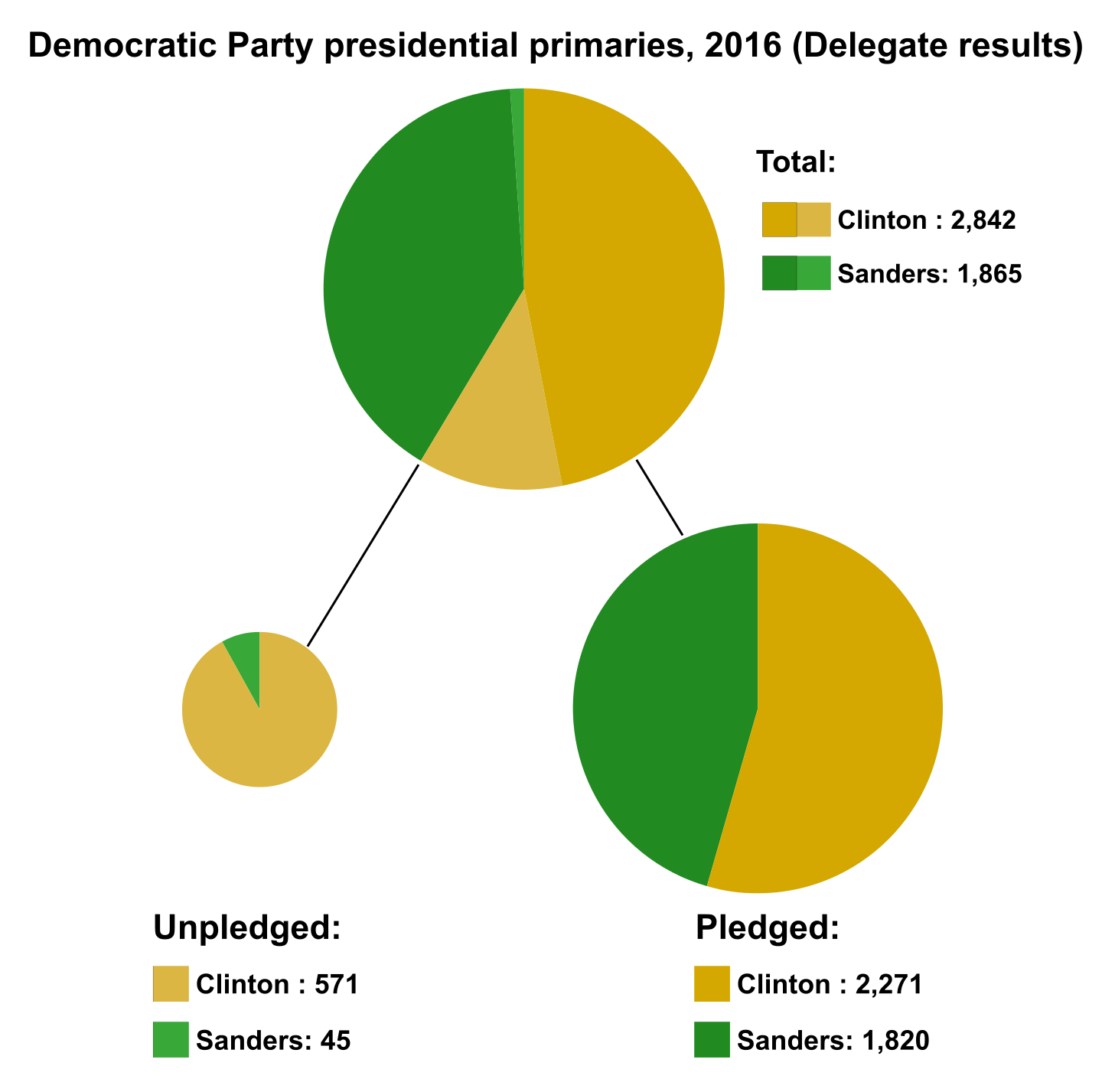
The following are the results of candidates who won at least one state. These candidates were on the ballots for every state, territory and federal district contest. The results of caucuses did not always have attached preference polls and attendance was extremely limited. The unpledged delegate count did not always reflect the latest declared preferences.
Superdelegate endorsements
Main article: List of superdelegates at the 2016 Democratic National Convention
Superdelegates are elected officials and members of the Democratic National Committee who vote at the Democratic National Convention for their preferred candidate. Also known as unpledged delegates, they comprise 15% of the convention (712 votes out of 4,763) and they may change their preference at any time. The table below reflects current public endorsements of candidates by superdelegates, as detailed and sourced in the full list above. Because commonly referenced estimates of superdelegate support, including those by CNN and the AP, do not identify individual delegates as supporting a given candidate, their published tallies may differ from the totals computed here.
Close states
Source:
States where the margin of victory was under 1%:
- Missouri, 0.25%
- Iowa, 0.25%
- Kentucky, 0.42% States where the margin of victory was under 5%:
- Massachusetts, 1.40%
- Michigan, 1.42%
- Illinois, 1.95%
- South Dakota, 2.06%
- New Mexico, 3.06%
- Indiana, 4.92% States where the margin of victory was under 10%:
- Nevada, 5.28%
- Connecticut, 5.38%
- California, 7.03%
- Montana, 7.40% States where the margin of victory was under 20%:
- Oklahoma, 10.36%
- Rhode Island, 11.63%
- Pennsylvania, 12.08%
- Ohio, 12.99%
- Wisconsin, 13.54%
- Wyoming, 13.64%
- North Carolina, 13.64%
- Oregon, 14.18%
- Nebraska, 14.28%
- Arizona, 14.90%
- West Virginia, 15.57%
- New York, 16.06%
- Colorado, 18.68%
Maps
File:U.S. States by Vote Distribution, 2016 (Democratic Party).svg|Breakdown of the results in vote distribution, by state File:Democratic Party presidential primaries results by county, 2016.svg|Results of popular vote, by county File:Democratic Party presidential primaries results, 2016 by margin of victory.svg|Results in popular vote margin, by state File:Democratic Party presidential primary results by county by popular vote margin 2.svg|Results in popular vote margin, by county File:Delegation Vote, 2016 (Democratic Party, only pledged delegates).svg|Breakdown of the results in pledged delegates, by state File:Delegation Vote ,2016 (Democratic Party, total delegates).svg|Breakdown of the results in total delegate count, by state File:Democratic Party presidential primaries pledged delegates results, 2016.svg|Results in pledged delegates, by state
Notes
References
References
- Berg-Andersson, Richard E.. "Democratic Convention". The Green Papers.
- Reston, Laura. (2015-10-14). "Americans Love an Underdog—Just Not Lincoln Chafee, Jim Webb, or Martin O'Malley".
- Strauss, Daniel. (November 2, 2015). "Lessig drops out of presidential race". Politico.
- Ballhaus, Rebecca. (February 11, 2016). "Why Candidates 'Suspend' Losing Campaigns Rather Than Say 'I Quit'". [[The Wall Street Journal]].
- "Sanders Lays Off Staff After Tuesday Primary Losses". NBC News.
- Dann, Carrie. (June 6, 2016). "Clinton hits 'magic number' of delegates to clinch nomination". [[NBC News]].
- (June 8, 2016). "Hillary Clinton secures majority of pledged delegate". Politico.
- Eric Bradner. (June 9, 2016). "Obama endorses Hillary Clinton in video". CNN.
- (June 9, 2016). "Hillary Clinton gets endorsements from Obama, Biden and Elizabeth Warren – as it happened". The Guardian.
- (24 June 2016). "US Election: Bernie Sanders says he will vote for Hillary Clinton". Reuters.
- Keith, Tamara. (11 July 2016). "Sanders And Clinton To Rally Together In New Hampshire". npr.org.
- "Released Emails Suggest the D.N.C. Derided the Sanders Campaign".
- Blake, Aaron. (July 25, 2016). "Here are the latest, most damaging things in the DNC's leaked emails". The Washington Post.
- Adam Entous, Ellen Nakashima and Greg Miller. (9 December 2016). "Secret CIA assessment says Russia was trying to help Trump win White House". [[The Washington Post]].
- Shane Harris, Ellen Nakashima and Craig Timberg. (18 April 2019). "Through email leaks and propaganda, Russians sought to elect Trump, Mueller finds". [[The Washington Post]].
- (November 3, 2017). "Elizabeth Warren agrees Democratic race 'rigged' for Clinton". BBC News.
- Schleifer, Theodore. (July 25, 2016). "What was in the DNC email leak?". CNN.
- Chan, Melissa. (July 24, 2016). "Bernie Sanders Calls for Debbie Wasserman Schultz to Resign After Email Leak".
- Yuhas, Alan. (July 24, 2016). "Hillary Clinton campaign blames leaked DNC emails about Sanders on Russia". The Guardian.
- Flaherty, Anne. (July 24, 2016). "Sanders Calls for DNC Chair's Resignation as Hacked Emails Overshadow Convention". Haaretz.
- (6 August 2015). "Democratic primary debate schedule criticized as Clinton 'coronation'". The Guardian.
- Andrew Prokop. (August 6, 2015). "The Democrats just released their debate schedule, and it's great news for Hillary Clinton". Vox.
- Harry Enten. (2016-05-06). "Is Six Democratic Debates Too Few?". FiveThirtyEight.
- Caputo, Marc. (July 24, 2016). "Wasserman Schultz steps down as DNC chair". Politico.
- (12 October 2016). "www.latimes.com/nation/politics/trailguide/la-na-trailguide-updates-former-senior-aide-to-bernie-sanders-1476297181-htmlstory.html". A Times.
- Brazile, Donna. (November 2, 2017). "Inside Hillary Clinton's Secret Takeover of the DNC". Politico.
- Stein, Jeff. (November 2, 2017). "Donna Brazile's bombshell about the DNC and Hillary Clinton, explained". Vox.
- Heersink, Boris (November 4, 2017). [https://www.washingtonpost.com/news/monkey-cage/wp/2017/11/04/no-the-dnc-didnt-rig-the-democratic-primary-for-hillary-clinton/ "No, the DNC didn't 'rig' the Democratic primary for Hillary Clinton"]. ''[[The Washington Post]]''. Retrieved March 8, 2018.
- Houle, Dana (July 25, 2016). [https://newrepublic.com/article/135472/no-dnc-didnt-rig-primary-favor-hillary "No, the DNC Didn't Rig the Primary in Favor of Hillary"]. ''[[The New Republic]]''. Retrieved March 8, 2018.
- Holland, Joshua (July 29, 2016). [https://www.thenation.com/article/what-the-leaked-e-mails-do-and-dont-tell-us-about-the-dnc-and-bernie-sanders/ "What the Leaked E-mails Do and Don't Tell Us About the DNC and Bernie Sanders"] {{Webarchive. link. (December 5, 2019 . ''[[The Nation]]''. Retrieved March 8, 2018.)
- Gaughan, Anthony J.. (August 27, 2019). "Was the Democratic Nomination Rigged? A Reexamination of the Clinton-Sanders Presidential Race". University of Florida Journal of Law & Public Policy.
- Wolf, Z. Byron. (2017-11-04). "Could Bernie Sanders have won a primary that wasn't 'rigged'? Um. {{!}} CNN Politics".
- Robillard, Kevin. (December 9, 2017). "DNC 'unity' panel recommends huge cut in superdelegates". Politico.
- Seitz-Wald, Alex. (August 25, 2018). "Democrats strip superdelegates of power and reform caucuses in 'historic' move". NBC News.
- "Hillary Clinton breaks the glass ceiling". Politico.
- Hook, Janet. (July 27, 2016). "Tim Kaine Accepts Vice-Presidential Nomination at Democratic National Convention". [[The Wall Street Journal]].
- Karni, Annie. (April 12, 2015). "Hillary Clinton formally announces 2016 run". Politico.
- Chozick, Amy. (July 12, 2016). "Bernie Sanders Endorses Hillary Clinton, Hoping to Unify Democrats". The New York Times.
- Mercia, Dan. (April 30, 2015). "Bernie Sanders is running for president". CNN.
- (Jun 9, 2016). "For the future of the country, I am committing my energies to the election of Secretary Clinton as the next President. #ImWithher".
- (May 30, 2015). "Martin O'Malley jumps into presidential race". [[USA Today]].
- Debenedetti, Gabriel. (February 1, 2016). "Martin O'Malley suspends bid for the Democratic nomination". Politico.
- (Aug 3, 2016). "Lincoln Chafee, who briefly ran against HRC, will "enthusiastically support" Hillary Clinton now that she is the nominee, per Chafee's spox.".
- Foley, Elise. (May 29, 2015). "Lincoln Chafee to announce presidential run on June 3". Politico.
- (October 23, 2015). "Lincoln Chafee drops out of Democratic primary race". CNN.
- Catanese, David. (July 2, 2015). "Jim Webb Announces For President". U.S. News & World Report.
- (October 20, 2015). "Webb drops Democratic presidential bid, weighs possible independent run". Fox News.
- "Campaign Press Release: Larry Lessig Hits $1 Million Fundraising Benchmark, Plans to Announce His Campaign for President at Historic New Hampshire Site".
- Strauss, Daniel. (November 2, 2015). "Lessig drops out of presidential race". Politico.
- Cohen, Jon. (December 5, 2012). "Run Hillary Run!: Majority want a Clinton 2016 candidacy". [[The Washington Post]].
- Steinhauser, Paul. (December 10, 2012). "Clinton rides high poll numbers into private life (for now?)". CNN.
- (January 23, 2013). "Hillary Clinton reaches new heights of political popularity". [[The Washington Post]].
- Marlantes, Liz. (December 10, 2012). "Are Republicans really 'incapable' of beating Hillary Clinton in 2016?". [[The Christian Science Monitor]].
- Marlantes, Liz. (December 5, 2012). "New polls fuel speculation about Hillary Clinton in 2016". [[The Christian Science Monitor]].
- Bolton, Alexander. (November 12, 2013). "Left wants challenger for Hillary Clinton". [[The Hill (newspaper).
- Martin, Jonathan. (September 29, 2013). "Populist Left Makes Warren Its Hot Ticket". [[The New York Times]].
- (December 4, 2013). "Elizabeth Warren: I'm Not Running For President". [[The Huffington Post]].
- (June 6, 2015). "Campaign To Draft Elizabeth Warren For President Comes To A Halt". The Huffington Post.
- (June 3, 2015). "Sanders Eyes Run Warren Run's Network in Iowa".
- Rudin, Ken. (May 7, 2013). "Joe Biden Has History On His Side But Little Else If Hillary Clinton Runs". [[NPR]].
- Hobratsch, Jonathan. (March 17, 2014). "When Vice Presidents Run for President". [[The Huffington Post]].
- Gaudiano, Nicole. (January 22, 2013). "Will Joe Biden run for president in 2016?". [[USA Today]].
- Rucker, Philip. (May 2, 2013). "Biden ponders a 2016 bid, but a promotion to the top job seems to be a long shot". [[The Washington Post]].
- Mason, Jeff. (October 21, 2015). "Biden says he will not seek 2016 Democratic nomination". AOL.
- (October 22, 2015). "Joe Biden Is Not Running For President In 2016". The Huffington Post.
- Colleen McCain Nelson, Peter Nicholas. (October 21, 2015). "Joe Biden Decides Not to Enter Presidential Race". The Wall Street Journal.
- (May 27, 2015). "Bernie Sanders formally launches run for president with attack on 'grotesque' level of inequality". The Guardian.
- (May 1, 2015). "Bernie Sanders, Long-Serving Independent, Enters Presidential Race as a Democrat". The New York Times.
- (September 14, 2014). "Senator Bernie Sanders May Run in 2016 – NYMag". Daily Intelligencer.
- (January 21, 2007). "The Socialist Senator". The New York Times.
- Trip Gabriel, Patrick Healy. (May 31, 2015). "Challenging Hillary Clinton, Bernie Sanders Gains Momentum in Iowa". The New York Times.
- Lee, Kurtis. (November 20, 2014). "Long shot Jim Webb launches exploratory committee for presidential bid". [[Los Angeles Times]].
- (2015-05-29). "Lincoln Chafee to announce presidential run on June 3".
- Merica, Dan. (April 9, 2015). "Lincoln Chafee launches 2016 exploratory committee, goes after Clinton on Iraq". [[CNN]].com.
- Wagner, John. (July 26, 2012). "O'Malley launches federal PAC as national profile rises". [[The Washington Post]].
- Wagner, John. (January 27, 2015). "O'Malley, with eye on 2016, retains two political operatives with Iowa experience". [[The Washington Post]].
- (September 6, 2015). "Harvard Professor Hits Million Dollar Benchmark for White House Bid".
- Foran, Clare. (August 11, 2015). "Why Exactly Is Lawrence Lessig Considering Running for President?". [[National Journal]].
- (September 6, 2015). "Harvard Professor Larry Lessig Says He's Running for President". ABC News.
- Merica, Dan. (August 11, 2015). "Harvard professor Lawrence Lessig is exploring a long shot presidential bid". CNN.
- (October 17, 2015). "Larry Lessig Isn't Giving Up On His Presidential Campaign". The Atlantic.
- "Election 2016 – Iowa Democratic Presidential Caucus". RealClearPolitics.
- Montanaro, Domenico. "Coin-Toss Fact-Check: No, Coin Flips Did Not Win Iowa For Hillary Clinton". National Public Radio, Inc..
- (February 2, 2016). "All Precincts Reported: Clinton Defeats Sanders By Historically Small Margin". WHO-TV.
- (February 2, 2016). "And the Winner of the Iowa Caucus Is: Hillary Clinton (Barely)". The Advocate.
- (February 27, 2016). "Iowa Caucus Results". The New York Times.
- (February 2, 2016). "Iowa Caucus 2016: Election Results". NBC News.
- Taylor, Jessica. (February 1, 2016). "Martin O'Malley Ends Presidential Bid". NPR.
- Gregory Krieg. (February 10, 2016). "Sanders 1st Jewish candidate to win presidential primary". CNN.
- Haberman, Maggie. (February 10, 2016). "New Hampshire Primary: Results and Analysis". The New York Times.
- (February 27, 2016). "New Hampshire Primary Results". The New York Times.
- Barone, Michael. (February 12, 2016). "New Hampshire Primary – Republicans Looking Better for General". National Review.
- (February 19, 2016). "What if Hillary Clinton Loses in Nevada?". The Washington Post.
- (February 12, 2016). "Why Hillary Clinton should be worried about Nevada". The Washington Post.
- Evan Halper, Michael A. Memoli. (February 5, 2016). "With New Hampshire primary nigh, Hillary Clinton shifts focus to Nevada caucuses and beyond". Los Angeles Times.
- (February 27, 2016). "Nevada Caucus Results". The New York Times.
- "Black Voters Boost Hillary Clinton to South Carolina Primary Win". ABC News.
- (March 14, 2016). "Super Tuesday Results 2016". The New York Times.
- Seitz-Wald, Alex. (March 2, 2016). "Super Tuesday: Hillary Clinton Hauls in Delegates But Bernie Sanders Fights On". NBC News.
- (March 2, 2016). "Hillary Clinton's Got This". FiveThirtyEight.
- (January 12, 2016). "2016 Primary Forecasts: Michigan Democratic primary". FiveThirtyEight.
- (January 12, 2016). "2016 Primary Forecasts: Mississippi Democratic primary". FiveThirtyEight.
- (March 9, 2016). "Sanders wins surprise, narrow victory in Michigan". The Washington Post.
- (March 9, 2016). "Why were the polls in Michigan so wrong?". The Washington Post.
- (March 9, 2016). "Why Did The Polls Fail To Predict Sanders' Win In Michigan?". NPR.
- (March 9, 2016). "Why The Polls Missed Bernie Sanders's Michigan Upset". FiveThirtyEight.
- (March 9, 2016). "Bernie Sanders surprises Hillary Clinton in Michigan. Is Ohio next?". Los Angeles Times.
- (January 12, 2016). "2016 Primary Forecasts: North Carolina Democratic primary". FiveThirtyEight.
- (January 12, 2016). "2016 Primary Forecasts: Florida Democratic primary". FiveThirtyEight.
- (March 22, 2016). "March 15 Primary Results 2016". The New York Times.
- (March 18, 2016). "Bernie Sanders Says He Won't Seek Recount in Missouri". The New York Times.
- "Missouri Election Results 2016". The Washington Post.
- Yoon, Robert. (March 21, 2016). "Bernie Sanders wins Democrats Abroad primary". CNN.
- Bradner, Eric. (March 23, 2016). "Primary election results: 5 takeaways from Western Tuesday". CNN.
- (March 22, 2016). "Clinton cruises in Arizona, Sanders takes Utah and Idaho". Politico.
- (March 23, 2016). "Hillary Clinton and Bernie Sanders square off in Arizona, Idaho, and Utah". Slate.
- (March 29, 2016). "March 22 Primary Results 2016". The New York Times.
- (March 26, 2016). "Can Sanders sweep Clinton in today's contests?". Politico.
- Harry Enten, Nate Silver. (March 26, 2016). "The System Isn't 'Rigged" Against Sanders".
- (March 27, 2016). "Bernie Sanders "Outperforming Obama" In Washington State".
- "NYC debate info". Democrats.org.
- "Wyoming Democrat". The Green Papers.
- (April 20, 2016). "How Every New York City Neighborhood Voted in the Democratic Primary". The New York Times.
- (April 27, 2016). "Donald Trump Hillary Clinton Win Big on Super Tuesday III". Fox News.
- (May 4, 2016). "Bernie Sanders pulls off shock victory over Hillary Clinton in Indiana". The Guardian.
- Roberts, Yoon. (May 7, 2016). "Hillary Clinton wins Guam Democratic caucuses". CNN.
- Gale, John A. (May 10, 2016). "Election Results". Nebraska Secretary of State.
- Wyman, Tim. (May 25, 2016). "Democratic primary results". Washington Secretary of State.
- Murray, Mark. (June 2, 2016). "Dem Race Tightens in California as Clinton Barely Leads Sanders 49% to 47%: Poll". NBC.
- Yen, Hope. (June 5, 2016). "Clinton moves closer to nomination, sweeps in Virgin Islands". Associated Press.
- (June 5, 2016). "Clinton wins Puerto Rico's primary". Associated Press.
- Oliphant, James. (June 6, 2016). "Clinton clinches Democratic presidential nomination: AP and NBC". Reuters.
- Memoli, Michael A.. "Hillary Clinton's immediate response to AP: Tuesday is the real clinching moment". Los Angeles Times.
- Dann, Carrie. (June 6, 2016). "Sanders Blames Media's 'Rush to Judgment' as Clinton Hits Delegate Majority". NBC News.
- (June 7, 2016). "Hillary Clinton Wins California, Bolstering Claim to Nomination". [[The New York Times]].
- "Bernie Sanders Will Fight One Last Primary But Pledges to Work With Hillary Clinton to Avert 'Disaster' of a President Trump".
- (June 14, 2016). "Clinton, Sanders meet; Clinton wins D.C. primary". CNN.
- Gaudiano, Nicole. (June 16, 2016). "Bernie Sanders says Democrats' top task is defeating Donald Trump". USA Today.
- (July 13, 2016). "Sen. Bernie Sanders ends bid, endorses Hillary Clinton for president". WPTZ.
- (25 July 2016). "Here are the latest, most damaging things in the DNC's leaked emails". The Washington Post.
- (24 July 2016). "Debbie Wasserman Schultz to Resign D.N.C. Post". The New York Times.
- (25 July 2016). "DNC CEO resigns in wake of email controversy". CNN.
- Debenedetti, Gabriel. (February 25, 2017). "Perez elected DNC chairman". Politico.
- "Clinton fundraising leaves little for state parties". Politico.
- Seitz-Wald, Alex. (November 3, 2017). "Memo Reveals Details of Hillary Clinton-DNC Deal". NBC News.
- (July 26, 2016). "DNC sought to hide details of Clinton funding deal". Politico.
- Lima, Cristiano. (November 5, 2017). "Brazile: I found 'no evidence' Democratic primary was rigged". Politico.
- Detrow, Scott. (November 3, 2017). "Clinton Campaign Had Additional Signed Agreement With DNC In 2015". NPR.
- Shelbourne, Mallory (November 14, 2017). [https://thehill.com/homenews/campaign/360304-brazile-primary-was-not-rigged-because-no-votes-were-overturned/ "Brazile: Dem primary was not rigged because no votes were overturned"]. ''[[The Hill (newspaper). The Hill]]''. Retrieved February 21, 2019.
- (November 8, 2017). "Donna Brazile is walking back her claim that the Democratic primary was 'rigged'". The Washington Post.
- (February 16, 2018). "Inside a 3-Year Russian Campaign to Influence U.S. Voters". The New York Times.
- (January 6, 2017). "Assessing Russian Activities and Intentions in Recent US Elections". [[Office of the Director of National Intelligence]].
- (9 December 2016). "Secret CIA assessment says Russia was trying to help Trump win White House". The Washington Post.
- (February 17, 2018). "Indictment: Russians also tried to help Bernie Sanders, Jill Stein presidential campaigns". USA Today.
- (12 April 2019). "Inside the Russian effort to target Sanders supporters — and help elect Trump". The Washington Post.
- Roth, Andrew. "Russia denies DNC hack and says maybe someone 'forgot the password'". The Washington Post.
- (2016-12-16). "Wikileaks founder Assange on hacked Podesta, DNC emails: 'Our source is not the Russian government'". Fox News.
- (July 13, 2018). "Read: Mueller indictment against 12 Russian spies for DNC hack". [[Vox (website).
- (April 21, 2016). "RNC's 2016 Presidential Primary Estimated Delegate Count". Republican Party.
- (April 27, 2016). "Republican Convention's Delegate Math Explained". The Wall Street Journal.
- Rivero, Daniel. (July 26, 2016). "A day after calling for party unity, Bernie Sanders goes back to being an independent". Fusion TV.
- "2016 Presidential Race". [[OpenSecrets]].
- "Summary data for Hillary Clinton, 2016 Cycle". opensecrets.org.
- "Summary data for Bernie Sanders, 2016 Cycle". opensecrets.org.
- "Democratic National Committee, 2016 Democratic National Convention Delegate/Alternate Allocation".
- "Democratic Detailed Delegate Allocation – 2016". The Green Papers.
- "2016 Election Center – Presidential Primaries and Caucuses". CNN.
- "Delegate Tracker".
- "2016 Presidential Democratic Primary Election Results".
This article was imported from Wikipedia and is available under the Creative Commons Attribution-ShareAlike 4.0 License. Content has been adapted to SurfDoc format. Original contributors can be found on the article history page.
Ask Mako anything about 2016 Democratic Party presidential primaries — get instant answers, deeper analysis, and related topics.
Research with MakoFree with your Surf account
Create a free account to save articles, ask Mako questions, and organize your research.
Sign up freeThis content may have been generated or modified by AI. CloudSurf Software LLC is not responsible for the accuracy, completeness, or reliability of AI-generated content. Always verify important information from primary sources.
Report