From Surf Wiki (app.surf) — the open knowledge base
2012 National Reconnaissance Office space telescope donation to NASA
Declassification and donation to NASA of two identical space telescopes
Declassification and donation to NASA of two identical space telescopes
The 2012 National Reconnaissance Office space telescope donation to NASA was the declassification and donation to NASA of two identical space telescopes by the United States National Reconnaissance Office. The donation has been described by scientists as a substantial improvement over NASA's current Hubble Space Telescope. Although the telescopes themselves were given to NASA at no cost, the space agency must still pay for the cost of instruments and electronics for the telescopes, as well as the satellites to house them and the launch of the telescopes. On February 17, 2016, the Nancy Grace Roman Space Telescope (then known as the Wide Field Infrared Survey Telescope or WFIRST) was formally designated as a mission by NASA, predicated on using one of the space telescopes.
Background
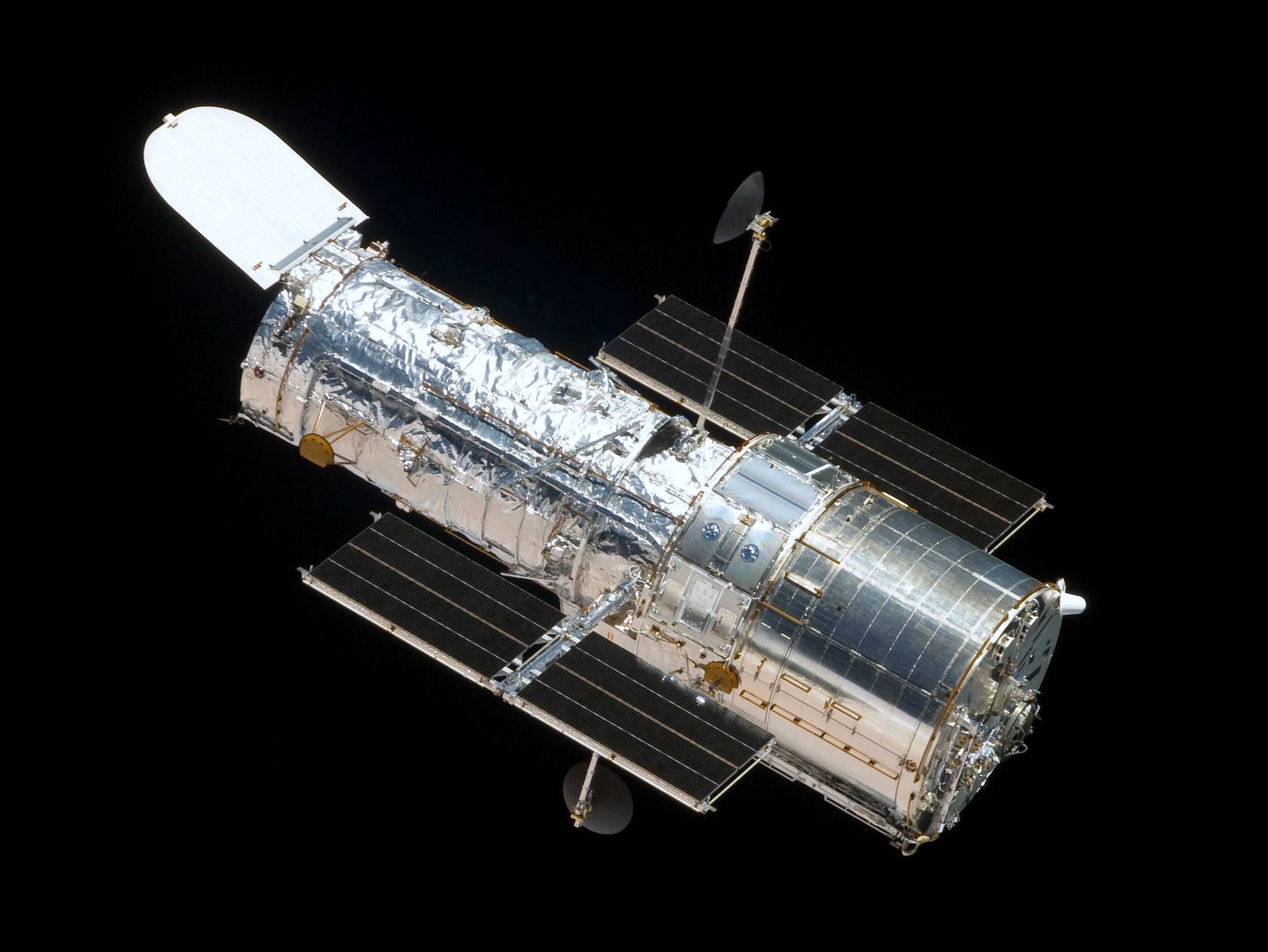
While the Hubble Space Telescope of the National Aeronautics and Space Administration (NASA) has collected a large amount of astronomical data, has outlived all expectations, and has been described as one of the space agency's most successful missions, the facility will eventually succumb to the extreme environment of space. In addition, with the James Webb Space Telescope costing at least US$9 billion, the agency's astrophysics budget is strained. As a result, NASA's other astrophysics missions have been delayed until funding becomes available.
In January 2011 the National Reconnaissance Office (NRO) revealed to NASA the existence of two unneeded telescope optical systems, originally built to be used in reconnaissance satellites, and available to the civilian agency. NASA accepted the offer in August 2011 and announced the donation on 4 June 2012. The instruments were constructed between the late 1990s and early 2000s, reportedly for NRO's unsuccessful Future Imagery Architecture program; in addition to the two completed telescopes, a primary mirror and other parts for a third also exist.
While NRO considers them to be obsolete, the telescopes are nevertheless new and unused. All charge-coupled devices (CCDs) and electronics have been removed, however, and NASA must add them at its own expense. When the telescopes' specifications were presented to scientists, large portions were censored due to national security. An unnamed space analyst stated that the instruments may be a part of the KH-11 Kennen line of satellites which have been launched since 1976, but which have now been largely superseded by newer telescopes with wider fields of view than the KH-11. The analyst stated, however, that the telescopes have "state-of-the-art optics" despite their obsolescence for reconnaissance purposes.
Potential uses
The early consensus for the usage of the telescopes was to follow the NASA Astronomy and Astrophysics Decadal Survey of 2010, which lists the Wide Field Infrared Survey Telescope (now renamed the Nancy Grace Roman Space Telescope) as its highest priority.
The NRO telescope design has several features which make it useful for Roman/WFIRST and superior to the Hubble. The NRO instrument's 2.4 m primary mirror is the same size and quality as the Hubble's. With double the mirror diameter of the original WFIRST design, it allows for up to twice the image resolution and gathers four times the light. and would be unsuitable for imaging the most distant galaxies at its longest infrared wavelengths, which requires cooling beyond the original NRO design temperature range.
Whether using the NRO telescopes would save NASA money is unclear. While each is worth at least $250 million, their larger size compared to the proposed WFIRST design would require a larger rocket and camera. According to one NASA estimate using an NRO telescope would raise the cost of WFIRST by $250 million above its $1.5 billion budget. Another estimate states that NASA would save up to $250 million. The agency's deputy acting director for astrophysics Michael Moore states that using both telescopes may ultimately save NASA $1.5 billion. David Spergel estimated that using an NRO telescope would add about $100 million to WFIRST's cost, but would prefer to spend another $200 million for a coronagraph to improve its direct-imaging capability.
Due to the budgetary constraints arising from the continued construction of the James Webb Space Telescope, NASA has stated that Roman/WFIRST may not be launched until 2024 at the earliest, despite early speculation that by using an NRO telescope the mission might launch by roughly 2020, at about the same time as the European Space Agency's Euclid. In addition, the availability of a telescope is believed to increase the probability that the mission will be launched at all.
While the first telescope is now in use as the basis for Roman/WFIRST, NASA currently does not have plans or funding for the usage of the second. and NASA considered dozens of proposals; the only prohibition is Earth observation, a condition of the NRO donation. Possibilities include observing Earth's aurora and ionosphere, or asteroids and other faint objects within the Solar System. NASA has also suggested that the telescope could be sent to Mars, photographing the surface with a resolution about four times finer than the current Mars Reconnaissance Orbiter's HiRISE instrument. From Martian orbit the telescope could also view the outer Solar System and the asteroid belt.
References
References
- (2016-02-18). "NASA Introduces New, Wider Set of Eyes on the Universe".
- Lemonick, Michael D.. (June 5, 2012). "NASA Gets Two New Hubble Telescopes — for Free". TIME Science.
- Achenbach, Joel. (June 4, 2012). "NASA gets two military spy telescopes for astronomy". The Washington Post National.
- Ferster, Warren. (2012-06-08). "Donated Space Telescopes are Remnants of Failed NRO Program". SpaceNews.
- Boyle, Rebecca. (June 5, 2012). "NASA Adopts Two Spare Spy Telescopes, Each Maybe More Powerful than Hubble". Popular Science.
- Cowen, Ron. (January 2013). "Fresh bid to see exo-Earths". Nature.
- Potter, Ned. (June 4, 2012). "NASA Gets 2 Unused Space Telescopes From Spy Agency". ABC Science Blog and News Posts.
- Hand, Eric. (October 2012). "The telescopes that came in from the cold". Nature.
- Clark, Stephen. (June 4, 2012). "NASA has a mission for grounded spy telescopes". Spaceflight Now.
- (November 30, 2018). "NASA Awards Optical Telescope Assembly for Wide Field Infrared Survey Telescope Mission". NASA.
- (September 2012). "New Telescope Meeting".
- Foust, Jeff. (February 2013). "The future of space telescopes beyond JWST". The Space Review.
- Leone, Dan. (2013-05-29). "NASA Soon To Judge Spy Telescope's Suitability for JWST Follow-On". Space News.
- Wall, Mike. (May 15, 2013). "NASA May Launch Donated Spy Satellite Telescope to Mars". Space.com.
This article was imported from Wikipedia and is available under the Creative Commons Attribution-ShareAlike 4.0 License. Content has been adapted to SurfDoc format. Original contributors can be found on the article history page.
Ask Mako anything about 2012 National Reconnaissance Office space telescope donation to NASA — get instant answers, deeper analysis, and related topics.
Research with MakoFree with your Surf account
Create a free account to save articles, ask Mako questions, and organize your research.
Sign up freeThis content may have been generated or modified by AI. CloudSurf Software LLC is not responsible for the accuracy, completeness, or reliability of AI-generated content. Always verify important information from primary sources.
Report