From Surf Wiki (app.surf) — the open knowledge base
2012 Iranian legislative election
none
none
| Field | Value | |
|---|---|---|
| country | Iran | |
| type | parliamentary | |
| previous_election | 2008 Iranian legislative election | |
| previous_year | 2008 | |
| next_election | 2016 Iranian legislative election | |
| next_year | 2016 | |
| turnout | 66.2% | |
| seats_for_election | All 290 seats to the Islamic Consultative Assembly | |
| majority_seats | 146 | |
| election_date | 2 March and 4 May 2012 | |
| image1 | [[File:Msc 2009-Friday, 16.00 - 19.00 Uhr-Dett 007 Larijani.jpg | 108px]] |
| leader1 | Ali Larijani | |
| party1 | {{collapsible list | |
| titlestyle | font-weight:normal;background:transparent;text-align:center; | |
| title | *Parties* | |
| colour1 | FF0000 | |
| alliance1 | United Front of Principlists | |
| leaders_seat1 | Qom | |
| seats1 | 133 | |
| 36+97 | ||
| percentage1 | 45.86% | |
| 1blank | Political camp | |
| 1data1 | Principlists | |
| 1data2 | Principlists | |
| 1data3 | Principlists | |
| 1data4 | Reformists | |
| 1data5 | Principlists | |
| 1data6 | Principlists | |
| 1data7 | Principlists | |
| 1data8 | Reformists | |
| colour2 | B0C4DE | |
| image2 | [[File:Ayatollah Mohammad-Taqi Mesbah-Yazdi (cropped).jpg | 100px]] |
| leader2 | Mohammad Taqi Mesbah Yazdi | |
| alliance2 | — | |
| party2 | Stability Front | |
| leaders_seat2 | *Did not stand* | |
| seats2 | 83 | |
| 18+65 | ||
| percentage2 | 28.62% | |
| colour3 | 008080 | |
| image3 | [[File:Mohsen Rezaee Mirgha'ed.jpg | 100px]] |
| leader3 | Mohsen Rezaee | |
| alliance3 | Resistance Front | |
| party3 | {{collapsible list | |
| titlestyle | font-weight:normal;background:transparent;text-align:center; | |
| title | *Parties* | |
| leaders_seat3 | *Did not stand* | |
| seats3 | 70 | |
| 18+52 | ||
| percentage3 | 24.13% | |
| colour4 | 7CFC00 | |
| image4 | [[File:Mostafa_Kavakebian2.jpg | 115px]] |
| leader4 | Mostafa Kavakebian | |
| alliance4 | Reformists Front | |
| party4 | {{collapsible list | |
| titlestyle | font-weight:normal;background:transparent;text-align:center; | |
| title | *Parties* | |
| leaders_seat4 | Semnan | |
| (*defeated*) | ||
| seats4 | 13 | |
| percentage4 | 4.48% | |
| colour5 | FFA500 | |
| image5 | ||
| leader5 | Mahmoud Ahmadinejad | |
| Esfandiar Mashaei | ||
| alliance5 | Justice Discourse | |
| Monotheism and Justice Front | ||
| party5 | — | |
| leaders_seat5 | *Did not stand* | |
| seats5 | 9 | |
| percentage5 | 3.10% | |
| colour6 | 000000 | |
| image6 | [[File:ShahabSadr cropped.jpg | 119px]] |
| leader6 | Shahabodin Sadr | |
| alliance6 | Insight and Islamic Awakening Front | |
| party6 | — | |
| leaders_seat6 | Tehran, Rey, Shemiranat and Eslamshahr | |
| (*disqualified*) | ||
| seats6 | 7 | |
| percentage6 | 2.41% | |
| colour7 | fdc238 | |
| image7 | [[File:Ali Motahari 01.jpg | 100px]] |
| leader7 | Ali Motahari | |
| alliance7 | People's Voice | |
| party7 | — | |
| leaders_seat7 | Tehran, Rey, Shemiranat and Eslamshahr | |
| seats7 | 2 | |
| percentage7 | 0.68% | |
| colour8 | 00017B | |
| image8 | [[File:World Economic Forum Annual Meeting Davos 2007.jpg | 75px]] |
| leader8 | *Mohammad Khatami* | |
| alliance8 | *Council for coordinating the Reforms Front* | |
| party8 | — | |
| leaders_seat8 | *Did not stand* | |
| seats8 | — | |
| percentage8 | *0*% | |
| title | Speaker | |
| before_election | Ali Larijani | |
| after_election | Ali Larijani | |
| before_party | United Front of Principlists | |
| after_party | United Front of Principlists |
| The two Societies | Front of Followers | Transformationalists 36+97 18+65
| Development and Justice Party | Green Party 18+52
| Democracy Party | Worker House (defeated)
Esfandiar Mashaei Monotheism and Justice Front
(disqualified)
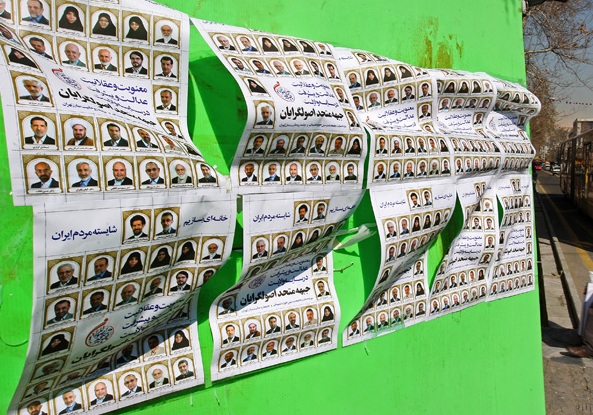
The parliamentary election for the 9th Islamic Consultative Assembly, or Majlis, were held in Iran on Friday, 2 March 2012 with a second round on 4 May 2012 in those 65 districts where no candidate received 25% or more of the votes cast. More than 5,000 candidates registered but more than a third were disqualified by the Guardian Council leaving about 3,400 candidates to run for the 290 seat representing the 31 provinces.
The election has been described by journalists and analysts "as a contest between" Iran's Supreme Leader Ali Khamenei and president Mahmoud Ahmadinejad, with Khamenei supporters winning a large majority of seats. Iranian officials and state media have described the election as a sign of Iranians' trust in the Islamic Republic and a message to the West rejecting pressure over Iran's nuclear program. Although no final election turnout figures were released, state media emphasized that voter turnout was high.
The parliament has "no direct control over key foreign and security policy matters" but some influence over those policies and coming elections. In the wake of the crushing of reformist protest against the 2009 election results, few if any reformist candidates were allowed by the Guardian Council to run. The new parliament was opened on 27 May 2012.
Background
After two consecutive wins in 2004 and 2008, the governing conservatives are hoping to secure yet another majority in the parliament.
Events since the 2008 election
The 2008 election saw a majority win for the conservatives and supporters of President Mahmoud Ahmadinejad but in the last years of the parliament, It was a despite with the president and the parliament, major in the budget approval. The parliament elected Ali Larijani, a former opponent of Ahmadinejad in the 2005 presidential election as the chairman. The first disagreement with the government was the vote of no confidence and dismissal of then Interior Minister, Ali Kordan, just three months after the opening of the new parliament. The presidential election was held in June 2009 in which Ahmadinejad was re-elected as the president. This was very despite with the results. Opposition repudiated the result and claimed that there was fraud in the election. The inauguration ceremony, held in parliament on 5 August 2009, was not attended by more than 60 of the 290 members of Parliament. Parliament also rejected three of the introduced ministers of Ahmadinejad's second cabinet.
Electoral system
The registration of candidates was handled by the Interior Ministry and candidates are vetted by the Guardian Council.
Since 2007, Iran has been divided into 207 electoral districts. These districts are roughly based on geography, but shaped according to the number of voters so that each district holds roughly the same number of registered voters. 202 districts are Muslim majority and 5 districts belong to the recognized religious minorities. Therefore, these districts do not correspond to the borders of top administrative divisions within Iran and each district contains one or more or parts of several provinces of Iran. The legal term of the parliament is four years. The elections must be held before the dissolution of the parliament. The new members must be sworn three months after their elections in the first day of opening of the parliament. The speaker and deputy speakers are elected in the opening day. In the time of war and military occupation, after the proposal of the president and approval of three-fourths of the members of the parliament and approval of the Guardian Council, elections can be postponed in the occupied areas or the entire country for a certain period.
If in a district, no one can earn ¼ of the votes, a second round election will be held after four weeks. If an elected MP dies, resigns or leaves office for other reasons, Ministry of the Interior must hold the election in her/his districts in less than seven months. None of the candidates can nominate herself/himself in more than one district. If so, her/his candidacy will be canceled and they will be disenfranchised. Voting must be an official holiday.
Qualifications
According to Iran's law, in order to qualify as a candidate one must:
- Be an Iranian citizen
- Have a master's degree (unless being an incumbent)
- Be a supporter of the Islamic Republic, pledging loyalty to constitution
- Be a practicing Muslim (unless running to represent one of the religious minorities in Iran)
- Not have a "notorious reputation"
- Be in good health, between the ages of 30 and 75.
Candidates found to be mentally impaired, actively supporting the Shah or supporting political parties and organizations deemed illegal or been charged with anti-government activity, converted to another faith or has otherwise renounced the Islamic faith, have been found guilty of corruption, treason, fraud, bribery, is an addict or trafficker or have been found guilty of violating Shariat law are disqualified.
Campaign
The chief of the Council of Guardians, Ayatollah Ahmad Jannati, has said that reformists he labeled as traitors "need not participate." Former president Mohammad Khatami demanded that political prisoners be freed and that former presidential candidates Mir-Hossein Mousavi and Mahdi Karroubi be released from house arrest as a precondition for his movements participation. Since his call went unheeded Ali Mohammad-Gharibani, head of the Reformist Front Coordination Council, said: "Despite efforts...to create an appropriate election climate, unfortunately more restrictions have been imposed. Therefore, the council has decided that it won’t issue any election list and won’t support anyone." The electoral campaign was started on 23 February and ended on 1 March. Over 5,400 had registered to contest the 290 parliamentary seats. More than 47,000 polling stations will operate nationwide during the elections. Some 3.9 million people will cast their votes for the first time. According to Iran's Interior Ministry, the election process will be managed by some 850,000 observers in 47,000 polling stations and 1,000 constituencies across the country.
Registration and vetting of candidates
The registration ran from 24 to 30 January 2012. 5,405 people applied at the Interior Ministry to stand as candidates. These included 490 women. 1,006 applied in Tehran. North Khorasan province had the smallest number with 39 people. The number of applications was down from the 2008 parliamentary elections when 7,597 applied. According to Aljazeera commentators, the number of rejections—including 33 sitting members of parliament—can be attributed primarily to stricter educational requirements, and the narrowing of what is considered politically acceptable by the Guardian Council.
Beginning with the 2012 elections, candidates have to have at least a master's degree to stand for elections, not just a Bachelors as in earlier elections. In addition candidate hopefuls may have been disqualified for affiliation with leftist organisations, the reformist camp, or even President Ahmadinejad.
Political parties and coalitions
According to Neil MacFarquhar of The New York Times, "there are no real political parties in Iran, only murky, shifting alliances of political figures," but according to Al Jazeera, the vote is a contest between the United Front of Principlists, who support Supreme Leader Khamenei, and the Front of Islamic Revolution Stability, which backs Ahmadinejad.
Principlists
- United Front of Principlists: The coalition is led by Ali Larijani, current chairman of the parliament.
- Front of Islamic Revolution Stability
- Monotheism and Justice Party: A group of Ahmadinejad supporters.
- People's Voice: The front formed by a group of conservatives led by Ali Motahari.
- Insight and Islamic Awakening Front: The front led by second deputy speaker of the parliament, Shahab od-Din Sadr.
Reformists
The Council for coordinating the Reforms Front or simply "Reforms Front" (), the highest decision-making body inside Iranian reform movement, called the elections 'illegal and unfair' and "decided not to present a unified list [of candidates] and not to support anyone [in the race]". However, some member groups inside the council including Worker House and Democracy Party, and some individual reformists formed the "Reformists Front" () led by Mostafa Kavakebian to compete in the elections. Some reformist groups like Assembly of Qom Seminary Scholars and Researchers, Association of Combatant Clerics and Islamic Iran Participation Front ruled out any cooperation with this group, and some labeled them as "fake reformists" ().
Results
;IranPolitik According to the IranPolitik, the results were:
- Principalist Unity Front: 65
- Persevering Front of the Islamic Revolution: 22
- Joint PUF/PFIR: 61
- Democratic Front: 20
- Independent Principalists: 17
- Independents: 105 ;Mizan Online According to Mizan Online, the official news agency of Iranian Judiciary, 182 were conservative, 13 were reformer and 88 were independent (excluding 5 religious minority members and 2 vacant seats).
| List | Shared Seats | Total Seats | UFP | FIRS | RFII | RF | PV | UFP | 133 | FIRS | 83 | RFII | 70 | RF | 25 | PV | 4 |
|---|---|---|---|---|---|---|---|---|---|---|---|---|---|---|---|---|---|
| **36** | 52 | 28 | 2 | *2 +RFII* | |||||||||||||
| 52 | **18** | *13 +UFP* | colspan=2 | colspan=2 | |||||||||||||
| 28 | *13 +UFP* | **18** | 9 | *2 +UFP* | |||||||||||||
| 2 | colspan=2 | 9 | **13** | 1 | |||||||||||||
| *2 +RFII* | colspan=2 | *2 +UFP* | 1 | **1** |
;Stratfor According to Stratfor, the United Front of Conservatives and Stability Front won 98 and 43 seats respectively, while other political parties and independents took the rest. ;Bani Kamal (2013) The affiliations of candidates are determined on the basis of the candidacy lists in which their names appeared. Given the overlap of candidacy lists, the share of each group might be claimed more or less than what is in the table, which shows the results out of 225 confirmed seats.
| Electoral list | Nominees listed (out of 290) | Seats won (out of 225) | Total | 290 | 225 | ||
|---|---|---|---|---|---|---|---|
| United Front of Principlists | 258 | 97 (including 49 supported by the FIRS) | |||||
| Independents (candidates who contested individually) | 83 | ||||||
| Front of Islamic Revolution Stability | 199 | 17 | |||||
| Resistance Front of Islamic Iran | 180 | 7 | |||||
| Democratic Front | 83 | 16 | |||||
| Coalition of Independent Candidates | 86 | 16 | |||||
| Monotheism and Justice Front | 30 | 5 | |||||
| Source: Abdol Moghset Bani Kamal |
Analysis
The government hopes that the high turnout it claims will give it a boost. According to a statement issued on the Web site of the Foreign Ministry, by turning out in droves, Iranians "especially in this sensitive historical era, have shown that, despite all of the conspiracies, pressures, and sanctions, and the bleak portrait painted by the media of global arrogance, they will continue defending independence and the national interest".
However, the foreign journalist Laura Secor found a polling station in Tehran (Hosseiniyeh Ershad) where she had always seen long lines of voters in previous elections, nearly empty this year.
Majid Zavari, a Tehran-based political analyst, said the economy and the persistent unemployment would be pivotal issues in the election: "From one end, Iranian society is facing high unemployment, particularly among educated youth who, despite university degrees, do not have decent living standards. This has increased discontent amongst people," Zavari told Al Jazeera.
According to analyst, Maryam Khatibi, "reformists are nowhere to be seen," in the election campaign. Nasser Karimi and Brian Murphy of the Associated Press see the election as divided between pro-Ahmadinejad conservatives and pro-Ali Khamenei conservatives.
Liberals, reformists and youth groups that led the protests are virtually absent from the parliamentary ballots after relentless crackdowns and arrests. Conservatives – now left without a unifying foe – have splintered into various factions either backing or rejecting Ahmadinejad for daring to challenge Khamenei and the ruling clerics.
However, Mohammad Khatami – former president of the Islamic Republic and the "spiritual leader of the reformist movement" – who had urged Iranians not to vote, did end up voting March 2.
Turnout
According to the official accounts, out of 48,288,799 eligible voters, 26,472,760 turned out.
Notes
References
References
- (2017). "Iran: Stuck in Transition". Taylor & Francis.
- "تعداد و درصد گرايش سياسي نمايندگان مجلس نهم". Mizan Online.
- (February 23, 2012). "Hardline group emerges as Iran poll threat". [[Financial Times]].
- "Political road map of Iran before the Parliamentary (Majlis) elections". [[Today's Zaman]].
- "خواهر احمدي نژاد شکست خورد/ کواکبيان هم به مجلس نرفت". Khabar Online.
- (5 January 2008). "ناکامان بزرگ انتخابات مجلس نهم". Deutsche Welle.
- "تشديد اختلافات در آستانه انتخابات؛ اصولگرايان هشت فهرست انتخاباتي مي دهند". Radio Farda.
- [https://www.aljazeera.com/programmes/insidestory/2012/03/20123282513580403.html Iran elections clouded by doubts] 02 Mar 2012
- 4 March 2012
- [http://www.huffingtonpost.com/2012/05/05/iran-elections-2012-ahmadinejad_n_1483744.html Iran Elections 2012: Ahmadinejad Routed By Rivals] By ALI AKBAR DAREINI 05/05/12]
- [https://web.archive.org/web/20190102180544/https://www.washingtonpost.com/world/middle-east/iran-starts-registering-candidates-for-march-parliamentary-elections-reformists-stay-out/2011/12/24/gIQA9f82EP_story.html Iran starts registering candidates for March parliamentary elections; reformists stay out] By Associated Press, 24 December 2011
- [http://www.farsnews.com/newstext.php?nn=13901011001364 Electoral law of the Consultative Assembly]
- [https://www.hamshahrionline.ir/news-155442.aspx Number of the candidates for parliamentary election]
- [https://www.csmonitor.com/World/Middle-East/2012/0302/Iran-election-draws-conservatives-God-please-accept-this-vote-from-me Iran election draws conservatives: 'God, please accept this vote from me'] By Scott Peterson / csmonitor.com / 2 March 2012
- [https://www.aljazeera.com/indepth/features/2012/02/2012218132517668868.html What it takes to run for Iran's parliament]
- (13 June 2013). "واژه نامه جریان های فعال در انتخابات ریاست جمهوری ایران – BBC Persian". [[BBC Persian]].
- Cyrus Green. (20 December 2011). "'Upcoming elections illegal and unfair' says Green Council". Oye! Times.
- Mohammad Reza Yazdanpanah. (5 March 2013). "We Want to Meet the Supreme Leader". [[Rooz Online]].
- {{usurped
- "تعداد و درصد گرایش سیاسی نمایندگان مجلس نهم". Mizan Online.
- (5 May 2012). "Iran: Implications of Ahmadinejad's Parliamentary Defeat". Stratfor.
- Abdol Moghset Bani Kamal. (2013). "The ninth Majlis elections in Iran: Electoral laws, procedures and institutions". International Islamic University of Malaysia.
- [https://www.newyorker.com/reporting/2012/05/07/120507fa_fact_secor Letter from Tehran{{! Election, Monitored] newyorker.com by Laura Secor May 7, 2012
- [http://www.huffingtonpost.com/2012/03/01/iran-elections-2012_n_1314653.html?ref=world Iran Elections 2012: Everything You Need To Know On Upcoming Parliamentary Vote], 1 March 2012
- [https://www.pbs.org/wgbh/pages/frontline/tehranbureau/2012/03/dispatch-tehranis-talk-of-the-elections-stakes-and-khatamis-shock-ballot.html#ixzz1oGR7TGgc Dispatch {{! Tehranis Talk of the Elections' Stakes and Khatami's Shock Ballot] by ALI CHENAR. 04 Mar 2012
This article was imported from Wikipedia and is available under the Creative Commons Attribution-ShareAlike 4.0 License. Content has been adapted to SurfDoc format. Original contributors can be found on the article history page.
Ask Mako anything about 2012 Iranian legislative election — get instant answers, deeper analysis, and related topics.
Research with MakoFree with your Surf account
Create a free account to save articles, ask Mako questions, and organize your research.
Sign up freeThis content may have been generated or modified by AI. CloudSurf Software LLC is not responsible for the accuracy, completeness, or reliability of AI-generated content. Always verify important information from primary sources.
Report