From Surf Wiki (app.surf) — the open knowledge base
2011 New Zealand general election
General election in New Zealand
General election in New Zealand
| Field | Value | |
|---|---|---|
| election_name | 2011 New Zealand general election | |
| country | New Zealand | |
| type | parliamentary | |
| ongoing | no | |
| previous_election | 2008 New Zealand general election | |
| previous_year | 2008 | |
| outgoing_members | 49th New Zealand Parliament | |
| next_election | 2014 New Zealand general election | |
| next_year | 2014 | |
| seats_for_election | All 121 seats in the House of Representatives, including one overhang seat | |
| majority_seats | 61 | |
| election_date | ||
| elected_mps | [elected members](50th-new-zealand-parliament) | |
| opinion_polls | Opinion polling for the 2011 New Zealand general election | |
| turnout | 2,278,989 (74.21%) 5.25% | |
| 1blank | Electorate vote | |
| 3blank | Party vote | |
| <!-- National --> | image1 | |
| leader1 | John Key | |
| leader_since1 | [27 November 2006](2006-new-zealand-national-party-leadership-election) | |
| party1 | New Zealand National Party | |
| leaders_seat1 | Helensville | |
| last_election1 | 58 seats, 44.93% | |
| seats_before1 | 58 | |
| seats1 | **59** | |
| seat_change1 | 1 | |
| 1data1 | **1,027,696 | |
| 47.31%** | ||
| 0.71 pp | ||
| 3data1 | **1,058,638 | |
| 47.31%** | ||
| 2.38 pp | ||
| <!-- Labour --> | image2 | |
| leader2 | Phil Goff | |
| leader_since2 | [11 November 2008](2008-new-zealand-labour-party-leadership-election) | |
| party2 | New Zealand Labour Party | |
| leaders_seat2 | Mount Roskill | |
| last_election2 | 43 seats, 33.99% | |
| seats_before2 | 42 | |
| seats2 | 34 | |
| seat_change2 | 9 | |
| 1data2 | 762,897 | |
| 35.12% | ||
| 0.10 pp | ||
| 3data2 | 614,936 | |
| 27.48% | ||
| 6.51 pp | ||
| <!-- Green --> | image3 | |
| leader3 | Russel Norman | |
| Metiria Turei | ||
| leader_since3 | 3 June 2006 | |
| 30 May 2009 | ||
| party3 | Green Party of Aotearoa New Zealand | |
| leaders_seat3 | List | |
| List | ||
| last_election3 | 9 seats, 6.72% | |
| seats_before3 | 9 | |
| seats3 | 14 | |
| seat_change3 | 5 | |
| 1data3 | 155,492 | |
| 7.16% | ||
| 1.53 pp | ||
| 3data3 | 247,370 | |
| 11.06% | ||
| 4.34 pp | ||
| <!-- NZ First--> | image4 | |
| leader4 | Winston Peters | |
| leader_since4 | 18 July 1993 | |
| party4 | New Zealand First | |
| leaders_seat4 | List | |
| last_election4 | 0 seats, 4.07% | |
| seats_before4 | 0 | |
| seats4 | 8 | |
| seat_change4 | 8 | |
| 1data4 | 39,892 | |
| 1.84% | ||
| 0.15 pp | ||
| 3data4 | 147,544 | |
| 6.59% | ||
| 2.52 pp | ||
| <!-- Māori --> | image5 | |
| leader5 | Tariana Turia | |
| Pita Sharples | ||
| leader_since5 | 7 July 2004 | |
| party5 | Māori Party | |
| leaders_seat5 | Te Tai Hauāuru | |
| Tāmaki Makaurau | ||
| last_election5 | 5 seats, 2.39% | |
| seats_before5 | 4 | |
| seats5 | 3 | |
| seat_change5 | 1 | |
| 1data5 | 39,320 | |
| 1.81% | ||
| 1.53 pp | ||
| 3data5 | 31,982 | |
| 1.43% | ||
| 0.96 pp | ||
| <!-- Mana --> | image6 | |
| leader6 | Hone Harawira | |
| leader_since6 | 30 April 2011 | |
| party6 | Mana Party (New Zealand) | |
| leaders_seat6 | Te Tai Tokerau | |
| last_election6 | *(not yet founded)* | |
| seats_before6 | 1 | |
| seats6 | 1 | |
| seat_change6 | ||
| 1data6 | 29,872 | |
| 1.38% | ||
| *new* | ||
| 3data6 | 24,168 | |
| 1.08% | ||
| *new* | ||
| <!-- ACT --> | image7 | |
| leader7 | Don Brash | |
| leader_since7 | 28 April 2011 | |
| party7 | ACT New Zealand | |
| leaders_seat7 | *Ran in North Shore (lost)* | |
| last_election7 | 5 seats, 3.65% | |
| seats_before7 | 5 | |
| seats7 | 1 | |
| seat_change7 | 4 | |
| 1data7 | 31,001 | |
| 1.43% | ||
| 1.56 pp | ||
| 3data7 | 23,889 | |
| 1.07% | ||
| 2.58 pp | ||
| <!-- United Future --> | image8 | |
| leader8 | Peter Dunne | |
| leader_since8 | 16 November 2000 | |
| party8 | United Future | |
| leaders_seat8 | Ōhariu | |
| last_election8 | 1 seat, 0.87% | |
| seats_before8 | 1 | |
| seats8 | 1 | |
| seat_change8 | ||
| 1data8 | 18,792 | |
| 0.87% | ||
| 0.26 pp | ||
| 3data8 | 13,443 | |
| 0.60% | ||
| 0.27 pp | ||
| map_image | 2011 New Zealand general election - Results.svg | |
| map_size | 450px | |
| map_caption | Results by electorate, shaded by winning margin | |
| title | Prime Minister and coalition | |
| posttitle | Subsequent Prime Minister and coalition | |
| before_election | John Key (National) | |
| after_election | John Key (National) | |
| before_party | *National (C&S: ACT, Māori, United Future)* | |
| after_party | *National (C&S: Māori, ACT, United Future)* |
47.31%** 0.71 pp 47.31%** 2.38 pp
35.12% 0.10 pp 27.48% 6.51 pp
Metiria Turei 30 May 2009 List 7.16% 1.53 pp 11.06% 4.34 pp
1.84% 0.15 pp 6.59% 2.52 pp
Pita Sharples Tāmaki Makaurau 1.81% 1.53 pp 1.43% 0.96 pp
1.38% new 1.08% new
1.43% 1.56 pp 1.07% 2.58 pp
0.87% 0.26 pp 0.60% 0.27 pp
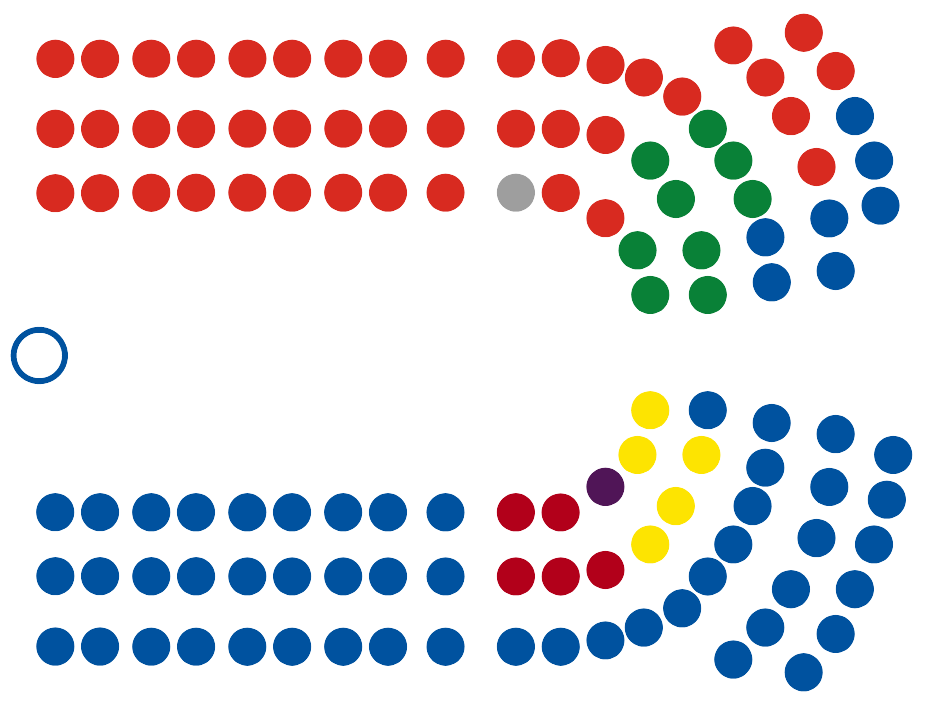
Government: Opposition: ]] A general election took place in New Zealand on 26 November 2011 to determine the membership of the 50th New Zealand Parliament.
One hundred and twenty-one MPs were elected to the New Zealand House of Representatives, 70 from single-member electorates, and 51 from party lists including one overhang seat. New Zealand since 1996 has used the Mixed Member Proportional (MMP) voting system, giving voters two votes: one for a political party and the other for their local electorate MP. A referendum on the voting system was held at the same time as the election, with voters voting by majority to keep the MMP system.
A total of 3,070,847 people were registered to vote in the election, with over 2.2 million votes cast and a turnout of 74.21% – the lowest turnout since 1887. The incumbent National Party, led by John Key, gained the plurality with 47.3% of the party vote and 59 seats, two seats short of holding a majority. The opposing Labour Party, led by Phil Goff, lost ground winning 27.5% of the vote and 34 seats, while the Green Party won 11.1% of the vote and 14 seats – the biggest share of the party vote for a minor party since 1996. New Zealand First, having won no seats in 2008 due to its failure to either reach the 5% threshold or win an electorate, made a comeback with 6.6% of the vote entitling them to eight seats.
National's confidence and supply partners in the 49th Parliament meanwhile suffered losses. ACT New Zealand won less than a third of the party vote it received in 2008, reducing from five seats to one. The Māori Party was reduced from five seats to three, as the party vote split between the Māori Party and former Māori Party MP Hone Harawira's Mana Party. United Future lost party votes, but retained their one seat in Parliament.
Following the election, National reentered into confidence and supply agreements with ACT and United Future on 5 December 2011, and with the Māori Party on 11 December 2011, to form a minority government with a seven-seat majority (64 seats to 57) and give the Fifth National Government a second term in office.
Background
Election date and other key dates
The election date was set as Saturday 26 November 2011, as predicted by the media. Breaking with tradition, Prime Minister John Key announced the election date in February. Traditionally, the election date is a closely guarded secret, announced as late as possible. The date follows the tradition of holding the general election on the last Saturday of November unless the schedule is interrupted by a snap election or to circumvent holding a by-election.
The Governor-General must issue writs for an election within seven days of the expiration or dissolution of Parliament. Under section 17 of the Constitution Act 1986, Parliament expires three years "from the day fixed for the return of the writs issued for the last preceding general election of members of the House of Representatives, and no longer." The writs for the previous general election were returnable on 27 November 2008. As a result, the 49th Parliament would have expired, if not dissolved earlier, on 27 November 2011. As that day was a Sunday, the last available working day was 25 November 2011. Consequently, the last day for issuance of writs of election was 2 December 2011. Except in some circumstances (such a recount or the death/incapacitation of an electorate candidate), the writs must be returned within 50 days of their issuance with the last possible working day being 20 January 2012. Because polling day must be a Saturday, the last possible polling date for the election was 7 January 2012, allowing time for the counting of special votes. The Christmas/New Year holiday period made the last realistic date for the election Saturday 10 December 2011. The Rugby World Cup 2011 was hosted by New Zealand between 9 September and 23 October 2011, and ruled out all the possible election dates in this period. This left two possible windows for the general election: on or before 2 September and 29 October to 10 December.
Key dates of the election were:
| 15 December 2011 | Writ for election returned; official declaration of elected members |
|---|
However, as the recount of the Waitakere was not completed in time for the writ to be returned on 15 December, the return of the writ was delayed to 17 December 2011.
49th Parliament, 2008–2011
Following the 2008 general election, National Party leader and Prime Minister John Key announced a confidence and supply agreement with ACT, the Māori Party and United Future to form the Fifth National Government. These arrangements gave the National-led government a majority of 16 seats, with 69 on confidence-and-supply in the 122-seat Parliament.
Labour, Greens and the Progressives are all in opposition, although only the Labour and Progressive parties formally constitute the formal Opposition; the Greens have a minor agreement with the government but are not committed to confidence and supply support.
At the 2008 election, the National Party had 58 seats, the Labour Party 43 seats, Green Party 9 seats, ACT and Māori Party five each, and Progressive and United Future one each. During the Parliament session, two members defected from their parties – Chris Carter was expelled from Labour in August 2010, and Hone Harawira left the Māori Party in February 2011. Carter continued as an independent, while Harawira resigned from parliament to recontest his Te Tai Tokerau electorate in a by-election under his newly formed Mana Party. Two MPs resigned from Parliament before the end of the session, John Carter of National and Chris Carter, but as they resigned within 6 months of an election, their seats remained vacant.
At the dissolution of the 49th parliament on 20 October 2011, National held 57 seats, Labour 42 seats, Green 9 seats, ACT 5 seats, Māori 4 seats, and Progressive, United Future and Mana one each.
Marginal seats in 2008
At the 2008 election, the following seats were won by a majority of less than 1000 votes:
| Electorate | Member of Parliament | Incumbent party | Majority | Second place | Second party |
|---|---|---|---|---|---|
| New Plymouth | |||||
| Waimakariri | |||||
| Waitakere | |||||
| Rimutaka | |||||
| Hauraki-Waikato | |||||
| Christchurch Central | |||||
| West Coast-Tasman | 971 |
MPs retiring in 2011
Nineteen MPs, including all five ACT MPs and the sole Progressive MP, intended to retire at the end of the 49th Parliament. One of the ACT MPs, John Boscawen, contested Tāmaki, but did not expect to win and was not on the party list. National MP Allan Peachey died three weeks before the election.
| Party | Name | Electorate | ||||||||
|---|---|---|---|---|---|---|---|---|---|---|
| ACT New Zealand}}" | ACT | Roger Douglas | ||||||||
| Rodney Hide | Epsom | |||||||||
| Heather Roy | (List) | url=http://www.stuff.co.nz/national/politics/5191845/Roy-to-quit-on-her-own-terms | title=Roy to quit – on her own terms | author=Vance, Andrea | date=25 June 2011 | work=The Dominion Post | access-date=30 October 2011 | archive-date=7 October 2011 | archive-url=https://web.archive.org/web/20111007194618/http://www.stuff.co.nz/national/politics/5191845/Roy-to-quit-on-her-own-terms | url-status=live }} |
| Hilary Calvert | (List) | url=http://www.nbr.co.nz/article/nz-politics-daily-hilary-calvert-suddenly-looks-ideal-politician-ck-99744 | title=Hilary Calvert, ideal politician | author=Edwards, Bryce | date=29 August 2011 | work=National Business Review | access-date=30 October 2011 | archive-date=26 January 2016 | archive-url=https://web.archive.org/web/20160126090908/http://www.nbr.co.nz/article/nz-politics-daily-hilary-calvert-suddenly-looks-ideal-politician-ck-99744 | url-status=live }} |
| John Boscawen | (List) | |||||||||
| Green Party of Aotearoa New Zealand}}" | Green | Sue Kedgley | ||||||||
| Keith Locke | (List) | |||||||||
| New Zealand Progressive Party}}" | Progressive | Jim Anderton | ||||||||
| New Zealand Labour Party}}" | Labour | Ashraf Choudhary | ||||||||
| George Hawkins | Manurewa | url=http://www.nzherald.co.nz/nz/news/article.cfm?c_id=1&objectid=10693070 | title=Labour in turmoil over MP's threat to resign | author=Trevett, Claire | date=9 December 2010 | work=The New Zealand Herald | access-date=30 October 2011 | archive-date=25 October 2012 | archive-url=https://web.archive.org/web/20121025195233/http://www.nzherald.co.nz/nz/news/article.cfm?c_id=1&objectid=10693070 | url-status=live }} |
| Pete Hodgson | Dunedin North | |||||||||
| Lynne Pillay | (List) | |||||||||
| Mita Ririnui | (List) | |||||||||
| New Zealand National Party}}" | National | John Carter | ||||||||
| Sandra Goudie | Coromandel | |||||||||
| Wayne Mapp | North Shore | url=http://www.stuff.co.nz/national/politics/4460226/National-MP-Wayne-Mapp-to-retire | date=15 December 2010 | title=National MP Wayne Mapp to retire | author=Liz Willis | access-date=2 March 2011 | archive-date=19 December 2010 | archive-url=https://web.archive.org/web/20101219012318/http://www.stuff.co.nz/national/politics/4460226/National-MP-Wayne-Mapp-to-retire | url-status=live}} | |
| Simon Power | Rangitīkei | |||||||||
| Allan Peachey | Tāmaki | |||||||||
| Georgina te Heuheu | (List) |
Electorate boundaries
Electorates in the election were the same as at the 2008 election.
Electorates and their boundaries in New Zealand are reviewed every five years after the New Zealand census. The last review took place in 2007, following the 2006 census. The next review is not due until 2014, following the 2013 census (the 2011 census was cancelled due to the 22 February 2011 Christchurch earthquake).
Election procedures
On 17 September 2010, Justice Minister Simon Power announced the government was introducing legislation making this the first election where voters would be able to re-enrol completely on-line. Enrolments on-line beforehand still required the election form to be printed, signed, and sent by post.
Voters in the Christchurch region were encouraged to cast their votes before election day if they had doubt about being able to get to a polling booth on election day or to avoid long queues, as many traditional polling booths are unavailable due to the earthquakes. Nineteen advance voting stations were made available, with three of them campervans, which are usually only used in rural areas of New Zealand. The Christchurch Central electorate, for example, has 33 polling stations in 2011 compared to 45 in 2008.
Contesting parties and candidates
Main article: Candidates in the New Zealand general election 2011 by electorate, Party lists in the 2011 New Zealand general election
At the close of nominations, 544 individuals had been nominated to contest the election, down from 682 at the 2008 election. Of those, 91 were list-only, 73 were electorate-only (43 from registered parties, 17 independents, and 13 from non-registered parties), and 380 contested both list and electorate.
Political parties registered with the Electoral Commission on Writ Day can contest the general election as a party, allowing it to submit a party list to contend the party vote, and have a party election expenses limit in addition to individual candidate limits. At Writ Day, sixteen political parties were registered to contend the general election. At the close of nominations, thirteen registered parties had put forward a party list to the commission to contest the party vote, down from nineteen in 2008.
| Party | Leader(s) | Party vote % | |||
|---|---|---|---|---|---|
| (2008 election) | Seats | ||||
| (October 2011) | Electorate | ||||
| candidates | Party list | ||||
| candidates | |||||
| **Parties with seats in the 49th Parliament** | |||||
| Rodney Hide | 3.65 | 5 | 50 | 55 | |
| Russel Norman / Metiria Turei | 6.72 | 9 | 59 | 61 | |
| Phil Goff | 33.99 | 42 | 70 | 65 | |
| Hone Harawira | – | 1 | 21 | 20 | |
| Pita Sharples / Tariana Turia | 2.39 | 4 | 11 | 17 | |
| John Key | 44.93 | 57 | 63 | 65 | |
| Peter Dunne | 0.87 | 1 | 19 | 15 | |
| **Other parties** | |||||
| Andrew McKenzie / Kay Murray | 0.08 | – | 5 | 14 | |
| Colin Craig | – | – | 52 | 30 | |
| Stephnie de Ruyter | 0.05 | – | 14 | 24 | |
| Michael Appleby | 0.41 | – | 18 | 28 | |
| Richard McGrath | 0.05 | – | 9 | 27 | |
| Winston Peters | 4.07 | – | 31 | 33 |
The Kiwi Party, the New Citizen Party and the Progressive Party were registered, but did not contend the election under their own banners. The Kiwi Party and the New Citizen Party stood candidates for the Conservative Party.
In addition to the registered parties and their candidates, thirteen candidates from nine non-registered parties contested electorates. The Human Rights Party contested Auckland Central, the Communist League Manukau East and Mount Roskill, the Nga Iwi Morehu Movement contested Hauraki-Waikato and Te Tai Hauauru, the Pirate Party contested Hamilton East and Wellington Central, the Sovereignty Party contested Clutha-Southland and Te Tai Hauauru, Economic Euthenics contested Wigram, New Economics contested Wellington Central, Restore All Things In Christ contested Dunedin South, and the Youth Party contested West Coast-Tasman.
Seventeen independent candidates also contested the electorates in thirteen electorates: Christchurch Central, Coromandel, Epsom (two), Hamilton West (two), New Plymouth, Ōtaki, Rangitikei (two), Rongotai, Tāmaki (two), Tauranga, Waitaki, Wellington Central, and Ikaroa-Rawhiti
Campaigning
Epsom and the Tea Tape scandal
Main article: Tea Tape scandal
On 11 November, National Party leader John Key met with John Banks, the ACT candidate for Epsom, over a cup of tea at a cafe in Newmarket to send a signal to Epsom voters about voting tactically. The National Party passively campaigned for Epsom voters to give their electorate vote to ACT while giving their party vote to National. This would allow ACT to bypass the 5% party vote threshold and enter Parliament by winning an electorate seat, thereby providing a coalition partner for National. However, in October and November 2011, polls of the Epsom electorate vote taken by various companies showed that the National candidate for Epsom, Paul Goldsmith, was leading in the polls and likely to win the seat. During the meeting, the two politicians' discussion was recorded by a device left on the table in a black pouch. The recording tapes were leaked to The Herald on Sunday newspaper, and subsequently created a media frenzy over the content of the unreleased tapes.
Debates
TVNZ held three party leaders' debates: two between the Prime Minister and the Leader of the Opposition, and one between the leaders of the smaller parties. TV3 hosted a single debate between the Prime Minister and the Leader of the Opposition.
| Date | Host | Leaders | Presenter / Moderator | ||||
|---|---|---|---|---|---|---|---|
| 30 October | TVNZ | Don Brash, Metiria Turei, Hone Harawira, Pita Sharples, Peter Dunne | Paul Holmes | ||||
| **Highlights** – The debate included a variety of topics, ranging from the age of superannuation eligibility to youth unemployment to asset sales. Peter Dunne won the debate, with Metiria Turei coming second. | |||||||
| 31 October | TVNZ | John Key, Phil Goff | Mark Sainsbury / Guyon Espiner | ||||
| **Highlights** – The economy, asset sales, the cost of living, education, welfare, environment and mining, crisis management and recovery, leadership and New Zealand's involvement in Afghanistan. A text poll conducted alongside gave the debate to John Key with 61%. | |||||||
| 16 November | TVNZ | Don Brash, Russel Norman, Hone Harawira, Tariana Turia, Winston Peters, Peter Dunne | Mark Sainsbury / Guyon Espiner | ||||
| **Highlights** – The debate included the economy, the age of superannuation eligibility, Māori affairs, the environment, the Emissions Trading Scheme, the Tea Tape scandal, the [voting system referendum](2011-new-zealand-voting-method-referendum), and potential partners after the election. A text poll conducted alongside gave the debate to Winston Peters with 36%, with Hone Harawira coming second with 27%. | |||||||
| 21 November | TV3 | John Key, Phil Goff | John Campbell | ||||
| **Highlights** – A studio audience of undecided voters gave positive or negative reactions to the leaders, which showed up on a reactor worm. Aside from claims that the studio audience was biased, Phil Goff won the debate. | |||||||
| 23 November | TVNZ | John Key, Phil Goff | Mark Sainsbury / Guyon Espiner | ||||
| **Highlights** – *to be completed* |
Pre-election coalition preferences
The National Party ruled out working with New Zealand First's Winston Peters after the election. ACT confirmed it would work with National after the elections.
The Labour Party leader Phil Goff ruled out a coalition agreement with Hone Harawira's new Mana Party, but left open the possibility of reaching an agreement with New Zealand First.
In the 16 November minor parties debate, leaders from the minor parties stated their preferences:
- The Green's preference was it would work in a coalition government with Labour, but wouldn't completely rule out working with National.
- Mana would not work in a coalition government with National and/or ACT
- Māori would not work in a coalition government with ACT.
- No preference was stated for New Zealand First, but later said it would not work with National or Labour.
- United Future ruled out working with Labour
Media bias
A Massey University study released in November 2012 suggested newspaper coverage was favourable towards National and John Key. In the month leading up to the election, the big four newspapers in New Zealand – The New Zealand Herald, The Herald on Sunday, The Dominion Post and The Sunday Star-Times – printed 72 percent more photos of Key than his opponent, Phil Goff, and devoted twice as many column inches of text coverage.
Opinion polling
Main article: Opinion polling for the 2011 New Zealand general election

The nature of the Mixed Member Proportional voting system, whereby the share of seats in Parliament a party gets is determined by its share of the nationwide party vote, means aside from normal polling bias and error, opinion polling in New Zealand is fairly accurate in predicting the outcome of an election compared with other countries.
Opinion polls were undertaken periodically since the 2008 election by MediaWorks New Zealand (3 News Reid Research), The New Zealand Herald (Herald Digipoll), Roy Morgan Research, and Television New Zealand (One News Colmar Brunton), with polls having also being conducted by Fairfax Media (Fairfax Media Research International) since July 2011. The graph on the right shows the collated results of all five polls for parties that have polled above the 5% electoral threshold.
After the 2008 election, National gained in popularity, and since 2009 has regularly polled in the 50–55% range, peaking at 55% in August 2009 and October 2011, before falling to 51% in the week before the election. Labour and Green meanwhile kept steady after the election at 31–34% and 7–8% respectively until July 2011, when Labour started to lose support, falling to just 26% before the election. The majority of Labour's loss was the Green's gain, rising to 13% in the same period. No other party peaked on average above 5% in the period.
Results
Parliamentary parties

|- style="text-align:center;" ! colspan=2 rowspan=2 style="width:213px;" | Party ! Colspan=3 | Party vote ! Colspan=3 | Electorate vote ! Colspan=4 | Seats |- style="text-align:center;" ! Votes ! % ! Change (pp) ! Votes ! % ! Change (pp) ! List ! Electorate ! Total ! +/- |- | | 1,058,636 | 47.31 | 2.38 | 1,027,696 | 47.31 | 0.71 | 17 | 42 | 59
| 1 |
|---|
| | 614,937 | 27.48 | 6.50 | 762,897 | 35.12 | 0.10 | 12 | 22 | 34
| 9 |
|---|
| | 247,372 | 11.06 | 4.33 | 155,492 | 7.16 | 1.53 | 14 | 0 | 14
| 5 |
|---|
| | 147,544 | 6.59 | 2.53 | 39,892 | 1.84 | 0.15 | 8 | 0 | 8
| 8 |
|---|
| | 31,982 | 1.43 | 0.96 | 39,320 | 1.81 | 1.53 | 0 | 3 | 3
| 2 |
|---|
|
| 24,168 | 1.08 | new | 29,872 | 1.38 | new | 0 | 1 | 1
| new |
|---|
| | 23,889 | 1.07 | 2.58 | 31,001 | 1.43 | 1.56 | 0 | 1 | 1
| 4 |
|---|
| | 13,443 | 0.60 | 0.27 | 18,792 | 0.87 | 0.26 | 0 | 1 | 1 | |- | | 59,237 | 2.65 | new | 51,678 | 2.38 | new | 0 | 0 | 0
| new |
|---|
| | 11,738 | 0.52 | 0.12 | 6,384 | 0.29 | 0.12 | 0 | 0 | 0 | |- | | 1,714 | 0.08 | 0.03 | 2,255 | 0.10 | 0.02 | 0 | 0 | 0 | |- | | 1,595 | 0.07 | 0.02 | 1,459 | 0.07 | 0.01 | 0 | 0 | 0 | |- | | 1,209 | 0.05 | 0.03 | 1,245 | 0.06 | 0.02 | 0 | 0 | 0 | |- | — | — | — | 1,557 | 0.07 | 0.01 | — | | 0 | |- | | — | — | — | 2,894 | 0.13 | 0.40 | — | | 0 | |- ! colspan=2 style="text-align:left;" | Valid votes ! 2,237,464 ! 98.18 ! 0.48 ! 2,172,434 ! 95.32 ! 1.47 ! Colspan=4 | |- | 19,872 | 0.87 | 0.37 | 53,332 | 2.34
| 1.27 |
|---|
| 21,653 |
| 0.95 |
| 0.11 |
| 53,223 |
| 2.34 |
| 0.20 |
| - |
| 75,493 |
| 3.31 |
| | — | —
| — |
|---|
| ! colspan=2 style="text-align:left;" |
| ! 2,278,989 |
| ! 100 |
| ! |
| ! 2,278,989 |
| ! 100 |
| ! |
| ! 51 |
| ! 70 |
| ! 121 |
| ! 1 |
| - |
| 3,070,847 |
| 74.21 |
| 5.25 |
| 3,070,847 |
| 74.21 |
| 5.25 |
| } |
Votes summary
Electorate results
.svg)
Prior to the election, the National Party held the majority of the electorate seats with 41. Labour held 20 seats, Māori held four seats, and ACT, Mana, Progressive, United Future and an ex-Labour independent held one seat each.
After the election, National gained one seat to hold 42 seats, Labour gained three seats to hold 23 electorates, Māori lost one seat to hold three, and ACT, Mana, and United Future held steady with one seat each. A National or Labour candidate took second place in all the general electorates except Rodney, where it was Conservative Party leader Colin Craig.
In eleven electorates, the incumbents did not seek re-election, and new MPs were elected. In Coromandel, North Shore, Northland, Rangitikei, Rodney and Tāmaki, the seats were passed from incumbent National MPs to new National MPs; in Epsom, the seat was passed from the incumbent ACT MP to the new ACT MP; and in Dunedin North and Manurewa, the seats were passed from incumbent Labour MPs to new Labour MPs. Labour also won Te Atatū from the retiring ex-Labour independent, and Wigram from the retiring Progressive MP.
Of the 59 seats where the incumbent sought re-election, four changed hands. In West Coast-Tasman, Labour's Damien O'Connor regained the seat from National's Chris Auchinvole, who defeated him for the seat in 2008. In Waimakariri, National's Kate Wilkinson defeated Labour MP Clayton Cosgrove, and in Te Tai Tonga, Labour's Rino Tirikatene defeated Maori Party MP Rahui Katene. Christchurch Central on election night ended with incumbent Labour MP Brendon Burns and National's Nicky Wagner tied on 10,493 votes each, and on official counts, swung to Nicky Wagner with a 45-vote majority, increasing to 47 votes on a judicial recount. Despite losing their electorate seats, Chris Auchinvole and Clayton Cosgrove were re-elected into parliament via the party list.
On election night, Waitakere was won by incumbent National MP Paula Bennett with a 349-vote majority over Labour's Carmel Sepuloni. On official counts, it swung to Sepuloni with a majority of 11 votes, and Bennett subsequently requested a judicial recount, and on the recount, the seat swung back to Bennett with a majority of nine votes. Bennett was declared elected, and Sepuloni was not returned via the party list due to her list ranking, being replaced in the Labour caucus with Raymond Huo.
Five electorates returned with the winner having a majority of less than one thousand – Waitakere (9), Christchurch Central (47), Waimakariri (642), (717) and Tāmaki Makaurau (936).
The table below shows the results of the 2011 general election:
Key:
| - |
|---|
| } |
;Notes
List results
Main article: Party lists in the 2011 New Zealand general election

The election was notable for the entry in Parliament of New Zealand's first ever profoundly deaf MP, Mojo Mathers, number 14 on the Green Party's list.
| Lockwood Smith (03) | |
|---|---|
| Chris Finlayson (09) | |
| David Carter (10) | |
| Tim Groser (12) | |
| Steven Joyce (13) | |
| Hekia Parata (18) | |
| Michael Woodhouse (31) | |
| Melissa Lee (34) | |
| Kanwal Singh Bakshi (35) | |
| Jian Yang (36) | |
| Alfred Ngaro (37) | |
| Katrina Shanks (38) | |
| Paul Goldsmith (39) | |
| Tau Henare (40) | |
| Chris Auchinvole (43) | |
| Jackie Blue (46) | |
| Cam Calder (50) | David Parker (04) |
| Maryan Street (07) | |
| Clayton Cosgrove (08) | |
| Sue Moroney (10) | |
| Charles Chauvel (11) | |
| Jacinda Ardern (13) | |
| Andrew Little (15) | |
| Shane Jones (16) | |
| Darien Fenton (18) | |
| Moana Mackey (19) | |
| Rajen Prasad (20) | |
| Raymond Huo (21) | Metiria Turei (01) |
| Russel Norman (02) | |
| Kevin Hague (03) | |
| Catherine Delahunty (04) | |
| Kennedy Graham (05) | |
| Eugenie Sage (06) | |
| Gareth Hughes (07) | |
| David Clendon (08) | |
| Jan Logie (09) | |
| Steffan Browning (10) | |
| Denise Roche (11) | |
| Holly Walker (12) | |
| Julie Anne Genter (13) | |
| Mojo Mathers (14) | Winston Peters (01) |
| Tracey Martin (02) | |
| Andrew Williams (03) | |
| Richard Prosser (04) | |
| Barbara Stewart (05) | |
| Brendan Horan (06) | |
| Denis O'Rourke (07) | |
| Asenati Taylor (08) |
Unsuccessful list candidates
| Kay Murray, Andrew McKenzie, Kevin Campbell, Jim Flynn, Paul Piesse, Victor Billot, Mary O'Neill, Kelly Buchanan, Robert van Ruyssevelt, Jen Olsen, Tom Dowie, Thomas O'Neill, Eunice Billot, Norman MacRitchie |
|---|
;Notes:
- These party list members would eventually enter parliament in the term as other list MPs elected resigned from parliament.
- These party list members have since resigned.
Changes in MPs
In total, 25 new MPs were elected to Parliament, and three former MPs returned.
New MPs: Scott Simpson, Maggie Barry, Mike Sabin, Ian McKelvie, Mark Mitchell, Simon O'Connor, Alfred Ngaro, Jian Yang, Paul Goldsmith, David Clark, Rino Tirikatene, Megan Woods, Andrew Little, Eugenie Sage, Jan Logie, Steffan Browning, Denise Roche, Holly Walker, Julie Anne Genter, Tracey Martin, Andrew Williams, Richard Prosser, Denis O'Rourke, Asenati Taylor, Brendan Horan
Returning MPs: John Banks, Winston Peters, Barbara Stewart
Defeated MPs: Paul Quinn, Steve Chadwick, Stuart Nash, Carmel Sepuloni, Rick Barker, Rahui Katene
Defeated MPs who later returned during the 50th Parliament Aaron Gilmore, Carol Beaumont, Kelvin Davis
Election expenses
The Electoral Commission released party electoral expense returns on 21 March 2012, stating how much each party spent on campaigning between 26 August and 25 November 2011. Candidate only expenses were excluded.
Of note in the party expenses was the $1.88 million spent by the Conservative Party, spending more than but gaining less than one-tenth of the votes of the Labour Party. Translated into dollars spent per party vote gained, the Conservatives spent $31.71 per vote, compared to Labour's $2.91 and National's $2.19.
| Party | Campaign expenditure | Party votes received | Expenditure per party vote |
|---|---|---|---|
| $2,321,216 | 1,058,636 | $2.19 | |
| $1,878,486 | 59,237 | $31.71 | |
| $1,789,152 | 614,937 | $2.91 | |
| $779,618 | 247,372 | $3.15 | |
| $617,035 | 23,889 | $25.83 | |
| $155,903 | 147,544 | $1.06 | |
| $72,173 | 31,982 | $2.26 | |
| $60,082 | 24,168 | $2.49 | |
| $34,676 | 1,714 | $20.23 | |
| $27,719 | 13,443 | $2.06 | |
| $4,003 | 11,738 | $0.34 | |
| $2,760 | 1,595 | $1.73 | |
| $2,407 | 1,209 | $1.99 | |
| **Total/Average** | **$7,745,081** | **2,237,464** | **$3.46** |
Post-election events
Changes in party leadership
For the ACT party the mediocre election results on 26 November 2011 (1.1% of the party vote, with no list MPs, 1 electorate MP) resulted in Don Brash tendering his resignation as leader, stating that he took full responsibility for the party's poor performance.
On 29 November the leader of the Labour party Phil Goff and the deputy leader Annette King tendered their resignations to a meeting of the caucus, effective on Tuesday 13 December 2011. After a fortnight-long leadership campaign and election, David Shearer, with deputy Grant Robertson, won Labour caucus support over the ticket of David Cunliffe and Nanaia Mahuta.
References
References
- (2 February 2011). "Key confirms election date". [[The New Zealand Herald]].
- (20 October 2009). "MMP referendum to be held with 2011 election". [[The New Zealand Herald]].
- (10 December 2011). "Overall Results – 2011 Referendum on the Voting System". Electoral Commission.
- "Party Votes and Turnout by Electorate – Statistics – 2011 General Election". Electoral Commission (New Zealand).
- [[Otago Daily Times]] "Decision 2011":Election Special Issue, 28 November 2011, p. 2.
- (5 December 2011). "Dunne, Banks secure ministerial roles in coalition deals". Television New Zealand.
- (5 December 2011). "Dunne, Banks get Govt roles". [[The New Zealand Herald]].
- (11 December 2011). "Key finalises Maori coalition deal". Television New Zealand.
- (3 January 2011). "Challenges ahead but first, a break". [[The New Zealand Herald]].
- (17 August 2011). "Electoral Act 1993, Sec. 125". Legislation.co.nz.
- CEO. (2010-06-04). "2008 General Election Timetable".
- (17 August 2011). "Electoral Act 1993, Sec. 139". Legislation.co.nz.
- "New Zealand's system of government – an overview". [[Electoral Commission (New Zealand).
- "2011 general election and referendum timetable". Electoral Commission.
- (19 February 2011). "Sir Roger Douglas to quit parliament". [[Radio New Zealand]].
- (3 May 2011). "Hide won't contest general election". [[The New Zealand Herald]].
- (1 August 2011). "Hide refuses to give traditional farewell". [[The New Zealand Herald]].
- Vance, Andrea. (25 June 2011). "Roy to quit – on her own terms". [[The Dominion Post (Wellington).
- Edwards, Bryce. (29 August 2011). "Hilary Calvert, ideal politician". [[National Business Review]].
- (6 September 2011). "Nix NAIT Says Nicolson | ACT New Zealand". Act.org.nz.
- (17 September 2010). "Kedgley sprints to the 2011 finish line". Green Party of Aotearoa New Zealand.
- (17 September 2010). "Kedgley confirms resignation".
- (26 January 2011). "Locke to retire at election". Green Party of Aotearoa New Zealand.
- Sachdeva, Sam. (12 October 2010). "Anderton will retire from House in 2011". [[Fairfax New Zealand]].
- (11 April 2011). "Labour's list 'not trusted' by MP". [[Manawatu Standard]].
- Trevett, Claire. (9 December 2010). "Labour in turmoil over MP's threat to resign". [[The New Zealand Herald]].
- Makenzie, Dene. (5 June 2010). "Hodgson exits politics on 'own terms'". [[Otago Daily Times]].
- (3 December 2009). "Lynne Pillay confirms she will stand down in 2011". Scoop Media.
- (15 February 2011). "Mita Ririnui: Time for new challenges". New Zealand Labour Party.
- (11 February 2011). "McCully names new High Commissioner to the Cook Islands". New Zealand Government.
- (14 January 2011). "Coromandel MP Sandra Goudie to retire". [[The New Zealand Herald]].
- Liz Willis. (15 December 2010). "National MP Wayne Mapp to retire".
- Martin Kay. (2 March 2011). "Justice Minister Simon Power to retire". [[Stuff (website).
- John Hartevelt. (5 October 2011). "Nationals Allan Peachey steps down". [[Stuff (website).
- (10 May 2011). "Georgina te Heuheu to retire from politics". [[The New Zealand Herald]].
- (17 September 2010). "Government to allow voters to enrol via Internet". New Zealand Government.
- Gamble, Warren. (18 November 2011). "Campervans collect early votes in Christchurch". [[The Press]].
- (2 November 2011). "Candidates locked in for election". [[The New Zealand Herald]].
- (7 October 2011). "Registered political parties – overview & register". Electoral Commission.
- (2 November 2011). "Party lists for the 2011 General Election". Electoral Commission.
- Danya Levy. (18 October 2011). "New Citizens Party joins with Conservatives". [[Stuff (website).
- McMahon, Lyle. (11 November 2011). "PM and Banks have their Epsom cup of tea". [[Stuff (website).
- (20 November 2011). "Epsom street survey: Goldsmith on top". [[New Zealand Herald]].
- Wilson, Peter. (16 November 2011). "Key may face more teapot tape accusations". [[3 News]].
- (13 October 2011). "TV ONE election debates announced". Television New Zealand.
- Drinnan, John. (26 August 2011). "Worm returns for leaders' debate". [[The New Zealand Herald]].
- Cheng, Derek. (30 October 2011). "Dunne wins debate by a hair". [[The New Zealand Herald]].
- (31 October 2011). "Goff and Key clash in fiery opening debate". [[Television New Zealand]].
- (16 November 2011). "Multi party debate: As it happened". [[Television New Zealand]].
- Vance, Andrea. (17 November 2011). "Winston Peters winner in minor party debate".
- (22 November 2011). "The worm turns for Goff in leaders' debate". Fairfax Media (via Stuff.co.nz).
- (2 February 2011). "PM rules out any NZ First deal". [[The New Zealand Herald]].
- (14 March 2011). "Goff rules out deal with Hone Harawira". [[Stuff (website).
- (27 November 2012). "Election coverage biased towards Key, National – study". 3 News NZ.
- (14 November 2020). "2011 GENERAL ELECTION – OFFICIAL RESULTS AND STATISTICS". [[Electoral Commission (New Zealand).
- (10 December 2011). "Official Count Results – Electorate Status". Electoral Commission.
- Young, Audrey. (29 November 2011). "10 things you didn't know about the election results". [[The New Zealand Herald]].
- (14 December 2011). "Christchurch Central Judicial Recount Official Results". Electoral Commission.
- Chapman, Kate. (14 December 2011). "Recount confirms Christchurch Central seat". Fairfax Media (via Stuff.co.nz).
- (17 December 2011). "Waitakere Judicial Recount Official Results". Electoral Commission.
- "Election Results – Electorate Status".
- (10 December 2011). "Greens 'ecstatic' to have 14 MPs". Television New Zealand.
- (10 December 2011). "First deaf MP to join Parliament". [[The New Zealand Herald]].
- (21 March 2012). "Party expense returns – Election '11". Electoral Commission.
- [http://www.radionz.co.nz/news/election-2011/92180/act-wins-espom,-don-brash-resigns Don Brash resigns leadership of ACT] {{Webarchive. link. (28 November 2011 [[Radio New Zealand]], 27 November 2011. Retrieved: 27 November 2011)
- [http://www.radionz.co.nz/audio/player/2503502 Don Brash interview] {{Webarchive. link. (24 September 2015 [[Radio New Zealand]], 26 November 2011. Retrieved: 27 November 2011)
- [http://www.radionz.co.nz/news/election-2011/92386/labour-leadership-battle-begins-as-phil-goff-quits Phil Goff tenders resignation] {{Webarchive. link. (29 November 2011 [[Radio New Zealand]], 29 November 2011. Retrieved: 29 November 2011)
- [http://www.3news.co.nz/Shearer-routs-Cunliffe-for-Labour-leadership/tabid/419/articleID/236418/Default.aspx Shearer routs Cunliffe for Labour leadership: Duncan Garner] {{Webarchive. link. (15 December 2013 [[3 News]], 13 December 2011. Retrieved: 13 December 2011)
This article was imported from Wikipedia and is available under the Creative Commons Attribution-ShareAlike 4.0 License. Content has been adapted to SurfDoc format. Original contributors can be found on the article history page.
Ask Mako anything about 2011 New Zealand general election — get instant answers, deeper analysis, and related topics.
Research with MakoFree with your Surf account
Create a free account to save articles, ask Mako questions, and organize your research.
Sign up freeThis content may have been generated or modified by AI. CloudSurf Software LLC is not responsible for the accuracy, completeness, or reliability of AI-generated content. Always verify important information from primary sources.
Report