From Surf Wiki (app.surf) — the open knowledge base
2011 MD
Asteroid in the solar system
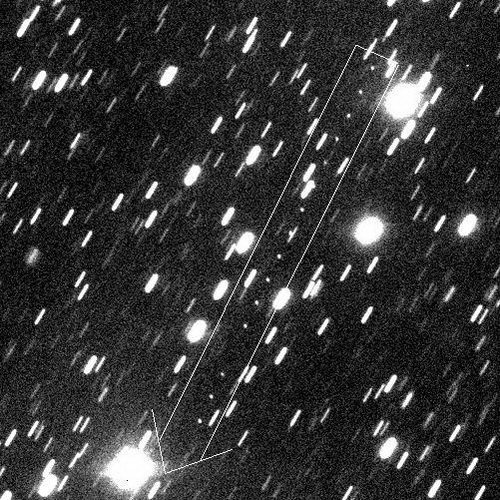
Asteroid in the solar system
| Field | Value |
|---|---|
| minorplanet | yes |
| name | 2011 MD |
| background | #FFC2E0 |
| image | PIA18453-Asteroid2011MD-SpitzerSpaceTelescope-IRAC-Feb2014.jpg |
| caption | imaged by *Spitzer* in February 2014 |
| discovery_ref | |
| discoverer | LINEAR |
| discovery_site | Lincoln Lab's ETS |
| discovered | 2011 June 22 |
| (first observed only) | |
| mpc_name | 2011 MD |
| mp_category | NEOApolloAmor |
| orbit_ref | |
| epoch | 13 July 2011 (JD 2455755.5) |
| uncertainty | 20 |
| observation_arc | 2.65 yr (967 days) |
| aphelion | 1.1031 AU |
| perihelion | 1.0161 AU |
| semimajor | 1.0596 AU |
| eccentricity | 0.0411 |
| period | 1.09 yr (398 days) |
| mean_anomaly | 11.051° |
| mean_motion | / day |
| inclination | 2.5624° |
| asc_node | 273.96° |
| arg_peri | 4.6748° |
| moid | 0.0003 AU (0.1 LD) |
| mean_diameter | (estimate) |
| density | (est. rubble pile) |
| albedo | 0.3 |
| rotation | |
| abs_magnitude | 28.0 |
(first observed only)
2011 MD is a bright micro-asteroid, classified as a near-Earth object of the Apollo and Amor group, respectively. On 27 June 2011, at around 17:00 UTC (13:00 EDT), the object passed exceptionally close to Earth's surface at a distance of approximately 12000 km, roughly the diameter of the Earth.
Description
Although was initially believed to be space junk, subsequent observations confirmed that it is an asteroid. A few hours before the asteroid's nearest approach in 2011, it appeared close to the Sun, so observations were possible for only a brief period. Backyard astronomers were able to observe it with telescopes from Australia, southern Africa, and the Americas.
was discovered on 22 June 2011, by astronomers of the Lincoln Near-Earth Asteroid Research (LINEAR) at the U.S. Lincoln Laboratory Experimental Test Site in Socorro, New Mexico, by a pair of robotic telescopes. According to original rough estimates, the asteroid's length was between 10 and. However, according to the more recent absolute magnitude (H) measurement of 28.1 and its albedo of 0.3, the asteroid is closer to 6 meters or 20 feet in diameter.
Emily Baldwin of Astronomy Now said that there was no threat of collision, and should the asteroid enter Earth's atmosphere, it would "mostly burn up in a brilliant fireball, possibly scattering a few meteorites", causing no likely harm to life or property on the ground.
The 27 June 2011 close approach to Earth increased the orbital period of from 380 days to 396 days. During close approach the asteroid passed Earth at a relative speed of 6.7 km/s with a geocentric eccentricity of 1.1.
was observed by the Spitzer Space Telescope in February 2014 and estimated to be 6 m in diameter. The asteroid is a porous rubble pile with a density similar to water. On 19 June 2014, NASA reported that asteroid was a prime candidate for capture by the Asteroid Redirect Mission (ARM) in the early 2020s.
| Parameter | Epoch | aphelion | |||||||||||||||
|---|---|---|---|---|---|---|---|---|---|---|---|---|---|---|---|---|---|
| (Q) | perihelion | ||||||||||||||||
| (q) | Semi-major | ||||||||||||||||
| axis | |||||||||||||||||
| (a) | eccentricity | ||||||||||||||||
| (e) | Period | ||||||||||||||||
| (p) | inclination | ||||||||||||||||
| (i) | Longitude | ||||||||||||||||
| ascending | |||||||||||||||||
| node | |||||||||||||||||
| (Ω) | Mean | ||||||||||||||||
| anomaly | |||||||||||||||||
| (M) | Argument | ||||||||||||||||
| of | |||||||||||||||||
| perihelion | |||||||||||||||||
| (ω) | Units | AU | — | (days) | (°) | Pre-flyby | Post-flyby | ||||||||||
| 2011-Jun-01 | 1.043 | 1.006 | 1.025 | 0.01804 | 379.1 | 2.739° | 97.79° | 269.8° | 244.3° | ||||||||
| 2011-Aug-01 | 1.097 | 1.016 | 1.056 | 0.03875 | 396.9 | 2.477° | 273.0° | 29.09° | 4.734° |
Gallery
References
- Encounter animations (Pasquale Tricarico)
References
- "The Spacious Structure of Asteroid 2011 MD (Artist's Concept)".
- Don Yeomans. (June 23, 2011). "Bend it Like Beckham! Small Asteroid to Whip Past Earth on June 27, 2011". [[NASA]]/JPL Near-Earth Object Program Office.
- "Asteroid Just Buzzed Earth—Came Closer Than the Moon".
- Tony Flanders. (June 23, 2011). "Asteroid To Buzz Earth Monday, June 27th". Sky & Telescope observing blog.
- Paul Sutherland. (June 23, 2011). "Incoming! Another asteroid to skim by". Skymania: Astronomy and space guide.
- NASA [[Jet Propulsion Laboratory. "NASA Announces Latest Progress in Hunt for Asteroids".
- Mommert, M.. (2014). "Physical properties of near-earth asteroid 2011 MD". Astrophys. J..
- Borenstein, Seth. (June 19, 2014). "Rock that whizzed by Earth may be grabbed by NASA". [[AP News]].
This article was imported from Wikipedia and is available under the Creative Commons Attribution-ShareAlike 4.0 License. Content has been adapted to SurfDoc format. Original contributors can be found on the article history page.
Ask Mako anything about 2011 MD — get instant answers, deeper analysis, and related topics.
Research with MakoFree with your Surf account
Create a free account to save articles, ask Mako questions, and organize your research.
Sign up freeThis content may have been generated or modified by AI. CloudSurf Software LLC is not responsible for the accuracy, completeness, or reliability of AI-generated content. Always verify important information from primary sources.
Report