From Surf Wiki (app.surf) — the open knowledge base
2008 Turkish incursion into northern Iraq
Military operation
Military operation
| Field | Value |
|---|---|
| conflict | Operation Sun |
| partof | the Kurdish–Turkish conflict, Iraq War and the Iraqi civil war (2006–2008) |
| image | File:Iraqi Kurdistan in Iraq (de-facto and disputed hatched).svg |
| image_size | 300px |
| caption | Location of the Kurdistan Regional Government in northern Iraq |
| place | Kurdistan Region, Iraq |
| date | February 21, 2008 – February 29, 2008 |
| result | Both sides claim victory |
| combatant1 | Turkey |
| combatant2 | flag of Kurdistan Workers Party (PKK).svg PKK |
| Flag_of_Partiya_Jiyana_Azad_a_Kurdistanê.svg PJAK | |
| commander1 | Turkey Yaşar Büyükanıt |
| Turkey İlker Başbuğ | |
| Turkey Aydoğan Babaoğlu | |
| Turkey Bekir Kalyoncu | |
| commander2 | PKK.svg Murat Karayilan |
| PKK.svg Fehman Huseyin | |
| PKK.svg Cemil Bayik | |
| Flag_of_Partiya_Jiyana_Azad_a_Kurdistanê.svg Murat Karasac | |
| strength1 | 5,000–10,000 troops or several hundred, including 3,000 special forces |
| 14 aircraft | |
| strength2 | 5,000 (estimated) |
| casualties1 | 24 soldiers killed |
| 3 village guards killed<ref name | "hurr"/ |
| 1 AH-1 Cobra lost<ref name | "bbcobra"/ |
| casualties2 | 237 killed, 3 captured |
| "Tens" killed (PKK claim) |
Flag_of_Partiya_Jiyana_Azad_a_Kurdistanê.svg PJAK Turkey İlker Başbuğ Turkey Aydoğan Babaoğlu Turkey Bekir Kalyoncu PKK.svg Fehman Huseyin PKK.svg Cemil Bayik Flag_of_Partiya_Jiyana_Azad_a_Kurdistanê.svg Murat Karasac 14 aircraft
3 village guards killed
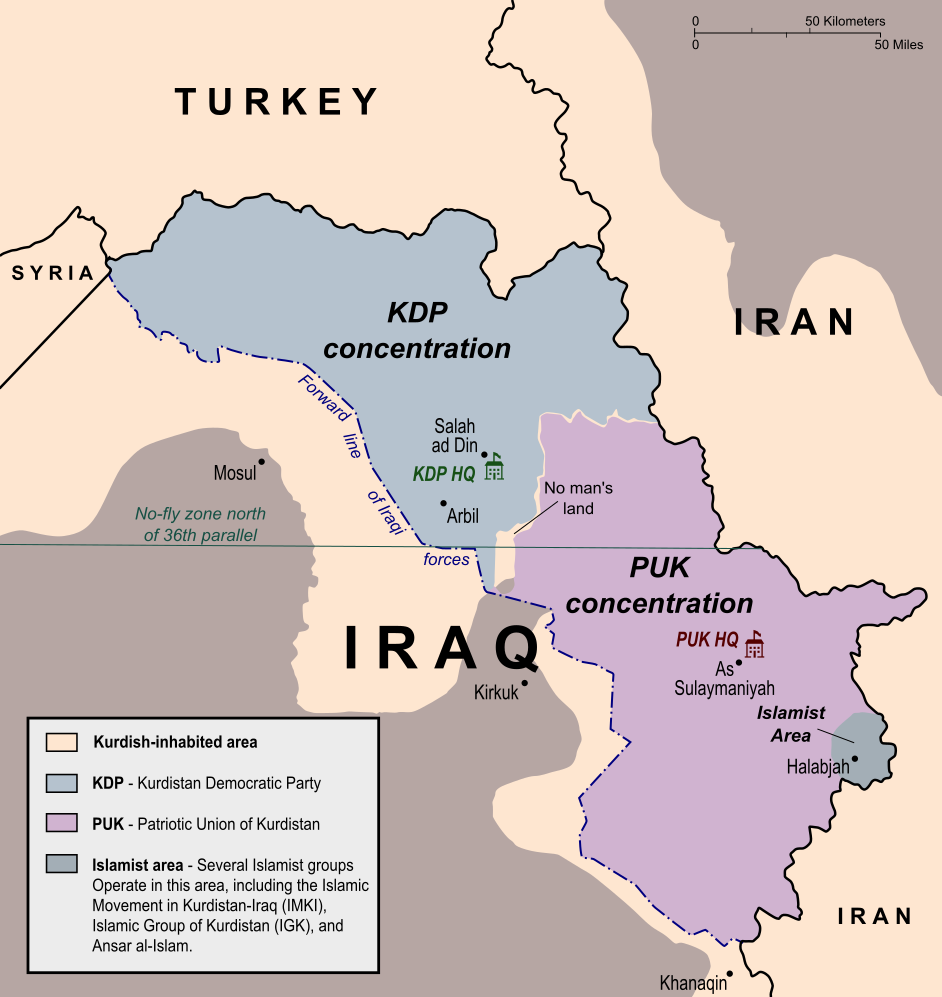
1 AH-1 Cobra lost "Tens" killed (PKK claim) The 2008 Turkish incursion into northern Iraq, code-named Operation Sun () by the Turkish Armed Forces, began on February 21, 2008, when the Turkish Army sent troops into northern Iraq to target the Kurdistan Workers' Party (PKK). The ground offensive was preceded by Turkish Air Force bombardments of PKK camps in northern Iraq, which began on December 16, 2007. It was the "first confirmed ground incursion" of Iraq since the 2003 U.S.-led invasion.
Initial reports indicated that up to 10,000 troops had taken part in the operation, although the Kurdistan Regional Government and the Multi-National Force – Iraq claimed only a few hundred troops were involved.
Background
In October 2007, Turkish jets and ground forces clashed with PKK forces in Turkey and over the border into northern Iraq.
Winter bombing campaign
Turkey launched its first cross-border raid on December 16, 2007, involving 50 fighter jets. A Turkish military statement said that up to 175 militants were killed on that day alone, while Iraqi officials reported that the strikes had targeted 10 villages and killed one civilian. The PKK reported seven deaths.
On December 26, the Turkish General Staff said Turkish military aircraft bombed eight PKK bases in northern Iraq in a raid undertaken after "it was determined that a large group of militants, who have been watched for a long time, were preparing to pass the winter in eight caves and hideouts in the Zap region," the statement said.
On January 10, 2008, Turkish warplanes bombed PKK hideouts in northern Iraq, the military announced, but there were no reports of casualties or serious damage.
The Turkish military said in a statement on February 4 that Turkish fighter jets struck nearly 70 PKK targets in northern Iraq in a series of strikes.
The president of Kurdish region of northern Iraq, Massoud Barzani, condemned Turkey's raids and warned Ankara to stop the strikes, and the Iraqi Foreign Minister Hoshyar Zebari, who is a member of the Kurdish Democratic Party (KDP), expressed concern that "unilateral actions" could harm Iraqi and Turkish interests. According to the Turkish General Staff's estimates, there were 300 PKK militants in the region prior to the incursion and the General Staff claims that 240 militants were killed.
Operation Sun
Preparation for the ground incursion
On February 21, Turkey began targeted artillery and aerial bombardment of PKK positions in northern Iraq in order to "destroy the organizational infrastructure in the region." This lasted from 10:00 to 18:00 local time. The Turkish government reported that on the day of the operation, Turkish President Abdullah Gül made a telephone call to Iraqi President Jalal Talabani, himself a Kurd, to brief him on the details of the incursion. He also invited Talabani to come to Turkey.
Turkish Prime Minister Recep Tayyip Erdogan said he called Iraqi Prime Minister Nouri al-Maliki on the night the ground operation began, and later U.S. President George W. Bush. The United States was guarded in its response to the incursion, requesting that Turkey take care to only target the PKK, to "limit the scope and duration of their operations," and to work with Iraqi and Kurdish officials.
Incursion
The incursion itself began at 17:00 UTC February 21, 2008. Reports from NTV Turkey indicated that 10,000 troops were involved in the operation, and had advanced 10 km beyond the Turkish border into Iraq, mainly around the Hakurk region. Another report from CNN-Turk said that 3000 special forces were involved.
The incursion was announced on the Turkish General Staff's website the following day, and would constitute the "first confirmed ground incursion" since the 2003 invasion of Iraq.
According to the Iraqi Foreign Minister, Turkish troops had advanced only 5 km into Iraqi territory. 60 tanks were also said to have initially entered Iraq, but by the following day some had returned across the border.
Kurdish-Iraqi peshmerga forces were put on alert and prevented Turkish military monitors in northern Iraq from leaving their camps.
Iraqi officials announced that no Turkish troops had crossed the Iraqi border using the major land route into Iraq, the Khabur Bridge, and there were no reports of Turkish contact from the Kurdistan Regional Government Peshmerga forces. Iraq claimed that Turkey had destroyed five bridges in the area.
On February 24, PKK sources claimed that PKK fighters had shot down a Turkish Cobra helicopter and Turkey confirmed this later in the day, saying that the incident happened "due to an unknown reason." Advancing Turkish troops were attacking the PKKs' shelters, logistic centers and ammunition. According to Turkey, the retreating PKK militants set booby traps under the corpses of dead comrades and planted mines on escape routes in order to gain time.
By February 25, the military had advanced more than 30 km (20 miles) into Iraq and claimed to have destroyed seven militant camps. Heavy fighting raged at the entrance to the Great Zab valley with most of the Turkish troops inside Iraq involved in an attack on a key PKK command centre in the valley after taking control of the PKK's Haftanin camp about 5 km (3 miles) from the border. Fighting was concentrated on a strategic hill controlling the entrance to the valley. At least 21 militants were killed in the battle for the hill according to the Turkish army. The PKK used long-range guns to hold off the military, killing two Turkish soldiers, until silenced with light and heavy weapons fire. PKK losses could not be determined because of bad weather.
In the coming days Turkish warplanes bombed PKK hideouts in the mountainous Siladze area and heavy fighting raged in the area near the PKK camps in Zap and Haftanin, with the guerrillas putting up stiff resistance. On February 27 Turkey sent additional troops to Iraq in the face of ongoing pressure from the international community for a speedy withdrawal.
On February 28 a senior Turkish official said Turkish security forces were planning to pull back their troops in a few days to an uninhabited cordon sanitaire on the southern side of the border. Pressure on Turkey to withdraw, however, continued to mount.
The Turkish Army withdrew from Iraq on February 29, declaring that their goals had been achieved and the operation concluded, while also denying that the withdrawal had been prompted by pressure from the United States.
Casualties and losses
After Turkey withdrew from Iraq, it reported having completed their mission and having killed more than two-hundred PKK militants while also admitted the loss of twenty-seven Turkish soldiers. On the other side the PKK reported the death of over a hundred dead Turkish soldiers and only having lost five militants. Prior to the ground operation, Turkey estimated that an additional 300 PKK militants had been killed by Turkish air strikes which began on December 16, 2007 and continued until the beginning of the ground offensive on February 21, 2008. The number of dead militants denied by the PKK, who claimed they had evacuated the areas before the bombardments.
Post-conflict operations
Turkey continued sporadic long-range attacks in the weeks following the operation. In the week of March 24, 2008, Turkey's military announced that it had killed at least 15 rebels in northern Iraq after firing on them with long-range weapons. A spokesman for the Iraqi Kurdish Regional Security Forces, however, denied the report, saying Turkey has not conducted any military operation or air assault there in the previous two weeks.
On April 25 and 26, 2008, the Turkish Air Force bombed the PKK bases in the northern Iraqi regions of Zap, Avasin-Basyan and Hakurk. This was described as the largest attack since the end of Operation Sun. First the T-155 Fırtına howitzers were used to shell the PKK positions starting from 18:00 pm on April 25, which lasted for two hours. Then F-16 jets equipped with LANTIRN belonging to the 181st Squadron (Pars Filo) and F-4E 2020 Terminator jets belonging to the 171st Squadron (Korsan Filo) began bombing the PKK's positions in northern Iraq, which lasted 45 minutes. In the meantime, Heron MALE UAVs were used for gaining reconnaissance data regarding the PKK's positions, and about 1000 Turkish commandos entered 8 kilometers into northern Iraq from the border area near Derecik (Şemdinli) in pursuit of the PKK militants. On April 26, 2008, at around 06:00 am, a second aerial strike by the jets of the Turkish Air Force from Diyarbakır Air Base took place, in which the PKK militants using the cemetery area in Hakurk as a hideout were bombed. This was followed by another air strike at 10:00 am in the same morning, during which the Turkish Air Force jets entered 30 kilometers into Iraqi air space.
On May 1, 2008, at least 30 jets of the Turkish Air Force bombed the PKK camps in northern Iraq. The operation began just before midnight and continued into Friday, May 2, 2008. The Turkish General Staff, without giving a precise name, implied that the PKK rebels who were neutralized may also include "a guerilla who leads the organization" as well;
Reaction
International organizations
- European Union – Foreign policy advisor Javier Solana spoke at a news conference in Slovenia, saying, "We understand the concerns of Turkey...but we think this action is not the best response. The territorial integrity of Iraq is for us very important." The European Commission said through a spokeswoman that "The European Union understands Turkey's need to protect its population from terrorism and it also says that Turkey should refrain from taking any disproportionate military action and respect human rights and the rule of law."
- – Secretary General Ban Ki-moon released a statement asking for "utmost restraint" and respect of international borders on the part of Turkey and the immediate end of "incursions by PKK elements" into Turkey.
National governments
- Australia – Foreign Affairs Minister Stephen Smith called on Turkey to respect Iraq's sovereignty and withdraw as soon as possible.
- Germany – The Foreign Office urged Turkey not to escalate regional tensions.
- Iraq – The Iraqi government protested to the Turkish chargé d'affaires in Baghdad. An Iraqi government spokesman said, "Our position is Turkey should respect the sovereignty of Iraq and avoid any military action which would threaten security and stability." On February 26 Iraq increased its criticism, saying the "unilateral military action was unacceptable and it threatened the good relations between the two neighbouring countries."
- Russia - The Russian Foreign Ministry expressed the hope that a political solution respecting Iraqi sovereignty and regional security could be found, though it also acknowledged the importance of not allowing "the territory of any state to be used as a staging ground for terrorist activities against their neighbours."
- United Kingdom – The Foreign Office stated, "We would urge Turkey to withdraw from Iraqi territory as early as possible and take the greatest possible care to avoid causing harm to the civilian population." On February 23 Turkish Foreign Minister Ali Babacan called British Foreign Minister David Miliband to update him on the operation's progress and exchange views.
- United States – In the months leading up to the incursion the US had repeatedly expressed concerns that large-scale military action in Northern Iraq had the potential to destabilize the region, although it supported Turkey's right to defend itself against insurgents.{{Cite news | publication-date =2007-10-17 | access-date =2008-07-10 | publication-date =2007-12-19 | access-date =2008-07-10 |publication-date=2008-02-25 |access-date=2008-07-10 |url-status=dead |archive-url=https://web.archive.org/web/20080804072841/http://www.spiegel.de/international/world/0,1518,537554,00.html |archive-date=August 4, 2008 | publication-date =2008-02-29 | access-date =2008-07-10
Regional governments
- Kurdistan The Kurdistan Regional Government condemned the Turkish operation and called for an immediate withdrawal of troops. The KRG suggested immediate four-way talks between Turkey, the U.S., the Iraqi government, and the Kurdish regional government in Northern Iraq. President of the regional government, Massoud Barzani, though stating the Kurdish government refuses to be part of the Turkish-PKK conflict, warned Turkey about inflicting civilian casualties saying, "if the Turkish military targets any Kurdish civilian citizens or any civilian structures then we will order a large-scale resistance", and, "if the clashes harmed any of the Kurdish citizens or further reached Kurdish inhabited areas, Kurds are instructed and prepared to counter attack". On February 28 the Kurdish prime minister Nechirvan Barzani said that he is unsure about whether the Turkish offensive is aimed at the Kurdistan region of Iraq or at PKK.
References
References
- "PKK triumphant as Ankara retreats from Northern Iraq".
- "Turkey claims victory over PKK as it withdraws troops from Iraq".
- (2008-02-24). "Genel Kurmay Basın Açıklamaları: Duyurular - Yüz 2". GuncelMeydan.
- "Page 2".
- Muir, Jim. (2008-02-22). "Turkey border tensions fuel confusion". BBC News.
- (February 22, 2008). "Turkey launches ground operation against PKK in Northern Iraq, Turkish army said". Hürriyet News.
- (2008-02-27). "US to seek end to Turkey assault". BBC News.
- (June 2008 )
- Acar, Hasan. (2022). "Türkiye'nin uluslararası askeri harekat deneyimi ve terörle mücadelede askeri kapasitesi". Tarsus Üniversitesi.
- Bendern, Paul de. (2008-02-22). "Turkey army launches land offensive into Iraq". Reuters.
- "News Channel - Homepage - flightglobal.com".
- (2008-01-15). "Turkish jets bomb Kurdish rebel hideouts in northern Iraq". [[The Jerusalem Post]].
- Tavernise, Sabrina. (2008-02-22). "Turkey Says It Has Sent Ground Troops Into Iraq". The New York Times.
- Bendern, Paul de. (2008-02-22). "Turkey launches major land offensive into N.Iraq". [[Reuters]].
- (2007-12-23). "Turkey continues raids into Iraq". BBC.
- (2007-12-19). "Turkey defends incursions in Iraq". BBC.
- (2007-12-26). "Turkey Targets Northern Iraq Again". Al Jazeera.
- (2008-01-15). "Turkish jets bomb Kurdish terrorists hideouts in northern Iraq". [[Ynet]].
- (2008-02-04). "Turkey Targets 'PKK bases in Iraq'". Al Jazeera.
- (2007-12-25). "Turkey Iraq raids 'killed hundreds'". BBC.
- [http://www.tsk.tr/10_ARSIV/10_1_Basin_Yayin_Faaliyetleri/10_1_Basin_Aciklamalari/2008/BA_25.html Turkish General Staff: Final report regarding the operation] {{webarchive. link. (April 2, 2011)
- (2008-02-22). "HIGHLIGHTS - Turkey launches ground operation vs PKK in the Northern Iraq (updated at GMT 1202)". Hurriyet.
- (2008-02-22). "Turkish president invites Iraqi counterpart to visit Turkey". Xinhua News Agency.
- Hacaoglu, Selcan. (2008-02-22). "Turkish Troops Enter Iraq Seeking Rebels". USA Today.
- (2008-02-22). "Turkey Told US, Iraq of Incursion Plan". USA Today.
- (2008-02-22). "U.S. urges Turkey to end incursion in Iraq". NBC News News Services.
- Bentley, Mark. (2008-02-22). "Turkish Army Begins Ground Assault on PKK in Iraq (Update9)". Bloomberg.
- Karouny, Mariam. (2008-02-22). "Iraq protests Turkish incursion into Northern Iraq". Reuters.
- Susman, Tina. (2008-02-22). "Turkish troops invade Iraq in pursuit of rebel Kurds". Houston Chronicle.
- Torchia, Christopher. (2008-02-22). "Turkey Launches Ground Operation in Iraq". Baltimore Sun.
- (2008-02-22). "Turkish troops enter north Iraq". BBC News.
- (2008-02-24). "Turkey admits loss of helicopter". BBC News.
- (2008-02-26). "Iraq condemns Turkish incursion". Reuters.
- (2008-02-26). "Iraq denounces Turkish offensive". BBCNews.
- (2008-02-28). "Turkey steps up Iraq onslaught as US urges quick pull-out". The Sydney Morning Herald.
- (2008-02-27). "Turkey sends more troops into Iraq". Cable News Network.
- Borger, Julian. (2008-02-28). "Turkey to pull out of Iraq in days as US calls for swift end to conflict". The Guardian.
- Sevastopulo, Demetri. (2008-02-28). "US raises pressure on Turks over incursion". The Financial Times Ltd..
- (2008-02-29). "Turkey Leaves Iraq After U.S. Pressure". CBS Interactive Inc..
- (February 29, 2008). "Örgütün kalpgahı imha edildi".
- (2008-03-01). "Turkey denies US pressure influenced withdrawal". Australian Broadcasting Corporation.
- "Vol. 62, No. 3, Summer, 2008 of Middle East Journal on JSTOR".
- [http://www.tsk.tr/10_ARSIV/10_1_Basin_Yayin_Faaliyetleri/10_1_Basin_Aciklamalari/2008/BA_25.html Turkish General Staff: Final Report regarding Operation Sun] {{webarchive. link. (April 2, 2011)
- (2008-03-29). "Turkey: 'Kurdish rebels killed in northern Iraq'". CNN.
- (2008-04-26). "Turkey launches raids on N Iraq". BBC News.
- (April 27, 2008). "Hem karadan hem havadan".
- (2008-05-01). "Turkish jets bomb PKK camps in Northern Iraq: Anatolian". Reuters.
- (2008-05-03). "Turkey 'kills 150 Kurdish rebels'". BBC News.
- [http://www.tsk.tr/10_ARSIV/10_1_Basin_Yayin_Faaliyetleri/10_3_Bilgi_Notlari/2008/BN_33.html Turkish General Staff: BİLGİ NOTLARI. TARİH: May 3ıs 2008. NO: BN - 33 / 08.] {{webarchive. link. (January 23, 2016)
- (May 3, 2008). "Ankara'da Karayılan öldürüldü iddiası".
- (May 3, 2008). "150'den fazla terörist öldürüldü".
- John, Mark. (2008-02-22). "EU's Solana: Turkey incursion "not best response"". Reuters.
- (2008-02-22). "Secretary-General concerned by latest escalation of tension along Turkish-iraqi border". Department of Public Information of the United Nations.
- (2008-02-26). "Iraq says Turkey incursion 'unacceptable'".
- Croft, Adrian. (2008-02-22). "UK urges Turkey to leave Iraq as early as possible". Reuters.
- (2008-02-24). "Tens of PKK terrorists killed, Turkey continues diplomatic initiatives (UPDATED)". Hurriyet.
- Gűtaṣli, Selçuk. (2008-02-23). "US seemingly approves ground operation". Today's Zaman.
- (2008-02-23). "Iraqi Kurds condemn Turkey incursion, call for troops withdrawal". Xinhua.
- (2008-02-23). "Barzani says Kurds will fight back against Turkish troops". The Earth Times.
- Aqrawi, Shamal. (2008-02-28). "INTERVIEW-Turkey targets Iraq Kurds, not just rebels-Kurd PM". Reuters.
This article was imported from Wikipedia and is available under the Creative Commons Attribution-ShareAlike 4.0 License. Content has been adapted to SurfDoc format. Original contributors can be found on the article history page.
Ask Mako anything about 2008 Turkish incursion into northern Iraq — get instant answers, deeper analysis, and related topics.
Research with MakoFree with your Surf account
Create a free account to save articles, ask Mako questions, and organize your research.
Sign up freeThis content may have been generated or modified by AI. CloudSurf Software LLC is not responsible for the accuracy, completeness, or reliability of AI-generated content. Always verify important information from primary sources.
Report