From Surf Wiki (app.surf) — the open knowledge base
2007 Venezuelan constitutional referendum
none
none
| Field | Value |
|---|---|
| country | Venezuela |
| date | 2 December 2007 |
| barwidth | 180px |
| part1_subject | Block A articles |
| part1_choice1 | For |
| part1_percentage1 | 49.35 |
| part1_choice2 | Against |
| part1_percentage2 | 50.65 |
| part2_subject | Block B articles |
| part2_choice1 | For |
| part2_percentage1 | 48.99 |
| part2_choice2 | Against |
| part2_percentage2 | 51.01 |
A constitutional referendum was held in Venezuela on 2 December 2007 to amend 69 articles of the 1999 Constitution. President Hugo Chávez and supporters claimed the changes were needed to initiate the transformation into a socialist country; opponents claimed the reforms would undermine democracy in the country.
The referendum was narrowly defeated, giving Chávez the first and only election loss of his nine-year presidency. University student protests and opposition from former allies helped fuel the defeat, but the referendum results and the 44% abstention rate suggest that support had also waned among Chávez's traditional base of Venezuela's poor.
Proposal
On 15 August 2007 President Hugo Chávez proposed an amendment to 33 articles of Venezuela's 350-article Constitution. A constitutional provision allows the president, the National Assembly of Venezuela or a constituent assembly to ask for changes; reform should be approved by a national referendum. The 1999 constitution was promoted by Chávez and adopted by popular referendum. The proposed constitutional reforms were needed, according to Chávez, to complete the transition to a socialist republic and implement his socialist agenda; detractors said he was using the reforms to become a dictator. The proposal was hailed by government supporters as "the start of a new era towards socialism", but Podemos, a pro-government party, expressed disagreement and claimed Chávez was seeking lifelong power.
Venezuela's constitutional procedures require three debates before the National Assembly, to reform the constitution. During the second successful vote on 11 September 2007, the National Assembly added amendments to the original Chávez reform proposal, again angering the Podemos party, which said that the National Assembly had infringed the Constitution. The third vote on 25 October 2007 approved the proposal, enlarged from 33 articles to 69. Final parliamentary approval for the referendum was given on 2 November 2007.
The final proposal included 69 constitutional amendments to be voted on in two blocks: 33 that were originally proposed by President Chávez plus another 13 articles introduced by the National Assembly (Proposal A) and 23 more reform articles proposed by the National Assembly (Proposal B). Proposed changes included:
- abolish presidential term limits, allowing for indefinite re-election of the president (not allowed for any other political post),
- expand social security benefits to workers in the informal economy,
- end the autonomy of the central bank, giving control to the president, and place the president in charge of administering the country's international reserves,
- prohibit large land estates, while "allowing the state to provisionally occupy property slated for expropriation before a court has ruled",
- reorganize the country's administrative districts and allow the president to control elected state governors and mayors by an unelected "popular power" dependent on the presidency,
- reduce the maximum working week from 44 to 36 hours and reduce the workday from eight to six hours,
- lower the voting age from 18 to 16,
- increase the presidential term from six to seven years,
- allow the president to declare an unlimited state of emergency,
- prohibit foreign funding for political associations.
- allow public funding for political associations.
- ban discrimination based on sexual orientation.
Campaign
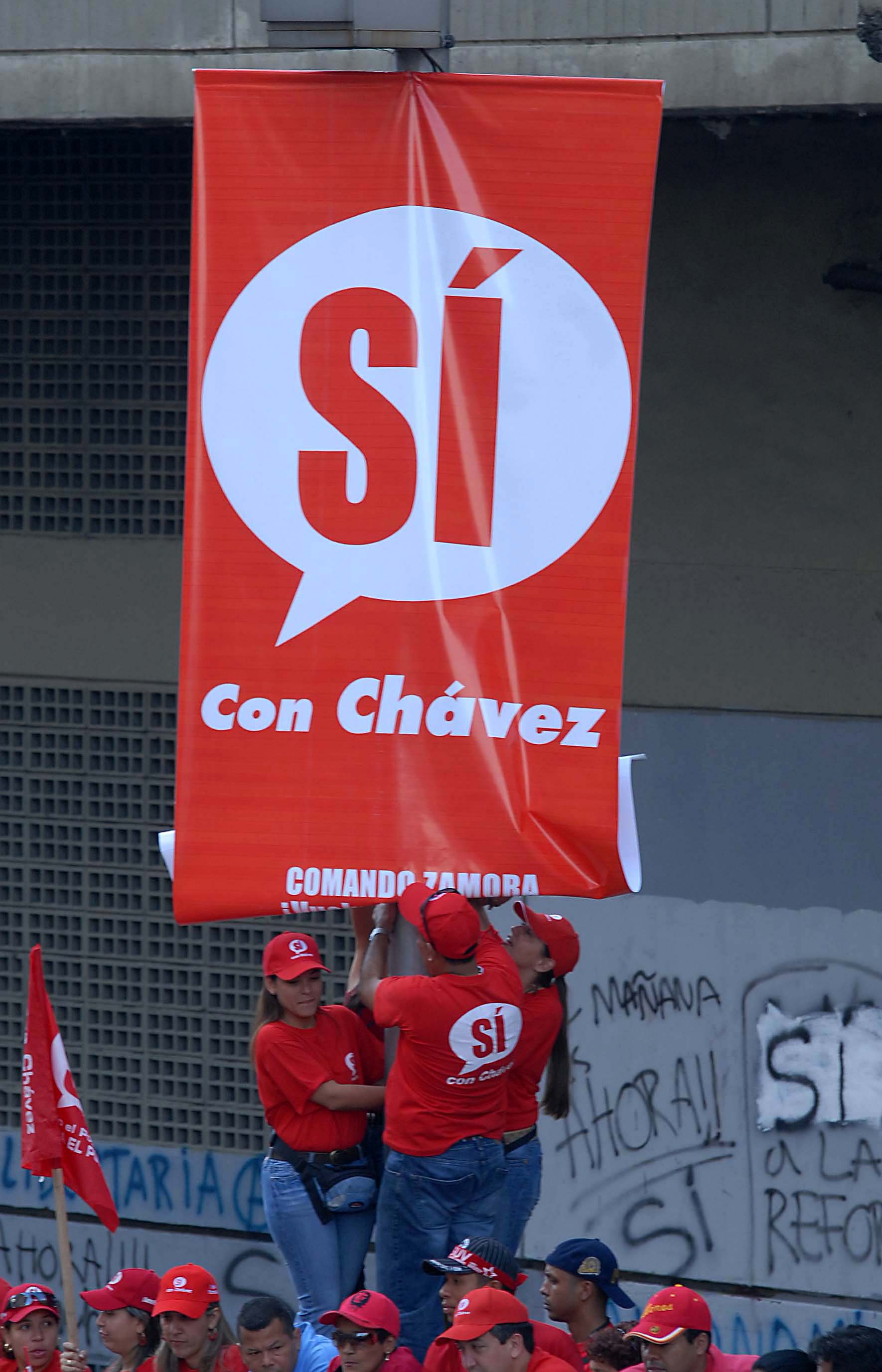
In November 2007, demonstrations arose in Caracas, Venezuela and six other cities over the proposed constitutional changes. "Tens of thousands" of "Yes" voters marched in Caracas after the referendum had finally been approved on 2 November. A 7 November riot at the Central University of Venezuela resulted in gunfire and several injuries; footage was caught on tape. In late November 2007, just days before the referendum, tens of thousands marched in Caracas for both the "Yes" and "No" votes. An opposition politician estimated the crowd marching for the "No" vote at 160,000. Protests were largely peaceful, and only one death has been reported.
Some of Chávez's supporters expressed concerns and disagreement with his proposals to change the constitution. Many voters abstained in the vote, rather than cast a "No" vote against Chávez. and in organizing numerous rallies. The Centre for Applied Nonviolent Action and Strategies (CANVAS), created by former members of Otpor, contributed to the movement and provided training for students in Belgrade. The student movement has played a large role in the Venezuelan political process, having gained a prominent position during the RCTV broadcast license expiration protests. Although the student movement is not limited to the opposition, it has been the opposition students that have gained the largest support, in part because they are not officially affiliated with any political cadres.
Raúl Baduel, former Minister of Defense and one of the four founding members of Chávez's Revolutionary Bolivarian Movement-200, expressed his concern by describing the reform as "nothing less than an attempt to establish a socialist state in Venezuela ... [which] is contrary to the beliefs of Simón Bolívar and it is also contrary to human nature and the Christian view of society, because it grants the state absolute control over the people it governs". Other leaders and former Chávez supporters who distanced themselves from the proposal were Ismael García, a deputy in the National Assembly, and Ramón Martínez, governor of Sucre State.
Venezuela's state television network broadcast coverage prior to the referendum of a memo written in Spanish, claiming it evidenced a plan by the CIA to destabilize Chávez —an allegation referred to as Operation Pliers. Chávez threatened to cut off oil exports to the United States if violence resulted from the referendum and "a fake". Independent analysts doubt the authenticity of the document, noting both the lack of an original document in English and that "the timing of its release is strange."
Opinion polls

Polls from November saw very close results. In mid-November, a Hinterlaces poll found that 51% of decided voters supported the change, while Mecanálisis said 64% of decided voters would vote against reform. A poll by Keller & Asociados concluded defeat for the proposal with 45% "No" to 31% "Yes" votes; about 65% of eligible people planned to vote. A late-November poll by Datanalisis of 1,854 likely voters indicated 49% were opposed, with 39% in favor. Reportedly, some moderate Chávez backers were likely to vote "No"; it was the first Datanalisis survey to project a loss, contrasted with earlier surveys that showed a win for Chávez "amid low turnout and despite widespread skepticism of his proposal".
Results
The proposal was narrowly defeated, 51 to 49 percent, in the first major electoral defeat for Chávez in the nine years of his presidency. Chávez conceded defeat, saying, "I congratulate my adversaries for this victory", and "for now, we could not do it."


| Option | For | Against | Invalid/ | ||||||||
|---|---|---|---|---|---|---|---|---|---|---|---|
| blank | Total | Registered | |||||||||
| voters | Turnout | Outcome | Votes | % | Votes | % | |||||
| Option A | 4,404,626 | 49.35 | 4,521,494 | 50.65 | 119,155 | 9,045,275 | 16,109,664 | 56.05 | |||
| Option B | 4,360,014 | 48.99 | 4,539,707 | 51.01 | 145,239 | 9,044,960 | 56.15 | ||||
| Source: [El Universal](http://www.eluniversal.com/2007/12/08/pol_art_cne-proclama-al-bloq_631111) |
Results by state

| State | Proposal A | Proposal B | Option | Votes | % | Option | Votes | % |
|---|---|---|---|---|---|---|---|---|
| Amazonas | **Yes** | **21,076** | **65.76** | **Yes** | **17,222** | **57.94** | ||
| No | 10,971 | 34.23 | No | 12,501 | 42.05 | |||
| Anzoátegui | Yes | 206,826 | 45.60 | Yes | 205,048 | 45.34 | ||
| **No** | **246,657** | **54.39** | **No** | **247,124** | **54.65** | |||
| Apure | **Yes** | **70,761** | **61.16** | **Yes** | **70,392** | **60.99** | ||
| No | 44,936 | 38.83 | No | 45,022 | 39.00 | |||
| Aragua | **Yes** | **324,745** | **52.92** | **Yes** | **321,586** | **52.57** | ||
| No | 288,897 | 47.07 | No | 290,095 | 47.42 | |||
| Barinas | **Yes** | **118,198** | **55.92** | **Yes** | **117,440** | **55.68** | ||
| No | 93,166 | 44.07 | No | 93,468 | 44.31 | |||
| Bolívar | **Yes** | **202,767** | **52.70** | **Yes** | **200,843** | **52.40** | ||
| No | 181,929 | 47.29 | No | 182,414 | 47.59 | |||
| Carabobo | Yes | 367,532 | 47.17 | Yes | 363,825 | 46.87 | ||
| **No** | **411,622** | **52.82** | **No** | **412,337** | **53.12** | |||
| Cojedes | **Yes** | **65,210** | **60.87** | **Yes** | **64,736** | **60.64** | ||
| No | 41,914 | 39.12 | No | 42,012 | 39.35 | |||
| Delta Amacuro | **Yes** | **28,505** | **60.96** | **Yes** | **28,299** | **60.71** | ||
| No | 18,251 | 39.03 | No | 18,308 | 39.28 | |||
| Distrito Capital | Yes | 392,489 | 47.58 | Yes | 388,757 | 47.15 | ||
| **No** | **432,251** | **52.41** | **No** | **435,627** | **52.84** | |||
| Falcón | **Yes** | **136,038** | **50.12** | Yes | 134,710 | 49.76 | ||
| No | 135,337 | 49.87 | **No** | **135,983** | **50.23** | |||
| Guárico | **Yes** | **132,490** | **58.35** | **Yes** | **131,586** | **58.12** | ||
| No | 94,539 | 41.64 | No | 94,796 | 41.87 | |||
| Lara | Yes | 284,726 | 48.97 | Yes | 281,262 | 48.50 | ||
| **No** | **296,603** | **51.02** | **No** | **298,658** | **51.50** | |||
| Mérida | Yes | 132,979 | 45.28 | Yes | 132,355 | 45.16 | ||
| **No** | **160,657** | **54.71** | **No** | **160,681** | **54.83** | |||
| Miranda | Yes | 422,811 | 43.78 | Yes | 416,797 | 43.30 | ||
| **No** | **542,799** | **56.21** | **No** | **544,717** | **56.65** | |||
| Monagas | **Yes** | **160,096** | **57.87** | **Yes** | **159,079** | **57.64** | ||
| No | 116,532 | 42.12 | No | 116,894 | 42.35 | |||
| Nueva Esparta | Yes | 69,495 | 43.90 | Yes | 69,106 | 43.74 | ||
| **No** | **88,799** | **56.09** | **No** | **88,862** | **56.25** | |||
| Portuguesa | **Yes** | **169,499** | **63.08** | **Yes** | **168,025** | **62.68** | ||
| No | 99,207 | 36.92 | No | 100,013 | 37.31 | |||
| Sucre | **Yes** | **125,494** | **51.07** | **Yes** | **124,818** | **50.88** | ||
| No | 120,214 | 48.92 | No | 120,472 | 49.11 | |||
| Táchira | Yes | 169,171 | 42.68 | Yes | 168,024 | 42.49 | ||
| **No** | **227,156** | **57.31** | **No** | **227,379** | **57.50** | |||
| Trujillo | **Yes** | **139,657** | **62.16** | **Yes** | **138,935** | **61.98** | ||
| No | 85,011 | 37.83 | No | 85,215 | 38.01 | |||
| Vargas | **Yes** | **68,629** | **56.21** | **Yes** | **67,555** | **55.65** | ||
| No | 53,465 | 43.79 | No | 53,830 | 44.34 | |||
| Yaracuy | **Yes** | **97,736** | **52.43** | **Yes** | **96,778** | **52.07** | ||
| No | 88,647 | 47.56 | No | 89,074 | 47.92 | |||
| Zulia | Yes | 472,462 | 43.05 | Yes | 467,958 | 42.74 | ||
| **No** | **624,790** | **56.94** | **No** | **626,850** | **57.25** |
Source: National Electoral Council (CNE)
Reactions
In conceding defeat, Chávez insisted that he would "continue in the battle to build socialism". Chávez conceded defeat by saying "for now, we couldn't" ("por ahora no pudimos"), echoing the phrase he used after the failure of the February 1992 Venezuelan coup d'état attempt. Manuel Rosales, a 2006 Venezuelan presidential candidate, said, "Tonight, Venezuela has won". Leopoldo López, a popular opposition mayor, said "Venezuela won today, democracy won today".
Latin American media responses included special reports that highlighted Chávez's first electoral setback in nine years and his ethical acceptance of defeat. According to a Mercosur press release, the general Latin American response was praise for the "democratic maturity" evidenced by the Venezuelan people. Brazil's Foreign Affairs Minister, Celso Amorin, said "The president accepted the result in a very calm and elegant manner."
The U.S. administration of President George W. Bush hailed the defeat as a victory for democracy. Bush said, "The Venezuelan people rejected one-man rule. They voted for democracy." A National Security Council spokesman said, "We congratulate the people of Venezuela on their vote and their continued desire to live in freedom and democracy".
The Organization of American States Secretary-General José Miguel Insulza called the results of the referendum an "exemplary development" on the part of the Venezuelan government and people, saying that democracy in the Americas "passed a difficult test and emerged stronger, showing clearly its consolidation." Reporters without Borders expressed hope that the result of the vote would end the "media war" in Venezuela.
The day after the referendum, financial markets were buoyed by Chávez's defeat; Venezuelan bonds rose and the stock index in Caracas surged 4% following a year-to-date 24% decline.
Aftermath
Chávez said on 5 December that he intended to launch a second attempt to change the Constitution. According to El Universal newspaper, he said: Responding to George W. Bush's remarks, he said:
A month after the referendum was defeated, Chávez named Ramón Carrizales to replace vice-president Jorge Rodríguez, who had been blamed by many Chávez supporters for the failed referendum.
References
References
- Romero, Simon. (3 December 2007). "Venezuela Hands Narrow Defeat to Chávez Plan". The New York Times.
- Kofman, Jeffrey. (3 December 2007). "Tension, Then Surprise, Chavez Loses Reform Vote". ABC Global News.
- [[Jens Erik Gould, Jens Erik. (3 December 2007). "Why Venezuelans Turned on Chavez".
- Romero, Simon. (4 December 2007). "Venezuela Vote Sets Roadblocks on Chávez Path". The New York Times.
- (18 November 2007). "Understanding constitutional reform in Venezuela (a background)". Maldives Independent News Media.
- "Reforma de la constitución de la República Bolivariana de Venezuela". [[National Electoral Council (Venezuela)]].
- (22 August 2007). "Venezuela lawmakers back reforms". BBC News.
- [http://news.monstersandcritics.com/americas/news/article_1368718.php/Chavez_gets_constitutional_reform_backing_from_Venezuelan_Congress "Chavez gets constitutional reform backing from Venezuelan Congress"] {{Webarchive. link. (11 July 2012 , Deutsche Presse-Agentur (monstersandcritics.com), 25 October 2007. Retrieved on 4 December 2007.)
- (2 November 2007). "Venezuela assembly passes reforms". BBC News.
- (2 November 2007). "AN presenta al CNE pregunta para referéndum". Gobierno Bolivariano de Venezuela.
- (30 November 2007). "Q&A: Venezuela's referendum". BBC News.
- (2 December 2007). "A glance at Venezuela's referendum". The Mercury News.
- (3 December 2007). "US hails Chavez referendum defeat". BBC News.
- (6 December 2007). "Defeat for Hugo Chávez: The wind goes out of the revolution". The Economist.
- "Gay rights were part of rejected Venezuelan referendum". PinkNews.
- James, Ian. (21 November 2007). "Thousands Rally for Chavez's Proposal".
- Sierra, Sandra. (8 November 2007). "Gunfire erupts at Venezuela university". The Guardian.
- Strange, Hannah. (30 November 2007). "100,000 march against Hugo Chavez reforms". Times Online.
- (30 November 2007). "Students stage anti-Chavez rally". BBC News.
- (26 November 2007). "One person killed in demonstration in Venezuela". [[El Universal (Caracas).
- (27 November 2007). "Un muerto y 6 heridos durante protestas". [[El Universal (Caracas).
- Kraul, Chris. (4 December 2007). "Chavez revolution takes hit in election". Los Angeles Times.
- (23 October 2007). "Students want referendum to be hold (sic) on 3 February 2008". El Universal.
- (5 October 2007). "Venezuela: The Marigold Revolution?".
- (3 December 2007). "Venezuela: A New Player in the Mix".
- Nunez, Elizabeth. (4 June 2007). "Venezuela Students Spur Protest Movement". The Washington Post.
- (21 November 2007). "Bolivarian students are marching to Chávez's government headquarters". [[El Universal (Caracas).
- [[Raúl Baduel]]. (1 December 2007). "Why I Parted Ways With Chávez". The New York Times.
- Orozco, Jose. (2 December 2007). "Ex-wife damns Hugo Chavez 'coup'". The Sunday Times.
- (4 February 2011). "In Venezuela, an American Has the President's Ear".
- and declared at his campaign's closing that "whoever voted 'Yes' was voting for Hugo Chávez, but whoever voted 'No' was voting for George W. Bush". The U.S. has responded by calling the allegations "ridiculous"[http://news.bbc.co.uk/2/hi/americas/7121487.stm Chavez urges reform for Venezuela.] BBC News, 1 December 2007. Retrieved 3 December 2007
- Romero, Simon. (30 November 2007). "In Chávez Territory, Signs of Dissent". The New York Times.
- (19 November 2007). "Outcome of Venezuela's Referendum Uncertain". [[Angus Reid Global Monitor]].
- (23 November 2007). "Última encuesta de Keller & Asociados da ganadora opción del NO". Globovision.
- (24 November 2007). "Poll says Chavez loses Venezuela referendum lead". B92.net.
- (29 November 2007). "Half in Venezuela Reject New Constitution". Angus Reid Global Monitor : Polls & Research.
- {{in lang. link. (19 February 2009 [[National Electoral Council (Venezuela)). National Electoral Council]], 3 December 2007. Accessed on 3 December 2007
- García, James L.. (2007-12-06). "Chávez califica de 'victoria de mierda' el triunfo de la oposición". [[El Mundo (Venezuela).
- Matthew Walter and Helen Murphy. [https://www.bloomberg.com/apps/news?pid=20601087&sid=aSpYEZW_eEhM&refer=home Venezuelans Reject Chavez's Plans for Constitution (Update1).] ''Bloomberg'', 3 December 2007. Accessed on 3 December 2007
- Peregil, F. (3 December 2007). "Venezuela dice 'no' a la Constitución de Chávez". El País.
- Bachelet, Pablo. (3 December 2007). "Bush administration hails Chavez defeat". The Kansas City Star.
- (3 December 2007). "Foreign media on the referendum". [[El Universal (Caracas).
- "Venezuelan Student Movement Leader Awarded $500,000 Milton Friedman Liberty Prize". [[Cato Institute]].
- (3 December 2007). "Insulza congratulates Venezuelan government and people". El Universal.
- (3 December 2007). "RSF hopes referendum to stop "media war" in Venezuela". [[El Universal (Caracas).
- Lesova, Polya Lesova. (3 December 2007). "Emerging Markets Report: Venezuelan bonds rally after Chavez referendum loss". MarketWatch.
- (5 December 2007). "Chávez announces second offensive to reform the Constitution". El Universal.
- "Presidente Chávez: "Vendrá una nueva ofensiva" para reformar la Carta Magna". YVKE Caracas.
- (5 December 2007). "Presidente Chavez desmiente haber sido presionado por alto mando militar y reitera que insistirá en su proyecto". Globovisión.
- Jack Daniel, Frank. (3 January 2008). "Venezuela's Chavez reshuffles cabinet after defeat". [[Reuters]].
This article was imported from Wikipedia and is available under the Creative Commons Attribution-ShareAlike 4.0 License. Content has been adapted to SurfDoc format. Original contributors can be found on the article history page.
Ask Mako anything about 2007 Venezuelan constitutional referendum — get instant answers, deeper analysis, and related topics.
Research with MakoFree with your Surf account
Create a free account to save articles, ask Mako questions, and organize your research.
Sign up freeThis content may have been generated or modified by AI. CloudSurf Software LLC is not responsible for the accuracy, completeness, or reliability of AI-generated content. Always verify important information from primary sources.
Report