From Surf Wiki (app.surf) — the open knowledge base
2007 United States federal budget
None
None
| Field | Value |
|---|---|
| title | Budget of the United States federal government |
| year | 2007 |
| country | United States |
| previous_budget | 2006 United States federal budget |
| previous_year | 2006 |
| next_budget | 2008 United States federal budget |
| next_year | 2008 |
| date_submitted | February 6, 2006 |
| submitter | George W. Bush |
| submitted_to | [109th Congress](109th-united-states-congress) |
| Total_Revenue | $2.416 trillion *(requested)* |
| $2.568 trillion *(actual)* | |
| 17.9% of GDP *(actual)* | |
| Total_Expenditures | $2.77 trillion *(requested)* |
| $2.729 trillion *(actual)* | |
| 19.1% of GDP *(actual)* | |
| deficit | $354 billion *(requested)* |
| $160.7 billion *(actual)* | |
| 1.1% of GDP *(actual)* | |
| debt | $8.95 trillion *(at fiscal end)* |
| 62.5% of GDP *(actual)* | |
| gdp | $14.323 trillion |
| url | [Government Publishing Office](http://www.gpo.gov/fdsys/browse/collection.action?collectionCode=BUDGET&browsePath=Fiscal+Year+2007) |
$2.568 trillion (actual) 17.9% of GDP (actual) $2.729 trillion (actual) 19.1% of GDP (actual) $160.7 billion (actual) 1.1% of GDP (actual) 62.5% of GDP (actual)
The budget of the United States government for fiscal year 2007 was produced through a budget process involving both the legislative and executive branches of the federal government. While the Congress has the constitutional "power of the purse", the President and his appointees play a major role in budget deliberations. Since 1976, the federal fiscal year has started on October 1 of each year.
The government was initially funded through a series of three temporary continuing resolutions. Final funding for the Department of Defense was enacted on September 29, 2006 as part of the Department of Defense Appropriations Act, 2007, while the Department of Homeland Security was funded through the Department of Homeland Security Appropriations Act, 2007, enacted on October 4, 2006. The remaining departments and agencies were funded as part of a full-year continuing resolution, the Revised Continuing Appropriations Resolution, 2007, on February 15, 2007.
Total receipts
Receipts by source: (in billions of dollars)
| Source | url=http://www.gpo.gov/fdsys/pkg/BUDGET-2007-DB/xls/BUDGET-2007-DB-3.xls | work=Fiscal Year 2007 Public Budget Database | title=2007 Public Budget Database | at=Receipts: Public Budget Database | publisher=United States Office of Management and Budget | access-date=March 15, 2015}} | url=http://www.gpo.gov/fdsys/pkg/BUDGET-2009-DB/xls/BUDGET-2009-DB-3.xls | work=Fiscal Year 2009 Public Budget Database | title=2009 Public Budget Database | at=Receipts: Public Budget Database | publisher=United States Office of Management and Budget | access-date=March 15, 2015}} |
|---|---|---|---|---|---|---|---|---|---|---|---|---|
| Individual income tax | ||||||||||||
| Corporate income tax | ||||||||||||
| Social Security and other payroll tax | ||||||||||||
| Excise tax | ||||||||||||
| Estate and gift taxes | ||||||||||||
| Customs duties | ||||||||||||
| Other miscellaneous receipts | ||||||||||||
| **Total** | **** | **** |
The IRS estimated that there were about $345 billion in uncollected taxes, which is sometimes referred to as the "tax gap.".
Total spending
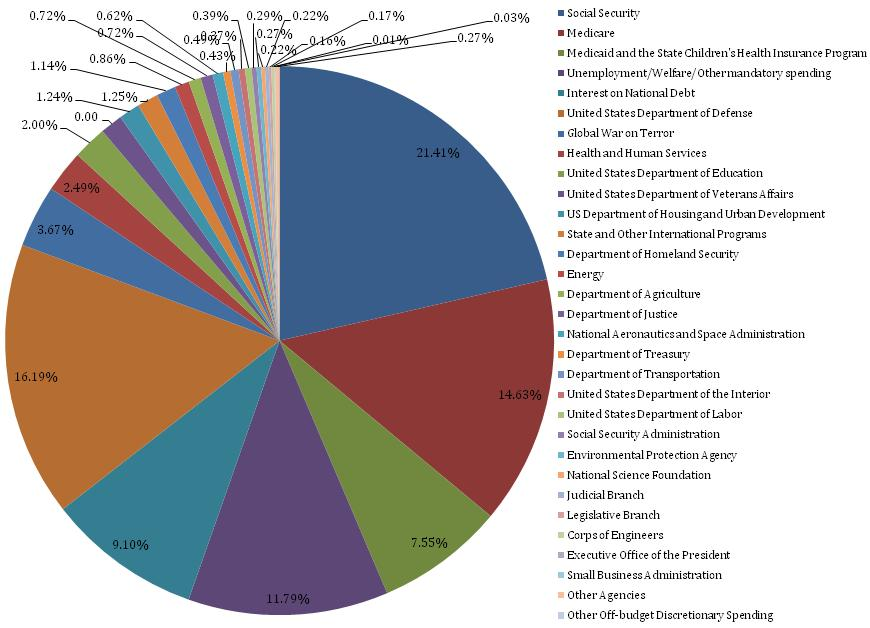
The President's actual budget for 2007 totals $2.8 trillion. Percentages in parentheses indicate percentage change compared to 2006. This budget request is broken down by the following expenditures:
- $586.1 billion (+7.0%) - Social Security
- $548.8 billion (+9.0%) - Defense
- $394.5 billion (+12.4%) - Medicare
- $294.0 billion (+2.0%) - Unemployment and welfare
- $276.4 billion (+2.9%) - Medicaid and other health related
- $243.7 billion (+13.4%) - Interest on debt
- $89.9 billion (+1.3%) - Education and training
- $76.9 billion (+8.1%) - Transportation
- $72.6 billion (+5.8%) - Veterans' benefits
- $43.5 billion (+9.2%) - Administration of justice
- $33.1 billion (+5.7%) - Natural resources and environment
- $32.5 billion (+15.4%) - Foreign affairs
- $27.0 billion (+3.7%) - Agriculture
- $26.8 billion (+28.7%) - Community and regional development
- $25.0 billion (+4.0%) - Science and technology
- $20.5 billion (+0.8%) - Energy
- $20.1 billion (+11.4%) - General government
Much of the costs of the Iraq war and the Afghanistan war until FY2008 have been funded through supplemental appropriations or emergency supplemental appropriations, which are treated differently from regular appropriations bills. Senior congressional leaders have contended that those war costs, as much as possible, should go through the regular budget process, which provides for greater transparency. Determining the costs of the wars in Iraq and Afghanistan is complex. CBO has estimated that "war-related defense activities" in 2007 were "roughly $115 billion."
2007 total military budget
The total requested military budget of the United States for 2007 was $699 billion.
U.S. Military Budget - DoD Base Spending: The U.S. Department of Defense (DoD) has the single largest budget of any government agency in the discretionary budget. This department is responsible for the four branches - the Army, Air Force, Navy and Marine Corps. This includes the cost of base administration, pay for military members, and the costs of repairing and procuring equipment.
- FY 2006, Defense Department base budget expenditures were $411 billion, nearly half of net discretionary spending.
- FY 2007, it increased to $430 billion, still about half.
- FY 2008, it is projected to grow to $481 billion, or 52%.
U.S. Military Budget - War on Terror Base Spending : The War on Terror (WoT) incurs additional costs by other departments. When added to the DoD base spending, the amount comes to:
- $474 billion in FY 2006, which is 56% of net discretionary spending,
- $505 billion in FY 2007,
- $554 billion in FY 2008, nearly 60% of discretionary spending.
- FY 2006 Supplemental Funding : The Defense Department base budget also does not include “one time only” costs attributable to the War on Terror, which are submitted as Supplemental Funding.
- In FY 2006, an additional $153 billion in Supplemental Funding was added to the base budget - the War on Terror received $120 billion, while $33 billion went primarily for Hurricane Katrina. As a result, 60% of last year's discretionary spending went to DoD/WoT.
- FY 2007 Supplemental Funding : For FY 2007, $70 billion has already been approved, while the President’s FY 2008 Budget requests an additional $102 billion. If approved by Congress, total FY 2007 spending for DoD/WoT would be $673 billion, or 64% of the net discretionary budget.
- FY 2008 Budget Proposal : For FY 2008, the President has requested the following:
- The Defense Department Base Budget - $481 billion.
- WoT(non-DoD) Base Budget - $73 billion.
- Supplemental Funding for WoT - $145 billion.
- Total requested Dod/WoT spending is $699 billion, or 65% of total net Discretionary spending.
References
References
- (February 6, 2006). "Press Briefing". [[whitehouse.gov]].
- "2007 Budget Summary Tables". Government Publishing Office.
- "Table 1.1—SUMMARY OF RECEIPTS, OUTLAYS, AND SURPLUSES OR DEFICITS (–): 1789–2020". Government Publishing Office.
- "Fiscal Year 2016 Budget Historical Tables". Office of Management and Budget.
- "Table 1.2—SUMMARY OF RECEIPTS, OUTLAYS, AND SURPLUSES OR DEFICITS (–) AS PERCENTAGES OF GDP: 1930–2020". Government Publishing Office.
- "Appropriations for Fiscal Year 2007".
- "2007 Public Budget Database". United States Office of Management and Budget.
- "2009 Public Budget Database". United States Office of Management and Budget.
- $345B tax gap: [https://www.npr.org/templates/story/story.php?storyId=15111003 Random Tax Audits Return to the IRS], 9 Oct 2007, Morning Edition.
- "''The President's Budget of the United States Government,'' FY 1996 -- present".
- [http://www.cbo.gov/ftpdoc.cfm?index=8565&type=0 The Budget and Economic Outlook: An Update], CBO.gov. August, 2007.
- [https://www.whitehouse.gov/omb/budget/fy2008/defense.html Department of Defense Budget] {{Webarchive. link. (2007-10-03 - OMB FY 2008 President's Budget Charts and Tables)
This article was imported from Wikipedia and is available under the Creative Commons Attribution-ShareAlike 4.0 License. Content has been adapted to SurfDoc format. Original contributors can be found on the article history page.
Ask Mako anything about 2007 United States federal budget — get instant answers, deeper analysis, and related topics.
Research with MakoFree with your Surf account
Create a free account to save articles, ask Mako questions, and organize your research.
Sign up freeThis content may have been generated or modified by AI. CloudSurf Software LLC is not responsible for the accuracy, completeness, or reliability of AI-generated content. Always verify important information from primary sources.
Report