From Surf Wiki (app.surf) — the open knowledge base
2007 Estonian parliamentary election
none
none
| Field | Value |
|---|---|
| country | Estonia |
| type | parliamentary |
| previous_election | 2003 Estonian parliamentary election |
| next_election | 2011 Estonian parliamentary election |
| previous_year | 2003 |
| next_year | 2011 |
| image_size | 130x130px |
| seats_for_election | All 101 seats in the Riigikogu |
| majority_seats | 51 |
| election_date | 4 March 2007 |
| image1 | Portrait Andrus Ansip.jpg |
| leader1 | Andrus Ansip |
| party1 | Estonian Reform Party |
| last_election1 | 19 seats |
| seats1 | **31** |
| seat_change1 | 12 |
| popular_vote1 | **153,044** |
| percentage1 | **27.8%** |
| swing1 | 10.11pp |
| image2 | Edgar Savisaar 2005-crop.jpg |
| leader2 | Edgar Savisaar |
| party2 | Estonian Centre Party |
| last_election2 | 28 seats |
| seats2 | 29 |
| seat_change2 | 1 |
| popular_vote2 | 143,518 |
| percentage2 | 26.1% |
| swing2 | 0.70pp |
| image3 | IRL Tõnis Lukas.jpg |
| leader3 | Tõnis Lukas and Taavi Veskimägi |
| party3 | Pro Patria and Res Publica Union |
| last_election3 | 32 seats |
| seats3 | 19 |
| seat_change3 | 16 |
| popular_vote3 | 98,347 |
| percentage3 | 17.9% |
| swing3 | 14.06pp |
| image4 | Ivari Padar MEP 01.JPG |
| leader4 | Ivari Padar |
| party4 | Social Democratic Party (Estonia) |
| last_election4 | 6 seats |
| seats4 | 10 |
| seat_change4 | 4 |
| popular_vote4 | 58,363 |
| percentage4 | 10.6% |
| swing4 | 3.56pp |
| image5 | Lotman, Aleksei (cropped).jpg |
| leader5 | Aleksei Lotman |
| party5 | Estonian Greens |
| last_election5 | – |
| seats5 | 6 |
| seat_change5 | *New* |
| popular_vote5 | 39,279 |
| percentage5 | 7.1% |
| swing5 | *New* |
| image6 | KE Ester Tuiksoo.jpg |
| leader6 | Ester Tuiksoo |
| party6 | People's Union of Estonia |
| last_election6 | 13 seats |
| seats6 | 6 |
| seat_change6 | 7 |
| popular_vote6 | 39,215 |
| percentage6 | 7.1% |
| swing6 | 5.93pp |
| map_image | 2007. aasta Riigikogu valimiste tulemused.svg |
| map_caption | Results by electoral district |
| title | Prime Minister |
| posttitle | Prime Minister after election |
| before_election | Andrus Ansip |
| before_party | Estonian Reform Party |
| after_election | Andrus Ansip |
| after_party | Estonian Reform Party |
Parliamentary elections were held in Estonia on 4 March 2007. The newly elected 101 members of the 11th Riigikogu assembled at Toompea Castle in Tallinn within ten days of the election. It was the world's first nationwide vote where part of the voting was carried out in the form of remote electronic voting via the internet.
The election saw the Estonian Reform Party emerge as the largest faction in the Riigikogu with 31 seats. The Estonian Centre Party finished second with 29 seats, whilst the new Union of Pro Patria and Res Publica lost 16 seats compared to the 35 won by the two parties in the 2003 elections. The Social Democrats gained 4 seats, whilst the Greens entered the Riigikogu for the first time with 6 seats and the People's Union lost seven of its 13 seats. This election would be the last time that the Greens and the People's Union would enter into parliament. The Riigikogu elected after this election became the only one in contemporary Estonian history to have a single government last throughout an entire parliamentary term.
After the election, the Centre Party, led by the mayor of Tallinn Edgar Savisaar, had been increasingly excluded from collaboration due to his open collaboration with Putin's United Russia party, real estate scandals in Tallinn, and the Bronze Soldier controversy, considered a deliberate attempt to split Estonian society by provoking the Russian minority.
Background
After the 2003 election, the Centre and Res Publica parties nearly tied for first place, with both saying that they should get the chance to try and form the next government, while ruling out any deal between themselves. President Rüütel had to decide who he should nominate as Prime Minister and therefore be given the first chance at forming a government. On the 2 April he invited the leader of the Res Publica party, Juhan Parts to form a government and after negotiations a coalition government composed of Res Publica, the Reform Party and the People's Union was formed on the 10 April. The government has also been referred to as the Harmony coalition.
On 20 August 2004, Lihula municipality head Tiit Madisson erected the Lihula monument on the territory of the municipality, which represented a soldier in SS uniform. The national government had ordered the removal of the monument and by the evening of 2 September, the rescue services and the police had arrived to take down the monument. The takedown was secured by police with dogs and rubber batons but the locals started pelting the rescue services and police with stones. The police then threatened them with tear gas.
At the beginning of March, the Reform Party and the People's Union decided to present a motion of no confidence against the Minister of Justice Ken-Marti Vaher of Res Publica as part of the proposal by Res Publica to start using metrics to catch corrupt people. The Riigikogu voted no-confidence in Vaher with 54 votes in favor. After the vote, Prime Minister Juhan Parts said he would resign. On 24 March 2005, Juhan Parts submitted his resignation request to President Arnold Rüütel, and the government resigned.
Reform and the People's Union then entered negotiations with the Centre Party to form a new government. The new government took office on 13 April 2005 and left office after a new coalition was formed following the 2007 election. The government has also been called the garlic coalition due to the agreement being reached in the corresponding restaurant in Tallinn's Old Town.
On 15 November 2006 Res Publica and the Pro Patria Union officially merged into the Pro Patria and Res Publica Union (Erakond Isamaa ja Res Publica Liit - IRL).
Campaign
Reform Party
During the campaign, Reform campaigned on lowering taxes as well as trying to paint itself as the main alternative to Centre which they painted in a Russophilic light, claiming the party "represents primarily Russians". The party's campaign also featured a promise to bring Estonia "among the five wealthiest countries in Europe" within 15 years. The claim has since been ridiculed by many as a promise that failed to materialize. In 2022, 15 years after the election campaign, then-Reform leader Andrus Ansip commented that the promise had simply been a slogan and an appeal, telling a journalist that "even you can understand that it's impossible".
Centre Party
Centre campaigned on wage increases, bringing troops home from Iraq, building municipal apartments and a Russian-language public broadcasting service. Moreover, the party promised free higher education. Both Reform and Centre published contrasting advertisements with yes-no tables listing policies that they claimed one party supported and the other did not.
IRL
IRL campaigned on promises such as providing a computer to every ninth-grader, increased welfare spending and wages as well as the construction of the War of Independence Victory Column. Moreover, the newly united party launched an ad campaign featuring endorsements of the party and one of its figureheads, former prime minister Mart Laar by various conservative European leaders, including Swedish foreign minister Carl Bildt, Georgian president Mikheil Saakashvili and British prime minister David Cameron.
Electoral system
Main article: Electronic voting in Estonia
In 2007 Estonia held its and the world's first national Internet election. Voting was available from February 26 to 28. A total of 30,275 citizens (3.4%) used Internet voting.
Electronic voting in Estonia began in October 2005 local elections when Estonia became the first country to have legally binding general elections using the Internet as a means of casting the vote and was declared a success by the Estonian election officials.
The electoral system was a two-tier semi-open list proportional representation system with a 5% (27,510.65 votes for this election) election threshold.
Seats by electoral district
| District number | Electoral District | Seats |
|---|---|---|
| 1 | Haabersti, Põhja-Tallinn and Kristiine districts in Tallinn | 8 |
| 2 | Kesklinn, Lasnamäe and Pirita districts in Tallinn | 11 |
| 3 | Mustamäe and Nõmme districts in Tallinn | 8 |
| 4 | Harjumaa (without Tallinn) and Raplamaa counties | 13 |
| 5 | Hiiumaa, Läänemaa and Saaremaa counties | 7 |
| 6 | Lääne-Virumaa county | 6 |
| 7 | Ida-Virumaa county | 8 |
| 8 | Järvamaa and Viljandimaa counties | 8 |
| 9 | Jõgevamaa and Tartumaa counties (without Tartu) | 7 |
| 10 | Tartu city | 8 |
| 11 | Võrumaa, Valgamaa and Põlvamaa counties | 9 |
| 12 | Pärnumaa county | 8 |
Contesting parties
The Estonian National Electoral Committee announced that 11 political parties and seven individual candidates registered to take part in the 2007 parliamentary election. Their registration numbers and order were determined by a draw lot, as opposed to the order of registration as was done previously.
| Name | Ideology | Political position | Leader | Total candidates | 2003 result | Votes (%) | Seats | |
|---|---|---|---|---|---|---|---|---|
| Party of Estonian Christian Democrats}}" | Christian Democrats | Christian democracy | Centre-right | Peeter Võsu | 108 | 1.1% | ||
| Estonian Centre Party}}" | Centre Party | Populism | Centre-left | Edgar Savisaar | 125 | 25.4% | ||
| Estonian Reform Party}}" | Reform Party | Classical liberalism | Centre-right | Andrus Ansip | 125 | 17.7% | ||
| Estonian Independence Party}}" | Independence Party | Estonian nationalism | Far-right | Vello Leito | 10 | 0.6% | ||
| Estonian Left Party}}" | Left Party | Democratic socialism | Left-wing | Sirje Kingsepp | 12 | 0.4% | ||
| Pro Patria and Res Publica Union}}" | IRL | Liberal conservatism | Centre-right | Tõnis Lukas and Taavi Veskimägi | 125 | 31.9% | ||
| Russian Party | Russian minority interests | Syncretic | Stanislav Tšerepanov | 35 | 0.2% | |||
| Constitution Party (Estonia)}}" | Constitution Party | Russia's national interests | Centre-left | Sergei Jürgens | 53 | 2.3% | ||
| People's Union of Estonia}}" | People's Union | Agrarianism | Centre to centre-left | Ester Tuiksoo | 125 | 13.0% | ||
| Social Democratic Party (Estonia)}}" | Social Democratic Party | Social democracy | Centre-left | Ivari Padar | 125 | 7.0% | ||
| Estonian Greens}}" | Greens | Green politics | Centre-left | Aleksei Lotman | 125 | *did not exist* | ||
| Independent politician}}" | Individual candidates | — | 7 | *did not exist* |
Results
Main article: Members of the 11th Riigikogu
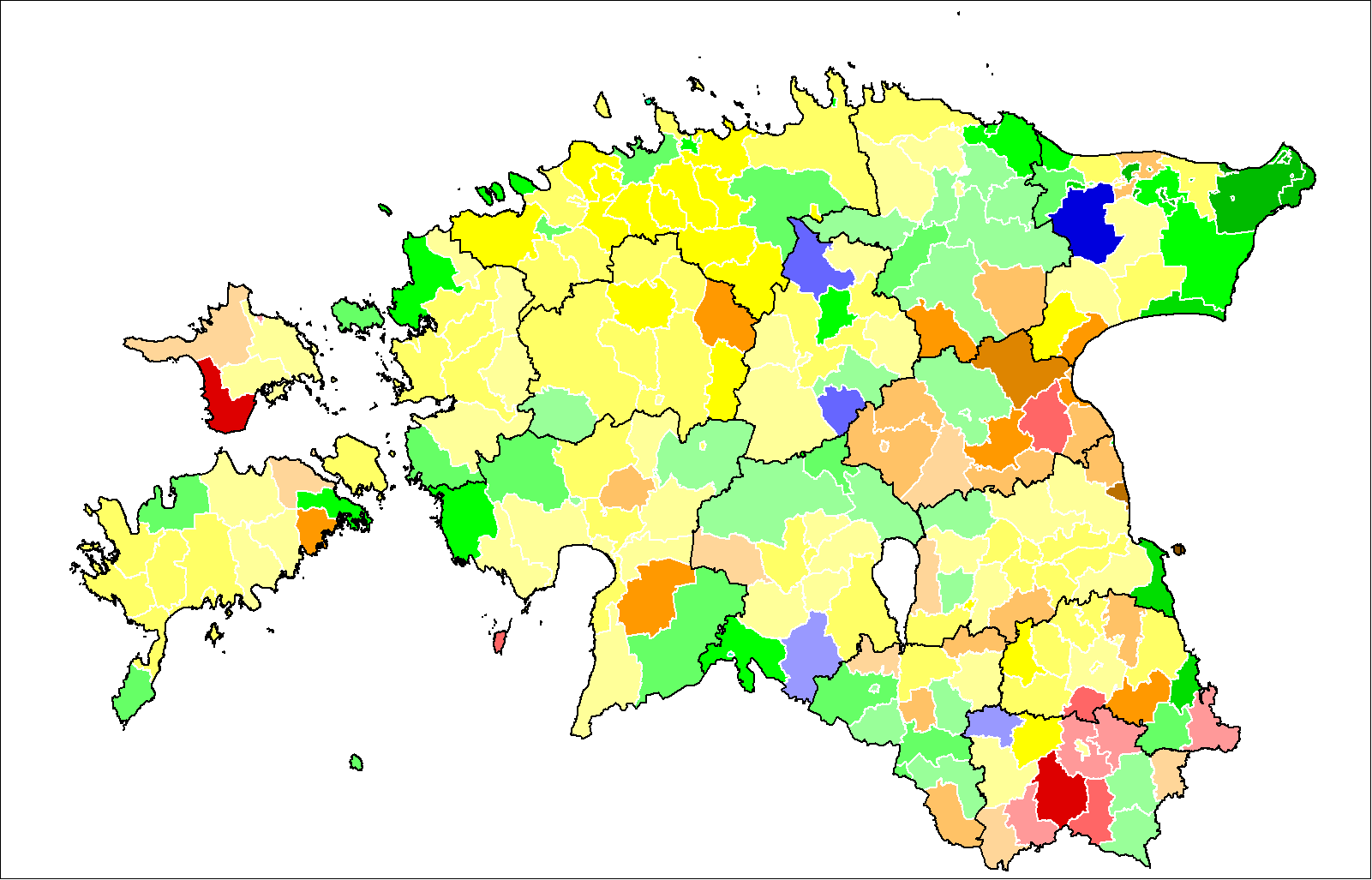
Leading party by municipality:
| ERE | EKE | IRL | SDE | ERL |
|---|
]]
Aftermath
Following the election a three party coalition government, also called the Triple Alliance, was formed between Reform, the Pro Patria and Res Publica Union and SDE. This lasted until May 2009, when SDE left the government following budget cuts as a result of the global economic crisis, the two remaining parties were able to carry on in government as a minority coalition however, holding 50 out of 101 seats in the Parliament.
Notes
References
References
- [https://archive.today/20120728210611/http://www.delfi.ee/archive/article.php?id=11378593 Savisaar's and Kruuda's mutual gifts]
- [http://postimees.ee/300407/esileht/arvamus/257922.php Lõhestaja number üks] {{webarchive. link. (2007-10-06 Postimees)
- (2003-03-03). "Estonia: Two Parties Want To Form Government After Close Election". [[Radio Free Europe/Radio Liberty]].
- (2003-03-03). "Estonia quandary after split vote". [[BBC News Online]].
- "Estonia: parliamentary elections Riigikogu, 2003". [[Inter-Parliamentary Union]].
- (2022-03-30). "Koosmeele koalitsioon 2003 {{!}} Reformierakond".
- (2003-03-09). "Koosmeele koalitsioon".
- "Res Publica pooldas koosmeele koalitsiooni".
- "Res Publica pooldab koosmeele koalitsiooni".
- ERR. (2021-06-21). "Suri Tiit Madisson".
- "Lihula monument võeti ööpimeduses maha".
- "Korruptantide jahtimise plaan lõi Vaheri ametikoha kõikuma".
- "Arhiiv {{!}} ERR".
- (2005-03-21). "Juhan Parts astub peaministri kohalt tagasi".
- (2005-03-24). "Peaminister Juhan Partsi valitsus astus tagasi".
- "Küüslaugukoalitsioon sünnib suure valuga".
- (2006-06-04). "Isamaaliidu ja Res Publica üldkogud kiitsid liitumise ülekaalukalt heaks".
- (2006-11-14). "Isamaa ja Res Publica Liit: Õnn ei ole rahas".
- "e-Äriregister – ISAMAA Erakond".
- "RIIGIKOGU VALIMISED 2007: Kampaaniakulutuste rekordid, Ansipi ja Savisaare vastandumine".
- (2006-11-02). "Reformierakond alustab kampaaniat "Viime Eesti viie jõukaima Euroopa riigi hulka!" {{!}} Reformierakond".
- "Valimisreklaamid 2007".
- ERR, Tanel Kiik, Keskerakond {{!}}. (2023-08-04). "Tanel Kiik: viies kvartal majanduslangust - teel viie jõukama hulka?".
- uudised, Uued. (2022-01-29). ""Ühe tagumiku kaks kannikat": sarnaselt Ansipile lubab ka Kristina Kallas Eesti viie rikkaima riigi hulka viia - Uued Uudised".
- (2023-07-29). "ANVAR SAMOST ⟩ Automaks on Reformierakonna muutumise märgiline tunnistaja".
- "Reformierakonna "Viie rikkaima riigi hulka!" rehkendusest on pool tegemata".
- "Ansip lubas, et selleks aastaks jõuame Euroopa viie rikkaima riigi hulka. Ei jõudnud".
- [https://archive.today/20120713191050/http://news.com.com/Estonia+to+hold+first+national+Internet+election/2100-1028_3-6161005.html Estonia to hold first national Internet election], [[News.com]], February 21, 2007
- link. (2020-05-28 , [[InformationWeek]] February 28, 2007)
- (2011). "Valimised Eestis: statistikat ja selgitusi". Vabariigi Valimiskomisjon.
- [[Eesti Päevaleht]] 20 June 2008: [http://www.epl.ee/artikkel/433236 Kaitsepolitsei aastaraamat: Vene luure tegi mullu Eestis usinalt tööd] {{Webarchive. link. (2008-06-30 by [[Kärt Anvelt]])
- (2008). "Annual Review 2007". [[Estonian Security Police]].
- [https://www.kapo.ee/sites/default/files/public/content_page/aastaraamat-2007.pdf KAPO aastaraamat 2007]
- "Kaitsepolitsei aastaraamat: Vene luure tegi mullu Eestis usinalt tööd".
- [[Dieter Nohlen]] & Philip Stöver (2010) ''Elections in Europe: A data handbook'', pp585–588 {{ISBN. 978-3-8329-5609-7
This article was imported from Wikipedia and is available under the Creative Commons Attribution-ShareAlike 4.0 License. Content has been adapted to SurfDoc format. Original contributors can be found on the article history page.
Ask Mako anything about 2007 Estonian parliamentary election — get instant answers, deeper analysis, and related topics.
Research with MakoFree with your Surf account
Create a free account to save articles, ask Mako questions, and organize your research.
Sign up freeThis content may have been generated or modified by AI. CloudSurf Software LLC is not responsible for the accuracy, completeness, or reliability of AI-generated content. Always verify important information from primary sources.
Report