From Surf Wiki (app.surf) — the open knowledge base
2006 New York City Cirrus SR20 crash
Aircraft crash into a building

Aircraft crash into a building
| Field | Value |
|---|---|
| name | 2006 New York City Cirrus SR20 crash |
| image | N929CD impact site.jpg |
| caption | The impact site of the aircraft in the Belaire Apartments |
| date | |
| type | Controlled flight into building |
| occurrence_type | Accident |
| site | Belaire Apartments, Manhattan, New York City, US |
| coordinates | |
| occupants | 2 |
| fatalities | 2 |
| survivors | 0 |
| plane1_caption | A Cirrus SR20 similar to the aircraft involved in the incident |
| aircraft_type | Cirrus SR20 |
| operator | Private |
| tail_number | N929CD |
| origin | Teterboro Airport |
| Teterboro, New Jersey, US | |
| ground_fatalities | 0 |
| ground_injuries | 21 (including 11 firefighters) |
| plane1_image | CirrusSR20Landing.jpg |
| total_fatalities | 2 |
| total_injuries | 21 |
Teterboro, New Jersey, US On October 11, 2006, a Cirrus SR20 aircraft crashed into the Belaire Apartments on the Upper East Side of Manhattan, New York City, United States, at about 2:42 p.m. EDT (18:42 UTC). The aircraft struck the north side of the building, causing a fire in several apartments that was extinguished within two hours.
Both people aboard the aircraft were killed in the accident: New York Yankees pitcher Cory Lidle and his certificated flight instructor Tyler Stanger. Twenty-one people were injured, including eleven firefighters. An apartment resident, Ilana Benhuri, who lived in the building with her husband, was hospitalized for a month with severe burns incurred when the post-impact fire engulfed her apartment.
The Cirrus SR20 aircraft, tail number N929CD, was owned by Lidle. On May 1, 2007, the National Transportation Safety Board (NTSB) stated that the probable cause of the crash was pilot error. The NTSB was unable to determine which person was flying the aircraft at the time of the crash.
Flight
The aircraft departed from Teterboro Airport in Teterboro, New Jersey, at 2:29 pm EDT (18:29 UTC). With the Yankees' season having come to an end four days prior, Lidle planned to fly to Nashville, Tennessee, where he had a hotel room booked for the night, then to Dallas, Texas, and finally on to his home in California.
Radar measurements show that, immediately before the crash, Lidle's aircraft was flying at 112 mph (180 km/h) at 700 ft altitude in the East River VFR corridor, an area which former NTSB official Peter Goelz described as "very tricky" due to its narrow width and frequent congestion. The VFR corridor ends abruptly at the northern tip of Roosevelt Island. Aircraft must receive an air traffic control clearance to proceed beyond the boundaries of the corridor, or else make a sharp U-turn and return the way they came. Lidle's plane flew north along the corridor almost to the end before executing a turn and hitting the north face of the building along the river.
Crash
The airplane struck the Belaire, a 42-story condominium tower at 524 East 72nd Street, nose-first at approximately 30 stories above the ground. The plane hit the apartment owned by Dr. Parviz Benhuri and his wife Ilana, the latter of whom was seated in the room when the plane crashed and, thus, sustained fragmentation injuries and burns. Her housekeeper was also present and helped her escape. The engine landed in and set fire to the apartment of a woman who had suffered a previous freak accident—having been left comatose when a balloon at the 1997 Macy's Thanksgiving Day Parade knocked a piece of a lamppost onto her head—but the apartment was unoccupied at the time.

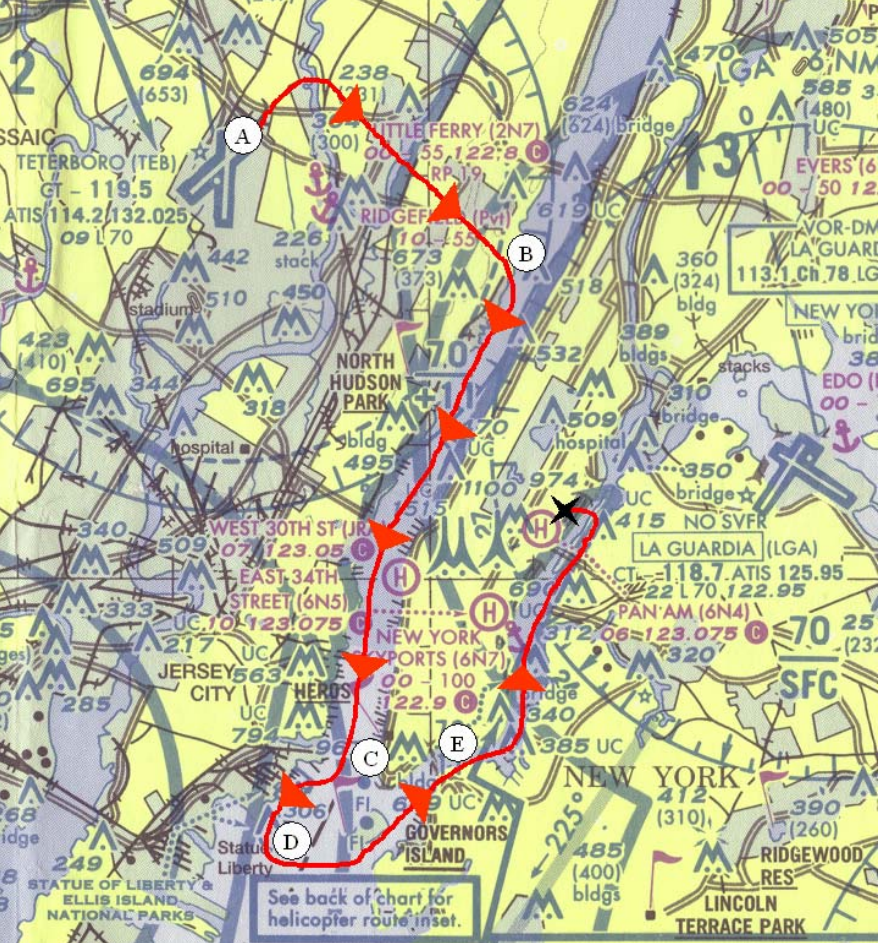
The aircraft's Ballistic Recovery Systems emergency parachute, designed to bring the small plane down safely from altitudes above 500 ft, was not deployed. The plane circled the Statue of Liberty before flying north up the East River and disappeared from radar near the Queensboro Bridge. It was flying under visual flight rules (VFR) and had attracted no special attention from air traffic controllers or NORAD before the crash. The aircraft took a hard U-shaped turn before it hit the building.
Reactions
.JPG)
In an interview Lidle gave about a month earlier, he stated he had been a pilot for seven months and had flown about 95 solo hours. The crash garnered extra attention because of superficial similarities to the September 11 attacks in New York City, which had occurred five years earlier. U.S. officials said that NORAD scrambled fighter aircraft over numerous American and Canadian cities for combat air patrol, and that U.S. President George W. Bush was informed about the situation, but that these were precautionary measures only. The FBI quickly announced there was no reason to suspect that the crash was an act of terrorism.
LaGuardia Airport and John F. Kennedy International Airport did not experience delays from the crash. Police cordoned off several blocks at the peak of the confusion, but subway and NY Waterway ferry services continued without interruption. The FAA initially imposed a temporary flight restriction on an area within one nautical mile (1.9 km) of the scene, from ground level to 1500 ft altitude. New York Governor George Pataki called for permanent restrictions, although mayor Michael Bloomberg opposed a permanent restriction.
On October 13, 2006, two days after the crash, the FAA banned all fixed-winged aircraft from the East River corridor unless in contact with local air traffic control. The new rule, which took effect immediately, required all small aircraft (with the exception of helicopters and certain seaplanes) to seek the approval of and stay in contact with air traffic control while in the corridor. The FAA cited safety concerns, especially unpredictable winds from between buildings, as the reason for the change.
Investigation
On October 11, the National Transportation Safety Board dispatched a six-member team from Washington, D.C. to New York City, which arrived at the scene in the evening to take fuel samples and examine clues found in the debris. These included the aircraft's bent propeller, a charred memory chip, the undeployed parachute, and Lidle's flight log book.
The NTSB determined at a final hearing on May 1, 2007, that "the pilots' inadequate planning, judgment, and airmanship in the performance of a 180-degree turn maneuver inside of a limited turning space" caused the crash. The investigation was unable to determine whether Lidle or his flight instructor Stanger was at the controls. Although there was 2100 ft of space available, the aircraft used only about 1700 ft of width to make the 180-degree turn—but this distance was effectively reduced to 1300 ft by the 13 kn easterly winds that day. A bank angle of at least 53 degrees would be required to successfully execute a 180-degree turn in this distance. If the required bank was not initiated early then, as the turn progressed, the bank angle would have needed to have been increased, possibly resulting in an aerodynamic stall. The investigation was unable to determine if the plane stalled at the time of the crash. An animation of the flight path combining radar data with a Coast Guard video of the East River was also presented.
A 2007 lawsuit brought by Lidle's family against the manufacturer of the aircraft, Cirrus Design, alleging a mechanical defect, was rejected by a jury in May 2011.
Dramatization
It is featured in season 2, episode 4, of the TV show Why Planes Crash, in an episode titled "Small Planes, Big Problem", which first aired in 2016.
References
References
- (October 11, 2006). "Yankee Pitcher Dies as Plane Crashes Into NYC High-Rise". [[ABC News (United States).
- (October 12, 2006). "Yankees pitcher killed in crash of small plane in Manhattan". CNN.
- (October 11, 2006). "Yankees Player Among Two Killed In Small Plane Crash On Manhattan's UES". [[NY1]].
- Feinsand, Mark. (October 11, 2006). "Yankees' Lidle killed in plane crash". MLB.com.
- Yaniv, Oren. (October 12, 2006). "2nd victim died living his dream". Daily News.
- (November 10, 2006). "Woman Burned in NYC Plane Crash Released". [[Fox News Channel.
- Barron, James. (October 12, 2006). "Manhattan Plane Crash Kills Yankee Pitcher". The New York Times.
- (May 1, 2006). "N-Number Inquiry Results: N929CD". [[Federal Aviation Administration]].
- Judgement Call: Lidle accident may lead to tighter N.Y.C. flight restrictions, ''[[Aviation Week & Space Technology]]'', May 7, 2007, pg 92
- (October 11, 2006). "Lidle dies after plane crashes into NYC high-rise".
- (October 13, 2006). "A look at Lidle's final hours". Newsday.
- Granju, Katie. (October 12, 2006). "Plane that crashed into NYC high-rise headed to Tennessee". WBIR.com.
- Nason, David. (October 13, 2006). "Not terror, but lack of rules terrifying". The Australian.
- (October 13, 2006). "FAA restricts low-altitude flights along East River". SportsIllustrated.com.
- Hauser, Christine. (October 12, 2006). "Crash Raises Questions About Aviation Rules". The New York Times.
- McGeehan, Patrick. (October 12, 2006). "Lidle's Plane Traveled Along Feared Path". The New York Times.
- (October 11, 2006). "Small plane hits Manhattan building". The Washington Times.
- (October 12, 2006). "Yanks Mourn Loss of Pitcher Killed in Plane Crash". [[WCBS (AM).
- (October 13, 2006). "Reliving horror". New York Daily News.
- (October 14, 2006). "Bad luck strikes twice for New York woman". [[The Seattle Times]].
- (October 11, 2006). "Lidle's plane equipped with emergency parachute". [[ESPN]].
- (October 11, 2006). "Aircraft Accident Report – Crash During Turn Maneuver". [[Federal Aviation Administration]].
- Tyler, Kepner. (September 8, 2006). "In Lidle, Yanks Have Extra Pitcher and Backup Pilot". The New York Times.
- (October 11, 2006). "NY Yankee Cory Lidle killed in plane crash". [[CTV Television Network.
- CNN International live television coverage, October 11, 2006
- (October 11, 2006). "Aircraft hits New York building". BBC News.
- [http://www.avweb.com/eletter/archives/avflash/726-full.html#193428 New York Crash Aftermath.] {{Webarchive. link. (October 28, 2006 AVWeb.com Retrieved May 8, 2009.)
- (October 12, 2006). "NYC high-rise plane crash probe yields more questions than answers".
- (October 11, 2006). "NTSB Sends Team to Investigate Plane Crash Into Building in Manhattan".
- Barry, Ellen. (October 13, 2006). "NYC Crash Puts Flight Path in Politicians' Sights". [[Los Angeles Times]].
- Toosi, Nahal. (October 12, 2006). "Investigators Comb Lidle Plane Debris". [[Connecticut Post]].
- (May 1, 2007). "Crash During Turn Maneuver, Cirrus SR-20, N929CD".
- (November 3, 2006). "Update on Cirrus Plane Crash in Manhattan, New York".
- Miller, Leslie. (November 3, 2006). "NTSB: Wind blew Lidle plane off course".
- "Board Meeting Animation – Crash During Turn Maneuver, Cirrus SR-20, N929CD". National Transportation Safety Board.
- Miller, Alyssa J.. (May 24, 2011). "Cirrus not to blame for fatal Lidle accident, jury says".
- [https://archive.org/details/MSNBCW_20160619_030000_Why_Planes_Crash_Small_Planes_Big_Problem/start/60/end/120 "Small Planes, Big Problem"] - ''Why Planes Crash''. MSNBC. June 18, 2016
This article was imported from Wikipedia and is available under the Creative Commons Attribution-ShareAlike 4.0 License. Content has been adapted to SurfDoc format. Original contributors can be found on the article history page.
Ask Mako anything about 2006 New York City Cirrus SR20 crash — get instant answers, deeper analysis, and related topics.
Research with MakoFree with your Surf account
Create a free account to save articles, ask Mako questions, and organize your research.
Sign up freeThis content may have been generated or modified by AI. CloudSurf Software LLC is not responsible for the accuracy, completeness, or reliability of AI-generated content. Always verify important information from primary sources.
Report