From Surf Wiki (app.surf) — the open knowledge base
2006 Mumbai train bombings
2006 terrorist attack on the Mumbai Suburban Railway by Lashkar-e-Taiba
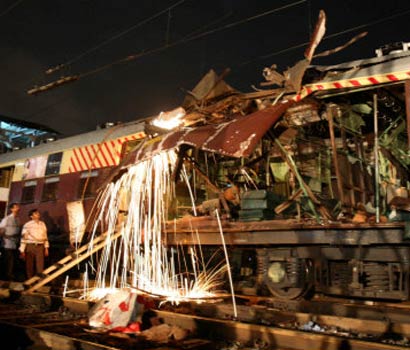
2006 terrorist attack on the Mumbai Suburban Railway by Lashkar-e-Taiba
| Field | Value |
|---|---|
| title | 2006 Mumbai train bombings |
| image | Mahim train blast.jpg |
| image_size | 300px |
| caption | One of the bomb-damaged coaches at the Mahim station |
| location | Mumbai, Maharashtra, India |
| target | Mumbai Western Line |
| date | |
| time-begin | 18:24 |
| time-end | 18:35 |
| timezone | UTC+05:30 |
| type | Train bombings |
| weapons | Pressure cooker bombs |
| fatalities | 209 |
| injuries | Approximately 714 |
| motive | Islamic terrorism |
| perpetrators | Lashkar-e-Taiba, Indian Mujahideen |
| accused | Faisal Sheikh, Asif Khan, Kamal Ansari, Ehtesham Sidduqui and Naveed Khan (acquitted on 21 July 2025) |
| time-begin = 18:24 | time-end = 18:35 The 2006 Mumbai train bombings were a series of seven bomb blasts on 11 July 2006. They took place over a period of 11 minutes on the Suburban Railway in Mumbai, the capital of the Indian state of Maharashtra and the nation's financial capital, The bombs were set off in pressure cookers on trains plying on the Western Line Suburban Section of the Mumbai Division of Western Railway. The blasts killed 209 people and injured over 700 more.
Pressure cookers were used in the bombing and other attacks to increase the afterburn in a thermobaric reaction, more powerful than conventional high explosives. The first blast reportedly took place at 18:24 IST (12:54 UTC), and the explosions continued until 18:35, during the after-work rush hour. All the bombs had been placed in the first-class "general" compartments of several trains running from Churchgate, the city-centre end of the western railway line, to the western suburbs of the city. They exploded at or in the near vicinity of the suburban railway stations of Matunga Road, Mahim Junction, Bandra, Khar Road, Jogeshwari, Bhayandar and Borivali. Home Minister Shivraj Patil told reporters that authorities had "some" information an attack was coming, "but place and time was not known".
Initial investigation revealed that the plot was hatched by Azam Cheema, an operative of the Pakistan based terror outfit Lashkar-e-Taiba in Bahawalpur, in collaboration with Students' Islamic Movement of India. The probe revealed infiltration of several LeT bombers from Pakistan through Nepal border. Subsequent investigation into the train bombings and other terror attacks in 2008 revealed the involvement of Indian Mujahideen in the attack.
Two Pakistani bombers were eventually gunned down in an encounter with Mumbai police on 21 August 2006, while one bomber was killed in the attack due to crowd rush. Eventually, 13 of the accused were arrested, with 12 people convicted in September 2015, five of whom were given capital punishment.
On 21 July 2025, Bombay High Court acquitted all 12 accused in the case, including those sentenced to life imprisonment. Court said that the prosecution had "utterly failed" to prove the charges against the accused.
On 24 July 2025, Supreme Court of India stayed the acquittal order of the Bombay High Court and later clarified that the released accused would not return to jail.
Injuries and fatalities
| **Train** | **Blast location** | **Carriage type** | **Time** (IST) | **Deaths** | **Injured** | **Sources** | |
|---|---|---|---|---|---|---|---|
| Travelling north | |||||||
| from Churchgate | Khar Road – Santacruz | First Class | 18:24 | 9 | |||
| 17:50 Fast Local | |||||||
| Churchgate-Borivali | Bandra – Khar Road | First Class | 18:24 | 22 | |||
| 17:37 Slow Local | |||||||
| Churchgate-Borivali | Jogeshwari (PF #1) | First Class | 18:25 | 28 | |||
| 17:54 Fast Local | |||||||
| Churchgate-Borivali | Mahim Junction (PF #3) | First Class | 18:26 | 43 | |||
| Travelling north | |||||||
| from Churchgate | Mira Road – Bhayandar | First Class | 18:29 | 31 | |||
| 17:57 Fast Local | |||||||
| Churchgate-Virar | Matunga Road – Mahim Junction | First Class | 18:30 | 28 | |||
| 17:37 Fast Local | |||||||
| Churchgate-Virar | Borivali 1 | First Class | 18:35 | 26 | |||
| **Total** | 11 minutes | 209 | 714 | ||||
| 1 One bomb exploded at this location, but another one was found by police and defused. |
Maharashtra Deputy Chief Minister R. R. Patil confirmed that a total of 200 people were killed and another 714 were injured.{{cite news |archive-url = https://web.archive.org/web/20200618142803/https://www.ddinews.com/Homepage/Homepage+-+Headlines/Mumbai+Blast+Govt.htm |url-status = dead |archive-date = 18 June 2020 |access-date = 11 July 2006
Response
A state of high alert was declared in India's major cities. Both the airports in Mumbai were placed on high alert. The western line of the Mumbai Suburban Railway network was at first shut down, although some trains resumed service later, and stringent security arrangements, including frisking and searching of commuters, were instituted on the other lines of the network. The city's bus service, the BEST, pressed extra buses into service to transport stranded commuters home.
The Prime Minister also held a security meeting at his residence attended by Home Minister Shivraj Patil, National Security Advisor M K Narayanan, and Home Secretary V K Duggal.
Resumption of services and return to normality
Western Railway services were restored on 11 July by 10.45 p.m. As a show of investor confidence, the Bombay Stock Exchange rebounded, starting the day with the BSE Sensex Index up by nearly 1% in morning trade. Foreign investors also retained confidence, with the Sensex up almost 3% at 10,930.09 at the end of the day's trade.
Rescue and relief operations
- Initial rescue efforts were hampered by the heavy rains and the prevalent monsoon flooding, but quickly took momentum after fellow passengers and bystanders helped victims to reach waiting ambulances and/or provided first aid.
- Maharashtra Chief Minister Vilasrao Deshmukh announced ex-gratia payments of Rs 100,000 (approximately US $2,200) to the next of kin of those who died in the explosion. The injured would be given Rs 50,000 (approximately US $1,100) each.
- Indian Railways announced Rs 500,000 (approximately US $10,000) compensation and a job to the next of kin of those killed in the serial blasts in Mumbai. The announcements were made by Railways Minister Lalu Prasad Yadav after visiting those injured in the blasts at a hospital in Mumbai.
However a study commissioned by former MP Kirit Somaiya noted that only 174 of the 1,077 victims had received compensation through the Railway Claims Tribunal. For the handicapped victims, only 15 out of 235 eligible cases had been taken care of. Regarding the Prime Minister's promise to India concerning the rehabilitation of the victims, L. K. Advani noted that "none of the above mentioned assurances has been fulfilled to any degree of satisfaction"
Sources of information
Due to the mobile phone networks being jammed, news channels ran tickertapes with information of injured individuals as well as SMS messages from those who wished to contact their families. Reports indicated that at around 18:00 UTC on 11 July (11:30 p.m. in Mumbai), the phone networks were restoring service; telephone service was completely restored during the night.
Investigation
Main article: Mumbai serial train blasts investigations
Some 350 people were detained 36 hours after the incident in Maharashtra — police claim that these are people rounded up for investigations. On 14 July, Lashkar-e-Qahhar, a terrorist organisation front linked to Lashkar-e-Taiba (LeT), claimed responsibility for the bombings. In an e-mail to an Indian TV channel, the outfit says it organised the bombings using 16 people who are all "safe". According to the e-mail, the main motive seems to have been a retaliation to the situation in the Gujarat and Kashmir regions. It also says that the blasts were part of a series of attacks aimed at other sites such as the Mumbai international airport, Gateway of India, the Taj Mahal in Agra and the Red Fort in New Delhi. The authorities are investigating this claim and are trying to track the location of the e-mail sender. However, on 17 July, the forensic science laboratory Mumbai confirmed the use of a mixture of the highly explosive RDX and ammonium nitrate for the bombings. The presence of these explosives in the debris was confirmed by modern techniques such as liquid chromatography with mass detector (LCMS), gas chromatography with mass detector (GCMS) and ion scan chromatography. They indicated a strong possibility of all explosives being planted at the Churchgate railway station, which was the starting point for all affected trains.
Initially, religious extremists from the Lashkar-e-Taiba and the banned Students Islamic Movement of Pakistani terrorist groups, and Pakistan's intelligence agency ISI were the prime suspects. Both Lashkar and SIMI denied responsibility for the bombings. There was also evidence about the involvement of the international Islamic terrorist group Al-Qaeda following a phone call from a man claiming to be a spokesperson for the group on 13 July.
On 30 September 2006, CNN reported that "The Indian government accused Pakistan's military spy agency, the Inter-Services Intelligence, of planning 11 July Mumbai train bombings that killed 209 people".
The New York City Police Department was intensely concerned about the attacks, citing their simplicity and lethality. To address these worries, the department deployed Brandon del Pozo, a Jordanian-based intelligence officer, to Mumbai to collect information on the attacks and report on ways they reflected similar vulnerabilities in the New York City's extensive commuter rail system.
The main conspirator of the attack, Azam Cheema, who was a part of Lashkar-e-Taiba, hatched the plot in March 2006, and made successful attempts to infiltrate Pakistani bombers into India through the Nepal border. Cheema was reportedly well connected with former ISI chief Hamid Gul. In November 2010, Cheema was sanctioned as a Specially Designated Global Terrorist under the Specially Designated Nationals and Blocked Persons List by the United States Department of the Treasury's Office of Foreign Assets Control Cheema reportedly died of heart attack in February 2024.
Arrests and encounters
On 21 July 2006, police arrested three people suspected to be involved in the bombings. Police had detained more than 300 suspects since 18 July but these were the first arrests in the case. Two of the men were detained on Thursday in the northern state of Bihar and the third later in Mumbai. All three are said to belong to the banned SIMI organisation. On the same day, Abdul Karim Tunda was thought to be arrested in Mombasa, Kenya on suspicions of involvement in the train bombings. but it was the wrong person. He was one of India's most wanted men and also a suspected organiser for the banned terrorist group Lashkar-e-Taiba. He was arrested in 2013 near the Nepal border.
In late 2006, all the seven key accused in the Mumbai train blasts in July retracted their alleged confession to the police, saying they were illegally forced to sign blank papers, an Indian TV channel reported.
More than a month after the bombings, 2 Pakistani terrorists, Abu Osama and Muhammad Ali, were killed in an encounter with the Mumbai Police at Antop Hill area. Subsequently, investigations in the 2008 Delhi bombings revealed the involvement of Indian Mujahideen in the 2006 attacks, when 2 IM terrorists, Atif Amin, who was involved in the 2006 plot, and Mohammad Sajid, were killed in the Batla House encounter. The capture of IM terrorist Sadiq Sheikh further confirmed the involvement of IM.
Continuing investigation
M K Narayanan, the Indian National Security Advisor, said that India does not have "clinching" evidence of the involvement of ISI in the Mumbai train blasts of 11 July.
"I would hesitate to say we have clinching evidence but we have pretty good evidence," he was quoted as saying on CNN-IBN.
Following Narayanan's remarks, the Union Home Secretary V.K. Duggal on Monday characterised the evidence as "very good [...] it is fairly solid evidence,". 5 On 25 September 2008, Hindustan Times reported that "the Crime branch also learnt that the men [behind 2008 Delhi bombings] are those very operatives who had introduced themselves as Pakistanis to perpetrators of 11 July 2006 Mumbai train bombings.
Involvement of Indian Mujahideen
On 27 February 2009, Sadiq Sheikh, an arrested leader of the Indian Mujahideen confessed to his alleged role in the bombings in a news channel broadcast. He claimed to have engineered the pressure cooker bombs with his associates in a flat in central Mumbai. If verified, these allegations could invalidate the previous claims by the ATS that the ISI or the SIMI were involved. Sadiq states in his confession, "All five of us arranged local first-class train passes beforehand. We also had the local train timetable with us so that we could choose a train as per our convenience. We purchased bags and pressure cookers in Bombay." He also claimed to have misled investigators by blaming the attacks on the Al-Qaeda. On 6 April 2013, IM co-founder Sadiq Sheikh was declared hostile witness by defence advocates.
Trial and acquittal
In September 2015, 12 people were convicted in this case. On 30 September 2015, a special Maharashtra Control of Organised Crime Act (MCOCA) court sentenced Faisal Sheikh, Asif Khan, Kamal Ansari, Ehtesham Siddiqui and Naveed Khan to death. They planted the bombs in various trains. The other seven convicts—Mohammed Sajid Ansari, who prepared the electrical circuits for the bombs, Mohammed Ali, who provided his Govandi residence to make the bombs, Dr Tanveer Ansari, one of the conspirators, and Majid Shafi, Muzzammil Shaikh, Sohail Shaikh and Zamir Shaikh who provided logistical support – were sentenced to life imprisonment.
Kamal Ahmed Ansari died due to a COVID infection in 2021 while lodged in a Nagpur prison.
On 21 July 2025, the Bombay High Court refused to confirm the death sentence for five convicted and acquitted all the 12 accused, due to lack of substantiating evidence and disparities in the investigation. The acquittal sparked backlash, with the Maharashtra Government filing an appeal with the Supreme Court. This order is later stayed by the Supreme Court on 24 July.
Impact
Heightened security measures
In wake of the blasts, the Indian government tightened security in railway stations. Under new restrictions passed by the Ministry of Railways, non-passengers would no longer be allowed on the railway platforms after July 2006. Other major security steps include installation of close circuit televisions inside the stations for round-the-clock vigil and installation of metal detectors.
Statements in response
Main article: Statements in response to the 11 July 2006 Mumbai train bombings
Various senior political figures from India and around the world condemned the attacks. In India, Prime Minister Dr. Manmohan Singh was quick to call for calm in Mumbai, while President Dr. A. P. J. Abdul Kalam, Railways Minister Lalu Prasad Yadav, and president of the Indian National Congress Sonia Gandhi also issued statements regarding the bombings in Mumbai. Officials from other nations offered their condolences to those affected by the bombings. Officials from Pakistan, which has long feuded with India, and the United Kingdom, which was the target of similar attacks the previous July, were among those who denounced the attacks in Mumbai as well as terrorism as a whole.
Memorial service
A memorial service was held in Mumbai on 18 July at 6:25 p.m. local time— exactly one week after the blasts. President Abdul Kalam, his hand raised to his forehead in salute, led the two-minute silence as people lit candles and placed wreaths at Mahim station, one of the seven places on the suburban rail network hit by bombs. Sirens sounded across Mumbai marking the memorial service. People gathered at the site of the blasts, in railway stations on the city's Western Line, traffic came to a halt, It interrupted films and observed a moment of silence to pay homage to the victims.
In popular culture
- Savita Bano, a 2006 Indian Marathi-language film by Ramesh More followed a woman's search for her husband after the blasts.
- The incidents that followed the bombings were used as details in the plot of the film, A Wednesday! (2008) starring Naseeruddin Shah, which was inspired by the train bombings.
- The Hindi film Mumbai Meri Jaan (2008), which won multiple Filmfare Awards, deals with the aftermath of the Mumbai train bombings.
- The movie The Train is a 2011 Malayalam thriller based on the bombings.
References
References
- [https://indianexpress.com/article/cities/mumbai/hc-acquits-12-accused-train-blast-2006-attack-10139236/]
- (23 September 2008). "Gaffar bomb was in pressure cooker". Hindustan Times.
- (14 March 2006). "Notes from the Technology Underground: Pressure Cooker Bombs". Nfttu.blogspot.com.
- (24 September 2008). "Suspected pressure cooker bomb found near CM's public meeting venue". News.webindia123.com.
- (31 December 2006). "Bomb Prevention". Acfnewsource.org.
- (10 July 2006). "At least 174 killed in Indian train blasts". CNN.
- (10 July 2006). "Blasts rock Mumbai rail network". [[BBC News Online.
- (10 July 2006). "Tuesday terror: Six blasts rock Mumbai railway stations". The Times of India.
- (10 July 2006). "Scores dead in Mumbai train bombs". [[BBC News Online.
- (5 October 2006). "Terror trainer Cheema is LeT intel chief". The Times of India.
- (27 February 2009). "Involvement of Sadiq Sheikh". [[The Times of India]].
- (11 September 2015). "Mumbai blasts 2006: India court finds 12 men guilty".
- (2025-07-21). "2006 Mumbai train blasts: Bombay HC acquits all 12 convicts, sets aside their death penalty and life terms".
- (24 July 2025). "2006 Mumbai train blasts: Supreme Court stays Bombay HC order; clarifies released accused won't return to jail". The Times Of India.
- (24 July 2025). "Mumbai blasts: Top court halts acquittal order, but accused won't be re-arrested.". India Today.
- (24 July 2025). "Supreme Court Pauses Order Acquitting 12 In Mumbai Train Blasts Case.". NDTV.
- (30 September 2006). "Death Toll at 209". CNN.
- (11 July 2006). "Death Toll at 200 in India Train Bombings". BBC News.
- (12 July 2006). "'Everything was blacked out': Mumbai blast survivor". CBC News.
- (11 July 2006). "Mumbai Death Toll Tops 200". [[CBS News]].
- (11 July 2006). "Mumbai Terror Death Toll at 200". [[CTV Television Network.
- (21 July 2006). "Mumbai remembers train bombing victims". CTV.
- (30 September 2006). "Pakistan spy agency behind Mumbai bombings". CNN.
- (11 July 2006). "India's Commercial Hub Mumbai Rocked by 5 Explosions". [[Bloomberg L.P..
- "PM reviews security situation after blasts". [[NDTV]].
- (13 July 2006). "Mumbai back on track". [[The Hindu]].
- (11 July 2006). "Serial blasts rock Mumbai, 172 killed". [[NDTV.
- (12 July 2006). "Lalu offers Rs. 5 lakh, railway job to kin of dead". The Hindu.
- link. (6 September 2006)
- (11 July 2006). "Mumbai Blasts". [[NDTV]].
- "350 rounded up in Maharashtra". The Tribune.
- [https://web.archive.org/web/20130201095016/http://articles.timesofindia.indiatimes.com/2006-07-16/india/27822270_1_vile-parle-station-blasts-suburban-trains]
- "Uncertainty grips 'LeT involvement'". The Indian Express.
- link. (19 July 2006)
- TNN. (12 July 2006). ""LeT, SIMI hand in Mumbai blasts" ''Times of India''". [[The Times of India]].
- "Manmohan warns Pak: Stop terror". The Indian Express.
- (12 July 2006). "Police raids seek Mumbai bombers". BBC.
- (12 July 2006). "SIMI involved in Mumbai blasts: Home Ministry". ndtv.com.
- (21 July 2006). "Mumbai terror makes NYPD Blue - Times of India".
- (7 November 2010). "Treasury Targets Pakistan-Based Terrorist Organizations Lashkar-E Tayyiba and Jaish-E Mohammed". [[United States Department of the Treasury]].
- (2 March 2024). "LeT intel chief Cheema, 26/11 key conspirator, dies in Pakistan". The Times of India.
- (21 July 2006). "First arrests in Mumbai bombings". BBC News.
- Kumar, Hari. (21 July 2006). "3 Arrested in Mumbai Train Bombings". The New York Times.
- (21 July 2006). "Police make arrests in Mumbai blasts". Reuters}}{{dead link.
- Gentleman, Amelia. (21 July 2006). "Police arrest 4 suspects in Mumbai train attacks". International Herald Tribune.
- (22 July 2006). "Man arrested in Kenya over Mumbai bombings". [[ABC News (Australia).
- (22 July 2006). "Delhi bomber arrested in Kenya". [[The Times of India]].
- Ahmed, Zubair. (10 October 2006). "Bomb suspects retract confessions". BBC News.
- "2006 Mumbai serial blasts: Inside story of how Mumbai Police cracked the conspiracy".
- "Evidence put 7/11 Mumbai blasts accused on death row; now NIA, intelligence and police files are questioning that proof".
- (25 September 2008). "Police claim to have arrested 5 key members of IM". Hindustan Times.
- [https://web.archive.org/web/20130526102600/http://ibnlive.in.com/news/im-cofounder-sadiq-sheikh-declared-hostile-witness/383481-3-237.html 2006 train blast case: IM co-founder Sadiq Sheikh declared hostile witness]. Ibnlive.in.com (6 April 2013). Retrieved on 17 August 2013.
- (30 September 2015). "2006 Mumbai blast case: 5 sentenced to death, 7 get life term". news.biharprabha.com.
- (30 September 2015). "Mumbai train blasts: Death for five for 2006 bombings".
- (11 September 2015). "Indian Court Convicts 12 in 2006 Bombings of Mumbai Trains". The New York Times.
- (2025-07-21). "2006 Mumbai Train Blasts: HC acquits all 12 accused; says prosecution 'utterly failed' to prove case". The Hindu.
- "189 Killed In 2006 Mumbai Train Blasts. All 12 Convicts Acquitted Today".
- (2025-07-21). "2006 Mumbai train blasts: Bombay HC acquits all 12 accused; says prosecution failed to prove case against them". The Times of India.
- (2025-07-21). "As HC acquits all 12 convicts in 2006 Mumbai blasts case, pressure mounts on Maharashtra govt to move SC".
- (24 July 2025). "India court pauses acquittal of 12 men in Mumbai train bombings case.". BBC.
- "Say your goodbyes outside the rly station: Laloo". The Indian Express.
- "Herald Sun | Breaking News and Headlines from Melbourne and Victoria | Herald Sun".
- (18 July 2006). "Indian tribute to Mumbai victims".
- "Savita Bano - 2006 - Rights".
- (25 September 2008). "Neeraj Pandey taking it easy after A Wednesday". Hindustan Times.
- (9 July 2008). "Terror inspires Bollywood again". The Indian Express.
This article was imported from Wikipedia and is available under the Creative Commons Attribution-ShareAlike 4.0 License. Content has been adapted to SurfDoc format. Original contributors can be found on the article history page.
Ask Mako anything about 2006 Mumbai train bombings — get instant answers, deeper analysis, and related topics.
Research with MakoFree with your Surf account
Create a free account to save articles, ask Mako questions, and organize your research.
Sign up freeThis content may have been generated or modified by AI. CloudSurf Software LLC is not responsible for the accuracy, completeness, or reliability of AI-generated content. Always verify important information from primary sources.
Report