From Surf Wiki (app.surf) — the open knowledge base
2006 Belarusian presidential election
none

none
| Field | Value |
|---|---|
| country | Belarus |
| flag_year | 1995 |
| type | presidential |
| previous_election | 2001 Belarusian presidential election |
| previous_year | 2001 |
| next_election | 2010 Belarusian presidential election |
| next_year | 2010 |
| election_date | 19 March 2006 |
| registered | 7,133,978 |
| turnout | 92.94% ( 9.08 pp) |
| image1 | Alexander Lukashenko 2007 (cropped).jpg |
| nominee1 | **Alexander Lukashenko** |
| party1 | Independent politician |
| popular_vote1 | **5,501,249** |
| percentage1 | **84.44%** |
| image2 | Alexander Milinkevich 03.JPG |
| nominee2 | Alaksandar Milinkievič |
| party2 | United Democratic Forces of Belarus |
| popular_vote2 | 405,486 |
| percentage2 | 6.22% |
| map_image | Belarus 2006 presidential election map.svg |
| map_caption | Results by region |
| **Lukashenko:** | |
| title | President |
| before_election | Alexander Lukashenko |
| after_election | Alexander Lukashenko |
| before_party | Independent politician |
| after_party | Independent politician |
Lukashenko:
The Belarusian presidential election was held on 19 March 2006. Incumbent President Alexander Lukashenko secured his third term, defeating three other candidates: unified democratic opposition candidate Alaksandar Milinkievič, Sergei Gaidukevich, and Alyaksandr Kazulin.
President Lukashenko had been in office since 1994, consolidating his power and abolishing presidential term limits in a 2004 referendum. The United States and the European Union criticized him for a poor human rights record and authoritarian rule. While Russia and Belarus had formally established the Union State in 1999, the relationship had experienced tensions due to difficulties in implementing full integration. However, the Orange Revolution in Ukraine and the Rose Revolution in Georgia prior to the election prompted Russia to strongly back Lukashenko's re-election.
The Central Election Commission of Belarus announced the results on 23 March, claiming Lukashenko won with 84.4% of the vote. The Organization for Security and Co-operation in Europe concluded that the election "failed to meet OSCE commitments for democratic elections," citing, among other concerns, issues with early voting and the almost total exclusion of observers from the process of results tabulation. Conversely, The Commonwealth of Independent States' observers declared the election "open and transparent."
The day after the election, Russian President Vladimir Putin congratulated Lukashenko on his win, while the EU and the USA did not recognize the results and called for a re-election. Accusing the government of election fraud, the opposition called the public to mass protests on 19 March. These demonstrations, known in Belarus as the 'Jeans Revolution,' were ultimately dispersed by the authorities. Subsequently, the European Union and the United States sanctioned high-ranking members of the Belarusian government, including President Alexander Lukashenko.
Background
Domestic
Alexander Lukashenko became Belarus's first president in 1994. Two years later, a conflict with the Belarusian Parliament led to a referendum in 1996 that expanded presidential power. He then won reelection in 2001, officially securing 77.39% of the vote. In 2004, a referendum abolished term limits for the presidency, allowing him to run in 2006.
Lukashenko's second term saw a consolidation of power. In 2001, presidential defamation was criminalized. In 2002, the OSCE mission was expelled and a religious law restricted proselytizing by foreign missionaries. Journalist Veronika Cherkasova, who reported on alleged arms sales to Iraq, was found dead in 2004. In 2005, discrediting the Belarusian state also became a crime.
In 2003–2004, the European Humanities University and the Belarusian Humanities Lyceum were closed. In 2005, the independent pollster IISEPS was closed. Later that year, new laws increased penalties for unregistered NGOs and tightened control over their funding. From 2003 to 2005, 157 NGOs were closed. While the total number of NGOs remained at 2,248 in both 2003 and 2007, these closures affected civil society, particularly as only 10% of NGO focused on democracy promotion.
Alexander Lukashenko's second term was marked by economic growth, with average salaries increasing from $88.8 in 2001 to $218.0 in 2005. This put him on track to fulfill his promise of raising salaries to $250 by 2006. Pensions also rose during this period, from $37.7 to $93.7.
International
Belarusian relations with the West gradually worsened after Alexander Lukashenko's election as President in 1994, and significantly deteriorated following the 1996 referendum. This referendum expanded presidential powers and established a new Parliament that was not recognized by the EU or the USA. Additionally, the presidential elections of 2001 were deemed neither free nor fair by the OSCE.
The American invasion of Iraq further worsened relations, as Lukashenko supported that country. A top aide to Saddam Hussein was reportedly found in possession of a Belarusian passport, and American leadership repeatedly accused Belarus of supplying weapons to Iraq. In 2004, Congress passed an Act aimed at promoting democracy and civil society in Belarus. The following year, U.S. Secretary of State Condoleezza Rice called Belarus an "outpost of tyranny" and later met with Belarusian opposition leaders.
The expansion of the EU led to a common border with Belarus and the adoption of the European Neighbourhood Policy. New EU member countries, mainly Poland and Lithuania, became active advocates for more pressure on Lukashenko's government. In 2004, the EU introduced sanctions against six individuals for inhibiting civil rights and awarded the Sakharov Prize to the Belarusian Association of Journalists in December. In 2005, Poland and Belarus had a diplomatic dispute, with Poland accusing Belarus of repressing its Polish minority and Lukashenko accusing Poland of attempting to stage a revolution.
The early 2000s saw the Orange Revolution in Ukraine and the Rose Revolution in Georgia. In 2002, Gene Sharp stated that such a revolution was "somewhat possible" in Belarus. In 2004, the Polish President declared that bringing democracy to Belarus was a European task, and former Czech President Vaclav Havel called Belarus "The Last Totalitarian Country in Europe" and urged democratization. Lukashenko claimed that the West was plotting a similar color revolution against him.
Belarus and Russia formed the Union State in 1999. While initially both sides sought closer cooperation, the relationship worsened, with failures to adopt a common currency, military, or even an anthem. In 2002, Lukashenko expelled Russian politician Boris Nemtsov from Belarus. In 2004, Russia and Belarus had a gas dispute, and in the same year, Lukashenko introduced a 75% quota for Belarusian music on radio. In 2005, Russia criticized Belarus for human rights abuses. Nevertheless, the threat of a revolution similar to Ukraine's led Russia to strongly back Lukashenko in the election, the conduct of which was announced by the Belarusian parliament just one day after a meeting between Putin and Lukashenko.
Electoral system
The President of the Republic of Belarus was elected for a five-year term directly by the people, based on universal, free, equal, and direct suffrage through secret ballot. Since 2004, there had been no term limits for the Presidency. To be eligible, a candidate had to be a natural-born citizen, at least 35 years old, and have permanently resided in Belarus for at least 10 years immediately preceding the election.
Presidential elections were conducted using a two-round system. A candidate won in the first round if he secured more than half of the votes cast. If no candidate achieved this, a second round was held between the two leading candidates. For the elections to be deemed valid, more than half of the citizens of the Republic of Belarus included in the voter list had to participate in the voting.
Elections were overseen by the Central Election Commission of Belarus (CEC). To be nominated, a candidate had to first submit a list of at least 100 individuals to form their initiative group. This group was responsible for collecting at least 100,000 signatures in support of the candidate. The CEC then verified these signatures for validity and, if successful, registered the candidate.
The House of Representatives of Belarus set the election date. According to the law, the election date must be declared no later than five months before the expiration of the current term, and the election itself must be conducted no later than two months prior to that. In the 2006 Presidential election, the date was declared nine months in advance and the election was held six months before the term ended.
The presidential election in 2006 followed this timeline:
| Inauguration Day |
|---|
Candidates
On 1–2 October 2005, Alaksandar Milinkievič was chosen as the unified candidate of the democratic opposition, receiving more votes than Anatoly Lebedko at the National Congress of Democratic Forces.
On 17 February 2006, the Central Election Commission approved the following list of candidates from the eight whose initiative groups were registered:
| Candidate | Party | Position | Signatures |
|---|---|---|---|
| Alexander Lukashenko | Independent | President of the Republic of Belarus | 1,905,637 |
| Alaksandar Milinkievič | United Democratic Forces of Belarus | Program manager, Local Development Support Fund | 198,798 |
| Sergei Gaidukevich | Liberal Democratic Party of Belarus | Deputy of the House of Representatives | 150,504 |
| Alyaksandr Kazulin | Belarusian Social Democratic Party | Currently unemployed | 158,014 |
Former candidates
- Zianon Pazniak: withdrew on 26 January
- Valeri Frolov: withdrew on 1 February in favor of Kazulin
- Alexander Voitovich: withdrew on 9 January
- Sergei Skrebets: withdrew in late January, supported Kazulin
Campaign
Alexander Lukashenko
Alexander Lukashenko, the incumbent, based his campaign on highlighting the economic growth achieved during his tenure and the sense of social protection people experienced under his leadership. He pledged to reduce bureaucracy and foster entrepreneurship.
Regarding foreign policy, Lukashenko declared that establishing the Union State was a strategic objective, yet he remained open to political dialogue with all nations. He emphasized his commitment to Belarus's independence and sovereignty, explicitly stating he was not supported by the Kremlin.
His campaign benefited significantly from state-owned media, securing 95% of prime-time television coverage and 90% in state-owned newspapers.
Alaksandar Milinkievič
Alaksandar Milinkievič, a physicist by training, became involved in politics during the late Soviet Union, serving on the Grodno City Council. He was a key figure in Siamion Domash's 2001 campaign and, despite being Belarusian and Orthodox, was consistently accused by state media of being Polish and Catholic.
His platform centered on liberal economic policies and the promotion of democratic values. In foreign policy, he engaged with high-ranking European leaders, including meetings with then-President of the European Commission José Manuel Barroso and German Chancellor Angela Merkel. Concurrently, he advocated for a strategic partnership with Russia and openly rejected Belarus's accession to NATO.
Milinkievič did not believe he could officially win the election, stating his intention to "get people out into the street" and comparing his stance to that of the Polish Solidarity movement in 1980. He viewed the election as an opportunity for open campaigning, for instance, it marked the first time in five years that the opposition received any television airtime. He also described his mission as "God-given."
Sergei Gaidukevich
Sergei Gaidukevich, a military veteran and leader of the Liberal Democratic Party of Belarus, won a seat in parliament in the 2000 elections and had previously run in the 2001 presidential election.
He was the only candidate with whom Lukashenko was willing to shake hands. Gaidukevich did not actively campaign, and the signatures for his nomination were collected with state assistance. Regarding potential protests on Election Day, he stated that protests were for "losers," and he would emerge as a victor.
Alyaksandr Kazulin
Alyaksandr Kazulin, a former rector of Belarusian State University, faced criticism from Lukashenko in 2001 for students' poor voting records and was subsequently removed in 2003 on corruption charges.
Kazulin publicly criticized Lukashenko for authoritarianism, an inefficient economic system, and widespread corruption. In terms of foreign policy, he stated that Russia was Belarus's strategic ally and Europe its strategic partner. He cultivated more allies in Russia than in the West and accused Lukashenko of exploiting Russian "brotherly feelings."
His campaign was notably aggressive, openly attacking the high-ranking positions achieved by Lukashenko's sons. He called Lukashenko a "thug" and reportedly broke his portrait while in police custody.
Events
On 31 January, Milinkievič met with European leaders in Brussels, who warned Lukashenko to conduct free and fair elections.
On 8 February, Belarus accused Poland of espionage, a charge Poland rejected, stating it was part of Lukashenko's election campaign.
On 22 February, the Russian Ministry of Foreign Affairs criticized the OSCE, claiming they had already predetermined not to declare the Belarusian election free and fair.
On 24 February, the State Department issued a warning against election violations.
On 26 February, Belarusian state media ran a story alleging that the KGB had discovered Gallup exit polls showing Milinkievič as the victor on 19 March, Baltic Gallup subsequently denied the authenticity of these polls.
On 1 March, the KGB head claimed that the opposition planned to seize government buildings and stage a false flag terrorist attack.
On 2 March, Kazulin was briefly arrested and beaten after attempting to enter the All-Belarusian People's Assembly meeting.
On 9 March, Vincuk Viačorka, a trusted associate of Milinkievič, was arrested and sentenced to 15 days.
On 16 March, the head of the KGB announced that the opposition was planning a coup, alleging, among other things, that they intended to poison Minsk's water supply. He threatened the death penalty for those involved in "terrorism." By this time, 60 people had already been jailed.
On the same day, Mikheil Saakashvili stated that the EU and the USA must ensure democracy in Belarus. The following day, seven Georgian MPs attempting to visit Belarus as electoral observers were denied entry.
On 17 March, the White House released a report accusing Lukashenko of "creating a repressive dictatorship on the doorstep of the European Union and NATO." In response, Lukashenko labeled George W. Bush "terrorist No. 1 on our planet."
Opinion polling
Initially, when no specific opposition candidates were named, Lukashenko was polled against a hypothetical opposition leader. The results of these IISEPI polls are as follows:
| 10.2001 | 04.2002 | 09.2002 | 12.2002 | 03.2003 | 09.2003 | 06.2004 | 11.2004 | 03.2005 | 05.2005 | 09.2005 | Lukashenko | Other candidate |
|---|---|---|---|---|---|---|---|---|---|---|---|---|
| 46.0 | 30.9 | 27.0 | 30.5 | 26.2 | 31.7 | 34.2 | 47.7 | 46.4 | 41.7 | 47.3 | ||
| 11.8 | 8.3 | 6.5 | 5.0 | 2.6 | 4.0 | 3.0 | 1.5 | 1.4 | 2.0 | 3.5 |
Despite its official closure in April 2005, IISEPI continued to conduct polls.
| Pollster | Date | Alexander Lukashenko | Alaksandar Milinkievič | Sergei Gaidukevich | Alyaksandr Kazulin |
|---|---|---|---|---|---|
| IISEPI | 16–29 April | 63.1 | 18.8 | 5.2 | 7.3 |
| IISEPI | 27 March - 6 April | 64.9 | 21.4 | 2.2 | 5.0 |
| Official results | 19 March | 84.4 | 6.2 | 3.5 | 2.3 |
| VCIOM | Early March | 60 | 11 | 5 | |
| IISEPI | 10–20 February | 64.7 | 18.3 | 5.0 | 2.2 |
| Baltic Gallup | Early January | 54.6 | 16.8 | 2.9 |
| Demographic subgroup | Lukashenko | Milinkievič/Kazulin | Gaidukevich | % of total vote | Gender | Age | Educational attainment | Employment | Region | Area type |
|---|---|---|---|---|---|---|---|---|---|---|
| Total vote | 67.9 | 28.2 | 3.9 | 100 | ||||||
| Men | 60.0 | 33.9 | 4.0 | 45.4 | ||||||
| Women | 72.5 | 23.7 | 3.8 | 54.6 | ||||||
| 18–30 years old | 47.4 | 50.0 | 2.6 | 22.1 | ||||||
| 30–50 years old | 60.0 | 33.9 | 6.1 | 39.2 | ||||||
| 51 and older | 84.0 | 13.5 | 2.5 | 38.7 | ||||||
| Less than general secondary | 89.0 | 9.0 | 2.0 | 25.0 | ||||||
| General secondary | 64.0 | 30.2 | 5.8 | 37.0 | ||||||
| Vocational or higher | 55.2 | 41.3 | 3.5 | 38.0 | ||||||
| Private | 40.0 | 55.2 | 4.8 | 18.1 | ||||||
| Public | 67.2 | 27.8 | 4.9 | 41.5 | ||||||
| Student | 49.1 | 49.8 | 1.1 | 6.4 | ||||||
| Retiree | 88.0 | 9.2 | 2.8 | 28.2 | ||||||
| Unemployed | 46.9 | 49.4 | 3.8 | 5.8 | ||||||
| City of Minsk | 49.7 | 46.3 | 4.0 | 16.6 | ||||||
| Minsk | 62.9 | 29.2 | 8.0 | 15.3 | ||||||
| Brest | 74.4 | 22.2 | 3.4 | 14.6 | ||||||
| Grodno | 71.4 | 27.6 | 1.1 | 12.0 | ||||||
| Vitebsk | 58.9 | 37.6 | 3.6 | 13.8 | ||||||
| Mogilev | 78.9 | 20.5 | 0.6 | 12.1 | ||||||
| Gomel | 85.4 | 9.3 | 5.3 | 15.6 | ||||||
| Capital | 49.7 | 46.3 | 4.0 | 16.6 | ||||||
| Oblast center | 65.1 | 32.8 | 2.1 | 17.0 | ||||||
| 50,000 pop. | 67.7 | 26.9 | 5.5 | 18.1 | ||||||
| 73.3 | 23.0 | 3.7 | 17.6 | |||||||
| Rural | 75.8 | 20.1 | 4.1 | 30.7 |
Results
Monitoring
The election, observed by 546 OSCE observers, "failed to meet OSCE commitments for democratic elections," according to their statement. The OSCE criticized early voting, through which 31% of eligible people cast their ballots, as well as limited access to result tabulation, the exclusion of opposition members from electoral commissions, and their sparse representation among observers.
In response, Central Election Commission of Belarus claimed that the alleged abuses were either unverified or conducted in accordance with Belarusian law, which they asserted met international standards.
Conversely, the 467-member delegation from the Commonwealth of Independent States monitored the election and found it to be open and transparent.
Electoral results
Official results, announced on 23 March, showed Alexander Lukashenko winning in a landslide.
Results by region
| Region | Lukashenko | Milinkievič | Gaidukevich | Kazulin | Independent}} | United Democratic Forces of Belarus}} | Liberal Democratic Party of Belarus}} | Belarusian Social Democratic Party (Assembly)}} | Votes | % | Votes | % | Votes | % | Votes | % | Total | 5,501,249 | 83.0% | 405,486 | 6.1% | 230,664 | 3.5% | 147,402 | 2.2% | ||||
|---|---|---|---|---|---|---|---|---|---|---|---|---|---|---|---|---|---|---|---|---|---|---|---|---|---|---|---|---|---|
| Brest | 802,971 | 82.6% | 61,581 | 6.3% | 18,450 | 1.9% | 20,560 | 2.1% | |||||||||||||||||||||
| Vitebsk | 724,772 | 83.1% | 39,002 | 4.5% | 46,413 | 5.3% | 18,941 | 2.2% | |||||||||||||||||||||
| Gomel | 959,641 | 90.3% | 37,004 | 3.5% | 34,942 | 3.3% | 11,862 | 1.1% | |||||||||||||||||||||
| Grodno | 651,523 | 83.8% | 49,384 | 6.4% | 16,501 | 2.1% | 14,472 | 1.9% | |||||||||||||||||||||
| Minsk | 878,763 | 83.5% | 76,906 | 7.3% | 19,889 | 1.9% | 25,758 | 2.4% | |||||||||||||||||||||
| Mogilev | 716,697 | 88.5% | 32,231 | 4.0% | 39,600 | 4.9% | 13,300 | 1.6% | |||||||||||||||||||||
| City of Minsk | 766,882 | 70.8% | 109,378 | 10.1% | 54,869 | 5.1% | 42,509 | 3.9% | |||||||||||||||||||||
| Source: |
Reactions
Domestic
Main article: Jeans Revolution
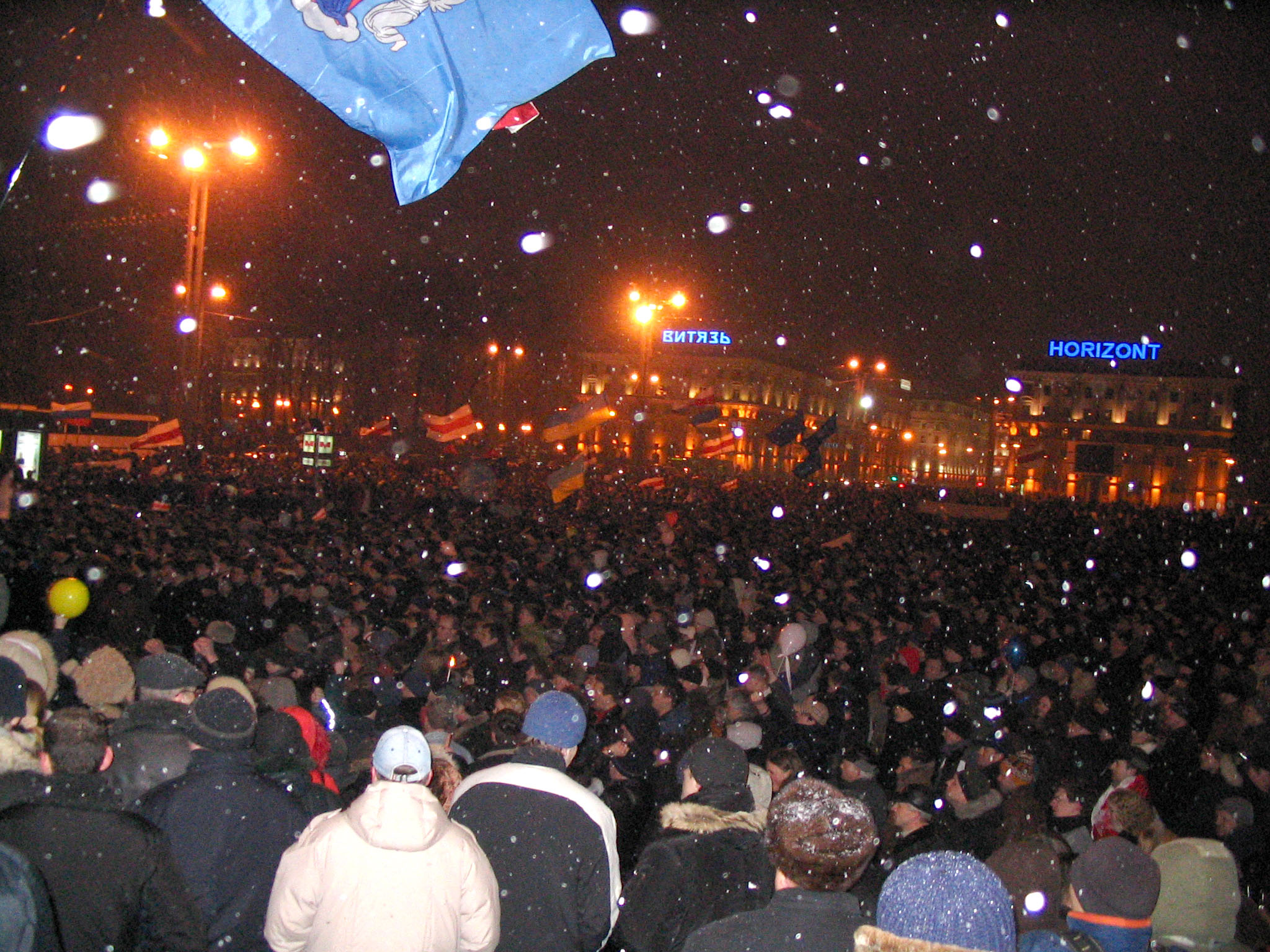
Following the election, an organization with ties to the government released exit poll results claiming that Lukashenko secured over 80% of the vote. In contrast, Milinkievič's campaign office asserted that he received 25.6% of the vote, compared to Lukashenko's 47%.
Belarusian authorities vowed to crush unrest in the event of large-scale protests following the election. Lukashenko declared victory and the defeat of the "revolution," stating that while he was unwilling to jail Milinkievič and Kazulin, he did not rule out the possibility.
In protest of the election results, approximately 10,000 people gathered at October Square in Minsk. They waved the white-red-white flag of independent Belarus, the flag of Europe, and flags of other nations such as Ukraine, Poland, and Russia. Several hundred protesters remained at the square overnight, with thousands present each evening.
The opposition planned a significant "show of strength" for Saturday, 25 March, coinciding with the anniversary of the establishment of the Belarus Democratic Republic. However, police dispersed the protests early on Friday, arresting hundreds. On Saturday, 6,000 people gathered, but riot police blocked their access to the central square and arrested Kazulin., who was sentenced to five and a half years in prison in July.
According to the Czech News Agency, Jan Rybar, reporter of the Czech daily Mlada fronta Dnes, was attacked and beaten up at the opposition demonstration in Minsk. He said in his opinion he had been beaten up by agents of the Belarusian secret police KGB, but has no direct piece of evidence to prove it.
During the protests, Belarusian authorities also arrested Mariusz Maszkiewicz, the former Polish ambassador to Belarus, and Polish journalist Weronika Samolinska. They reported arresting over 500 people during the protests.
Belarusian state television claimed that two of its reporters were beaten by protesters, Belarusian Association of Journalists doubted the incident occurred, suggesting the reporters were at most hit with snowballs. Amidst the unrest, Lukashenko postponed his inauguration, eventually conducting it on 8 April in military uniform. He blamed the West for inciting the protests. He later claimed in November that his true vote count was over 90% and that he had falsified it down to 80% to appear more appealing to Europeans, but they did not appreciate his gesture.
Western countries
The report of the OSCE claimed that the election failed to meet commitments for democratic processes.
On 20 March, the State Department refused to accept the election results and called for a new vote. On 15 May, George W. Bush issued a proclamation barring high-ranking Belarusian officials from traveling to the USA. Later, on 16 June, he introduced financial sanctions against 10 individuals, including Lukashenko, for undermining democratic processes.
On 6 April, the European Parliament adopted a resolution condemning the "failed Presidential elections." This was followed by the Council of the European Union sanctioning 31 individuals, including Alexander Lukashenko, on 10 April. In October, Milinkievič was awarded the Sakharov Prize, the EU's top human rights award.
Czech President Vaclav Klaus decided not to congratulate the re-elected Belarusian President.
Russia
The CIS observation mission deemed the elections open and transparent. Russian President Vladimir Putin called Lukashenko the day after the elections to congratulate him. On 24 March, Russian Foreign Minister Sergey Lavrov claimed that OSCE mission had played an instigatory role.
Pro-government media lauded the outcome as a defeat for "orange" political technologies. Meanwhile, the liberal opposition condemned Lukashenko's actions, and on 26 March, a protest they organized, involving about ten people, was dispersed.
Russia stated on 30 March that Belarus's gas prices were unacceptably lower than European ones. By 19 April, Belarus reportedly agreed to cede some control of Beltransgaz, the state natural gas monopoly. Russia had sought this control since the early 1990s, nearly securing a similar deal in April 2002 that ultimately had no follow-up. The formal agreement, signed on 18 May 2007, allowed Gazprom to acquire a 50% stake in the company by paying $2.5 billion from 2007 to 2010.
Notes
References
Bibliography
References
- [[Dieter Nohlen]] & Philip Stöver (2010) ''Elections in Europe: A data handbook'', p262 {{ISBN. 978-3-8329-5609-7
- "Заявление международных наблюдателей от Содружества Независимых Государств по результатам наблюдения за подготовкой и проведением выборов Президента Республики Беларусь от 19 марта 2006 года".
- (16 March 2006). "Белоруссия: 1994-2006". [[BBC]].
- (16 November 2002). "Europe: Countries To Bar Belarus Leader". The New York Times.
- (2 November 2002). "Europe: Belarus: New Law Restricts Religions". The New York Times.
- (11 March 2005). "Judge cancels request for psychiatric examination of Veronika Cherkasova's son". [[Reporters Without Borders]].
- (22 December 2005). "Europe: Belarus: Criminal Penalties For Political Action". The New York Times.
- (9 June 2005). "European Parliament resolution on the situation in Belarus".
- (October 2006). "Belarus: Learning From Defeat". Journal of Democracy.
- "The condition of NGOs and civil society in Belarus".
- (2007). "Belarusian Society '2007 Hopes, Illusions, Perspectives". East European Democratic Centre.
- "Динамика среднемесячной заработной платы работающих в среднегодовом исчислении (2001-2010 гг.)". [[:ru:НИСЭПИ.
- (2005). "Postcommunist Belarus". Bloomsbury Academic.
- "Динамика среднемесячной трудовой пенсии в среднегодовом исчислении (2001–2010 гг.)". [[IISEPS]].
- (10 June 1996). "Resolution on freedom of opinion in Albania and Belarus". [[European Parliament]].
- (20 January 1997). "Resolution on the situation in Belarus". [[European Parliament]].
- (20 October 2004). "Belarus Democracy Act of 2004. 22 USC 5811 note". [[United States Congress]].
- (4 October 2001). "Presidential Election, 9 September 2001". [[OSCE]].
- (25 June 2003). "AFTER THE WAR: DETAINEES; Hussein's Top Aide Got Belarussian Passports, U.S. Officials Say". The New York Times.
- (27 August 2003). "An unreliable ally : Pressure Putin on terrorism". The New York Times.
- (8 October 2004). "U.S. Report Says Hussein Bought Arms With Ease". The New York Times.
- (18 January 2005). "At confirmation hearings, Rice pledges to mend ties". The New York Times.
- (21 April 2005). "NATO and Rice Use Carrot and Stick With Former Soviet States". The New York Times.
- (27 October 2005). "Lithuanian leader faults EU over new gas pipeline". The New York Times.
- (13 December 2004). "Council Common Position 2004/848/CFSP of 13 December 2004 amending Common Position 2004/661/CFSP concerning restrictive measures against certain officials of Belarus". [[Council of the European Union]].
- (29 November 2006). "European Parliament resolution on the situation in Belarus prior to the presidential elections on 19 March 2006". [[European Parliament]].
- (29 July 2005). "Poland recalls envoy to protest Belarus raid". The New York Times.
- (24 November 2002). "THE WAY WE LIVE NOW: 11-24-02: QUESTIONS FOR GENE SHARP; Give Peace a Chance". The New York Times.
- (2 September 2004). "Take flexible stance, Polish leader urges : A plea from a close friend of U.S.".
- (August 2005). "The Last Totalitarian Country in Europe". [[Forum 2000]].
- (25 September 2005). "In Belarus, Battle Lines Are Drawn but Revolution Is Still a Tough Sell". [[Los Angeles Times]].
- (1 June 2003). "Hail, Hail to a Dysfunctional Union of Former Soviets".
- (24 October 2002). "World Briefing: Europe". The New York Times.
- (20 February 2004). "Europe: Russia: Gas Shipments Resume".
- (18 November 2004). "Обязаловка? Нет, поддержка!". [[Belarus Today]].
- (24 June 2005). "Europe: Russia: Rights Body Criticizes Belarus".
- (3 January 2012). "Belarus The Last European Dictatorship". Yale University Press.
- (15 December 2005). "President Vladimir Putin met with President of Belarus Alexander Lukashenko". [[Kremlin]].
- "Конституция Республики Беларусь. Текст правового акта с изменениями и дополнениями по состоянию на 5 декабря 2007 года".
- "Избирательный кодекс Республики Беларусь (с учетом изменений по состоянию на 4 июля 2000 г.)".
- (16 December 2005). "Постановление Палаты представителей Национального собрания Республики Беларусь от 16.12.2005 № 310-П3/III "О назначении выборов Президента Республики Беларусь"".
- "Сообщение Центральной комиссии Республики Беларусь по выборами проведению республиканских референдумов". [[Central Election Commission of Belarus]].
- "Сообщение Центральной комиссии Республики Беларусь по выборами проведению республиканских референдумов". [[Central Election Commission of Belarus]].
- (23 March 2006). "Сообщение Центральной комиссии Республики Беларусь по выборами проведению республиканских референдумов". [[Central Election Commission of Belarus]].
- (8 April 2006). "Торжественная церемония инаугурации Президента Республики Беларусь". [[President of Belarus]].
- "Итоговые сведения о количестве избирателей, поставивших подписи в подписных листах о выдвижении кандидатов в Президенты Республики Беларусь, принятых территориальными комиссиями". [[Central Election Commission of Belarus]].
- (1 February 2006). "Lukashenko's rival tries to calm Russia". Politico.
- (27 January 2006). "Инициативная группа Позняка не будет сдавать подписи в избирательные комиссии". [[Belorusskaya Delovaya Gazeta]].
- (1 February 2006). "Фролов со своей командой вливается в предвыборные структуры Козулина". [[Belorusskaya Delovaya Gazeta]].
- (15 January 2006). "Белоруссия: Александр Войтович отказался от участия в президентских выборах". [[RFE/RL]].
- (26 January 2006). "Соперников у Лукашенко стало еще меньше". [[RFE/RL]].
- (2 March 2006). "Государство для народа". [[Belarus Today]].
- "МИЛИНКЕВИЧ Александр Владимирович".
- (10 March 2007). "Белоруссия – форпост «старой» Европы?".
- (24 February 2006). "In Belarus, expecting to lose, then win". The New York Times.
- (26 February 2006). "Bringing Down Europe's Last Ex-Soviet Dictator". The New York Times.
- (17 February 2006). "Завершена регистрация кандидатов на пост президента Белоруссии". [[RFE/RL]].
- (13 March 2006). "Кандидат в президенты Белоруссии Александр Козулин заявил, что выборы будут сфальсифицированы". [[RFE/RL]].
- (17 March 2006). "Белорусская милиция будет «контролировать» оппозицию без огнестрельного оружия". [[RFE/RL]].
- (6 March 2006). "Текст выступления Александра Козулина, кандидата в Президенты Республики Беларусь, записанного 03.03.2006 г. для радиоэфира 06 марта 2006 г.".
- (2006). "Prospects for Democracy in Belarus". German Marshall Fund of the United States.
- "Europe: Belarus: European Warning On Presidential Vote". The New York Times.
- (8 February 2006). "NATO tops agenda for Poland-U.S.summit". The New York Times.
- (23 February 2006). "Newsline - February 23, 2006". [[RFE/RL]].
- (24 February 2006). "Прадстаўнік Дзярждэпартамэнту заклікае беларускія ўлады не ўжываць сілы". [[RFE/RL]].
- (27 February 2006). "БТ абвінаваціла апазыцыю ў намеры сфальшаваць вынікі экзыт-полаў". [[RFE/RL]].
- (7 December 2007). "КДБ раскрыў сцэнар "захопу будынкаў органаў улады"". [[RFE/RL]].
- (2 March 2006). "Candidate in Belarus is arrested". The New York Times.
- (9 March 2006). "Вінцук Вячорка і іншыя актывісты штабу Мілінкевіча асуджаныя на 15 сутак арышту". [[RFE/RL]].
- (16 March 2006). "Старшыня КДБ палохае арганізатараў акцыі 19 сакавіка сьмяротнай карай". [[RFE/RL]].
- (16 March 2006). "Belarus Arrests Dozens Days Before Disputed Election". The New York Times.
- (16 March 2006). "Hanging tough against tyranny". The New York Times.
- (17 March 2006). "Грузінскіх дэпутатаў не пускаюць у Беларусь". [[RFE/RL]].
- (18 March 2006). "Vote in Belarus Brings Fears and Warnings". The New York Times.
- (19 March 2006). "Thousands in Belarus Protest President's Expected Re-election". The New York Times.
- (25 February 2008). "Understanding Belarus and how western foreign policy misses the mark". Rowman & Littlefield.
- "20 лет борьбы за свободную мысль: хронология репрессий против НИСЭПИ".
- (24 January 2006). "По данным социологической службы "Балтик Гэллап", рейтинг узнаваемости Милинкевича составляет 79,2 процента". [[Tut.by]].
- "Замечания по промежуточному отчету №1 миссии по наблюдению за выборами БДИПЧ ОБСЕ". Central Election Commission of Belarus.
- (19 March 2006). "В Минске начался митинг протеста". [[Deutsche Welle]].
- (2006-03-19). "Opposition Accuses Lukashenko of Manipulating Belarus Vote". Deutsche Welle.
- link. Izvestia. (2006-03-21)
- (30 March 2006). "EU Leaders Slam Belarus Leader But Are Split on Sanctions". [[Deutsche Welle]].
- (20 March 2006). "Protesters Charge Fraud in Belarus Presidential Vote". The New York Times.
- (19 March 2006). "Митинг в Минске глазами корреспондента". [[Deutsche Welle]].
- (21 March 2006). "U.S. Calls Belarus Vote for Leader Invalid". The New York Times.
- (2006-03-21). "Belarus poll rallies 'must go on'". BBC News.
- (23 March 2006). "Belarus Police Storm Protest". The New York Times].
- (26 March 2006). "Belarus Police Deter Thousands of Protesters".
- (14 July 2006). "Conviction of Belarusian Opposition Figure". State Department.
- (2006-03-20). "Czech reporter beaten up at opposition demonstration in Minsk". [[Czech News Agency]].
- (2006-03-21). "Czech journalist beaten in Minsk". Pravda.
- (27 March 2006). "Belarus courts sentence protesters to jail". The New York Times.
- (29 March 2006). "Belarus to charge defeated candidate". The New York Times.
- "2 Belarus State TV Journalists Badly Beaten by Opposition - NEWS - MOSNEWS.COM".
- (25 March 2006). "A criminal case in connection with the fact of throwing snowballs at BT journalists is started". [[Belarusian Association of Journalists]].
- (28 March 2006). "Briefly: President postpones his inauguration date". The New York Times.
- (9 April 2006). "Belarus Leader Takes Oath, Attacking the West". The New York Times.
- БелаПАН. (2006-11-23). "TUT.BY | НОВОСТИ - Лукашенко: Последние выборы мы сфальсифицировали - Политика - 23.11.2006, 14:49". News.tut.by.
- (20 March 2006). "White House Rejects Results Of Belarus' Vote". [[RFE/RL]].
- (15 May 2006). "Suspension of Entry as Immigrants and Nonimmigrants of Persons Responsible for Policies or Actions That Threaten the Transition to Democracy in Belarus".
- (16 June 2006). "Blocking Property of Certain Persons Undermining Democratic Processes or Institutions in Belarus". [[Federal Register]].
- (6 April 2006). "European Parliament resolution on the situation in Belarus after the presidential elections of 19 March 2006". [[European Parliament]].
- (10 April 2006). "Council Common Position 2006/276/CFSP". [[Council of the European Union]].
- "Belarussian takes EU rights award". BBC.
- (21 March 2006). "Prezident nezašle blahopřání Lukašenkovi".
- (20 March 2006). "President Vladimir Putin congratulated Alexander Lukashenko on his re-election as President of the Republic of Belarus".
- (24 March 2006). "Transcript of Remarks and Replies to Media Questions by Russian Minister of Foreign Affairs Sergey Lavrov Following Talks with Minister for Foreign Affairs of Iceland Geir Haarde, Moscow, March 24, 2006". [[Ministry of Foreign Affairs of the Russian Federation]].
- (21 March 2006). ""Оранжевые" технологии в Белоруссии применимы, но неэффективны". [[RIA Novosti]].
- (26 March 2006). "Несанкционированную акцию в поддержку белорусской оппозиции попытались провести сегодня возле здания Российского МИДа в Москве активисты движения МЫ и Гражданского фронта.". [[Echo of Moscow]].
- (30 March 2006). "Russia Says Belarus Must Now Pay Market Price for Gas". The New York Times.
- (19 April 2006). "Today's Russian Newspapers". The New York Times.
- (9 September 1993). "Ельцин, Хасбулатов, Черномырдин". Kommersant.
- (12 April 2002). "Александр Лукашенко приехал за компенсацией". Kommersant.
- (6 June 2006). ""Газпром" досрочно оплатил 12,5% акций "Белтрансгаза"". Kommersant.
This article was imported from Wikipedia and is available under the Creative Commons Attribution-ShareAlike 4.0 License. Content has been adapted to SurfDoc format. Original contributors can be found on the article history page.
Ask Mako anything about 2006 Belarusian presidential election — get instant answers, deeper analysis, and related topics.
Research with MakoFree with your Surf account
Create a free account to save articles, ask Mako questions, and organize your research.
Sign up freeThis content may have been generated or modified by AI. CloudSurf Software LLC is not responsible for the accuracy, completeness, or reliability of AI-generated content. Always verify important information from primary sources.
Report