From Surf Wiki (app.surf) — the open knowledge base
2005 Tarapacá earthquake
Earthquake near the Peru-Bolivia border
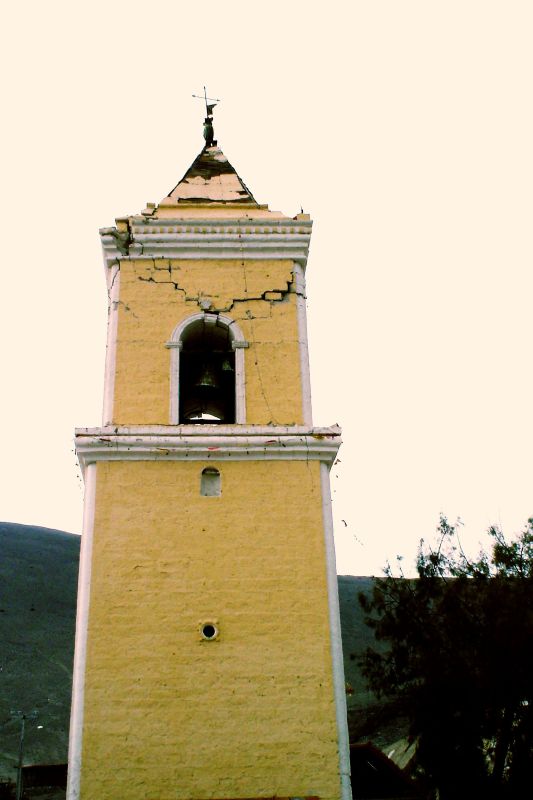
Earthquake near the Peru-Bolivia border
| Field | Value | |
|---|---|---|
| title | 2005 Tarapacá earthquake | |
| timestamp | 2005-06-13 22:44:33 | |
| anss-url | usp000dsw1 | |
| isc-event | 7143508 | |
| map2 | {{Location map | Chile#South America |
| relief | yes | |
| lat | -19.987 | |
| long | -69.197 | |
| marksize | 40 | |
| mark | Bullseye1.png | |
| width | 250 | |
| float | center | |
| caption | }} | |
| local-date | ||
| local-time | 18:44 | |
| magnitude | 7.8 | |
| depth | 115.6 km | |
| countries affected | Chile, Bolivia | |
| intensity | ||
| location | ||
| casualties | 11 dead, 182 injured | |
| pga | 0.72 *g* |
| anss-url = usp000dsw1 | isc-event = 7143508 | local-date = | local-time = 18:44 The 2005 Tarapacá earthquake occurred on June 13 at 22:44:33 UTC (18:44:33 local time). Its epicenter was located near Mamiña, in northern Chile about 125 km east-northeast of Iquique, affecting the Tarapacá Region and adjacent parts of Bolivia. It had a magnitude of 7.8 and a maximum felt intensity of VII (Very strong) on the Mercalli intensity scale.
Tectonic setting
Chile lies above the destructive plate boundary, where the Nazca Plate is being subducted beneath the South American Plate. In the Tarapacá region the plates converge at a rate of 78 mm per year. This boundary is associated with many large earthquakes, both along the plate interface and within the downgoing slab (Nazca Plate).
Earthquake
The earthquake was an intermediate-depth event, with a hypocentral depth of 115.6 km. The focal mechanism shows that this was a normal fault event, within the subducted Nazca Plate. Finite-fault modelling of the earthquake suggests that the fault plane responsible dips to the west at about 15°.
Damage
The greatest damage occurred in northern Chile, although parts of southern Peru and western Bolivia were also affected. The earthquake triggered many landslides, blocking roads and hindering relief efforts. 550 houses were completely destroyed, with at least a further 9,350 damaged. Adobe houses on the plateau in the Andes were particularly badly affected, with more than 80% destroyed in some villages. Eleven people were killed and at least a further 200 injured.
Aftermath
Initial efforts concentrated on repairing infrastructure affected by the earthquake. By June 2006 the government reported that most of the repairs to roads and irrigation canals was complete, but that, although work had started on repairing houses and schools, more needed to be done.
The effects of this earthquake on pregnant women were used to investigate the effects of acute stress on child development. The results showed that amongst poorer families, children affected by the earthquake in utero were at least six months behind in cognitive development seven years later compared to their peers in a control group in areas unaffected by the earthquake.
References
References
- Rondinel-Oviedo, E.A.. "The June 13th, 2005, Mw 7.8 Tarapacá (Chile) Earthquake".
- International Federation of Red Cross And Red Crescent Societies. (27 July 2005). "Chile: Earthquake - Information Bulletin n° 3".
- "Registros Terremoto de Tarapacá 7.9 Mw, 13/06/2005".
- {{Cite anss. Tarapacá. 2005. usp000dsw1. M 7.8 - Tarapaca, Chile
- United Nations Office for the Coordination of Humanitarian Affairs. (August 2005). "Natural Disaster Highlights No.2 - August 2005".
- Government of Chile. (June 2006). "Chile: Presidenta anuncia medidas para acelerar Plan de Reconstrucción de Tarapacá". ReliefWeb.
- De Witte M.. (August 2018). "Acute stress in utero has negative effects later in life among poor children, Stanford sociologist finds".
This article was imported from Wikipedia and is available under the Creative Commons Attribution-ShareAlike 4.0 License. Content has been adapted to SurfDoc format. Original contributors can be found on the article history page.
Ask Mako anything about 2005 Tarapacá earthquake — get instant answers, deeper analysis, and related topics.
Research with MakoFree with your Surf account
Create a free account to save articles, ask Mako questions, and organize your research.
Sign up freeThis content may have been generated or modified by AI. CloudSurf Software LLC is not responsible for the accuracy, completeness, or reliability of AI-generated content. Always verify important information from primary sources.
Report