From Surf Wiki (app.surf) — the open knowledge base
2005 New Zealand general election
none

none
| Field | Value | |
|---|---|---|
| election_name | 2005 New Zealand general election | |
| country | New Zealand | |
| type | parliamentary | |
| ongoing | no | |
| previous_election | 2002 New Zealand general election | |
| previous_year | 2002 | |
| outgoing_members | 47th New Zealand Parliament | |
| next_election | 2008 New Zealand general election | |
| next_year | 2008 | |
| seats_for_election | All 121 seats in the House of Representatives, including one overhang seat | |
| majority_seats | 61 | |
| election_date | ||
| elected_mps | [members](48th-new-zealand-parliament) | |
| turnout | 2,304,005 (80.92%) 3.94% | |
| opinion_polls | Opinion polling for the 2005 New Zealand general election | |
| 1blank | Electorate vote | |
| 3blank | Party vote | |
| <!-- Labour --> | image1 | |
| leader1 | Helen Clark | |
| leader_since1 | [1 December 1993](1993-new-zealand-labour-party-leadership-election) | |
| party1 | New Zealand Labour Party | |
| leaders_seat1 | Mount Albert | |
| last_election1 | 52 seats, 41.26% | |
| seats_before1 | 51 | |
| seats1 | **50** | |
| seat_change1 | 1 | |
| 1data1 | 902,072 | |
| 40.35% | ||
| 4.34 | ||
| 3data1 | **935,319 | |
| 41.10%** | ||
| 0.16 | ||
| <!-- National --> | image2 | |
| leader2 | Don Brash | |
| leader_since2 | [28 October 2003](2003-new-zealand-national-party-leadership-election) | |
| party2 | New Zealand National Party | |
| leaders_seat2 | List | |
| last_election2 | 27 seats, 20.93% | |
| seats_before2 | 27 | |
| seats2 | 48 | |
| seat_change2 | 21 | |
| 1data2 | **902,874 | |
| 40.38%** | ||
| 9.80 | ||
| 3data2 | 889,813 | |
| 39.10% | ||
| 18.17 | ||
| <!-- NZF --> | image3 | |
| leader3 | Winston Peters | |
| leader_since3 | 18 July 1993 | |
| party3 | New Zealand First | |
| leaders_seat3 | List | |
| *(lost Tauranga)* | ||
| last_election3 | 13 seats, 10.38% | |
| seats_before3 | 13 | |
| seats3 | 7 | |
| seat_change3 | 6 | |
| 1data3 | 78,117 | |
| 3.49% | ||
| 0.49 | ||
| 3data3 | 130,115 | |
| 5.72% | ||
| 4.66 | ||
| <!-- Green --> | image4 | |
| leader4 | Rod Donald | |
| Jeanette Fitzsimons | ||
| leader_since4 | 21 May 1995 | |
| party4 | Green Party of Aotearoa New Zealand | |
| leaders_seat4 | List | |
| List | ||
| last_election4 | 9 seats, 7.00% | |
| seats_before4 | 9 | |
| seats4 | 6 | |
| seat_change4 | 3 | |
| 1data4 | 92,164 | |
| 4.12% | ||
| 1.23 | ||
| 3data4 | 120,521 | |
| 5.30% | ||
| 1.70 | ||
| <!-- Maori --> | image5 | |
| leader5 | Tariana Turia | |
| Pita Sharples | ||
| leader_since5 | 7 July 2004 | |
| party5 | Māori Party | |
| leaders_seat5 | Te Tai Hauāuru | |
| Tāmaki Makaurau | ||
| last_election5 | – | |
| seats_before5 | 1 | |
| seats5 | 4 | |
| seat_change5 | 3 | |
| 1data5 | 75,076 | |
| 3.36% | ||
| *new* | ||
| 3data5 | 48,263 | |
| 2.12% | ||
| *new* | ||
| <!-- United Future ---> | image6 | |
| leader6 | Peter Dunne | |
| leader_since6 | 16 November 2000 | |
| party6 | United Future New Zealand | |
| leaders_seat6 | Ohariu-Belmont | |
| last_election6 | 8 seats, 6.69% | |
| seats_before6 | 8 | |
| seats6 | 3 | |
| seat_change6 | 5 | |
| 1data6 | 63,486 | |
| 2.84% | ||
| 1.52 | ||
| 3data6 | 60,860 | |
| 2.67% | ||
| 4.02 | ||
| <!-- ACT ---> | image7 | |
| leader7 | Rodney Hide | |
| leader_since7 | 13 June 2004 | |
| party7 | ACT New Zealand | |
| leaders_seat7 | Epsom | |
| last_election7 | 9 seats, 7.14% | |
| seats_before7 | 9 | |
| seats7 | 2 | |
| seat_change7 | 7 | |
| 1data7 | 44,071 | |
| 1.97% | ||
| 1.58 | ||
| 3data7 | 34,469 | |
| 1.51% | ||
| 5.63 | ||
| image8 | ||
| leader8 | Jim Anderton | |
| leader_since8 | 27 July 2002 | |
| party8 | New Zealand Progressive Party | |
| leaders_seat8 | Wigram | |
| last_election8 | 2 seats, 1.70% | |
| seats_before8 | 2 | |
| seats8 | 1 | |
| seat_change8 | 1 | |
| 1data8 | 36,638 | |
| 1.64% | ||
| 0.20 | ||
| 3data8 | 26,441 | |
| 1.16% | ||
| 0.54 | ||
| map_image | 2005 New Zealand general election - Results.svg | |
| map_size | 450px | |
| map_caption | Results by electorate, shaded by winning margin | |
| title | Prime Minister and coalition | |
| posttitle | Subsequent Prime Minister and coalition | |
| before_election | Helen Clark (Labour) | |
| after_election | Helen Clark (Labour) | |
| before_party | *Labour—Progressive (C&S: United Future)* | |
| after_party | *Labour—Progressive (C&S: United Future, NZ First)* |
40.35% 4.34 41.10%** 0.16
40.38%** 9.80 39.10% 18.17
(lost Tauranga) 3.49% 0.49 5.72% 4.66
Jeanette Fitzsimons List 4.12% 1.23 5.30% 1.70
Pita Sharples Tāmaki Makaurau 3.36% new 2.12% new
2.84% 1.52 2.67% 4.02
1.97% 1.58 1.51% 5.63 1.64% 0.20 1.16% 0.54
Government: Opposition: ]] A general election took place in New Zealand on 17 September 2005 and determined the membership of the 48th New Zealand Parliament. One hundred and twenty-one MPs were elected to the New Zealand House of Representatives: 69 from single-member electorates, including one overhang seat, and 52 from party lists (one extra due to the overhang).
No party won a majority, but the Labour Party of Prime Minister Helen Clark secured two seats more than its nearest rival, the National Party, led by Don Brash. With the exception of the newly formed Māori Party, which took four Māori electorates from Labour, most of the other parties polled lower than in the previous election, losing votes and seats.
Brash deferred conceding defeat until 1 October, when National's election-night 49 seats fell to 48 after special votes were counted. The official count increased the Māori Party share of the party vote above 2%, entitling them to three rather than two seats from the party vote. With four electorate seats, the election night overhang of two seats was reduced to one, and as National had the 120th seat allocated under the party vote, National lost one list seat (that of Katrina Shanks) that they appeared to have won on election night.
The election was a strong recovery for National, which won 21 more seats than at the 2002 election, where it suffered its worst result in its history, and the highest party vote percentage for the party since 1990; indeed, National saw its first vote share gain since 1990. Despite its resurgence, National failed to displace Labour as the largest party in Parliament. National's gains apparently came mainly at the expense of smaller parties, while Labour won only two seats less than in 2002.
On 17 October, Clark announced a new coalition agreement that saw the return of her minority government coalition with the Progressive Party, with confidence and supply support from New Zealand First and from United Future. New Zealand First parliamentary leader Winston Peters and United Future parliamentary leader Peter Dunne became ministers of the Crown outside Cabinet, Peters as Minister of Foreign Affairs and Dunne as Minister of Revenue. The Green Party, which had supported Labour before the election, received no cabinet post (see below), but gained several concessions from the coalition on matters such as energy and transport, and agreed to support the government on matters of confidence and supply. This was the second time that Labour won three consecutive elections, and to date it is the only time it has won three consecutive peacetime elections.
The election
The total votes cast in 2005 was 2,304,005 (2,164,595 & 139,510 Māori). Turnout was 80.92% of those on the rolls, or 77.05% of voting age population. Turnout was higher than in the previous 2002 election (72.5% and 76.98% respectively), and the Māori roll turnout at 67.07% was significantly higher than 2002 (57.5%).
In the election 739 candidates stood, and there were 19 registered parties with party lists. Of the candidates, 525 were electorate and list, 72 were electorate only and 142 were list only. All but 37 represented registered parties (on the list or in the electorate or both). Only 35 candidates from registered parties chose to stand as an electorate candidate only. 71% of candidates (523) were male and 29% (216) female; the same percentages as in 2002.
Labour had achieved a third term in office for the first time since 1943.
MPs retiring in 2005
Eight MPs intended to retire at the end of the 47th Parliament.
| Party | Name | Electorate | |
|---|---|---|---|
| ACT New Zealand}}" | ACT | Deborah Coddington | |
| Richard Prebble | (List) | ||
| Green Party of Aotearoa New Zealand}}" | Green | Ian Ewen-Street | |
| New Zealand National Party}}" | National | Lynda Scott | |
| Roger Sowry | (List) | ||
| New Zealand Labour Party}}" | Labour | Helen Duncan | |
| Janet Mackey | East Coast | ||
| Mark Peck | Invercargill |
Detailed results
Parliamentary parties
|- style="text-align:center;" ! colspan=2 rowspan=2 style="width:213px;" | Party ! Colspan=3 | Party vote ! Colspan=3 | Electorate vote ! Colspan=4 | Seats |- style="text-align:center;" ! Votes ! % ! Change (pp) ! Votes ! % ! Change (pp) ! List ! Electorate ! Total ! +/- |- | | 935,319 | 41.10 | 0.16 | 902,072 | 40.35 | 4.34 | 19 | 31 | 50
| 2 |
|---|
| | 889,813 | 39.10 | 18.17 | 902,874 | 40.38 | 9.84 | 17 | 31 | 48
| 21 |
|---|
| | 130,115 | 5.72 | 4.66 | 78,117 | 3.49 | 0.49 | 7 | 0 | 7
| 6 |
|---|
| | 120,521 | 5.30 | 1.70 | 92,164 | 4.12 | 1.23 | 6 | 0 | 6
| 3 |
|---|
| | 48,263 | 2.12 | new | 75,076 | 3.36 | new | 0 | 4 | 4
| new |
|---|
| | 60,860 | 2.67 | 4.02 | 63,486 | 2.84 | 1.52 | 2 | 1 | 3
| 5 |
|---|
| | 34,469 | 1.51 | 5.63 | 44,071 | 1.97 | 1.58 | 1 | 1 | 2
| 7 |
|---|
| | 26,441 | 1.16 | 0.54 | 36,638 | 1.64 | 0.20 | 0 | 1 | 1
| 1 |
|---|
| | 14,210 | 0.62 | new | 17,608 | 0.79 | new | 0 | 0 | 0
| new |
|---|
| | 5,748 | 0.25 | 0.39 | 2,601 | 0.12 | 0.05 | 0 | 0 | 0 | |- | | 2,821 | 0.12 | 1.23 | 1,296 | 0.06 | 1.99 | 0 | 0 | 0 | |- | | 1,641 | 0.07 | 1.20 | 1,901 | 0.09 | 1.60 | | 0 | 0 | |- | | 1,178 | 0.05 | new | 1,045 | 0.05 | new | 0 | 0 | 0
| new |
|---|
| | 1,079 | 0.05 | new | 565 | 0.03 | new | 0 | 0 | 0
| new |
|---|
| | 946 | 0.04 | 0.04 | 781 | 0.03 | | 0 | 0 | 0 | |- | | 782 | 0.03 | new | 1,934 | 0.09 | new | | 0 | 0
| new |
|---|
| | 601 | 0.03 | new | — | — | — | 0 | 0 | 0
| new |
|---|
| | 478 | 0.02 | 0.07 | 214 | 0.01 | 0.12 | | 0 | 0 | |- | | 344 | 0.02 | new | 131 | 0.01 | new | 0 | 0 | 0
| new |
|---|
| — |
| — |
| — |
| 1,466 |
| 0.07 |
| 0.12 |
| 0 |
| 0 |
| 0 |
| |- | | — | — | — | 11,829 | 0.53 | 0.22 | 0 | 0 | 0 | |- ! colspan=2 style="text-align:left;" | Valid votes ! 2,275,629 ! 98.77 ! 0.07 ! 2,235,869 ! 97.04 ! 0.05 ! Colspan=4 | |- | 10,561 | 0.46 | 0.04 | 24,801 | 1.08
| 0.21 |
|---|
| 17,815 |
| 0.77 |
| 0.03 |
| 43,335 |
| 1.88 |
| 0.26 |
| - |
| ! colspan=2 style="text-align:left;" |
| ! 2,304,005 |
| ! 100 |
| ! |
| ! 2,304,005 |
| ! 100 |
| ! |
| ! 52 |
| ! 69 |
| ! 121 |
| ! 1 |
| - |
| 2,847,396 |
| 80.92 |
| 3.94 |
| 2,847,396 |
| 80.92 |
| 3.94 |
| } |
The election saw an 81% voter turnout.
The results of the election give a Gallagher index of disproportionality of 1.11.
Votes summary
Electorate results
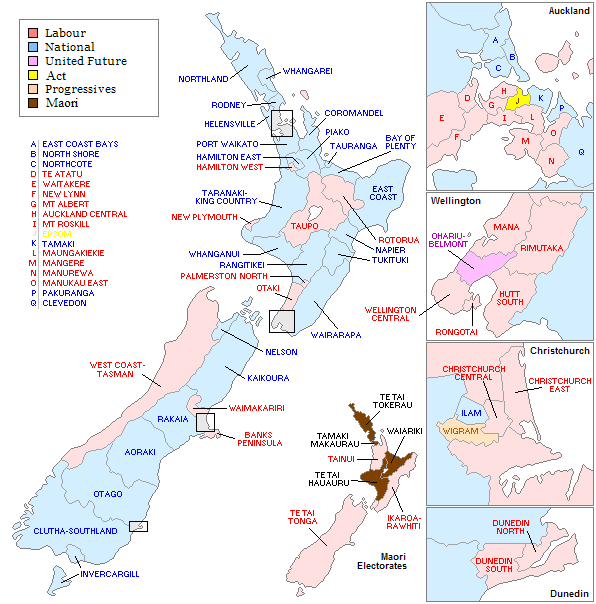
The table below shows the results of the 2005 general election:
Key:
| - |
|---|
| ! Electorate !! colspan=2 |
| - |
| } |
List results

MPs returned via party lists, and unsuccessful candidates, were as follows:
Main article: Party lists in the 2005 New Zealand general election
| **Republic of NZ** | **Unsuccessful**: Kerry James, Wayne Hawkins, Debra Potroz, Jack Gielen, Steven Hart, Gilbert Parker |
|---|
;Notes:
- These party list members later entered parliament in the term as other list MPs elected resigned from parliament.
- These party list members later resigned during the parliamentary term.
Changes during parliamentary term
| Party | New MP | Term started | Seat | Previous MP |
|---|---|---|---|---|
| Nándor Tánczos | List | Rod Donald1 | ||
| Charles Chauvel | List | Jim Sutton | ||
| Katrina Shanks | List | Don Brash | ||
| Lesley Soper | List | Georgina Beyer | ||
| Dail Jones | List | Brian Donnelly2 | ||
| Louisa Wall | List | Ann Hartley | ||
| William Sio | List | Dianne Yates | ||
| Russel Norman | List | Nándor Tánczos | ||
| (vacant) | Brian Connell3 |
Party vote by electorate
Analysis of results
Going into the election, Labour had assurances of support from the Greens (six seats in 2005, down three from 2002) and from the Progressives (one seat, down one). This three-party bloc won 57 seats, leaving Clark four seats short of the 61 seats needed for a majority in the 121-seat Parliament (decreased from the expected 122 because the final results gave the Māori Party only one overhang seat, after it appeared to win two overhang seats on election night). On 5 October the Māori Party began a series of hui to decide whom to support. That same day reports emerged that a meeting between Helen Clark and Māori co-leader Tariana Turia on 3 October had already ruled out a formal coalition between Labour and the Māori Party. Māori Party representatives also held discussions with National representatives, but most New Zealanders thought the Māori Party more likely to give confidence-supply support to a Labour-dominated government because its supporters apparently heavily backed Labour in the party vote.
Had Turia and her co-leader Pita Sharples opted to join a Labour-Progressive-Green coalition, Clark would have had sufficient support to govern with support from a grouping of four parties (Labour, Green, Māori and Progressive). Without the Māori Party, Labour needed the support of New Zealand First (seven seats, down six) and United Future (three seats, down five) to form a government. New Zealand First said it would support (or at least abstain from opposing in confidence-motions) the party with the most seats. Clark sought from New Zealand First a positive commitment rather than abstention. United Future, which had supported the previous Labour-Progressive minority government in confidence and supply, said it would talk first to the party with the most seats about support or coalition. Both New Zealand First and United Future said they would not support a Labour-led coalition which included Greens in Cabinet posts. However, United Future indicated it could support a government where the Greens gave supply-and-confidence votes.
Brash had only one possible scenario to become Prime Minister: a centre-right coalition with United Future and ACT (two seats, down seven). Given the election results, however, such a coalition would have required the confidence-and-supply votes of both New Zealand First and the Māori Party. This appeared highly unlikely on several counts. New Zealand First's involvement in such a coalition would have run counter to Peters' promise to deal with the biggest party, and Turia and Sharples would have had difficulty in justifying supporting National after their supporters' overwhelming support for Labour in the party vote. Turia and Sharples probably remembered the severe mauling New Zealand First suffered in the 1999 election. (Many of its supporters in 1996 believed they had voted to get rid of National, only to have Peters go into coalition with National; New Zealand First has never really recovered.) Even without this to consider, National had indicated it would abolish the Maori seats if it won power.
The new government as eventually formed consisted of Labour and Progressive in coalition, while New Zealand First and United Future entered agreements of support on confidence and supply motions. In an unprecedented move, Peters and Dunne became Foreign Affairs Minister and Revenue Minister, respectively, but remained outside cabinet and had no obligatory cabinet collective responsibility on votes outside their respective portfolios.
Background
The governing Labour Party retained office at 2002 election. However, its junior coalition partner, the Alliance, lost most of its support after internal conflict and disagreement and failed to win parliamentary representation. Labour formed a coalition with the new Progressive Coalition, formed by former Alliance leader Jim Anderton. The Labour-Progressive coalition then obtained an agreement of support ("confidence and supply") from United Future, enabling it to form a stable minority government. The National Party, Labour's main opponents, suffered a major defeat, winning only 21% of the vote (22.5% of the seats), its weakest showing in an election.
The collapse of National's vote led ultimately to the replacement of its Parliamentary party leader Bill English with parliamentary newcomer Don Brash, the former governor of the Reserve Bank of New Zealand, on 28 October 2003. Brash began an aggressive campaign against the Labour-dominated government. A major boost to this campaign came with his "Orewa speech" (27 January 2004), in which he attacked the Labour-dominated government for giving "special treatment" to the Māori population, particularly over the foreshore and seabed controversy. This resulted in a surge of support for the National Party, although most polls indicated that this subsequently subsided. National also announced it would not stand candidates in the Māori electorates, with some smaller parties following suit.
The foreshore-and-seabed controversy also resulted in the establishment of the Māori Party in July 2004. The Māori Party hoped to break Labour's traditional (and then current) dominance in the Māori electorates, just as New Zealand First had done in the 1996 election.
A large number of so-called "minor" parties also contested the election. These included Destiny New Zealand (the political branch of the Destiny Church) and the Direct Democracy Party.
Polls
Main article: Opinion polling for the 2005 New Zealand general election
A series of opinion polls published in June 2005 indicated that the National Party had moved ahead of Labour for the first time since June 2004. Commentators speculated that a prominent billboard campaign may have contributed to this. Some said the National Party had peaked too early. The polls released throughout July showed once more an upward trend for Labour, with Labour polling about 6% above National. The release by the National Party of a series of tax-reform proposals in August 2005 appeared to correlate with an increase in its ratings in the polls.
Direct comparisons between the following polls have no statistical validity:
| poll | date | Labour | National | NZ First | Greens |
|---|---|---|---|---|---|
| [One News Colmar Brunton](http://www.nzherald.co.nz/feature/story.cfm?c_id=1500936&ObjectID=10342917) | 29 August | 43% | 40% | 5% | 7% |
| [3 News TNS](http://www.nzherald.co.nz/section/story.cfm?c_id=1&ObjectID=10343461) | 1 September | 39% | 41% | 6% | 6% |
| [Herald DigiPoll](http://www.nzherald.co.nz/section/story.cfm?c_id=1&ObjectID=10343631) | 2 September | 43.4% | 39.1% | 6.6% | 5% |
| [Fairfax NZ/ACNeilsen](https://web.archive.org/web/20070930013231/http://stuff.co.nz/stuff/0,2106,3398256a14095,00.html) | 3 September | 41% | 44% | 5% | |
| [One News Colmar Brunton](http://www.nzherald.co.nz/section/story.cfm?c_id=1&ObjectID=10344059) | 4 September | 38% | 46% | 4.6% | 6% |
| [3 News TNS](http://www.nzherald.co.nz/section/story.cfm?c_id=1&ObjectID=10344486) | 7 September | 45% | 36% | 5% | 7% |
| [Herald Digipoll](http://www.nzherald.co.nz/section/story.cfm?c_id=1&ObjectID=10344765) | 8 September | 40.6% | 40.1% | 7.1% | 5.6% |
| [Herald Digipoll](http://www.nzherald.co.nz/section/story.cfm?c_id=1&ObjectID=10345035) | 11 September | 42.1% | 38.5% | 5% | 6% |
| [ACNielsen-Sunday Star-Times](http://www.stuff.co.nz/stuff/0,2106,3406961a10,00.html) | 11 September | 37% | 44% | 5% | 6% |
| [One News Colmar Brunton](http://tvnz.co.nz/view/page/576182/610367) | 11 September | 39% | 41% | 6% | 6% |
| [Fairfax ACNielsen](https://web.archive.org/web/20051203082928/http://stuff.co.nz/stuff/0,2106,3409630a14095,00.html) | 14 September | 37% | 43% | 7% | 6% |
| [3 News TNS](http://www.scoop.co.nz/stories/HL0509/S00238.htm) | 15 September | 40.5% | 38.7% | 6.8% | 6.9% |
| [TVNZ Colmar Brunton](http://www.scoop.co.nz/stories/HL0509/S00239.htm) | 15 September | 38% | 41% | 5.5% | 5.1% |
| [Herald Digipoll](http://www.nzherald.co.nz/section/story.cfm?c_id=1&ObjectID=10345819) | 16 September | 44.6% | 37.4% | 4.5% | 4.6% |
No single political event can explain the significant differences between most of these polls over the period between them. They show either volatility in the electorate and/or flaws in the methods of polling. In the later polls, the issue of National's knowledge of a series of pamphlets (distributed by members of the Plymouth Brethren Christian Church and attacking the Green and Labour parties) appeared not to have reduced National Party support.
Candidates
For lists of candidates in the 2005 election see:
- Candidates grouped by electorate
- Candidates grouped by party list
Major policy platforms
Labour Party
The Labour Party platform included:
- student loans: writing off interest if the recipient stays in New Zealand
- health: a pledge of extra public-hospital operations
- Treaty of Waitangi: accepting no lodgements for Treaty-claims after 1 September 2008
- increasing rates-rebates
- a "KiwiSaver" programme, aimed at getting first homeowners into their own homes
- sponsoring 5,000 new apprenticeships
- increasing community police-force numbers by 250.
- a "Working for Families" tax-relief/benefit programme aimed at lower to middle-income families
National Party
The National Party campaigned on the platform of (National Party Press Release):
- taxation: lowering income-tax rates. The party ran a television advertisement parodying the telethons aired by TVNZ in the 1980s, rewording the telethon theme song "Thank you very much for your kind donation" (itself a cover of the 1967 The Scaffolds song "Thank U Very Much") to "Thank you very much for your high taxation"
- removing references to the Treaty of Waitangi from existing legislation; and resolving all treaty claims amicably by 2010
- by 1 April 2006, make student-loan repayments and $5000 of pre-school childcare costs recoupable to mainstream New Zealanders
- "reworking" the New Zealand Resource Management Act 1991 to make development easier
- "removing excessive bureaucracy" in the education system, in particular by overhauling the NCEA, and by re-introducing "bulk funding" of schools
- abolishing early parole for violent criminals. (As of 2005 most prisoners became eligible for parole after serving one-third of their sentence)
- a return to "market rents" for state-housing tenants, including a system of paying housing-subsidies (for the poorest tenants) directly to private landlords
- increase Nationwide Maths and English standards
- welfare Reform – reduce the waste of having 300,000 working age New Zealand adults on benefits and to ensure all of those on benefits really need the help
- a "work-for-the-dole" scheme
- abolishing the Maori electorates
Voting
Postal voting for New Zealanders abroad began on 31 August. Ballot voting took place on Saturday 17 September, from 9am to 7pm. The Chief Electoral Office released a provisional result at 12:05am on 18 September.
Party funding
New Zealand operates on a system whereby the Electoral Commission allocates funding for advertising on television and on radio. Parties must use their own money for all other forms of advertising, but may not use any of their own money for television or radio advertising.
| Party | Funding in 2005 Election |
|---|---|
| Labour | $1,100,000 |
| National | $900,000 |
| ACT | $200,000 |
| Greens | $200,000 |
| NZ First | $200,000 |
| United Future | $200,000 |
| Māori Party | $125,000 |
| Progressives | $75,000 |
| Alliance | $20,000 |
| Christian Heritage NZ | $20,000 |
| Destiny NZ | $20,000 |
| Libertarianz | $20,000 |
| 99 MP Party* | $10,000 |
| Beneficiaries Party* | $10,000 |
| Democrats | $10,000 |
| National Front* | $10,000 |
| *New* Zealand F.R.P.P.* | $10,000 |
| Patriot Party* | $10,000 |
| The Republic of New Zealand Party | $10,000 |
*Must register for funding
Source: Electoral Commission
Controversies
Main article: 2005 New Zealand election funding controversy
Police investigated six political parties for alleged breaches of election-spending rules relating to the 2005 election, but brought no prosecutions, determining that "there was insufficient evidence to indicate that an offence under s214b of the Electoral Act had been committed."
The Auditor-General has also investigated publicly funded party-advertising for the 2005 election, with a leaked preliminary finding of much of the spending as unlawful. Observers expected the release of a final report in October 2006.
Plymouth Brethren Christian Church involvement
The 2005 general election was marked by controversial third-party campaigning by members of the Plymouth Brethren Christian Church (at the time known as the Exclusive Brethren), a secretive Christian group. Members of the church funded a campaign aimed at helping the National Party win, which included anonymous pamphlets and the hiring of private investigators.
Pamphlet campaign
Brethren members funded and distributed a series of pamphlets that attacked the incumbent Labour government and, in particular, the Green Party. The pamphlets made claims such as that the Greens' policies were "reminiscent...of communists". The campaign, which was later revealed to have a "war-chest" of $1.2 million, was organised by a group of seven Brethren businessmen who later identified themselves as the "secret seven".
Surveillance and links to Don Brash
The controversy deepened after the election when, in September 2006, it was revealed that Brethren members had hired private investigators to "dig dirt" on Labour MPs. This included the surveillance of Prime Minister Helen Clark and her husband, Peter Davis, which coincided with what Clark called a "smear campaign" of rumours about Davis.
The campaign also raised questions about the National Party's involvement. Party leader Don Brash initially distanced himself from the pamphlets. However, he later admitted to meeting with Brethren members, who told him they planned to issue pamphlets attacking the government, to which Brash replied, "that's tremendous". The full extent of the coordination was later detailed in Nicky Hager's 2006 book, The Hollow Men, which was based on leaked emails from Brash's office. In the wake of the scandal, Brash "cut ties" with the church.
References
References
- (21 October 2020). "2005 GENERAL ELECTION – OFFICIAL RESULTS AND STATISTICS". Electoral Commission.
- "General Statistics". Electionresults.govt.nz.
- "Party Lists of Successful Registered Parties". Electoral Commission.
- "Party Lists of Unsuccessful Registered Parties". Electoral Commission.
- Thomson, Ainsley. (19 September 2005). "United's 'Mr Reasonable' makes withering attack on Green Party". [[The New Zealand Herald]].
- [http://labour.org.nz/Campaign-2005/C05-policies/index.html Labour web site] {{webarchive. link. (31 October 2005)
- (5 August 2005). "New take on old jingle to push tax message".
- Ward, Tara. (2021-08-19). "Telethon was a glorious shambles that never slept".
- Thomson, Ainsley. (18 March 2006). "Labour escapes charges on pledge card but case found". [[The New Zealand Herald]].
- (2006-03-17). "No prosecutions for electoral complaints". New Zealand Police.
- Oliver, Paula. (11 September 2006). "Report on election spending almost complete". [[The New Zealand Herald]].
- NZPA. (25 February 2007). "Election row 'nightmare', Brethren say". The New Zealand Herald.
- Houlahan, Mike. (7 September 2005). "The secret seven behind anti-Government offensive". The New Zealand Herald.
- (8 September 2005). "Brash caught lying over Brethren pamphlets". New Zealand Labour Party.
- NZPA. (7 November 2006). "Exclusive Brethren's side of the story enters record". The New Zealand Herald.
- Young, Audrey. (22 September 2006). "Brethren dug dirt on Helen Clark says private detective". The New Zealand Herald.
- Walter, Charis. (30 September 2006). "Brethren spy comes in from the cold". The New Zealand Herald.
- (4 December 2006). ""I'm not answering any questions on Nicky Hager's book, 'The hollow men'..."".
This article was imported from Wikipedia and is available under the Creative Commons Attribution-ShareAlike 4.0 License. Content has been adapted to SurfDoc format. Original contributors can be found on the article history page.
Ask Mako anything about 2005 New Zealand general election — get instant answers, deeper analysis, and related topics.
Research with MakoFree with your Surf account
Create a free account to save articles, ask Mako questions, and organize your research.
Sign up freeThis content may have been generated or modified by AI. CloudSurf Software LLC is not responsible for the accuracy, completeness, or reliability of AI-generated content. Always verify important information from primary sources.
Report