From Surf Wiki (app.surf) — the open knowledge base
2004 FH
Near-Earth asteroid
Near-Earth asteroid
| Field | Value |
|---|---|
| minorplanet | yes |
| name | 2004 FH |
| background | #FFC2E0 |
| image | Asteroid 2004 FH.gif |
| caption | Flyby of asteroid ; the object that flashes by is a man-made satellite. |
| discovery_ref | |
| discoverer | LINEAR |
| discovery_site | Lincoln Lab's ETS |
| discovered | 16 March 2004 |
| mpc_name | 2004 FH |
| alt_names | 2004 FH |
| mp_category | NEOAten |
| orbit_ref | |
| epoch | 21 Nov 2025 (JD 2461000.5) |
| uncertainty | 1 |
| observation_arc | 6184 days (16.93 years) |
| aphelion | 1.0559 AU |
| perihelion | 0.5826 AU |
| semimajor | 0.8193 AU |
| eccentricity | 0.2888 |
| period | 0.7415 yr (270.84 days) |
| mean_anomaly | 333.74° |
| mean_motion | / day |
| inclination | 0.0549° |
| asc_node | 258.20° |
| arg_peri | 69.180° |
| moid | 0.000484 AU |
| dimensions | 24 m (calculated) |
| 30 m (estimate) | |
| mass | |
| rotation | 0.0504 h |
| albedo | 0.20 (assumed) |
| spectral_type | S (assumed) |
| abs_magnitude | 25.7 |
30 m (estimate)
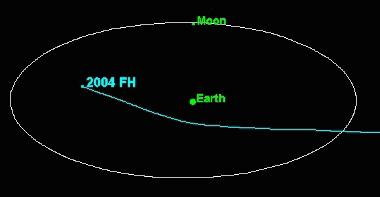
2004 FH is a micro-asteroid and near-Earth object of the Aten group, approximately 30 meters in diameter, that passed just 43000 km above the Earth's surface on 18 March 2004, at 22:08 UTC. It was the 11th-closest approach to Earth recorded . The asteroid was first observed on 16 March 2004, by astronomers of the Lincoln Near-Earth Asteroid Research at the Lincoln Laboratory's Experimental Test Site near Socorro, New Mexico.
Orbit and classification
is an Aten asteroid. It passed 43,000 km from the Earth on 18 March 2004. For comparison, geostationary satellites orbit Earth at 35,790 kilometers. Despite its small size, it is still the fourth-largest asteroid detected coming closer to the Earth than the Moon.
Had this object hit Earth, it would probably have detonated high in the atmosphere. It might have produced a blast measured in hundreds of kilotons of TNT, but may not have produced any effect on the ground. It could also have been an Earth-grazing fireball if it had been much closer but not close enough to impact.
On 17 March 2044 the asteroid will pass no closer than 0.0116 AU from the Earth. also has the distinction of having the lowest inclination of any known near-Earth asteroids.
Two weeks later another asteroid approached even closer, , which was smaller; and a few years later , which was closer in size, passed by at similar distance.
Physical characteristics
is an assumed stony S-type asteroid.
Rotation period
In March 2004, two rotational lightcurves of were obtained from photometric observations by astronomers Petr Pravec, Stefano Sposetti and Raoul Behrend. Lightcurve analysis gave a rotation period of 0.0504 hours (3.02 minutes) with a brightness amplitude of 1.16 and 0.75 magnitude, respectively ().
This makes this object a fast rotator, currently among the Top 100 known to exist. The photometric observations also revealed, that is a tumbler with a non-principal axis rotation.
Diameter and albedo
2004 FH has been estimated to measure approximately 30 m in diameter. The Collaborative Asteroid Lightcurve Link assumes a standard albedo for stony asteroids of 0.20 and calculates a diameter of 24 meters based on an absolute magnitude of 25.7.
Notes
References
- MPEC 2004-F24
- Images of 2004 FH at Klet
- Asteroid Lightcurve Database (LCDB), query form (info )
- Asteroids and comets rotation curves, CdR – Observatoire de Genève, Raoul Behrend
References
- "JPL Small-Body Database Browser: (2004 FH)". [[Jet Propulsion Laboratory]].
- "JPL Close-Approach Data: (2004 FH)".
- (March 17, 2004). "Recently Discovered Near-Earth Asteroid Makes Record-breaking Approach to Earth". NASA's Near Earth Object Program Office.
- "2004 FH". Minor Planet Center.
- Behrend, Raoul. "Asteroids and comets rotation curves – (2004 FH)". [[Geneva Observatory]].
- "LCDB Data for (2004)". Asteroid Lightcurve Database (LCDB).
This article was imported from Wikipedia and is available under the Creative Commons Attribution-ShareAlike 4.0 License. Content has been adapted to SurfDoc format. Original contributors can be found on the article history page.
Ask Mako anything about 2004 FH — get instant answers, deeper analysis, and related topics.
Research with MakoFree with your Surf account
Create a free account to save articles, ask Mako questions, and organize your research.
Sign up freeThis content may have been generated or modified by AI. CloudSurf Software LLC is not responsible for the accuracy, completeness, or reliability of AI-generated content. Always verify important information from primary sources.
Report