From Surf Wiki (app.surf) — the open knowledge base
2001 Mars Odyssey
NASA orbiter for geology and hydrology
NASA orbiter for geology and hydrology
| Field | Value | |||
|---|---|---|---|---|
| name | *2001 Mars Odyssey* | |||
| image | File:Mars Odyssey spacecraft model.png | |||
| image_caption | Artist's impression of the *Mars Odyssey* spacecraft | |||
| insignia | 2001 Mars Odyssey - mars-odyssey-logo-sm.png | |||
| insignia_size | 125px | |||
| mission_type | Mars orbiter | |||
| operator | NASA / JPL | |||
| website | ||||
| COSPAR_ID | 2001-013A | |||
| SATCAT | 26734 | |||
| mission_duration | {{ubli | |||
| <small>{{Age in years, months and days | year | 2001 | month=04 | day=07}} from launch |
| <small>{{Age in years, months and days | year | 2001 | month=10 | day=24}} at Mars ( sols) |
| Extended mission: {{Age in years, months and days | year | 2004 | month=08 | day=25}} ( sols) elapsed |
| manufacturer | Lockheed Martin | |||
| dry_mass | 376.3 kg | |||
| launch_mass | 725 kg | |||
| power | 750 W | |||
| launch_date | UTC | |||
| launch_rocket | Delta II 7925-9.5 | |||
| launch_site | Cape Canaveral SLC-17A | |||
| launch_contractor | Boeing | |||
| last_contact | Q1 2026 (planned) | |||
| orbit_epoch | October 19, 2002 | |||
| orbit_reference | Areocentric | |||
| orbit_regime | Sun-synchronous | |||
| orbit_altitude | 400 km | |||
| orbit_inclination | 93.064° | |||
| orbit_period | 2 hours | |||
| orbit_semimajor | 3793.4 km | |||
| orbit_RAAN | 34.98° | |||
| orbit_arg_periapsis | 0° | |||
| orbit_mean_anomaly | 0° | |||
| orbit_eccentricity | 0.0 | |||
| apsis | areion | |||
| type | orbiter | |||
| object | Mars | |||
| arrival_date | October 24, 2001, | |||
| MSD 45435 12:21 AMT | ||||
| programme | **Mars Exploration Program** | |||
| previous_mission | Mars Polar Lander | |||
| next_mission | Spirit |
| Elapsed:{{ubli | from launch | at Mars ( sols) | En route: 6 months, 17 days | Primary mission: 32 months (1007 sols) | Extended mission: ( sols) elapsed
MSD 45435 12:21 AMT
2001 Mars Odyssey is a robotic spacecraft orbiting the planet Mars. The project was developed by NASA, and contracted out to Lockheed Martin, with an expected cost for the entire mission of US$297 million. Its mission is to use spectrometers and a thermal imager to detect evidence of past or present water and ice, as well as study the planet's geology and radiation environment. The data Odyssey obtains is intended to help answer the question of whether life once existed on Mars and create a risk-assessment of the radiation that future astronauts on Mars might experience. It also acts as a relay for communications between the Curiosity rover, and previously the Mars Exploration Rovers and Phoenix lander, to Earth. The mission was named as a tribute to Arthur C. Clarke, evoking the name of his and Stanley Kubrick's 1968 film 2001: A Space Odyssey.
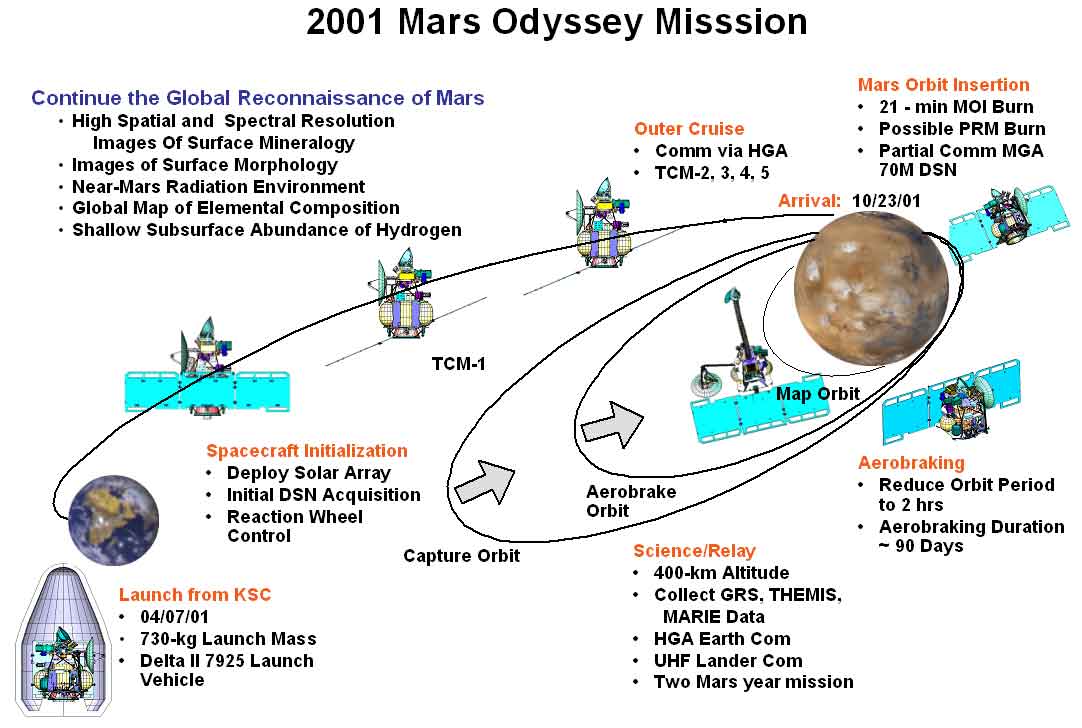
Odyssey was launched April 7, 2001, on a Delta II rocket from Cape Canaveral Air Force Station, and reached Mars orbit on October 24, 2001, at 02:30 UTC (October 23, 19:30 PDT, 22:30 EDT). As of March 2025, it is still collecting data, and is estimated to have enough propellant to function until the end of 2025. It currently holds the record for the longest-surviving continually active spacecraft in orbit around a planet other than Earth, ahead of the Pioneer Venus Orbiter (served 14 years) and the Mars Express (serving over 20 years), at . it is in a polar orbit around Mars with a semi-major axis of about 3,800 km or 2,400 miles.
On May 28, 2002 (sol ), NASA reported that Odysseys GRS instrument had detected large amounts of hydrogen, a sign that there must be ice lying within a meter of the planet's surface, and proceeded to map the distribution of water below the shallow surface. The orbiter also discovered vast deposits of bulk water ice near the surface of equatorial regions.
Odyssey has also served as the primary means of communications for NASA's Mars surface explorers in the past decade, up to the Curiosity rover.
Naming
In August 2000, NASA solicited candidate names for the mission. Out of 200 names submitted, the committee chose Astrobiological Reconnaissance and Elemental Surveyor, abbreviated ARES (a tribute to Ares, the Greek god of war). Faced with criticism that this name was not very compelling, and too aggressive, the naming committee reconvened. The candidate name "2001 Mars Odyssey" had earlier been rejected because of copyright and trademark concerns. However, NASA e-mailed Arthur C. Clarke in Sri Lanka, who responded that he would be delighted to have the mission named after his books, and he had no objections. On September 20, NASA associate administrator Ed Weiler wrote to the associate administrator for public affairs recommending a name change from ARES to 2001 Mars Odyssey. Peggy Wilhide then approved the name change.
Mission objectives
- Mapping the levels of elements across the entire Martian surface
- Determine how much hydrogen exists within the "shallow subsurface"
- Develop a library of high-resolution images and spectroscopy for the mineral composition of the Martian surface
- Provide information on the morphology of the Martian surface
- Identify the "radiation-induced risk to human explorers" through a characterization of the "near-space radiation environment" on the Martian surface
Scientific instruments
The three primary instruments Odyssey uses are the:
- Thermal Emission Imaging System (THEMIS). It is an onboard camera that provides visible and infrared imaging to characterize how minerals are distributed on the surface of Mars.
- Gamma Ray Spectrometer (GRS), including the High Energy Neutron Detector (HEND), provided by Russia. GRS is a collaboration between University of Arizona's Lunar and Planetary Lab., the Los Alamos National Laboratory, and Russia's Space Research Institute. It is a spectrometer focussed on the gamma-ray portion of the spectrum in order to search for various elements in the Martian atmosphere, including carbon, silicon, iron and magnesium.
- Mars Radiation Environment Experiment (MARIE). An "energetic particle spectrometer", measuring the radiation levels around Mars.
Mission
.jpg)
Mars Odyssey launched from Cape Canaveral on April 7, 2001, and arrived at Mars about 200 days later on October 24. Upon arrival, the spacecraft's main engine fired in order to decelerate, which allowed it to be captured into orbit around Mars. Odyssey then spent about 76 days aerobraking, using aerodynamic drag from the upper reaches of the Martian atmosphere to gradually slow down and reduce and circularize its orbit. By planning to use the atmosphere of Mars to slow the spacecraft in its orbit rather than firing its engine or thrusters, Odyssey did not need an additional 200 kilograms (440 lb) of propellant on board. This reduction in spacecraft weight allowed the mission to be launched on a Delta II 7925 launch vehicle, rather than a larger, more expensive launcher.
Aerobraking ended in January 2002, and Odyssey began its science mapping mission on February 19, 2002. Odysseys original, nominal mission lasted until August 2004, but repeated mission extensions have kept the mission active.
The payload's MARIE radiation experiment stopped taking measurements after a large solar event bombarded the Odyssey spacecraft on October 28, 2003. Engineers believe the most likely cause is that a computer chip was damaged by a solar particle smashing into the MARIE computer board.
About 85% of images and other data from NASA's twin Mars Exploration Rovers, Spirit and Opportunity, have reached Earth via communications relay by Odyssey. The orbiter helped analyze potential landing sites for the rovers and performed the same task for NASA's Phoenix mission, which landed on Mars in May 2008. Odyssey aided NASA's Mars Reconnaissance Orbiter, which reached Mars in March 2006, by monitoring atmospheric conditions during months when the newly arrived orbiter used aerobraking to alter its orbit into the desired shape.
Odyssey is in a Sun-synchronous orbit, which provides consistent lighting for its photographs. On September 30, 2008 (sol ) the spacecraft altered its orbit to gain better sensitivity for its infrared mapping of Martian minerals. The new orbit eliminated the use of the gamma ray detector, due to the potential for overheating the instrument at the new orbit.
By December 15, 2010, it broke the record for longest serving spacecraft at Mars, with 3,340 days of operation.
The orbiter's orientation is controlled by a set of three reaction wheels and a spare. When one failed in June 2012, the fourth was spun up and successfully brought into service. Since July 2012, Odyssey has been back in full, nominal operation mode following three weeks of 'safe' mode on remote maintenance.
Mars Odysseys THEMIS instrument was used to help select a landing site for the Mars Science Laboratory (MSL). Several days before MSL's landing in August 2012, Odysseys orbit was altered to ensure that it would be able to capture signals from the rover during its first few minutes on the Martian surface. Odyssey also acted as a relay for UHF radio signals from the (MSL) rover Curiosity. Because Odyssey is in a Sun-synchronous orbit, it passes over Curiositys location twice per day, enabling regular contact with Earth.
On February 11, 2014, mission control accelerated Odysseys drift toward a morning-daylight orbit to "enable observation of changing ground temperatures after sunrise and after sunset in thousands of places on Mars". The orbital change occurred gradually until November 2015. Those observations could yield insight about the composition of the ground and about temperature-driven processes, such as warm seasonal flows observed on some slopes, and geysers fed by spring thawing of carbon dioxide (CO2) ice near Mars's poles.
On October 19, 2014, NASA reported that the Mars Odyssey Orbiter, as well as the Mars Reconnaissance Orbiter and MAVEN, were healthy after the Comet Siding Spring flyby.
In 2010, a spokesman for NASA's Jet Propulsion Laboratory stated that Odyssey could continue operating until at least 2016. This estimate has since been extended to the end of 2025.
File:Animation of 2001 Mars Odyssey trajectory around Sun.gif|Animation of 2001 Mars Odysseys trajectory around Sun
File:Animation of 2001 Mars Odyssey trajectory around Mars.gif|Animation of 2001 Mars Odyssey trajectory around Mars from October 24, 2001, to October 24, 2002
Image:Mgs odyssey.gif|Mars Odyssey as imaged by Mars Global Surveyor Image:Mars Radiation Environment Experiment.jpg|MARIE hardware, designed to measure radiation
Major discoveries
By 2008, Mars Odyssey had mapped the basic distribution of water below the shallow surface. The ground truth for its measurements came on July 31, 2008, when NASA announced that the Phoenix lander confirmed the presence of water on Mars, as predicted in 2002 based on data from the Odyssey orbiter. The science team is trying to determine whether the water ice ever thaws enough to be available for microscopic life, and if carbon-containing chemicals and other raw materials for life are present.
The orbiter also discovered vast deposits of bulk water ice near the surface of equatorial regions. Evidence for equatorial hydration is both morphological and compositional and is seen at both the Medusae Fossae formation and the Tharsis Montes.
References
References
- "2001 Mars Odyssey". [[NASA Space Science Data Coordinated Archive]].
- (October 2002). "Odyssey Telecommunications".
- (April 16, 2024). "Mars Odyssey Goals". NASA JPL.
- "Mars Odyssey: Overview". JPL, CIT.
- "It's "2001 Mars Odyssey" for NASA's next trip to the red planet". NASA.
- (December 4, 2017). "2001 Mars Odyssey Quick Facts". NASA/JPL.
- (March 15, 2023). "Engineers Keep an Eye on Fuel Supply of NASA's Oldest Mars Orbiter". [[NASA]].
- (December 21, 2017). "Pioneer Venus 1: In Depth". NASA.
- "January, 2008: Hydrogen Map". Lunar & Planetary Lab at The University of Arizona.
- [https://arxiv.org/abs/1708.00518 Equatorial locations of water on Mars: Improved resolution maps based on Mars Odyssey Neutron Spectrometer data] (PDF). Jack T. Wilson, Vincent R. Eke, Richard J. Massey, Richard C. Elphic, William C. Feldman, Sylvestre Maurice, Luıs F. A. Teodoroe. ''Icarus'', 299, 148–160. January 2018.
- Hubbard, Scott. (2011). "Exploring Mars: Chronicles from a Decade of Discovery". [[University of Arizona Press]].
- (September 28, 2000). "It's "2001 Mars Odyssey" for NASA's Next Trip to the Red Planet". NASA HQ/JPL.
- (December 4, 2017). "Objectives". NASA/JPL.
- (2004). "The Thermal Emission Imaging System (THEMIS) for the Mars 2001 Odyssey Mission". Space Science Reviews.
- (2004). "The Mars Odyssey Gamma-Ray Spectrometer Instrument Suite". Space Science Reviews.
- (December 4, 2017). "Profile: Dr. William Boynton". [[NASA]].
- "NASA Facts: 2001 Mars Odyssey".
- (11 January 2002). "Mars Odyssey Mission Status". [[NASA Jet Propulsion Laboratory]].
- (April 16, 2024). "Mission Timeline – Mars Odyssey". NASA Jet Propulsion Laboratory.
- (December 4, 2017). "MARIE". [[NASA]].
- NASA, JPL. "Communications Relay – Mars Odyssey".
- "Mars Odyssey Begins Overtime After Successful Mission".
- (October 24, 2001). "Mars Odyssey".
- (22 June 2009). "NASA's Mars Odyssey Alters Orbit to Study Warmer Ground". [[Jet Propulsion Laboratory.
- (December 15, 2010). "NASA's Odyssey Spacecraft Sets Exploration Record on Mars". JPL, NASA.
- Howell, Elizabeth. (July 23, 2018). "Mars Odyssey: Record-Breaking Mission to Mars".
- (June 27, 2012). "Longest-Lived Mars Orbiter Is Back in Service". JPL.
- NASA, JPL. (December 4, 2017). "Guidance, Navigation, and Control – Mars Odyssey".
- (July 28, 2006). "THEMIS Support for MSL Landing Site Selection". Arizona State University.
- Gold, Scott. (August 7, 2012). "Curiosity's perilous landing? 'Cleaner than any of our tests'". Los Angeles Times.
- (July 2012). "Mars Science Laboratory Landing". NASA/JPL.
- Howell, Elizabeth. (August 3, 2012). "How NASA's New Mars Rover Will Phone Home".
- Staff. (February 12, 2014). "NASA Moves Longest-Serving Mars Spacecraft for New Observations". Jet Propulsion Laboratory.
- (October 19, 2014). "NASA's Mars Odyssey Orbiter Watches Comet Fly Near". [[NASA]].
- (October 19, 2014). "NASA's Mars Reconnaissance Orbiter Studies Comet Flyby". [[NASA]].
- (October 19, 2014). "NASA's MAVEN Studies Passing Comet and Its Effects". [[NASA]].
- (October 19, 2014). "All Three NASA Mars Orbiters Healthy After Comet Flyby". [[NASA]].
- (October 19, 2014). "A Comet's Brush With Mars". [[The New York Times]].
- Kremer, Ken. (December 13, 2010). "The Longest Martian Odyssey Ever". Universe Today.
- "January, 2008: Hydrogen Map". Lunar & Planetary Lab at The University of Arizona.
- (June 20, 2008). "Confirmation of Water on Mars". NASA.
- "NASA's Phoenix touches, tastes Martian water". The Economic Times.
This article was imported from Wikipedia and is available under the Creative Commons Attribution-ShareAlike 4.0 License. Content has been adapted to SurfDoc format. Original contributors can be found on the article history page.
Ask Mako anything about 2001 Mars Odyssey — get instant answers, deeper analysis, and related topics.
Research with MakoFree with your Surf account
Create a free account to save articles, ask Mako questions, and organize your research.
Sign up freeThis content may have been generated or modified by AI. CloudSurf Software LLC is not responsible for the accuracy, completeness, or reliability of AI-generated content. Always verify important information from primary sources.
Report