From Surf Wiki (app.surf) — the open knowledge base
2,6-Diaminopurine
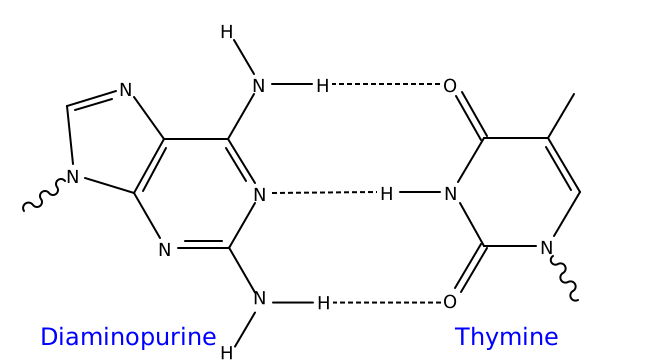
2,6-diaminopurine (2,6-DAP, also known as 2-aminoadenine, standard IUPAC symbol n2A) is a compound once used in the treatment of leukemia. It is found instead of adenine (A) in the genetic material of some bacteriophage viruses,
In August 2011, a report, based on NASA studies with meteorites found on Earth, was published suggesting 2,6-diaminopurine and related organic molecules, including the DNA and RNA components adenine and guanine, may have been formed extraterrestrially in outer space.
Abbreviations
In virology it is referred to as the "Z" base. However, "Z" refers instead to 6-amino-5-nitropyridin-2-one in the Artificially Expanded Genetic Information System (AEGIS), so context is required to differentiate. AEGIS refers to this base as "AminoA" instead.
It has also been called the "D" base, but the more common interpretation of "D" is dihydrouridine.
In viruses
Main article: nucleic acid analogues
In cyanophage S-2L (Siphoviridae), diaminopurine is used instead of adenine (host evasion). Diaminopurine base (Z) pairs perfectly with thymine (T) as it is identical to adenine (A) but has an amine group at position 2 forming 3 intermolecular hydrogen bonds, eliminating the major difference between the two types of basepairs (weak:A-T and strong:C-G). This improved stability affects protein-binding interactions that rely on those differences.
Four papers published April 2021 further describes the use and production of the Z-base. It is now known that:
- The S-2L phage avoids incorporating A bases in the genome by hydrolyzing dATP (DatZ enzyme);
- The Z base is produced by a pathway involving DUF550 (MazZ) and PurZ in S-2L and Vibrio phage PhiVC8;{{cite journal |date=30 April 2021 |volume=372 |issue=6541 |journal=Science |doi=10.1126/science.abe6494 |title=A third purine biosynthetic pathway encoded by aminoadenine-based viral DNA genomes
- The PrimPol/AEP DNA polymerase responsible for handling the Z base occurs in the same gene cluster as the three aforementioned enzymes;{{cite journal |date=30 April 2021 |volume=372 |issue=6541 |journal=Science |doi=10.1126/science.abe6542 |title=Noncanonical DNA polymerization by aminoadenine-based siphoviruses
- The Z base is quite widespread in both Siphoviridae and Podoviridae, based on the occurrence of the said gene cluster.{{cite journal |last1=Zhou |first1=Yan |last2=Su |first2=Xuexia |last3=Wei |first3=Yifeng
In August 2021, it was shown that DatZ, MazZ and PurZ are sufficient to replace some occurrence of A by Z in the bacterial genome of E. coli; expression of this system is toxic to the cell. The structures of MazZ (subtype 2) and PurZ are also determined, showing a possible link between PurZ and archaeal versions of PurA.
Biosynthesis
2-aminoadenine is produced in two steps. The enzyme MazZ (homologous to MazG, EC 3.6.1.8) first performs:
: dGTP + H2O = dGMP + diphosphate
The enzyme PurZ (homologous to PurA, EC 6.3.4.4) then performs:
: (d)ATP + dGMP + L-aspartate = (d)ADP + phosphate + 2-aminodeoxyadenylosuccinate (dSMP)
The resulting dSMP is processed by host enzymes analogously to adenylosuccinate to produce dZTP.
In cellular life
2,6-DAP was used to treat leukemia since as early as 1951. It is known to arrest progression of cell cycle in mouse leukemia cells by 1989. Cancer cells are known to become resistant to DAP by losing their adenine phosphoribosyltransferase (APRT) function, a process shared with E. coli.
DAP derivatives are in vitro antivirals useful against pseudorabies virus, a economically important livestock disease. This base, in its free form, is able to correct UGA nonsense mutations by encouraging translational readthrough, through the inhibition of FTSJ1.
Bioengineering
In bioengineering, anti-miRNA oligonucleotides (specifically, the serinol nucleic acid [SNA] type) incorporating base Z instead of A show enhanced binding to RNA.
DAP is used similarly to other nuclear acid analogues in the investigation of enzyme structures and mechanisms.
References
References
- IUPAC-IUB Commission on Biochemical Nomenclature. (1970). "Abbreviations and symbols for nucleic acids, polynucleotides, and their constituents". [[Biochemistry (journal).
- "George H. Hitchings". nobelprize.org.
- (5 May 2021). "Some viruses thwart bacterial defenses with a unique genetic alphabet".
- (11 August 2011). "Carbonaceous meteorites contain a wide range of extraterrestrial nucleobases". [[PNAS]].
- Steigerwald, John. (8 August 2011). "NASA Researchers: DNA Building Blocks Can Be Made in Space". [[NASA]].
- ScienceDaily Staff. (9 August 2011). "DNA Building Blocks Can Be Made in Space, NASA Evidence Suggests". [[ScienceDaily]].
- (26 October 2023). "Enzymatic synthesis and nanopore sequencing of 12-letter supernumerary DNA". Nature Communications.
- (1 September 2003). "Synthetic biology with artificially expanded genetic information systems. From personalized medicine to extraterrestrial life.". Nucleic Acids Research. Supplement.
- (26 July 2016). "Blind tests of RNA nearest-neighbor energy prediction.". Proceedings of the National Academy of Sciences of the United States of America.
- (18 September 2020). "Predictions and analyses of RNA nearest neighbor parameters for modified nucleotides.". Nucleic Acids Research.
- IUPAC-IUB Commission on Biochemical Nomenclature. (1970). "Abbreviations and symbols for nucleic acids, polynucleotides, and their constituents". [[Biochemistry (journal).
- (November 1977). "2-aminoadenine is an adenine substituting for a base in S-2L cyanophage DNA". Nature.
- Bowler, Jacinta. (4 May 2021). "Some Viruses Have a Completely Different Genome to The Rest of Life on Earth". [[ScienceAlert]].
- (2021-04-23). "How cyanophage S-2L rejects adenine and incorporates 2-aminoadenine to saturate hydrogen bonding in its DNA". Nature Communications.
- (2021-08-05). "Characterization of a triad of genes in cyanophage S-2L sufficient to replace adenine by 2-aminoadenine in bacterial DNA". Nature Communications.
- (May 1951). "The effects of the folic acid antagonists and 2,6-diaminopurine on neoplastic disease, with special reference to acute leukemia". Cancer.
- (1989). "Metabolic activation of 2,6-diaminopurine and 2,6-diaminopurine-2'-deoxyriboside to antitumor agents.". Advances in Enzyme Regulation.
- (20 June 2000). "Chromosome instability contributes to loss of heterozygosity in mice lacking p53.". Proceedings of the National Academy of Sciences of the United States of America.
- (1977). "[Mutations of resistance to 2,6-diaminopurine and 6-methylpurine that affect adenine phosphoribosyltransferase in Escherichia coli K-12].". Genetika.
- (29 February 2016). "Antiviral activities of 2,6-diaminopurine-based acyclic nucleoside phosphonates against herpesviruses: In vitro study results with pseudorabies virus (PrV, SuHV-1).". Veterinary Microbiology.
- (20 March 2020). "2,6-Diaminopurine as a highly potent corrector of UGA nonsense mutations.". Nature Communications.
- (5 October 2017). "Introduction of 2,6-Diaminopurines into Serinol Nucleic Acid Improves Anti-miRNA Performance.". ChemBioChem.
- (1 October 1998). "The use of diaminopurine to investigate structural properties of nucleic acids and molecular recognition between ligands and DNA". Nucleic Acids Research.
This article was imported from Wikipedia and is available under the Creative Commons Attribution-ShareAlike 4.0 License. Content has been adapted to SurfDoc format. Original contributors can be found on the article history page.
Ask Mako anything about 2,6-Diaminopurine — get instant answers, deeper analysis, and related topics.
Research with MakoFree with your Surf account
Create a free account to save articles, ask Mako questions, and organize your research.
Sign up freeThis content may have been generated or modified by AI. CloudSurf Software LLC is not responsible for the accuracy, completeness, or reliability of AI-generated content. Always verify important information from primary sources.
Report