From Surf Wiki (app.surf) — the open knowledge base
2-10-0
Locomotive wheel arrangement
.jpg)
Locomotive wheel arrangement
| Field | Value |
|---|---|
| name | 2-10-0 (Decapod) |
| image | WheelArrangement 2-10-0.svg |
| alt | Diagram of one leading wheel and five large driving wheels joined by a coupling rod |
| caption | Front of locomotive at left |
| image2 | PRR I1s 4300.jpg |
| caption2 | Pennsylvania Railroad class PRR I1s, the most successful class of such locomotives in North America. Note the firebox placed above the rear drivers. |
| UIC/Germany/Italy | 1′E |
| French/Spanish | 150 |
| Turkish | 56 |
| Swiss | 5/6 |
| Russian | 1-5-0 |
| date2 | 1886 |
| country2 | United States |
| locomotive2 | No. 1 & 2 |
| railway2 | Northern Pacific Railroad |
| designer2 | Burnham, Parry, Williams & Company |
| builder2 | Burnham, Parry, Williams & Company |
| evolvedfrom2 | [0-10-0](0-10-0) |
| evolvedto2 | [2-10-2](2-10-2) |
| mainbenefit2 | Better stability than the [0-10-0](0-10-0) |
| maindrawback2 | Small firebox |
| UIC/Germany/Italy= 1′E | French/Spanish = 150 Under the Whyte notation for the classification of steam locomotives, 2-10-0 represents the wheel arrangement of two leading wheels on one axle, ten powered and coupled driving wheels on five axles, and no trailing wheels. This arrangement was often named Decapod, especially in the United States, although this name was sometimes applied to locomotives of 0-10-0 "Ten-Coupled" arrangement, particularly in the United Kingdom. Notable German locomotives of this type include the war locomotives of Class 52.
These locomotives were popular in Europe, particularly in Germany and Russia; British use of the type was confined to the period during and after World War II. In the United States, the 2-10-0 was not widely popular but was a favorite of a small number of railroads which operated mostly in mountainous terrain. Among these was the Erie Railroad, a major Chicago to New York trunk line railroad, and the Pennsylvania Railroad, whose heavily graded routes crossed the Allegheny Mountains.
The 2-10-0's main advantage was that five out of six of its axles were powered, meaning almost all the weight was available for traction rather than being distributed over pilot and trailing wheels. The long rigid wheelbase caused problems on tightly curved track, so blind drivers were the norm, either on the central axle, and/or on the second and/or fourth axles. Often lateral motion devices were attached to the leading drive axle.
The wheel arrangement's disadvantages included the firebox size restriction caused by the lack of trailing wheel. This meant the firebox was fitted in between the wheels (common on earlier locomotives) and was long and narrow, or if mounted above the driving wheels, was wide and long but shallow. Many locomotives chose the latter option. A firebox mounted over the drivers also restricted the diameter of the driving wheels, which in turn limited speed. As with the Consolidation (2-8-0), "chopping" at speed ensured a rough ride for the crew due to instability caused by the wheel arrangement. In fact, backing any locomotive without a trailing axle was restricted to under twenty miles per hour or less. Most 2-10-0s were not operated at speeds greater than 50 mph (80 km/h).
The type operated as freight engine, although locomotives in Germany and the United Kingdom proved capable of hauling passenger trains.
United States
The first Decapods were built for the Lehigh Valley Railroad in the late-1860s. They proved too rough on the track because of their long coupled wheelbase.{{cite book
The first boost in the number of Decapods occurred when Imperial Russia ordered approximately 1,200 Decapods from American builders during World War I. When the Bolshevik revolution occurred in 1917, 857 had already been delivered, but more than 200 were either awaiting shipment or were in the process of construction. These stranded locomotives were adopted by the United States Railroad Administration (USRA), the body created by the Government to oversee and control the railroads during the War, converted to American standards, and put to use on American railroads. Small and light-footed, these Russian decapods proved popular with smaller railroads, and many of them remained in service long after the USRA's control of the railroads ceased. Many indeed lasted until the end of steam on those railroads.
Swengel suggested the 2-10-0 arrangement was 'obsolete' by 1916, when the Pennsylvania Railroad commenced an experiment with a 2-10-0 locomotive at its Juniata plant. Most 10 coupled engines constructed for U.S. railroads during World War I were of the USRA 2-10-2 arrangement, but the PRR committed to 122 of the 2-10-0s. Swengel argued this commitment to the 2-10-0, nicknamed "Deks", was controversial even in 1916 and was more so in 1922 when the PRR placed additional orders. The PRR was soon the biggest user of Decapods in the United States. The type was ideally suited to the Pennsy's heavily graded Allegheny Mountains routes, which required lugging ability according to tractive effort, not speed according to horse power.
The PRR bought 598 2-10-0s including 123 built at its own shops. In one of the largest locomotive orders ever, the rest came from the Baldwin Locomotive Works. The PRR 2-10-0s weighed 386100 lb and developed about 90000 lbf of tractive effort with an axle loading of over 70000 lb. The engines steamed at 250 psi and had a relatively large superheater. The grate area of about 70 sqft was on the small side, but a mechanical stoker partly compensated for this.
The PRR decapod, class I1s, was unlike the Russian decapod; it was huge, taking advantage of the PRR's heavy trackage and high axle loading, with a fat, free-steaming boiler that earned the type the nickname of 'Hippos' on the PRR. Two giant cylinders (30½ x 32 inch) gave the I1s power and their tenders permitted hard and long workings between stops. They were unpopular with the crews, for they were hard riding. The last operations on the PRR were 1957.
A small number of other Decapods were ordered by other railroads; the I-2 Decapods built for the Western Maryland Railway were the largest ever built, at almost 420000 lb weight, and are a notable exception to the rule of thumb for the comfort of the ride on a 2-10-0 wheel arrangement, crews said the engines cruised smoothly up to 50 mph without becoming a rough ride. (After the running gear was redesigned by the WM) The WM's I-2 are also noted as the strongest Decapods ever built, at 96,315 lbs of tractive effort. (Not to be confused with the 10 Russian Decapods the WM held in their roster, which were standard Russian Decapods aside from heavier steel frames the WM used to replace the original cast iron frames, the new frames also made the WM Russian Decapods 2 inches longer than other Russian Decapods)
Baldwin developed two standard 2-10-0s for railroads with low axle-load requirements.
Thirteen Decapod locomotives survive in the US, including two Baldwin standards, six Russian Decapods and one PRR I1. Two, Great Western 90, a Baldwin Decapod at the Strasburg Rail Road, and Frisco 1630, a Russian Decapod at the Illinois Railway Museum, are operational. One Decapod survives as a static exhibit at the North Carolina Transportation Museum in Spencer, North Carolina (Seaboard Air Line 2-10-0 #544).
Preserved Decapods in the United States
- 1621 is on display at the National National Museum of Transportation - St. Louis, MO
- 1625 is on display at the Museum of the American Railroad - Frisco, TX
- 1630 is operated by the Illinois Railway Museum - Union, IL.
- 90 is operated by Strasburg Railroad - Strasburg, PA.
- I1 class 4483 is at Hamburg, New York.
Proposed/Unbuilt (US)
L.D. Porta proposed a 2-10-0, triple expansion Modern steam locomotive as a "third generation" fast-freight locomotive in the 1970s, which he repurpoused for the ACE 3000 project as the ACE 6000.
Germany

The 2-10-0 arrangement was a very popular one in Germany. The first were built by the individual state railways from 1915 to 1918, and these later became the DRG BR58. The DRG then produced a number of standard classes of 2-10-0s: the heavy 3-cylinder BR44 (1753 built), the two-cylinder version BR43 (35 built), and the lightweight BR50 (3164 built). During wartime, the BR44 and BR50 designs were simplified as ÜK (Übergangs Kriegslokomotiven, or interim war locomotives). By 1941, it was clear that even these were too complicated, expensive, time-consuming to build, and used too much material in short supply, so new Kriegslokomotive (war locomotive) designs were developed: the lightweight BR52 (7794 built) and the intermediate weight BR42 (859 built).
Postwar locomotives of these types, particularly the BR 52, were spread all over Europe and were taken into service by the railways of many different countries:
- BR44 in France, SNCF 150X.
- BR50 in Belgium, NMBS/SNCB class 25; in Denmark, DSB class N.
- BR52 in Austria, ÖBB class 52; in Belgium, NMBS/SNCB class 26; in Norway, NSB Class 63.
United Kingdom
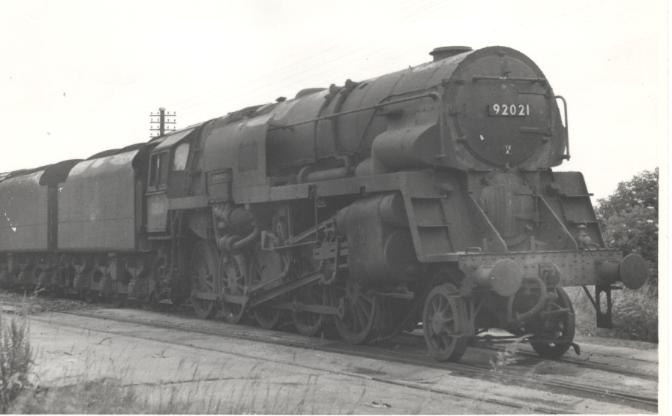
Locomotives with ten driving wheels were rare in British railway history. In 1913 an initial design for a four-cylinder 2-10-0 of 53328 lbf tractive effort was produced by the Lancashire and Yorkshire Railway, but none were built. This had been inspired by Jean-Baptiste Flamme's 2-10-0s working in Belgium and used a similar tapered boiler, with the round-topped firebox almost filling the loading gauge.{{Cite book
The only other 2-10-0 type was the 251-strong Standard class 9F introduced by British Railways in 1954. The class included 92220 Evening Star, the last steam locomotive built for British Railways, in 1960; and 92203 (named Black Prince when preserved), which in 1983 set a record for the heaviest steam locomotive-hauled train in Britain when it started a 2,162-ton train at Foster Yeoman quarry in Somerset.
Finland

The State Railroads of Finland purchased 20 American Decapods after WWII - these were originally built for the Soviet Union, but never delivered to them. Of the 20 engines, 10 were made by Baldwin, 10 by Alco. Since they were originally built for the USSR, they had the correct gauge for Finland, too ( exactly). One (Alco # 75214, 1947) is preserved at the Finnish Railway Museum in Hyvinkää, Finland. The Finnish designation was Tr2.
The locomotive was nicknamed Truman in Finland. It was used for hauling heavy freight trains.
France
From 1910 to 1951, the French industry built more than 500 decapods for three railway companies (Paris-Orléans, Nord, Est) and for the national railways (SNCF). Moreover, at the end of World War II, SNCF inherited more than 200 units of German decapods built in France, mostly BR 44. The last decapod, a SNCF 150P, was withdrawn in 1968. All 2-10-0s, of French or of German design, proved reliable and powerful in service. One can notice that some engines of the Paris-Orléans company were dedicated to passenger service on difficult mountain lines.
Poland


Between early 1920s and 1958 Polish industry delivered to PKP some 1200 decapods of classes , , and . PKP also operated German decapods BR 52 (Ty2) and BR 42 (Ty3), as well as American ones (, nicknamed "Truman"). They were used to work the heaviest goods trains.
Romania
.jpg)
After the Second World War, Romania built the 150.000 Class, after DRB Class 50. A total of 282 locomotives were built between 1946 and 1960, at Malaxa (later 23 August Works) in Bucharest, and in Reșița.
Builder details:
- 150.001-150.050 Reșița
- 150.051-150.081 Malaxa
- 150.082-150.282 Reșița
Soviet Union
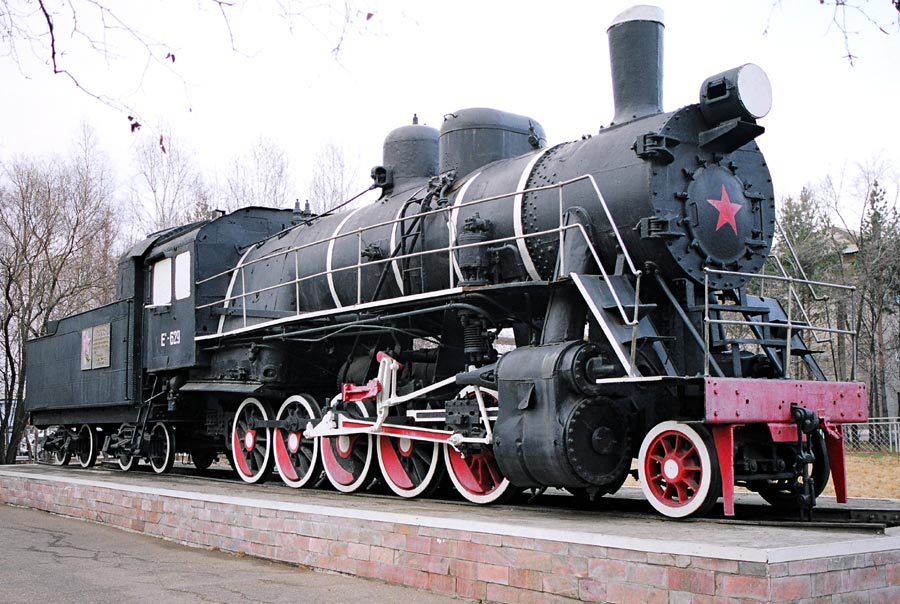
2-10-0 were fairly common freight locomotives in the former Soviet Union. They came from several sources: US imports (class Ye (), built by ALCO and Baldwin, respectively), German war trophy DRB 52 class locomotives (what became the Soviet TE-series) and locally built. The locally built 2-10-0 locomotives were represented by some TE (built from captured German parts), SO (Sergo Ordjonikidze) and L (Lebedyanski)–series locomotives. The L-series locomotives were one of the more advanced steam locomotives built in the former Soviet Union. They used an automatic stoker to feed coal and had a relatively low axle load (18 tonnes or 40,000 lb) to be compatible with the war-torn railroads of the former Soviet Union. Several examples of these locomotives are still preserved in working order.
There is a 2-10-0 Lebedyanski series locomotive L 4657, marooned in a siding at Port Baikal.{{Google maps|url= https://www.google.com/maps/place/Parovoz/@51.870826,104.8110227,3a,75y/data=!3m8!1e2!3m6!1sAF1QipMylkezRdekqvsoDCHWb-Cfa8DFOhp5MUdE_R0x!2e10!3e12!6shttps:%2F%2Flh5.googleusercontent.com%2Fp%2FAF1QipMylkezRdekqvsoDCHWb-Cfa8DFOhp5MUdE_R0x%3Dw129-h86-k-no!7i5184!8i3456!4m5!3m4!1s0x5da887b18c461b37:0x62f529f7c4708ce3!8m2!3d51.8706569!4d104.8111823?hl=en
Footnotes
References
References
- (2000). "Seaboard Air Line Railway: Steam Boats, Locomotives, and History". Indiana University Press.
- King, E.W., Jr. in Drury p. 351
- [http://www.railwayfan.ro/aburi/html/150_000.html 150.000 Class Locomotive] {{Webarchive. link. (2012-04-15 at railwayfan.ro {{in lang). ro
This article was imported from Wikipedia and is available under the Creative Commons Attribution-ShareAlike 4.0 License. Content has been adapted to SurfDoc format. Original contributors can be found on the article history page.
Ask Mako anything about 2-10-0 — get instant answers, deeper analysis, and related topics.
Research with MakoFree with your Surf account
Create a free account to save articles, ask Mako questions, and organize your research.
Sign up freeThis content may have been generated or modified by AI. CloudSurf Software LLC is not responsible for the accuracy, completeness, or reliability of AI-generated content. Always verify important information from primary sources.
Report