From Surf Wiki (app.surf) — the open knowledge base
1st millennium BC
Millennium between 1000 BC and 1 BC
Millennium between 1000 BC and 1 BC
File:1st millennium BC.jpg|thumb|400x400px|From top left clockwise: The Parthenon, a former temple in Athens, Greece; Aristotle, Greek philosopher; Gautama Buddha, a spiritual teacher and the founder of Buddhism; Wars of Alexander the Great last from 336 BC to 323 BC; Letters of the Greek alphabet; People working during the Iron Age; Roman dictator, Julius Caesar is assassinated by the Roman Senate in 44 BC. (Background: A mural from the Assyrian Empire which dissolved in the 7th century BC) rect 42 28 559 285 Parthenon rect 626 65 923 350 Aristotle rect 993 28 1239 387 Gautama Buddha rect 42 372 425 616 Assassination of Julius Caesar rect 483 388 749 502 Greek alphabet rect 775 468 1255 698 Wars of Alexander the Great rect 453 535 731 698 Iron Age
rect 1 1 1279 719 Assyrian Empire The 1st millennium BC, also known as the last millennium BC, was the period of time lasting from the years 1000 BC to 1 BC (10th to 1st centuries BC; in astronomy: JD – ). It encompasses the Iron Age in the Old World and sees the transition from the Ancient Near East to classical antiquity.
World population roughly doubled over the course of the millennium, from about 100 million to about 200–250 million after the birth of Jesus Christ and the establishment of the Julio-Claudian dynasty led by its founder Octavian.Klein Goldewijk, K., A. Beusen, M. de Vos and G. van Drecht (2011). The HYDE 3.1 spatially explicit database of human induced land use change over the past 12,000 years, Global Ecology and Biogeography20(1): 73–86. (pbl.nl). Goldewijk et al. (2011) estimate 188 million as of AD 1, citing a literature range of 170 million (low) to 300 million (high). Out of the estimated 188M, 116M are estimated for Asia (East, South/Southeast and Central Asia, excluding Western Asia), 44M for Europe and the Near East, 15M for Africa (including Egypt and Roman North Africa), 12M for Mesoamerica and South America. North America and Oceania were at or below one million. Jean-Noël Biraben, "Essai sur l'évolution du nombre des hommes", Population 34-1 (1979), 13–25 (p. 22) estimates c. 100 million at 1200 BC and c. 250 million at AD 1.https://www.persee.fr/doc/pop_0032-4663_1979_num_34_1_18032
Overview
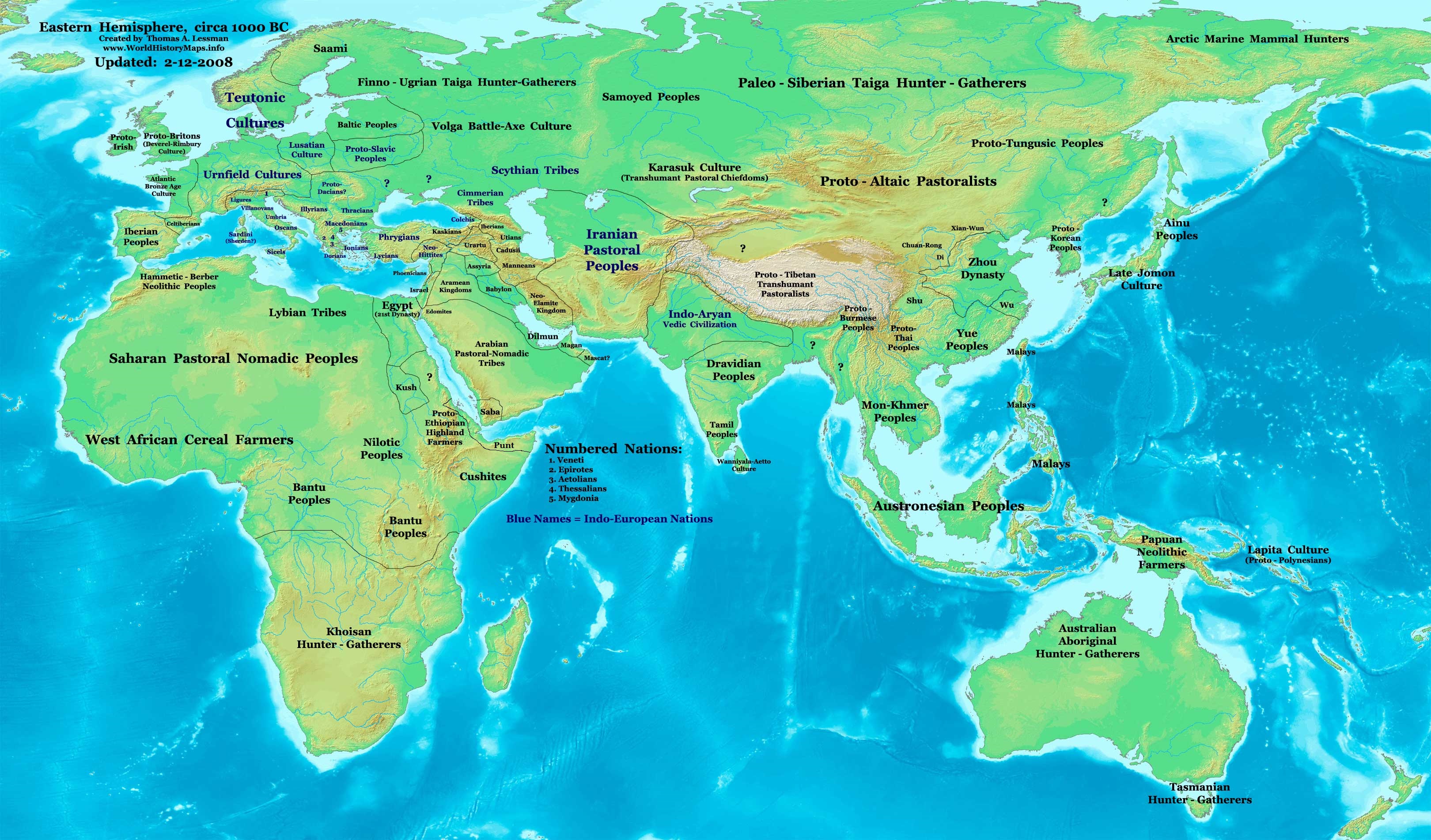
The Neo-Assyrian Empire dominates the Near East in the early centuries of the millennium, supplanted by the Achaemenid Empire in the 6th century. Ancient Egypt is in decline, and falls to the Achaemenids in 525 BC.
In Greece, Classical Antiquity begins with the colonization of Magna Graecia and peaks with the conquest of the Achaemenids and the subsequent flourishing of Hellenistic civilization (4th to 2nd centuries).
The Roman Republic supplants the Etruscans and then the Carthaginians (5th to 3rd centuries). The close of the millennium sees the rise of the Roman Empire. The early Celtic culture dominate Central Europe while Northern Europe is in the Pre-Roman Iron Age. In East Africa, the Nubian Empire and Aksum arise.
In South Asia, the Vedic civilization gives rise to the Maurya Empire. The Scythians dominate Central Asia. In China, the Zhou dynasty rules the Chinese heartland at the beginning of the millennium. The decline of the Zhou dynasty during Spring and Autumn period and the Warring States period sees the rise of such philosophical and spiritual traditions as Confucianism and Taoism. Towards the close of the millennium, the Han dynasty extends Chinese power towards Central Asia, where it borders on Indo-Greek and Iranian states. Japan is in the Yayoi period.
The Olmec civilization declines, and the Maya and Zapotec civilizations emerge in Mesoamerica. The Chavín culture flourishes in Peru.
The first millennium BC is the formative period of the classical world religions, with the development of early Judaism and Zoroastrianism in the Near East, and Vedic religion and Vedanta, Jainism and Buddhism in India. Early literature develops in Greek, Latin, Hebrew, Sanskrit, Tamil and Chinese. The term Axial Age, coined by Karl Jaspers, is intended to express the crucial importance of the period of c. the 8th to 2nd centuries BC in world history.
World population more than doubled over the course of the millennium, from about an estimated 50–100 million to an estimated 170–300 million. Close to 90% of world population at the end of the first millennium BC lived in the Iron Age civilizations of the Old World (Roman Empire, Parthian Empire, Graeco-Indo-Scythian and Hindu kingdoms, Han China). The population of the Americas was below 20 million, concentrated in Mesoamerica (Epi-Olmec culture); that of Sub-Saharan Africa was likely below 10 million. The population of Oceania was likely less than one million people.
Ancient history
Main article: Ancient history
Timeline
- 10th century BC
- Near East: Neo-Assyrian Empire
- Near East: Shoshenq I invades Canaan
- Aegean: Helladic period ends
- Sub-Saharan Africa West: Nok Culture slowly diffuse discernible ceramic sculpting, iron metallurgy and cereal farming cultures through the Niger Delta region, though debatable possible settling period and or foundation of proto Ile-Ife
- 9th century BC
- 8th century BC
- 727 BC: Egypt: Kushite invasion (25th Dynasty)
- 771 BC: China: Spring and Autumn period
- Near East: 727 BC: Death of Tiglath-Pileser III, Babylonia secedes from Assyria
- Near East: 722 BC: Sargon II takes Samaria; Assyrian captivity of the Israelites.
- Greece: Archaic Greece, Greek alphabet
- Greece: Homer
- 776 BC: Greece: First Olympiad
- 753 BC: Europe: foundation of Rome
- 7th century BC[[File:Lion Hunt of Ashurbanipal - king riding killing lion.jpg|thumb|Relief of King [[Ashurbanipal]] of [[Neo-Assyrian Empire|Assyria]] hunting a [[Mesopotamian lion]], from the Northern Palace in [[Nineveh]], -635 BC]]
- 6th century BC
- 5th century BC
- China: 479 BC: death of Confucius
- China: 476 BC: Warring States period
- China: 486 BC: Grand Canal construction begins
- Near East: Second Temple Judaism, redaction of the Hebrew Bible
- Greece: beginning of the classical period (Greece in the 5th century BC).
- Greece: Greco-Persian Wars (Battle of Marathon, Battle of Thermopylae)
- Greece: 440 BC: Herodotus' Histories
- Greece: 431 BC: Peloponnesian War
- Oceania: Austronesian expansion reaches Western Polynesia
- 4th century BC
- Greece: 395 BC: Corinthian War
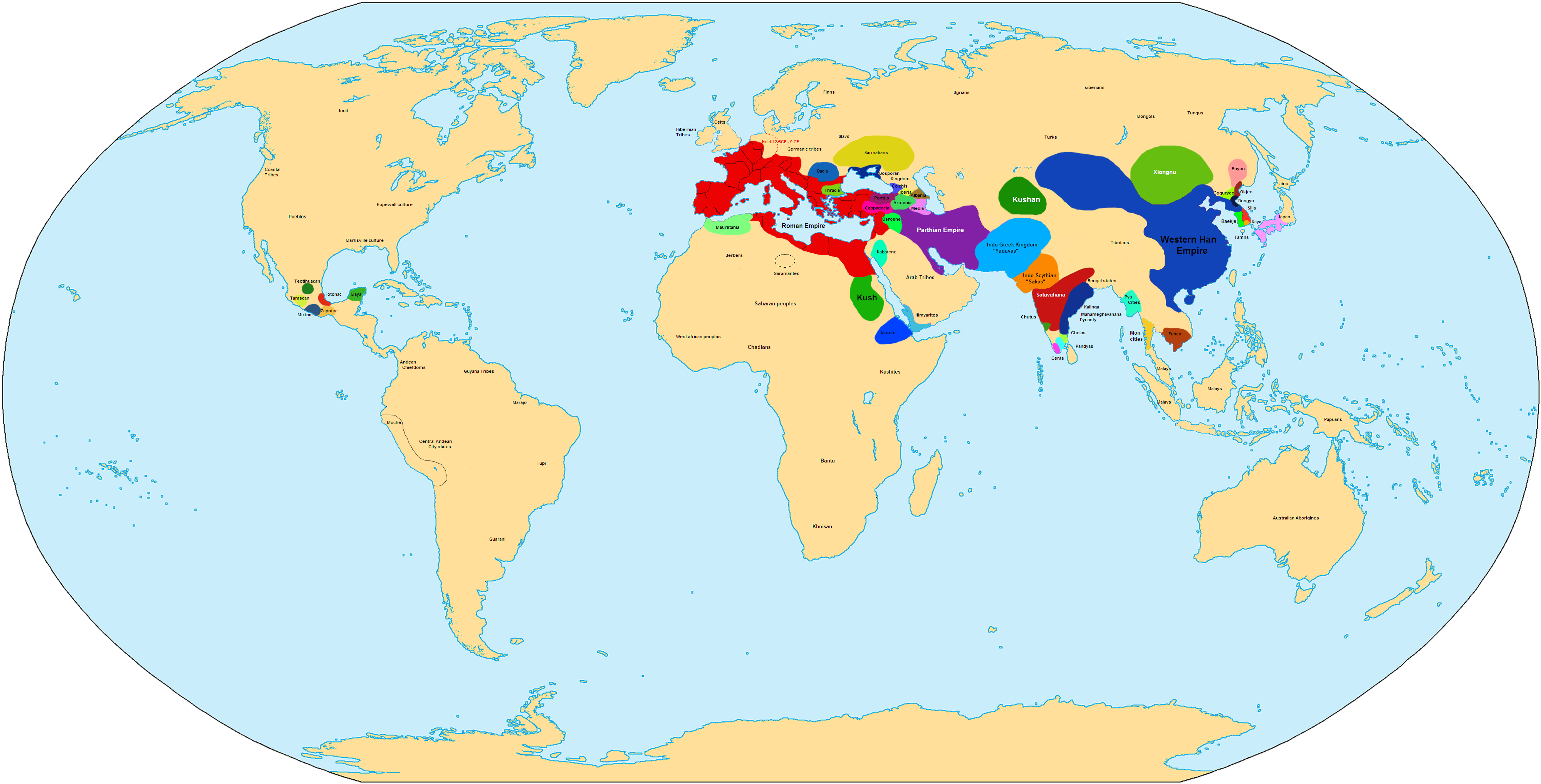
- Egypt: 343 BC: Achaemenid conquest[[File:World in 323 BCE.png|thumb|300px|right|Map of the world in 323 BC]]
- Greece/Asia/Egypt: 330s BC: conquests of Alexander the Great, end of the Achaemenid Empire, Macedonian Empire, beginning of the Hellenistic period
- South Asia: Mauryan Empire
- 3rd century BC
- 2nd century BC
- Rome/Carthage: 149 BC Third Punic War, Roman province of Africa[[File:Statue-Augustus (cropped).jpg|thumb|[[Augustus|Augustus Caesar]], the first emperor of the [[Roman Empire]]]]
- Rome/Greece: 146 BC Battle of Corinth, beginning of the Roman era
- South Asia: 185 BC: Fall of the Maurya Empire
- China: Confucianism became the state ideology of China
- 1st century BC
- China: 91 BC: Records of the Grand Historian finished
- Rome/Europe: 58–50 BC Gallic Wars
- Rome: 32/30 BC: Final War of the Roman Republic (Battle of Actium)
- Rome/Egypt: 31 BC: Roman conquest of Egypt
- Rome/Europe/West Asia/Africa: 27 BC: Roman Empire
Inventions, discoveries, introductions
- 8th century BC
- Greek alphabet, the first alphabet with vowels.
- 7th century BC
- Trireme
- 6th century BC
- Paved trackway
- Pythagorean theorem
- MonotheismAlthough disputed, some scholars see the emergence of monotheism proper in the context of the Babylonian exile, during which the Israelites adopted aspects of Babylonian religion, resulting in Second Temple Judaism by 515 BC. No Other Gods: Emergent Monotheism in Israel Also credited with early monotheism is Zoroastrianism, founded at roughly the same time. Zoroastrianism
- 5th century BC
- Blast furnace China
- Atomism
- Crossbow
- Siege engine
- 4th century BC
- formal grammar
- Kyrenia ship
- 3rd century BC
- Lighthouse of Alexandria
- Malleable Cast iron China
- Archimedes' principle
- Spherical Earth
- Water clock
- Qin built and unified various sections of the Great Wall of China.
- Qin built Qin Shi Huang's Mausoleum guarded by the life-sized Terracotta Army.
- 2nd century BC
- Antikythera mechanism
6th c
-
South America: Beginning of corn cultivation in the Amazon flood plain
-
West Africa: Nok culture iron smelting
-
Mesoamerica: Olmec ball courts 5th c.
-
Mesoamerica: Zapotec hierogphyps at Monte Albán 3rd c.
-
Mesoamerica: Mayan hieroglyphics
-
Mesoamerica: double-spout-and-bridge bottle --
Literature
Main article: Ancient literature
;Greco-Roman literature Main article: Greek literature, Latin literature
Archaic period
- Homer (late 8th or early 7th c.), Iliad, Odyssey
- Hesiod (8th to 7th c.), Theogony and Works and Days
- Archilochus (7th century), Greek poet
- Sappho, (late 7th to early 6th c.), Greek poet
- Ibycus
- Alcaeus of Mytilene
- Aesop's Fables Classical period
- Aeschylus (c. 525–455 BC), Greek playwright
- Herodotus (484–425 BC), Histories
- Euripides (c. 480–406 BC), Greek playwright
- Xenophon: Anabasis, Cyropaedia
- Aristotle (384–322 BC), corpus Aristotelicum Hellenistic to Roman period
- Septuagint
- Apollonius of Rhodes: Argonautica
- Callimachus (310/305-240 B.C.), lyric poet
- Manetho: Aegyptiaca
- Theocritus, lyric poet
- Euclid: Elements
- Menander: Dyskolos
- Theophrastus: Enquiry into Plants
- Old Latin Livius Andronicus, Gnaeus Naevius, Plautus, Quintus Fabius Pictor, Lucius Cincius Alimentus
- Classical Latin: Cicero, Julius Caesar, Virgil, Lucretius, Livy, Catullus
;Chinese literature Main article: Chinese literature
- I Ching (date unknown, between the 10th and 4th centuries BC)
- Classic of Poetry (Shījīng), Classic of Documents (Shūjīng) (authentic portions), Classic of Changes (I Ching)
- Spring and Autumn Annals (Chūnqiū) (722–481 BC, chronicles of the state of Lu)
- Confucius: Analects (Lúnyǔ)
- Classic of Rites (Lǐjì)
- Commentaries of Zuo (Zuǒzhuàn)
- Laozi (or Lao Tzu): Tao Te Ching
- Zhuangzi: Zhuangzi (book)
- Mencius: Mencius
;Sanskrit literature Main article: Sanskrit literature
- Vedic Sanskrit: Vedas, Brahmanas
- Vedanga
- Mukhya Upanishads
- Early layers of the Sanskrit epics (c. 3rd century BC to 4th century AD)
;Hebrew Main article: Ancient Hebrew writings, Hebrew Bible
- c. 8th to 7th c.: the Book of Nahum, Book of Hosea, Book of Amos, Book of Isaiah
- c. 6th c.: Psalms
- c. 5th century: redaction of the Torah
- 3rd century: Ecclesiastes
- 2nd century: Book of Wisdom
;Avestan
- Yasht, Avesta, Vendidad
;Other (2nd to 1st century BC) ;
- Pali literature: Tipitaka
- Tamil:Sangam literature
- Aramaic: Book of Daniel
Archaeology
| Culture | Region | Period | Notes | |||||||
|---|---|---|---|---|---|---|---|---|---|---|
| Urnfield culture | Europe, Central | 1300–750 BC | Bronze Age Europe | |||||||
| Atlantic Bronze Age | Europe, Western | 1300–700 BC | Bronze Age Europe | |||||||
| Painted Grey Ware culture | South Asia | 1200–600 BC | Bronze Age India, Indo-Aryan migration | |||||||
| Late Nordic Bronze Age | Europe, North | 1100–550 BC | Bronze Age Europe | |||||||
| Villanovan culture | Europe, Italy | 1100–700 BC | Iron Age Europe | |||||||
| Greek Dark Ages | Greece | 1100–800 BC | Dorian invasion | |||||||
| Iron Age II | Near East | 1000–586 BC | Ancient Near East, List of archaeological periods (Levant) | |||||||
| Sa Huỳnh culture | Southeast Asia, Vietnam | 1000 BC–AD 200 | ||||||||
| Woodland period | North America | 1000 BC – AD 1000 | List of archaeological periods (North America) | |||||||
| Bantu expansion | Sub-Saharan Africa | 1000 BC–AD 500 | ||||||||
| Middle Nok Period | Sub-Saharan Africa, West | 900–300 BC | Iron metallurgy in Africa | |||||||
| Novocherkassk culture | Europe, Eastern | 900–650 BC | ||||||||
| Chavín de Huántar | title = World Timeline of the Americas 1000 BC – AD 200 | publisher = The British Museum | year = 2005 | url = http://www.worldtimelines.org.uk/world/americas/1000-200BC | access-date = 2009-07-25 | archive-url = https://web.archive.org/web/20090227042132/http://www.worldtimelines.org.uk/world/americas/1000-200BC | archive-date = 2009-02-27 | url-status = dead }} | 1200–500 BC | |
| Poverty Point earthworks | North America, Louisiana | 1650–700 BC | ||||||||
| Olmecs | Mesoamerica | 1500–400 BC | ||||||||
| Adena culture | North America, Ohio | 1000–200 BC | ||||||||
| Liaoning bronze dagger culture | East Asia | 800–600 BC | ||||||||
| Middle Mumun | East Asia, Korea | 800–300 BC | ||||||||
| Etruscan civilization | Europe, Italy | 800–264 BC | ||||||||
| Paracas culture | South America, Peru | 800–100 BC | ||||||||
| Hallstatt culture | Europe, Central | 800 BC–500 BC | Iron Age Europe, Thraco-Cimmerian, Celts | |||||||
| British Iron Age | Europe, Britain | 700–50 BC | Insular Celts | |||||||
| Zapotec civilization | Mesoamerica | 700 BC – AD 700 | ||||||||
| Pazyryk culture | Central Asia | 600–300 BC | Scythians, Saka, Pazyryk burials | |||||||
| Aldy-Bel culture | Central Asia | 600–300 BC | Scythians, Saka | |||||||
| La Tène culture | Europe, Central/Western | 500–50 BC | Gauls | |||||||
| Pre-Roman Iron Age | Europe, North | 500–50 BC | Proto-Germanic | |||||||
| Northern Black Polished Ware | South Asia | 500–300 BC | Vedic period | |||||||
| Late Mumun | East Asia, Korea | 550–300 BC | ||||||||
| Urewe | Sub-Saharan Africa | 400 BC–AD 500 | Iron metallurgy in Africa | |||||||
| Late Nok Period | Sub-Saharan Africa, West | 300–1 BC | Iron metallurgy in Africa | |||||||
| Nasca culture | South America, Peru | 100 BC–800 AD | ||||||||
| Calima culture | South America, Colombia | 200 BC–400 AD | ||||||||
| Hopewell tradition | North America | 100 BC–AD 400 | ||||||||
| Teotihuacan | Mesoamerica | 100 BC –AD 550 | ||||||||
| Ipiutak site | North America, Alaska | title = World Timeline of the Americas 200 BC – AD 600 | publisher = The British Museum | year = 2005 | url = http://www.worldtimelines.org.uk/world/americas/200BC-AD600 | access-date = 2009-07-25 | archive-url = https://web.archive.org/web/20090227042137/http://www.worldtimelines.org.uk/world/americas/200BC-AD600 | archive-date = 2009-02-27 | url-status = dead }} |
Astronomy
;Historical solar eclipses
| Year | Date | Eclipse | Saros | Eclipse | Gamma | Ecliptic | Greatest | Duration | Description |
|---|---|---|---|---|---|---|---|---|---|
| **899** | 21 Apr | Annular | 53 | 0.9591 | 0.8964 | 22:32:15 | 22:21:56 | 00:03:04 | China's 'Double-Dawn' Eclipse [http://eclipse.gsfc.nasa.gov/SEhistory/SEhistory.html](http://eclipse.gsfc.nasa.gov/SEhistory/SEhistory.html) [http://eclipse.gsfc.nasa.gov/SEhistory/SEplot/SE-0898Apr21A.pdf](http://eclipse.gsfc.nasa.gov/SEhistory/SEplot/SE-0898Apr21A.pdf) |
| **763** | 15 Jun | Total | 44 | 1.0596 | 0.2715 | 08:11:13 | 08:14:01 | 00:05:00 | Assyrian Eclipse [http://eclipse.gsfc.nasa.gov/SEhistory/SEhistory.html#-0762](http://eclipse.gsfc.nasa.gov/SEhistory/SEhistory.html#-0762) [http://eclipse.gsfc.nasa.gov/SEhistory/SEplot/SE-0762Jun15T.pdf](http://eclipse.gsfc.nasa.gov/SEhistory/SEplot/SE-0762Jun15T.pdf) |
| **648** | 6 Apr | Total | 38 | 1.0689 | 0.6898 | 08:24:05 | 08:31:03 | 00:05:02 | Archilochus' Eclipse [http://eclipse.gsfc.nasa.gov/SEhistory/SEhistory.html#-0647](http://eclipse.gsfc.nasa.gov/SEhistory/SEhistory.html#-0647) [http://eclipse.gsfc.nasa.gov/SEhistory/SEplot/SE-0647Apr06T.pdf](http://eclipse.gsfc.nasa.gov/SEhistory/SEplot/SE-0647Apr06T.pdf) |
| **585** | 28 May | Total | 57 | 1.0798 | 0.3201 | 14:25:41 | 14:22:26 | 00:06:04 | Thales Eclipse (Medes vs. Lydians), firstly recorded in Herodotus History. [http://eclipse.gsfc.nasa.gov/SEhistory/SEhistory.html#-0584](http://eclipse.gsfc.nasa.gov/SEhistory/SEhistory.html#-0584) [https://www.wired.com/2008/05/may-28-585-bc-predicted-solar-eclipse-stops-battle/](https://www.wired.com/2008/05/may-28-585-bc-predicted-solar-eclipse-stops-battle/) [http://eclipse.gsfc.nasa.gov/SEhistory/SEplot/SE-0584May28T.pdf](http://eclipse.gsfc.nasa.gov/SEhistory/SEplot/SE-0584May28T.pdf) |
| **557** | 19 May | Total | 48 | 1.0258 | 0.3145 | 12:49:02 | 12:52:26 | 00:02:22 | The Siege of Larisa, firstly recorded by Xenophon. [http://eclipse.gsfc.nasa.gov/SEhistory/SEplot/SE-0556May19T.pdf](http://eclipse.gsfc.nasa.gov/SEhistory/SEplot/SE-0556May19T.pdf) |
| **480** | 2 Oct | Annular | 65 | 0.9324 | 0.4951 | 11:56:54 | 11:51:01 | 00:07:57 | Xerxes' Eclipse. recorded by Herodotus History. [http://eclipse.gsfc.nasa.gov/SEhistory/SEplot/SE-0479Oct02A.pdf](http://eclipse.gsfc.nasa.gov/SEhistory/SEplot/SE-0479Oct02A.pdf) |
| **431** | 3 Aug | Annular | 48 | 0.9843 | 0.8388 | 14:45:34 | 14:54:52 | 00:01:05 | Peloponnesian War. [http://eclipse.gsfc.nasa.gov/SEhistory/SEhistory.html#-0430](http://eclipse.gsfc.nasa.gov/SEhistory/SEhistory.html#-0430) [http://eclipse.gsfc.nasa.gov/SEhistory/SEplot/SE-0430Aug03A.pdf](http://eclipse.gsfc.nasa.gov/SEhistory/SEplot/SE-0430Aug03A.pdf) |
| **424** | 21 Mar | Annular | 42 | 0.9430 | 0.9433 | 07:43:30 | 07:54:29 | 00:04:39 | 8th Year of Peloponnesian War. [http://eclipse.gsfc.nasa.gov/SEhistory/SEplot/SE-0423Mar21A.pdf](http://eclipse.gsfc.nasa.gov/SEhistory/SEplot/SE-0423Mar21A.pdf) |
Centuries and decades
| **[1st century BC](1st-century-bc)** | [90s BC](90s-bc) | [80s BC](80s-bc) | [70s BC](70s-bc) | [60s BC](60s-bc) | [50s BC](50s-bc) | [40s BC](40s-bc) | [30s BC](30s-bc) | [20s BC](20s-bc) | [10s BC](10s-bc) | [0s BC](0s-bc) |
|---|
References
- {{cite book
References
- "Julian Day Number from Date Calculator".
- (2008). "Who Built it First". A&E Television Networks.
- {{Harvnb. Temple. 1986
- {{Harvnb. Temple. 1986
- (2005). "World Timeline of the Americas 1000 BC – AD 200". The British Museum.
- (2005). "World Timeline of the Americas 200 BC – AD 600". The British Museum.
This article was imported from Wikipedia and is available under the Creative Commons Attribution-ShareAlike 4.0 License. Content has been adapted to SurfDoc format. Original contributors can be found on the article history page.
Ask Mako anything about 1st millennium BC — get instant answers, deeper analysis, and related topics.
Research with MakoFree with your Surf account
Create a free account to save articles, ask Mako questions, and organize your research.
Sign up freeThis content may have been generated or modified by AI. CloudSurf Software LLC is not responsible for the accuracy, completeness, or reliability of AI-generated content. Always verify important information from primary sources.
Report