From Surf Wiki (app.surf) — the open knowledge base
1998 Queensland state election
none

none
| Field | Value |
|---|---|
| election_name | 1998 Queensland state election |
| country | Queensland |
| type | parliamentary |
| vote_type | Primary |
| ongoing | no |
| previous_election | 1995 Queensland state election |
| previous_year | 1995 |
| next_election | 2001 Queensland state election |
| next_year | 2001 |
| seats_for_election | All 89 seats in the Legislative Assembly of Queensland |
| majority_seats | 45 |
| opinion_polls | #Opinion polling |
| registered | 2,115,977 5.41% |
| turnout | 1,964,778 (92.85%) |
| (1.42 pp) | |
| election_date | |
| image1 | |
| leader1 | Peter Beattie |
| leader_since1 | |
| party1 | Australian Labor Party (Queensland Branch) |
| leaders_seat1 | Brisbane Central |
| popular_vote1 | **773,585** |
| percentage1 | **38.86%** |
| swing1 | 4.03 |
| last_election1 | 45 seats, 42.89% |
| seats_before1 | 44 |
| seats1 | **44** |
| seat_change1 | |
| image2 | |
| leader2 | Rob Borbidge |
| leader_since2 | 10 December 1991 |
| party2 | National–Liberal coalition |
| colour2 | |
| leaders_seat2 | Surfers Paradise |
| popular_vote2 | 605,353 |
| percentage2 | 31.26% |
| swing2 | 17.73 |
| last_election2 | 43 seats, 48.99% |
| seats2 | 32 |
| seats_before2 | 44 |
| seat_change2 | 12 |
| image3 | |
| leader3 | Heather Hill |
| leader_since3 | 21 May 1998 |
| party3 | Pauline Hanson's One Nation – Queensland |
| leaders_seat3 | None |
| *(contested Ipswich)* | |
| popular_vote3 | 439,121 |
| percentage3 | 22.68% |
| swing3 | 22.68 |
| last_election3 | *Did not exist* |
| seats_before3 | 0 seats |
| seats3 | 11 |
| seat_change3 | 11 |
| map_image | 1998 Queensland election - Vote Strength.svg |
| map_size | 400px |
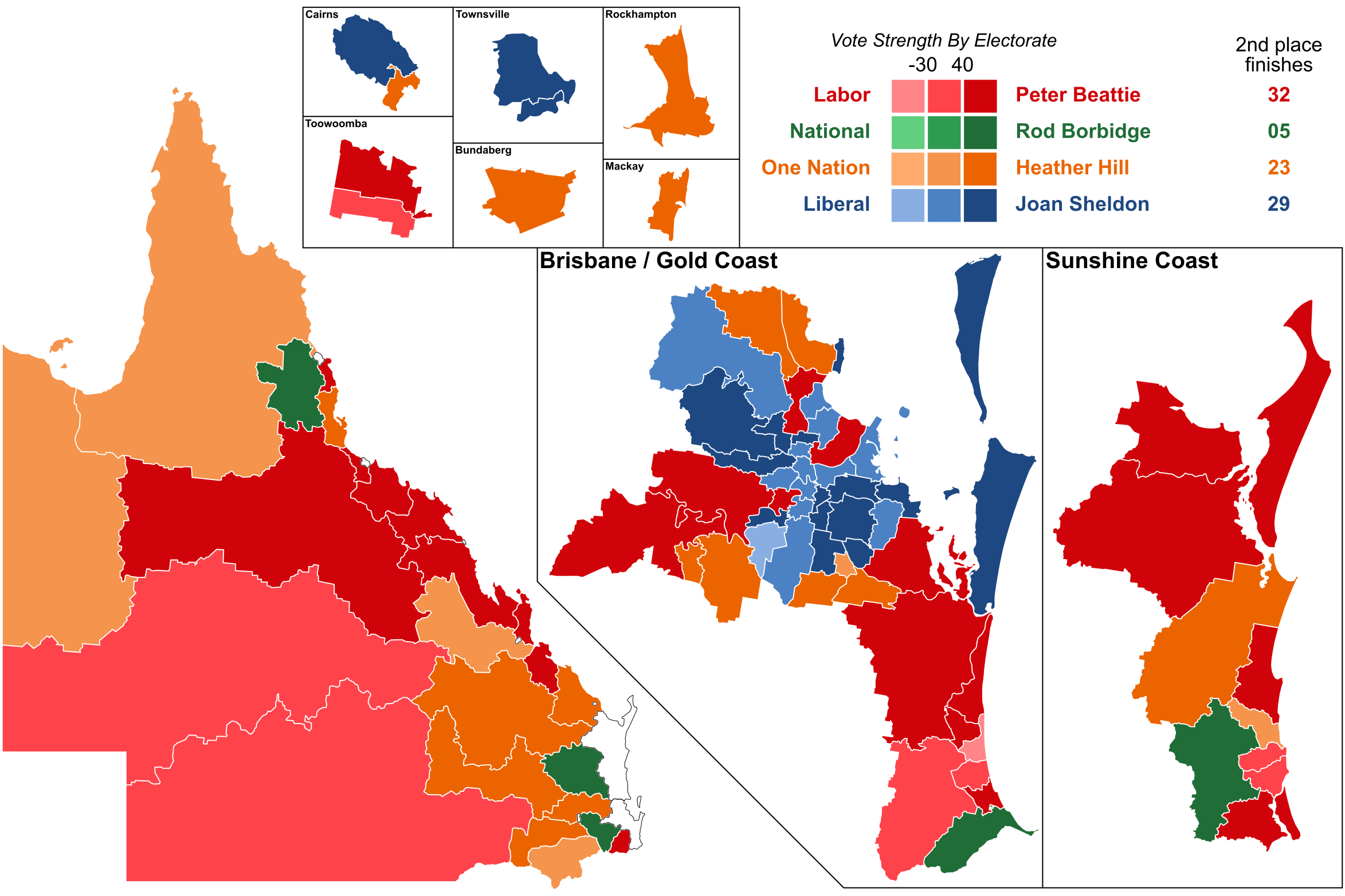
| map_caption | The top map shows the first party preference by electorate. The bottom map shows the final two-party preferred vote result by electorate. |
| title | Premier |
| posttitle | Resulting Premier |
| before_election | Rob Borbidge |
| before_party | National–Liberal Coalition |
| after_election | Peter Beattie |
| after_party | Australian Labor Party (Queensland Branch) |
(1.42 pp)
(contested Ipswich)
The 1998 Queensland state election was held on 13 June 1998 to elect all 89 members of the Legislative Assembly of Queensland.
The result of the election was a second consecutive hung parliament, with the Labor Party forming minority government after receiving the support of independent Peter Wellington. This election was the first in which One Nation supporters were elected to state Parliament, with the controversial party winning 11 seats. With nearly 23% of the vote, One Nation gained a higher percentage of the vote than any other third party (i.e. not Labor, Coalition, or independents) at the state or territory level since Federation. This was also the only election at which a third party gained more votes than both the Liberal Party and the National Party considered separately. Unlike in previous elections, no attempt was made to calculate the statewide two-party preferred vote (2PP), because the One Nation vote was so high that any 2PP result would have been meaningless.
A few months after the election, the One Nation member for Mulgrave, Charles Rappolt resigned. Labor won the ensuing by-election, allowing it to form government with a bare majority of 45 seats.
The fact that the Coalition Government came to office as a direct result of the 1996 Mundingburra by-election instead of the general election the previous year, as well as its failure to win in its own right at the 1998 election, meant that the 1998 election was the fourth consecutive election victory for the Queensland Branch of the ALP, which had won every election since 1989.
Background
The previous state election (1995) had resulted in one of the narrowest margins of any Australian election. The National–Liberal Coalition won a slim majority of the two-party vote. However, the Coalition's majority was wasted on massive landslides in its rural heartland, while Labor won 31 seats in Brisbane. Labor Premier Wayne Goss' government thus clung to life by a single seat. This was brought undone when the Court of Disputed Returns ordered a new election in the disputed seat of Mundingburra, which the Liberals won on a modest swing. The balance of power rested with newly elected Independent MLA Liz Cunningham, who announced her support for the Coalition. Goss resigned, and Nationals leader Rob Borbidge was appointed as Premier.
The Borbidge government's popularity suffered in the later part of its term due to the federal Howard government's GST plans. Seeking to create a more definite majority, Borbidge called a new election on 19 May 1998. Although early polling showed the government to be strongly competitive with Labor, led by Peter Beattie, later polls saw Labor gain a substantial lead.
However, the debate between the two parties was rapidly sidelined by One Nation's emerging support. Formed in 1997 by federal Independent MP for Oxley Pauline Hanson, One Nation gained significant support on a platform of economic nationalism, anti-immigration sentiments and opposition to native title. Its platform was particularly well received in the Nationals' heartland of rural Queensland; indeed, at the time the writs were dropped, there had been fears over the past two years that One Nation would sweep the Nationals out of existence. One Nation stood candidates in 79 seats, all largely political novices. The issue of preference allocations to One Nation, under Queensland's optional preferential voting (OPV) system, became a major campaign issue, with eventual poor results for the Liberals attributed to opposition from many of their traditional voters over their decision not to put One Nation last on preferences.
Borbidge had been well aware of the threat from One Nation. He tried to have One Nation preferenced last on Coalition how-to-vote cards. However, the national Liberal and National organisations pressured their Queensland counterparts to preference One Nation ahead of Labor. They apparently thought that One Nation's populism would peel off enough Labor voters to allow the Coalition to win another term.
One Nation won 11 seats and finished second (after preferences) in 23 seats. Seven of One Nation's seats would have gone to Labor had it not been for leakage of Coalition preferences; had Labor won those seats, it would have been able to form government in its own right.
Key dates
| Date | Event |
|---|---|
| 19 May 1998 | Writs were issued by the Governor to proceed with an election. |
| 23 May 1998 | Close of electoral rolls. |
| 26 May 1998 | Close of nominations. |
| 13 June 1998 | Polling day, between the hours of 8am and 6pm. |
| 25 June 1998 | Peter Wellington announced that he would support a minority Labor government. |
| 26 June 1998 | The Borbidge Ministry resigned and the interim Beattie Ministry was sworn in. |
| 29 June 1998 | The full Beattie Ministry was sworn in. |
| 27 July 1998 | The writ was returned and the results formally declared. |
Retiring members
Labor
- Len Ardill MLA (Archerfield)
- Clem Campbell MLA (Bundaberg)
- Keith De Lacy MLA (Cairns)
- Wayne Goss MLA (Logan)
- Glen Milliner MLA (Ferny Grove)
- Geoff Smith MLA (Townsville)
National
- Di McCauley MLA (Callide)
- Mark Stoneman MLA (Burdekin)
Results

Seats changing hands
- Members listed in italics did not contest their seats at this election.
- ¹ Frank Tanti gained Mundingburra for the Liberal Party at the 1996 by-election. The Labor Party had retained the seat at the 1995 election.
Post-election pendulum
Subsequent changes
- On 4 November 1998, One Nation Party member Charles Rappolt (Mulgrave) resigned. At the by-election on 5 December 1998, Warren Pitt gained the seat for the Labor Party. This gave Labor 45 seats, enough for a majority government.
- On 6 February 1999, the One Nation Party members Shaun Nelson (Tablelands), Dorothy Pratt (Barambah), and Ken Turner (Thuringowa) resigned from the party and sat as Independents.
- On 23 February 1999, the One Nation Party members John Kingston (Maryborough) and Jeff Knuth (Burdekin) resigned from the party and sat as Independents. On 18 February 2000, Jeff Knuth (Burdekin) joined the City Country Alliance.
- On 22 December 1999, the One Nation Party members Harry Black (Whitsunday), David Dalgleish (Hervey Bay), Bill Feldman (Caboolture), Jack Paff (Ipswich West), and Peter Prenzler (Lockyer) resigned from the party and formed the City Country Alliance.
- On 14 December 1999, the Labor Party member Bob Gibbs (Bundamba) resigned. At the by-election on 5 February 2000, Jo-Ann Miller retained the seat for the Labor Party.
- On 9 January 2000, the Labor Party member Bill D'Arcy (Woodridge) resigned. At the by-election on 5 February 2000, Mike Kaiser retained the seat for the Labor Party.
- On 30 November 2000, Deputy Premier Jim Elder (Capalaba) resigned from the Labor Party and sat as an Independent.
- On 4 December 2000, Grant Musgrove (Springwood) resigned from the Labor Party and sat as an Independent.
- On 10 January 2001, Mike Kaiser (Woodridge) resigned from the Labor Party and sat as an Independent.
Opinion polling
Although the Coalition government initially enjoyed strong levels of support subsequent to assuming office in 1996, support was quickly lost. From 1997, Labor opened a consistent, albeit narrow, lead in the polls and by 1998 Labor was enjoying a commanding lead. The Coalition was eventually disadvantaged by what was commonly deemed to be poor government performance and the rapid rise of One Nation support, which under the state's optional preferential voting, fractured the conservative vote. The Coalition vote significantly plummeted, whilst Labor essentially withstood the swing to One Nation.
| Primary vote | Date | L/NP | ALP | ONP | OTH | 1998 election | 10–11 Jun 1998 | 29–31 May 1998 | Apr–May 1998 | Jan–Mar 1998 | Oct–Dec 1997 | Jul–Sep 1997 | Apr–Jun 1997 | Jan–Mar 1997 | Oct–Dec 1996 | Jul–Sep 1996 | 1995 election |
|---|---|---|---|---|---|---|---|---|---|---|---|---|---|---|---|---|---|
| 31.3% | 38.9% | 22.7% | 7.1% | ||||||||||||||
| 33% | 41.5% | 18.5% | 7% | ||||||||||||||
| 34% | 44% | 15% | 7% | ||||||||||||||
| 39% | 41% | 10% | 10% | ||||||||||||||
| 39% | 41% | 5% | 15% | ||||||||||||||
| 38% | 43% | 19% | |||||||||||||||
| 41% | 40% | 19% | |||||||||||||||
| 41% | 41% | 18% | |||||||||||||||
| 41% | 44% | 15% | |||||||||||||||
| 46% | 41% | 13% | |||||||||||||||
| 49% | 42% | 9% | |||||||||||||||
| 49.0% | 42.9% | 8.1% |
References
References
- "1998 Queensland Election (Current Issues Brief 2 1998-99)". Aph.gov.au.
- [[Antony Green. Green, Antony]]. [https://www.abc.net.au/elections/qld/2012/guide/preview.htm Queensland election preview]. [[Australian Broadcasting Corporation]], 2012-01-25.
- Electoral Commission of Queensland. (1998). "Queensland Election 1998: Statistical Returns". Electoral Commission Queensland.
- Queensland Parliamentary Library. (2009). "Queensland Parliamentary Record: the 52nd parliament".
- Wanna, John. (December 1998). "Australian Political Chronicle: January–June 1998". Australian Journal of Politics and History.
- Hughes, Colin A.. (2002). "A handbook of Australian government and politics, 1985-1999". Federation Press.
- "QLD Newspoll".
This article was imported from Wikipedia and is available under the Creative Commons Attribution-ShareAlike 4.0 License. Content has been adapted to SurfDoc format. Original contributors can be found on the article history page.
Ask Mako anything about 1998 Queensland state election — get instant answers, deeper analysis, and related topics.
Research with MakoFree with your Surf account
Create a free account to save articles, ask Mako questions, and organize your research.
Sign up freeThis content may have been generated or modified by AI. CloudSurf Software LLC is not responsible for the accuracy, completeness, or reliability of AI-generated content. Always verify important information from primary sources.
Report