From Surf Wiki (app.surf) — the open knowledge base
1997 24 Hours of Le Mans
65th 24 Hours of Le Mans endurance race
65th 24 Hours of Le Mans endurance race

The 1997 24 Hours of Le Mans was the 65th Grand Prix of Endurance and took place on 14 and 15 June 1997. It was won by Michele Alboreto, Stefan Johansson, and Tom Kristensen, driving a TWR-Porsche WSC-95. The race was the first of a record 9 Le Mans wins for Kristensen, on what was his La Sarthe debut. This was only the third time in the races history that it was won by the same car and same chassis as the previous year, and in a unique ‘double-double’ one of those other times (1984-85) was also by Joest Racing.
Once again, it was at the expense of the works Porsche team who had dominated most of the race. But when the second team car stopped in flames with just two hours to go, it was the Joest team who had the fortune to be in the right place to pick up the pieces. New GT1 cars arrived from Nissan and the small new American Panoz company. Initially, the TWR held the lead for the first two hours, until the two works Porsches asserted their dominance and led into and through the night, with the TWR and the best of the McLarens gradually giving away ground. Come the new dawn though and the Porsche challenge faltered. Bob Wollek, hounded by his teammate, hit a curb and wrecked the suspension on their leading car. The other car took over and was looking comfortably at the front until, with two hours to go, Ralf Kelleners radioed the team to report an engine issue and then had to almost immediately pull over as the car burst into flames. From there, the TWR-Porsche moved up to the lead which it held to the finish, with the Gulf and works BMW McLarens coming home in second and third. The GT2 class was a battle between the Chrysler Vipers and Porsche 911s but in a race of attrition which, in the end, fell to the Haberthur Porsche team.
Regulations
.jpg)
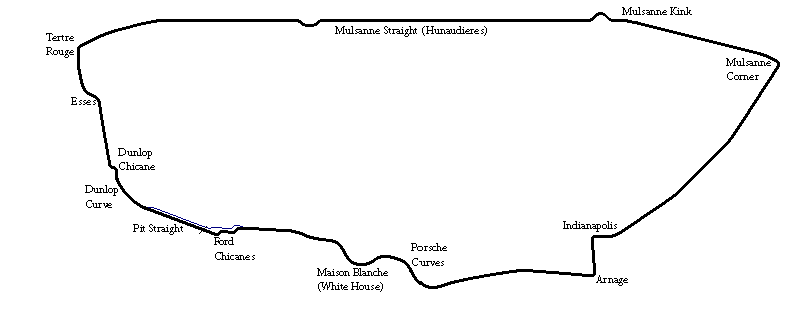
The circuit was adjusted very slightly, at the request of the FIM (Fédération Internationale de Motocyclisme) – the governing body for motorcycle racing – to modify the chicane after the Dunlop Bridge and increase the run-off area for improved safety, as part of the Bugatti Circuit used in motorcycling events. This extended the lap length by 5 metres. The Automobile Club de l'Ouest (ACO) made no notable changes this year to their technical specifications. They did decree that Prototype and GT1 cars would have white headlights, while the GT2s had yellow ones to aid in nighttime identification. GT2 cars were also now allowed carbon brakes if their base road car was fitted with them. The list of automatic entries was changed from an arbitrary choice of manufacturers to nominated class-victories of specific races.
The success of the BPR Global GT Series convinced the FIA to promote it to full World Championship status, and 1997 was the inaugural year of the FIA GT Championship. Organisation stayed with the Stéphane Ratel Organisation, with this year to consist of 8 races in Europe, 1 in Japan and the final 2 rounds in the USA. Alongside that, a new embryonic prototype series was set up. The 1997 International Sports Racing Series was a non-championship event of 4 races in Europe that would commence after the Le Mans 24 Hours.
Once again, the ACO lined up the first ten cars of each class behind each other, with prototypes on the left and GT cars on the right.
Entries
The ongoing strength of the GT championships meant there were 86 applications, of which 76 were accepted for the Pre-Qualifying weekend in May for the 46 starting spots. From those who turned up, there were 13 prototypes for 10 places, 29 GT1s for 22 and 21 GT2s for 16 slots. The ACO only gave automatic entry to a further 6 cars this year, as follows:
- 1996 Le Mans 24hr Prototype class-winner (Joest Racing)
- 1996 Le Mans 24hr GT1 class-winner (Porsche AG)
- 1996 Le Mans 24hr GT2 class-winner (Roock Racing)
- 1996 Coupe d’Automne 4hr Prototype class-winner (Welter Racing)
- 1996 Coupe d’Automne 4hr GT1 class-winner (Larbre Compétition)
- 1996 BPR Global GT Series winner (Gulf Racing) Fully half the cars coming from the Pre-Qualifying could be called works entries, and there were ten different manufacturers in GT1:
| Class | Quantity | Turbo and | |||||
|---|---|---|---|---|---|---|---|
| Rotary | |||||||
| engines | LM-P875 | LM-P650 | LM-GT1 | LM-GT2 | Total Entries | ||
| 13 / 10 | 11 / 8 | ||||||
| 2 / 0 | 2 / 0 | ||||||
| 35 / 22 | 17 / 11 | ||||||
| 26 / 16 | 13 / 8 | ||||||
| 76 / 48 | 43 / 27 |
- Note: The first number is the number that pre-qualified, the second the number who started.
.jpg)
LM-P875
.jpg)
Joest Racing returned with the victorious TWR-Porsche from last year. The second car had been returned to the Porsche factory. Neither had been raced since but Reinhold Joest availed himself of the automatic entry to defend their title, this time without the factory back-up. Very little extra work was done on the car. Michele Alboreto was now the lead driver and was reunited with his former F1 Ferrari teammate Stefan Johansson. Their rookie co-driver this year was Tom Kristensen, who was to become, over the next decade, Le Mans' most successful driver. At this time, he was leading the F3000 championship after 3 races. He was approached by Joest just nine days before the race, to replace an injured Davy Jones who had won for Joest in 1996, but was still unable to race after a single-seater accident in January.
Courage Compétition put together another big effort to try and get the overall win. Four cars were entered including the new C41, now adapted to the ACO prototype regulations. Celebrating the 40th anniversary of Michel Vaillant, the French motor-racing comic, the car was called the Courage-Vaillant and painted by the comic's publisher Studio Graton. It was entrusted to junior F3000 drivers Didier Cottaz, Marc Goossens and Jérôme Policand. The other three were their C36 spyders, with one again driven by Mario Andretti with his son Michael, and former F1 and Indycar driver Olivier Grouillard as their co-driver. Another C36 was again sponsored by the Elf La Filière young-driver academy. Joining the veteran Henri Pescarolo this year were Jean-Philippe Belloc and Emmanuel Clérico. Kremer Racing brought the same pair of K8 Spyders from last year. With the teams focus now on their GT cars in the BPR series, little work was done on the K8s. Regular Kremer GT drivers Tomás Saldaña and Carl Rosenblad were joined by Jürgen Lässig. The second car had former Minardi F1 driver Giovanni Lavaggi and Jean-Luc Maury-Laribière and Bernard Chauvin.
.jpg)
.jpg)
There was a sizeable entry from the IMSA GT Championship headlined by Ferrari. Two of the Ferrari 333 SP cars were entered. Gianpiero Moretti had bought the chassis run the previous year as the “Racing for Belgium” car from Team Scandia, while Michel Ferté's Pilot Racing had purchased their car from the EuroMotorsports team. Both cars arrived with the original body kit and although the Pilot car had not raced since the 1994 IMSA season (when it had scored the first victory for the 333 SP), Moretti's Momo Racing had proven competitive, recently winning the Lime Rock Park round in May. Moretti, now 57-years old, was back at Le Mans for the first time since he was in a Ferrari 512S in 1970, and raced with his regular co-drivers in 1996, Didier Theys and Max Papis.
Mazdaspeed worked again with their American representative Jim Downing. The tenth Kudzu chassis, the DLM4 was designed around the Mazda R26B quad-rotor engine that had formerly fitted in the 1991-winning Mazda 787B. Downing had finally convinced IMSA to allow the quad-rotor into the WSC. The ACO in turn required the car to run in the LM-P875 class, set up to the WSC regulations. Designed by Dave Lynn, the chassis had a longer wheelbase for the bigger engine. It had to run with a 5-speed gearbox and iron brakes, and the engine was limited to 560 bhp. The issue with rotary engines was the greater heat they generated, so the aerodynamics had to accommodate airflow to the engine. However, the drag created hobbled the top speed, not helped by the 150 kg increase in weight from the previous ultralight P2 DLM. Further engine issues meant the car failed pre-qualifying until a reprieve came from the withdrawal of the WR team. Extensive mechanical and aerodynamic work were done to improve the design. Downing once again raced with the same drivers, Yojiro Terada and Franck Fréon, that he had for the past two years.
In 1992 BRM entered Le Mans with its model P351 and it returned again this year. The chassis had been bought Keith Wiggins for his Pacific Racing team that had recently left Formula 1 after an unsuccessful foray. Rebranded the P301 it had a major revamp from Pacific engineer Peter Weston to comply to the new regulations. Converted to an open-top, spyder format, the rear-end was modified to replace the 3.5-litre V12 with the more compact Nissan 3.0-litre V6 turbo. Harri Toivonen, who had driven the BRM back in 1992, was lead driver, alongside veterans Eliseo Salazar and Jesús Pareja.
LM GT1
.jpg)
.jpg)
.jpg)
.jpg)
.jpg)
The Porsche 911 GT1 had made a big impact in its debut in the 1995 race. Porsche brought a pair of their next iteration, the GT1 Evo. The chassis and engine remained the same, as was the suspension except to widen it slightly and that its ABS brakes were banned. The main changes were improvements to the bodyshell with a more smoothly-curved aerodynamic shape. However, the FIA imposed smaller air restrictors on the car and banned ABS brakes that made it much less competitive in the Championship. However, with the ACO running lighter restrictions on turbo power, the water-cooled 3.2-litre engine could still make 590 bhp. The suspension was also upgraded to improve the sometime difficult handling. Hans-Joachim Stuck, Thierry Boutsen and Bob Wollek were again teamed up in one car, while Emmanuel Collard and Ralf Kelleners joined Yannick Dalmas in the other. Meanwhile, over the close season Porsche had opened up its 911 GT1 for customer sales. Thirty road-going versions had been produced, selling for about £450,000 each. Six customer cars were entered at Le Mans. Porsche stalwarts Kremer Racing backed up their prototypes with a GT1, with Le Mans winners Christophe Bouchut (with Peugeot, 1992) and Bertrand Gachot (with Mazda, 1991) along with IMSA owner Andy Evans. The fellow German teams of Roock Racing and Franz Konrad stepped up from the GT2 class this year in the GT Championship, bringing those cars to France. Roock had their regular team-driver Stéphane Ortelli with former Sauber F1 driver Karl Wendlinger and rookie Allan McNish. Konrad piloted his car with 1994 winner Mauro Baldi and Robert Nairn. Giuseppe Lucchini's BMS Scuderia Italia team had competed in Formula 1 from 1988-93 without success. Coming into touring cars, this year they entered the GT Championship with Pierluigi Martini and Christian Pescatori. Also new to GT1 were the French JB Racing (of former F1 Renault driver Jean-Pierre Jabouille) and Schübel Rennsport (with Pedro Lamy/Armin Hahne/Patrice Goueslard).
For McLaren Cars, the 1996 race had shown up that the F1 GTR was being outclassed by the new designs, despite winning the BPR Championship. Designer Gordon Murray and his team worked on reducing weight and increasing downforce, focusing on the rear end and suspension. BMW reduced the capacity slightly to 5990cc and lightened the engine by 25 kg. After the issues from the 1996 race, a new Xtrac 6-speed sequential gearbox was installed. Overall, 100 kg was trimmed with a wider, longer shell that further improved downforce. The BMW-Schnitzer works team had four cars, while another six of the new cars were sold: four more to Ray Bellm's Gulf Racing team and one each to Kazimuchi Goh's Team Lark and the new English Parabolica Motorsport team. The power remained at 600 bhp. As the road-cars were fitted with ABS brakes, they were eligible for the race-cars as well, although only those of the BMW works team chose to have them. The extra work in turn allowed bigger air-restrictors that meant the BMW works cars could generate up to 650 bhp. The Schnitzer works team had a dominant start to the season, winning all three of the opening rounds of the Championship between their two cars. Two of those went to JJ Lehto and Steve Soper, who raced with F1 champion Nelson Piquet), and Roberto Ravaglia/Peter Kox had McLaren F1 test driver Éric Hélary as their co-driver. Likewise, the Gulf team entered the three cars they were running in the GT Championship: Bellm and Andrew Gilbert-Scott were joined by McLaren Le Mans-winner Masanori Sekiya; Bellm's fellow team-owner Thomas Bscher raced with John Nielsen and Chris Goodwin while the third car of Pierre-Henri Raphanel and Jean-Marc Gounon got Anders Olofsson. Goh did not have a Le Mans entry but agreed to sponsor David Morrison's Parabolica Motorsport car and join forces. The latter's Gary Ayles had Team Lark's Akihiko Nakaya and Keiichi Tsuchiya. Such was the strength of field, the 1996-spec car of BBA Compétition failed to pass the Pre-Qualification.
This year Nissan came to Le Mans with a completely new model – the R390 GT1. A deal was arranged with Tom Walkinshaw Racing in September 1996 for a 2-year GT1 project specifically for Le Mans. Designed by Tony Southgate (ex-Jaguar, ex-Toyota and ex-Ferrari), the cars were built in England. Five were commissioned, including one as the requisite road-car for homologation. A low, dropping shape at front and rear, the carbon/kevlar body had been designed to maximise downforce with diffuser channels at both ends to direct airflow past the carbon brakes. The 3.5-litre VRH35L V8 engine could trace its heritage to the 1000 bhp beast that powered the Nissan Group C cars of 1988-90. With 4-valves per cylinder and twin ICI turbochargers, it could develop 600 bhp through the same 6-speed Xtrac sequential gearbox in the McLarens. When the spare chassis failed the mandatory crash-testing after a redesign, one of the race-chassis had to be used, before then completing 6000 km of testing at Estoril in Portugal. The remaining three cars were entered, with a strong driver lineup. Endurance experts Martin Brundle and Wayne Taylor had the lead car, with rookie Jörg Müller. Originally, Mauro Martini was slated for the drive but when he was injured in a mountain-biking accident, Taylor was brought in. Former F1 drivers Riccardo Patrese, Eric van de Poele and Aguri Suzuki ran the second while the third had the works drivers from the All-Japan GT Championship, Kazuyoshi Hoshino, Masahiko Kageyama and Érik Comas. All the preparation paid off when Brundle set the fastest time at the Pre-Qualifying weekend. However, only ten days before the race, Nissan was told by the ACO of the new FIA requirement to have a defined 125-litre luggage-space. This decision infuriated the team, who appealed that they had designed a car to existing European specifications, but it fell on deaf ears. Rushed modifications during race-week to create boot-space forced the redirecting of the airflow cooling the gearbox.
The Lister works team returned with the latest version of the Lister Storm GTL (‘L’ for Lightweight). It was lengthened to accommodate a better diffuser in the rear and a longer overhang ahead of the front wheels. Over 80 kg of weight was pruned off the chassis and engine, now comparable to the Porsches and Nissans. The big Jaguar 7.0-litre V12 was tuned in-house up to 650 bhp. Two cars were entered for Le Mans, although one was wrecked at the opening round of the British GT championship. In three weeks, after the Pre-Qualifying, a new car was built. Both arrived for race-week, decked out again in the black and white stripes of Newcastle United Football Club. The car had looked strong in the Daytona 24-hours at the start of the year, running in the top-3 in class until the gearbox broke, and both easily made it through at the Pre-Qualifying. Geoff Lees again led a strong driver line-up with Tiff Needell and South African George Fouché, while his regular British GT teammate, Julian Bailey raced with Thomas Erdos and (then) 2-time Australian Touring Car champion Mark Skaife. Lotus returned to Le Mans this year, having last entered in 1994 with the Esprit in the GT2 class. This year, they moved up to GT1 with their new model, the Elise. Designed by engineer Richard Rackham, the aerodynamic carbon-fibre/kevlar shell was mounted on an epoxy-bonded aluminium-alloy frame. Originally to take the Lotus V8 turbo in the Esprit, the new GT regulations hit it with harsh restrictors, so the decision was made to instead use the Chevrolet 6-litre V8 from the Corvette ZR-1 that Lotus had been involved with the design of when part of the GM group. Tuned to put out 575 bhp it ran through a 6-speed Hewland gearbox. Two cars were entered by the works factory, with Jan Lammers/Mike Hezemans/Alexander Grau and Fabien Giroix/Jean-Denis Delétraz/Ratanakul Prutirat as the drivers.
The IMSA invasion was augmented by the arrival of the visually distinctive Panoz Esperante GTR-1. Italo-American Don Panoz had made his money in pharmaceuticals (including the nicotine patch) before helping his son Danny found a low-volume sportscar company. Their first car, the AIV Roadster went into production in 1997, when Panoz Motorsports was also set up, based at the Road Atlanta track in Georgia which Panoz had purchased 6 months earlier. Reynard Motorsport, currently dominating the CART series, was commissioned to design their first racing model: the GTR-1. That team was led by John Piper, who had Nigel Stroud to assist with aerodynamics (who had earlier worked on the Mazda 787). Danny wanted a front-engined car with a stock Ford V8 engine. It was built on a honeycomb-monocoque with a bodyshell made by David Price’s DPS Composites in the UK. The low-slung chassis had the cockpit mounted behind the centre-line, but that meant the engine needed support from steel tubing. The purpose-built 6-speed gearbox was mounted at the rear to further help with the weight-bias. Reynard’s CART experience meant key components were mounted as single units for ease of maintenance. The team got Roush Engines to develop the 6-litre Ford V8. Based off the current NASCAR engine, it was also used in the IMSA-winning Riley & Scott Mk III WSC and was tuned to reach 600 bhp with the requisite ACO air restrictors. After a DNF at the Sebring 12 hours in its first race, the Panoz then won the Road Atlanta GT race, and won its class at the Watkins Glen 6-hour. Don Panoz arranged with David Price to run two cars in the World Championship and at Le Mans, joined by British TV celebrity Noel Edmonds. His two successful IMSA drivers, Andy Wallace and Harry “Doc” Bundy led the driver lines-ups with Butch Leitzinger and James Weaver (current leaders in the IMSA WSC series) with the former and David Brabham and Perry McCarthy with the latter. Two further chassis were entered by the DAMS team of René Arnoux, expanding on its success in single-seater racing. The team chose to use a Zytek engine-management system instead of the Roush-supplied one and that did seem to alleviate a number of issues that DPR had. However, only one made it past Pre-Qualifying, having the all-French line-up of Franck Lagorce, Éric Bernard and Jean-Christophe Boullion who had all previously raced for DAMS in Formula 3000.
LM GT2
.jpg)
Once again, the biggest representation among the 16 starters in GT2 was Porsche with 8 entries, all using the latest 993 GT2 iteration. The strong Roock Racing and Larbre Compétition teams (1996 and 1994 class-winners respectively) both had two cars on the grid. Roock’s lead driver, Bruno Eichmann, was partnered by André Ahrlé and Andy Pilgrim in one car while the other had the three Portuguese Mello-Breyner brothers. Jack Leconte's Larbre Compétition again ran the Porsche of Jean-Luc Chéreau moving from GT1 to GT2, and this year, Leconte and Chéreau were joined by Jean-Pierre Jarier. Their other car was led by Patrick Bourdais. Konrad Motorsport had a second Championship car, running in the GT2 series, with Toni Seiler and Michel Ligonnet as drivers. Swiss team Stadler Motorsport qualified this year, with regular drivers Enzo Calderari and Lilian Bryner while former teammate Luigino Pagotto had his own new outfit, GT Racing Team, and signed Roock Racing’s Claudia Hürtgen for this race. Finally, privateer Guido Haberthur returned to Le Mans with his 2-year-old Porsche, having enticed last year’s class-winner Guy Martinolle into his squad.
Chrysler’s foray with the Dodge Viper into GT1 the previous year had proven underwhelming, and in the face of the strong opposition, instead chose to adapt the cars for the GT2 regulations. The French ORECA team were brought fully on board as the works team to develop, build and race the cars. They set about updating the transmission, suspension, brakes and steering all with a lighter-weight chassis. The engine was also re-tuned to run at higher revs given the smaller air restrictors of the GT2 class. The brand arrived at Le Mans in force with five cars. ORECA was running two cars in the Championship and split their drivers among three cars: Olivier Beretta and Philippe Gache, class winners at the first round, were joined by Dominique Dupuy, himself twice a class-winner at Le Mans with Larbre Compétition. Justin Bell and Tommy Archer, who had won the class at the second round were in separate cars. Bell raced with the experienced John Morton and Pierre Yver, who had both first come to Le Mans in the 1970s, while Trans-Am expert Tommy Archer had Belgian veteran Marc Duez and French rookie Soheil Ayari. ORECA had sold two of their cars to Chamberlain Engineering that they were also running in the Championship, and which came to Le Mans.
Agusta Racing Team brought their 3-year old Callaway Corvette back to Le Mans. Aside from much-improved ferrous brakes, the main change was the swap from the 6.25-litre Chevrolet LT-1 to the 5.9-litre LT-5 engine that put out a lower 450 bhp. Once again, team owner “Rocky” Agusta raced with his regular co-driver Almo Coppelli, with Éric Graham as the third driver. Dutchman Cor Euser and his Team Marcos International came to the race with two cars, comprising the chassis raced in 1996 and a new car. Like the Callaway, the engine was reduced with their LT-5 coming from 6.1 to 5.9-litres.
Steve Saleen had raced Ford Mustangs in the American Trans-Am series, and his company had been production road-car conversions and upgrades since 1984. The Saleen SR was introduced in 1994 and, in partnership with TV comedian Tim Allen developed the Saleen RRR racing version raced under their RRR Speedlab team. Based on the current Ford Mustang model, it broadly conformed to the GT2 regulations, with kevlar panels but limited aerodynamics. Although not an official Ford works team, the company did offer their Special Vehicle Engineering unit to assist with suspension and technical set-up. The twin-valve 5.9-litre Ford V8 was tuned by McLaren Engines and with electronic fuel injection could produce 500 bhp pushing the car up to 315 kph (195 mph). Two cars were prepared for Le Mans, one with the original Xtrac 6-speed gearbox, the other with a more standard Hewland 5-speed. Saleen himself ran the Hewland-Mustang with Le Mans-winning American Price Cobb and Spaniard Carlos Palau and the X-trac-Mustang was run by Brits Schirle/Warnock/Lloyd.
Practice and Qualifying
.jpg)
May’s Pre-Qualification was marred by the tragic death of Frenchman Sébastien Enjolras when bodywork on his WM came loose that made the car go airborne over the safety barriers after Arnage. The car hit a pole and burst into flame with Enjolras killed instantly, the first death at Le Mans for a decade. Welter Racing withdrew their entries. The promising 21-year-old had been part of the winning car at the Coupe d’Automne that had earned the team their automatic entry. The quickest car in the weekend was the new Nissan driven by Martin Brundle, while Alboreto was second in the TWR-Porsche, getting testing-time despite their automatic entry. It was also the first appearance of the Porsche 911 GT1 Evo.
This year, the 52 cars from Pre-Qualifying and Automatic Entry lists would be culled down to a final 48 starters on the grid – with two each dropped from the prototypes and the GTs. On the Wednesday it was Boutsen in the works Porsche that set the pace. Then on Thursday, Alboreto put in a very quick time of 3:41.6, fully 5 seconds faster than the 1996 pole-time. Boutsen came back with strong run but fell short with a 3:43.4. Third quickest was van der Poele in the Nissan (3:45.3) just ahead of Lehto in the works McLaren (3:45.4) and Collard in the second works Porsche (3:45.5). In a strong effort, Martini put the Scuderia Italia Porsche in 6th just half a second down on the works cars (3:45.9). Despite having been top at pre-qualifying, Brundle could only manage 7th in practice with a 3:46.2 while the Lark/Parabolica entry was 10th, surprising as the second-quickest McLaren (3:47.1) after a hot lap by Gary Ayles. Although Theys, in the Momo Ferrari, lapped half-a-second faster than van der Poele did the year before, it was only good enough for 9th (3:46.4), putting them on the second row of the WSC grid. Behind the Ferrari was Policand in the first of the Courages (3:47.7). La Filière Courage needed extensive repairs on Thursday night after Clérico clouted the pit-wall. The work on the Kudzu had paid off with a 3:56.1, over 2 seconds faster than in its Pre-Qualifying.
Facing the drop in GT1 were the small British teams – David Price’s Panoz, the works Lotus and Newcastle Lister – each with a pair of cars. The situation was eased after a fire on the third Gulf McLaren. Despite John Nielsen already qualifying it, the car was too badly damaged to repair in time and had to be scratched. The beneficiary of that was Andy Wallace’s Panoz that had been off the pace with power and engine issues. Missing the cut in GT1 was the second Lotus which had electrical issues and terrible handling that stopped reliable times being set, and the second Marcos which needed an engine-change after Maunier over-revved it. The quicker of the two Kremers was put out when Lavaggi crashed in the Esses on the Thursday with no time left to repair and put in qualifying laps. In GT2, it was the two ORECA Vipers that started at the front of the class, in 33rd and 34th on the grid. Archer (4:04.6) and Beretta (4:04.7) put in qualifying times over two seconds faster than the nearest competition – Price Cobb surprised his boss by qualifying the Saleen Mustang third (4:06.9), ahead of all the Porsches. The best of those was fourth: Jarier, the old lion, with a 4:07.1 in the Larbre-Chéreau car.
Starting Grid
Class leaders are in bold.
| Pos | Class | Team | Pos | Class | Team | Car | Car | Time | Time | **1** | **2** | 3 | 4 | 5 | 6 | 7 | 8 | 9 | 10 | 11 | 12 | 13 | 14 | 15 | 16 | 17 | 18 | 19 | 20 | 21 | 22 | 23 | 24 | 25 | 26 | 27 | 28 | 29 | 30 | 31 | 32 | **33** | 34 | 35 | 36 | 37 | 38 | 39 | 40 | 41 | 42 | 43 | 44 | 45 | 46 | 47 | 48 |
|---|---|---|---|---|---|---|---|---|---|---|---|---|---|---|---|---|---|---|---|---|---|---|---|---|---|---|---|---|---|---|---|---|---|---|---|---|---|---|---|---|---|---|---|---|---|---|---|---|---|---|---|---|---|---|---|---|---|
| **LM-P875** | **#7 Joest Racing** | **LM-GT1** | **#25 Porsche AG** | ||||||||||||||||||||||||||||||||||||||||||||||||||||||
| TWR Porsche WSC95 | Porsche 911 GT1 Evo | ||||||||||||||||||||||||||||||||||||||||||||||||||||||||
| 3:41.58 | 3:43.36 | ||||||||||||||||||||||||||||||||||||||||||||||||||||||||
| LM-P875 | #3 Momo Racing | LM-GT1 | #22 NISMO | ||||||||||||||||||||||||||||||||||||||||||||||||||||||
| Ferrari 333SP | Nissan R390 GT1 | ||||||||||||||||||||||||||||||||||||||||||||||||||||||||
| 3:46.43 | 3:45.32 | ||||||||||||||||||||||||||||||||||||||||||||||||||||||||
| LM-P875 | #13 Courage Compétition | LM-GT1 | #42 BMW Motorsport | ||||||||||||||||||||||||||||||||||||||||||||||||||||||
| Courage C41 | McLaren F1 GTR 97 | ||||||||||||||||||||||||||||||||||||||||||||||||||||||||
| 3:47.66 | 3:45.40 | ||||||||||||||||||||||||||||||||||||||||||||||||||||||||
| LM-P875 | #10 Courage Compétition | LM-GT1 | #26 Porsche AG | ||||||||||||||||||||||||||||||||||||||||||||||||||||||
| Courage C36 | Porsche 911 GT1 Evo | ||||||||||||||||||||||||||||||||||||||||||||||||||||||||
| 3:48.01 | 3:45.49 | ||||||||||||||||||||||||||||||||||||||||||||||||||||||||
| LM-P875 | #8 La Filière Elf | LM-GT1 | #27 BMS Scuderia Italia | ||||||||||||||||||||||||||||||||||||||||||||||||||||||
| Courage C36 | Porsche 911 GT1 | ||||||||||||||||||||||||||||||||||||||||||||||||||||||||
| 3:48.65 | 3:45.91 | ||||||||||||||||||||||||||||||||||||||||||||||||||||||||
| LM-P875 | #4 Ferté Pilot Racing | LM-GT1 | #21 NISMO | ||||||||||||||||||||||||||||||||||||||||||||||||||||||
| Ferrari 333SP | Nissan R390 GT1 | ||||||||||||||||||||||||||||||||||||||||||||||||||||||||
| 3:51.09 | 3:46.23 | ||||||||||||||||||||||||||||||||||||||||||||||||||||||||
| LM-P875 | #9 Courage Compétition | LM-GT1 | #30 Kremer Racing | ||||||||||||||||||||||||||||||||||||||||||||||||||||||
| Courage C36 | Porsche 911 GT1 | ||||||||||||||||||||||||||||||||||||||||||||||||||||||||
| 3:51.38 | 3:46.39 | ||||||||||||||||||||||||||||||||||||||||||||||||||||||||
| LM-P875 | #5 Kremer Racing | LM-GT1 | #44 Team Lark McLaren | ||||||||||||||||||||||||||||||||||||||||||||||||||||||
| Kremer K8 | McLaren F1 GTR 97 | ||||||||||||||||||||||||||||||||||||||||||||||||||||||||
| 3:55.98 | 3:47.11 | ||||||||||||||||||||||||||||||||||||||||||||||||||||||||
| LM-P875 | #15 Team DTR | LM-GT1 | #32 Roock Racing International | ||||||||||||||||||||||||||||||||||||||||||||||||||||||
| Kudzu DLM4 | Porsche 911 GT1 | ||||||||||||||||||||||||||||||||||||||||||||||||||||||||
| 3:56.12 | 3:47.31 | ||||||||||||||||||||||||||||||||||||||||||||||||||||||||
| LM-P875 | #14 Pacific Racing | LM-GT1 | #33 Schübel Engineering | ||||||||||||||||||||||||||||||||||||||||||||||||||||||
| BRM P301 | Porsche 911 GT1 | ||||||||||||||||||||||||||||||||||||||||||||||||||||||||
| 3:56.73 | 3:47.43 | ||||||||||||||||||||||||||||||||||||||||||||||||||||||||
| LM-GT1 | #23 NISMO | LM-GT1 | #43 BMW Motorsport | ||||||||||||||||||||||||||||||||||||||||||||||||||||||
| Nissan R390 GT1 | McLaren F1 GTR LM 97 | ||||||||||||||||||||||||||||||||||||||||||||||||||||||||
| 3:47.75 | 3:48.06 | ||||||||||||||||||||||||||||||||||||||||||||||||||||||||
| LM-GT1 | #52 DAMS | LM-GT1 | #29 JB Racing | ||||||||||||||||||||||||||||||||||||||||||||||||||||||
| Panoz Esperante GTR-1 | Porsche 911 GT1 | ||||||||||||||||||||||||||||||||||||||||||||||||||||||||
| 3:48.12 | 3:48.34 | ||||||||||||||||||||||||||||||||||||||||||||||||||||||||
| LM-GT1 | #41 Gulf Team Davidoff | LM-GT1 | #49 GTI Lotus Racing | ||||||||||||||||||||||||||||||||||||||||||||||||||||||
| McLaren F1 GTR LM 97 | Lotus Elise GT1 | ||||||||||||||||||||||||||||||||||||||||||||||||||||||||
| 3:48.37 | 3:48.40 | ||||||||||||||||||||||||||||||||||||||||||||||||||||||||
| LM-GT1 | #39 Gulf Team Davidoff | LM-GT1 | #28 Konrad Motorsport | ||||||||||||||||||||||||||||||||||||||||||||||||||||||
| McLaren F1 GTR LM 97 | Porsche 911 GT1 | ||||||||||||||||||||||||||||||||||||||||||||||||||||||||
| 3:48.67 | 3:49.47 | ||||||||||||||||||||||||||||||||||||||||||||||||||||||||
| LM-GT1 | #46 Newcastle United Lister | LM-GT1 | #55 David Price Racing | ||||||||||||||||||||||||||||||||||||||||||||||||||||||
| Lister Storm GTL | Panoz Esperante GTR-1 | ||||||||||||||||||||||||||||||||||||||||||||||||||||||||
| 3:49.65 | 3:49.70 | ||||||||||||||||||||||||||||||||||||||||||||||||||||||||
| LM-GT1 | #45 Newcastle United Lister | LM-GT1 | #54 David Price Racing | ||||||||||||||||||||||||||||||||||||||||||||||||||||||
| Lister Storm GTL | Panoz Esperante GTR-1 | ||||||||||||||||||||||||||||||||||||||||||||||||||||||||
| 3:50.40 | 3:50.85 | ||||||||||||||||||||||||||||||||||||||||||||||||||||||||
| **LM-GT2** | **#62 Viper Team ORECA** | LM-GT2 | #61 Viper Team ORECA | ||||||||||||||||||||||||||||||||||||||||||||||||||||||
| Chrysler Viper GTS-R | Chrysler Viper GTS-R | ||||||||||||||||||||||||||||||||||||||||||||||||||||||||
| 4:04.59 | 4:04.65 | ||||||||||||||||||||||||||||||||||||||||||||||||||||||||
| LM-GT2 | #67 Saleen-Allen Speedlab | LM-GT2 | #77 Chéreau Sports | ||||||||||||||||||||||||||||||||||||||||||||||||||||||
| Saleen Mustang RRR | Porsche 911 GT2 | ||||||||||||||||||||||||||||||||||||||||||||||||||||||||
| 4:06.92 | 4:07.14 | ||||||||||||||||||||||||||||||||||||||||||||||||||||||||
| LM-GT2 | #74 Roock Racing Team | LM-GT2 | #63 Viper Team ORECA | ||||||||||||||||||||||||||||||||||||||||||||||||||||||
| Porsche 911 GT2 | Chrysler Viper GTS-R | ||||||||||||||||||||||||||||||||||||||||||||||||||||||||
| 4:07.15 | 4:08.08 | ||||||||||||||||||||||||||||||||||||||||||||||||||||||||
| LM-GT2 | #66 Saleen-Allen Speedlab | LM-GT2 | #60 Agusta Racing Team | ||||||||||||||||||||||||||||||||||||||||||||||||||||||
| Saleen Mustang RRR | Callaway Corvette LM-GT | ||||||||||||||||||||||||||||||||||||||||||||||||||||||||
| 4:09.80 | 4:10.05 | ||||||||||||||||||||||||||||||||||||||||||||||||||||||||
| LM-GT2 | #84 Stadler Motorsport | LM-GT2 | #73 Roock Racing Team | ||||||||||||||||||||||||||||||||||||||||||||||||||||||
| Porsche 911 GT2 | Porsche 911 GT2 | ||||||||||||||||||||||||||||||||||||||||||||||||||||||||
| 4:10.09 | 4:10.48 | ||||||||||||||||||||||||||||||||||||||||||||||||||||||||
| LM-GT2 | #75 Larbre Compétition | LM-GT2 | #78 Elf Haberthur Racing | ||||||||||||||||||||||||||||||||||||||||||||||||||||||
| Porsche 911 GT2 | Porsche 911 GT2 | ||||||||||||||||||||||||||||||||||||||||||||||||||||||||
| 4:10.90 | 4:11.13 | ||||||||||||||||||||||||||||||||||||||||||||||||||||||||
| LM-GT2 | #80 GT Racing Team | LM-GT2 | #70 Team Marcos | ||||||||||||||||||||||||||||||||||||||||||||||||||||||
| Porsche 911 GT2 | Marcos Mantara 600LM | ||||||||||||||||||||||||||||||||||||||||||||||||||||||||
| 4:11.63 | 4:11.90 | ||||||||||||||||||||||||||||||||||||||||||||||||||||||||
| LM-GT2 | #79 Konrad Motorsport | LM-GT2 | #64 Chamberlain Engineering | ||||||||||||||||||||||||||||||||||||||||||||||||||||||
| Porsche 911 GT2 | Chrysler Viper GTS-R | ||||||||||||||||||||||||||||||||||||||||||||||||||||||||
| 4:11.91 | 4:12.70 |
Race
Start
.jpg)
.jpg)
The Sunday afternoon was grey and overcast. On the formation lap, Franck Lagorce in the DAMS Panoz ran into the back of Hoshino's Nissan in the Ford Chicane and had to crawl round, shedding debris, before pitting for a new nose-section, immediately losing several laps. At the start Wollek swept by into the lead with the Porsche. Four laps later, Alboreto reasserted the TWR's dominance and took back the lead, and he and van der Poele in the Nissan got a break on the field. Over the next two hours, Alboreto put in a strong triple-stint building his lead to a minute when he handed over to Johansson. The works Porsches, two of the Nissans and the BMW McLarens were close by. Lehto put in a strong drive to get his McLaren up into third in the first shift able to run fast, and longer, than the opposition. Back in the field, in the first hour, the Andretti Courage was in the pits running on three cylinders from a blown fuse, forcing the fuel to be changed. On lap 7, rookie McNish crashed the Roock GT1 Porsche in the Porsche Curves after suffering a puncture. He had already had urgent repairs on the grid when an oil leak was found. So, at the end of the first hour, Alboreto had done 16 laps, with Dalmas (Porsche), van der Poele (Nissan) and Lehto (McLaren) all less than 5 seconds behind. Twenty seconds back was Brundle (Nissan) and Bouchut (Porsche). Gradually though, the pursuers fell away: Patrese put his Nissan in the gravel and Brundle's needed its clutch replaced. Theys had been running the Momo Ferrari up to 7th but when the owner took the wheel, they slipped back down the field. Then at 7pm, there was the disturbing sight of all three Nissans in the pits with the same problem – their overheating gearboxes had, as feared, caused the oil coolers to come apart. Brundle had come in from 5th but left in 29th, Patrese had been 6th but fell to 35th to also replace the starter motor. The third car suffered the least impact on its race and stayed just inside the top-10.
In the third hour, Soper had just taken over his McLaren in 3rd, when he was back in the pits with the V12 overheating from a split water-pipe. The team lost 9 laps while it was repaired. When Johansson took over the TVR he set a more conservative pace, that allowed the works Porsches to run 1-2 by 8pm and into the night. Back in front, the racing experience of Wollek, Stuck and Boutsen meant they could routinely run 13 laps between pit-stops, compared to the 12 of their team-mates. Meanwhile, the TWR stayed in contact on the same lap as the Porsches, helped by their own better fuel consumption over the GTs to match the speed of the Porsches. In the second hour, Fouché spun his Lister backwards into the barriers at Arnage on his out-lap – the first of many incidents at that difficult corner. In the fourth hour, the second Lister had a major drama when a tyre blew when Erdos was speeding down the Mulsanne Straight, tearing up the rear bodywork. After repairs, it then needed a gearbox change and when further clutch problems arose the mechanics found the undertray was damaged and the car was retired in the small hours. Leitzinger ran his Panoz out of fuel at pit entry and then burnt out the starter motor trying to creep to his pit-box. The repairs cost 10 laps. The Lark McLaren had been running in the top dozen most of the evening, but at 9.30pm Nakaya ran wide at Tertre Rouge, clouting the kerb. Spinning back across the track it hit the inside barrier, dropping gravel and debris all over the track and causing terminal damage.
From the outset in GT2, as expected it was the ORECA Vipers setting the pace, dominating the class for the first hours until at 7.20pm, Beretta's car lost 17 minutes pitting with a broken throttle linkage. Then, less than two hours later, Ayari spun the leading Viper at the Porsche curves, slamming heavily into the guardrails. Sliding down the length for 100 metres it burst into flames when the fuel tank punctured, although the driver escaped unscathed. The Agusta Corvette had been running behind the Vipers until it stopped with a misfire caused by ignition problems. It was Calderari in the Stadler Porsche that took the lead until sidelined by engine troubles, whereupon the recovering Beretta car retook the class lead into the night. British hopes for the remaining Marcos literally went up in huge cloud of smoke when its engine detonated after only 15 laps.
By 10pm, as the sun was going down, the two Porsches had completed 90 laps, with the TWR a minute back, clearly in their own race. The Gounon/Raphanel GTC McLaren was a further two minutes behind and a lap back were the other McLarens of Roberto Ravaglia and Ray Bellm scrapping with the Porsches and Nissans.
Night
.jpg)
.jpg)
Going into the night, the two works Porsches continued to hold a strong 1-2 lead, with the senior team still in front. In GT2, the ORECA Viper held the advantage, only losing the lead in the early darkness to the pursuing Roock and Haberthur Porsches at the fuel-stops. During the night, it steadily built its lead, (running as high as 12th overall) and by dawn had a comfortable 6-lap margin over the Haberthur Porsche. Then the team lost 40 minutes in the pits repairing ignition problems.
Around 3am, two of the Panoz cars went out of the race. After early transmission issues, the Brabham/Bundy/McCarthy DPR car had run fast and was about to break into the top-10 when a major engine fire on the Mulsanne Straight forced McCarthy to park and make a quick exit. Within the hour, the DAMS car was out with a terminal oil leak. The two delayed Nissans also went out in the small hours of the night, their gearboxes finally failing. At a similar time, the third car had its gearbox replaced while running 9th but doggedly soldiered on. At the halfway mark, despite hard driving the TWR had slipped a lap behind the Porsches. The two Gulf McLarens were close by with the Ravaglia BMW-McLaren in 6th. Next, it was the two new teams, Schübel and JB running cautious races, that were the best placed customer Porsches, in 7th and 8th, with the other BMW McLaren and the Momo Ferrari rounding out the top-10.
Morning
.jpg)
The Porsches had kept their lead through the night. By breakfast time at 7am, they had completed 226 laps, and now with a 2-lap advantage over the TWR and the GTC McLaren, the BMW-McLaren (223) and Bellm's car (222). Still running in close formation, at 7.45 Wollek made an uncharacteristic error. Chased by Dalmas, he went off at Arnage hitting the kerb hard, breaking a driveline joint. The damage was such that he ground to a halt in the Porsche Curves.
"I don’t really know what happened, I was trying to outpower a GTC McLaren and I ran right on the kerb and started to slide. All of a sudden, I spun. I don’t know if it was my mistake or if the driveshaft broke."
The JB Racing Porsche had been running well through the night until 8am, when Olivier Thévenin suffered a blown engine while running 8th. He pulled over at the Mulsanne corner, where marshals put out the resultant flash fire. A bad hour for Porsche continued when the Kremer car was put out by an overheating engine. The car had been the best-placed of the customer Porsches at the start of the race, consistently running in the top-10 before nightfall. In the next hour, Lehto also spun at Arnage, clouting the barrier. Since their delay from overheating in the first hours of the race the three drivers had been thrashing the BMW McLaren with nothing to lose. After 15 hours they had got back up to 7th overall, but Lehto's accident spelled the end of their charge. Through improving familiarity with the car, Johansson and Kristensen stayed in contention with the Porsche, never letting them relax. In fact, Kristensen did a monster quadruple-stint in the dawn light on one set of tyres, that included setting the fastest lap of the race.
All this left Dalmas with a 2-minute lead over the TVR and through the morning extended that to put a lap back over them. At 10am, they had done 271 laps. Likewise, the GTC McLaren of Gounon, Raphanel and Olofsson, in third (269), and the BMW car of Kox/Ravaglia/Hélary (268) kept in touch with the TWR. The McLarens were not on the pace of the Porsches and had had to be driven hard to keep up, albeit helped by getting a longer 14 laps per shift. Five laps back was Ray Bellm GTC McLaren (266) with the privateer Schübel Porsche in sixth (263). With the Viper getting repairs in the pits, the Haberthur Porsche took up the GT2 lead, until at 8.50am an unusual event thwarted them: as Martinolle came into the Ford Chicane, the left-rear wheel parted company with the chassis, 20 minutes after its last pit stop. It was fortunate he was so close to the pits so only 7 minutes were lost. The lead passed to Eichmann in the leading Roock car but in the race of attrition, they in turn blew both turbos. The recovering Haberthur moved back up to the lead. Late in the morning, the last of the three Panoz cars retired. It had just got into the top-10, at 10.15am, when Leitzinger radioed in about another broken Ford engine.
Finish and post-race
.jpg)
.jpg)
The sun finally broke through after midday. For six hours, the Porsche had led, still with over a lap in hand. Then at 1.45, Kelleners suddenly slowed on the Hunaudières straight on his out-lap, reporting the gearbox seizing up and that he was heading for the pits. But just as he crested the Mulsanne hump, he pulled off the track and hurriedly got out. A dramatic fire engulfed the engine bay caused by a transmission oil-leak. Just minutes later, Andrew Gilbert-Scott also had a fire break out, at virtually the same spot, parking the second GTC McLaren at Mulsanne corner and making a quick exit. Despite a breakfast-time 4-minute stop/go penalty for repeated pitlane speeding, the team had been on-course for a 4-place finish. This left the rookie Kristensen with a comfortable lead in the TWR-Porsche, and without pressure the team could ease off. At the final pit stop, Alboreto took over for the run to the flag and the team won with a 1-lap margin. The McLarens likewise stayed trouble-free to come home second and third.
It was then a very long 22-lap gap to the rest of the field, all of whom had suffered considerable problems. Fourth was the Courage-Vaillant of Cottaz/Policand/Goossens, whose race had been compromised by a recalcitrant Porsche engine that kept failing to restart after its pitstops. The issue was resolved by the team physiotherapist offering a painkiller cold-spray to the starter motor. The Schübel Porsche was fifth after a very conservative race, carefully nursing a water leak for the latter half of the race. Sixth place was the Momo Ferrari, 40 laps behind. They had been delayed by having to replace the alternator twice. That third alternator had come from the Pilot Ferrari, retired on early Saturday evening when Ferté ran out of fuel when the reserve tank failed. The Scuderia Italia Porsche had lost an hour during the night with a gearbox change. From 20th, they had risen back up to 8th until delayed mid-morning when Pescatori went off at Arnage, damaging the suspension. With other retirements they eventually made it back up to finish 8th. One of the Nissans did make it to the finish, coming home in 12th after its long climb back up the field during the night following two gearbox changes. In GT2, the Haberthur Porsche held off the hard-charging Roock car to finish a lap ahead. In a torrid race for the class of 16 cars, only six cars finished. Beretta had crashed his Viper with just two hours to go, trying to make up lost time. His teammates finished a distant fifth in class, almost 30 laps behind with the Chamberlain Viper coming 6th, and last, in class. Even at the tail of the strung-out field, the cars kept chasing – the final Courage had lost several hours early on Saturday with a malfunctioning throttle. Running at the back of the field thereafter, they persisted and in the last hour finally caught up and passed the ailing Kudzu. After a number of issues with the front suspension during the night, a rear wishbone failure (the fourth) in the final hour saw the Kudzu have the ignominy of finishing last for the second year in a row, although at least finishing. Jim Downing wryly observed that he'd have likely won the award for the most pitstops in the race.
Yet again, the Porsche GT1 had been thwarted for a Le Mans victory. And yet again it was TWR-Porsche WSC95 chassis 001 that beat them to the post, giving Joest Racing a unique double of twice now winning back-to-back Le Mans with the same car (having done it previously in 1984-5 with its #7 Porsche 956, when it had also beaten the works Porsche team). AMG-Mercedes had entered the GT Championship but chose not to race at Le Mans. Winning 6 of the 8 races after Le Mans with the new CLK, they claimed the inaugural World GT Championship title for Bernd Schneider. Lehto and Soper shared second bit in the face of the might of Porsche and Mercedes-Benz, BMW and McLaren retired from the Championship.
Official results
Finishers
Results taken from Quentin Spurring's book, officially licensed by the ACO Class Winners are in Bold text.
| Pos | Class | No. | Team | Drivers | Chassis | Engine | Tyre | Laps | **1** | **2** | 3 | 4 | 5 | 6 | 7 | 8 | **9** | 10 | 11 | 12 | 13 | 14 | 15 | 16 | 17 |
|---|---|---|---|---|---|---|---|---|---|---|---|---|---|---|---|---|---|---|---|---|---|---|---|---|---|
| ** LM-P875*** | **7** | **DEU Joest Racing** | **ITA Michele Alboreto | ||||||||||||||||||||||
| SWE Stefan Johansson | |||||||||||||||||||||||||
| DNK Tom Kristensen ** | TWR-Porsche WSC95 | Porsche 935/76 3.0L F6 | |||||||||||||||||||||||
| *twin turbo* | 361 | ||||||||||||||||||||||||
| **LM-GT1** | **41** | **GBR GTC/Gulf Team Davidoff** | **FRA Pierre-Henri Raphanel | ||||||||||||||||||||||
| FRA Jean-Marc Gounon | |||||||||||||||||||||||||
| SWE Anders Olofsson** | McLaren F1 GTR | BMW S70/3 6.1L V12 | 360 | ||||||||||||||||||||||
| LM-GT1 | 43 | DEU Team Schnitzer | |||||||||||||||||||||||
| DEU BMW Motorsport | ITA Roberto Ravaglia | ||||||||||||||||||||||||
| NLD Peter Kox | |||||||||||||||||||||||||
| FRA Éric Hélary | McLaren F1 GTR | BMW S70/3 6.1L V12 | 358 | ||||||||||||||||||||||
| LM-P875 | 13 | FRA Courage Compétition | FRA Didier Cottaz | ||||||||||||||||||||||
| FRA Jérôme Policand | |||||||||||||||||||||||||
| BEL Marc Goossens | Courage C41 | Porsche 935/82 3.0L F6 | |||||||||||||||||||||||
| *twin turbo* | 336 | ||||||||||||||||||||||||
| LM-GT1 | 33 | DEU Schübel Rennsport | |||||||||||||||||||||||
| *(private entrant)* | PRT Pedro Lamy | ||||||||||||||||||||||||
| DEU Armin Hahne | |||||||||||||||||||||||||
| FRA Patrice Goueslard | Porsche 911 GT1 | Porsche 9R1 3.2L F6 | |||||||||||||||||||||||
| *twin turbo* | 331 | ||||||||||||||||||||||||
| LM-P875 | 3 | ITA Momo Racing | ITA Gianpiero Moretti | ||||||||||||||||||||||
| BEL Didier Theys | |||||||||||||||||||||||||
| ITA Max Papis | Ferrari 333 SP | Ferrari F130E 4.0L V12 | 321 | ||||||||||||||||||||||
| LM-P875 | 8 | FRA La Filière Elf | FRA Henri Pescarolo | ||||||||||||||||||||||
| FRA Jean-Philippe Belloc | |||||||||||||||||||||||||
| FRA Emmanuel Clérico | Courage C36 | Porsche 935/76 3.0L F6 | |||||||||||||||||||||||
| *twin turbo* | 319 | ||||||||||||||||||||||||
| LM-GT1 | 27 | ITA BMS Scuderia Italia | ITA Pierluigi Martini | ||||||||||||||||||||||
| ITA Christian Pescatori | |||||||||||||||||||||||||
| BRA Antonio de Azevedo Herrmann | Porsche 911 GT1 | Porsche 9R1 3.2L F6 | |||||||||||||||||||||||
| *twin turbo* | 317 | ||||||||||||||||||||||||
| **LM-GT2** | **78** | **CHE Elf Haberthur Racing** | |||||||||||||||||||||||
| *(private entrant)* | **BEL Michel Neugarten | ||||||||||||||||||||||||
| FRA Guy Martinolle | |||||||||||||||||||||||||
| FRA Jean-Claude Lagniez** | Porsche 911 GT2 | Porsche M64/81 3.6L F6 | |||||||||||||||||||||||
| *twin turbo* | 307 | ||||||||||||||||||||||||
| LM-GT2 | 74 | DEU Roock Racing Team | CHE Bruno Eichmann | ||||||||||||||||||||||
| DEU André Ahrlé | |||||||||||||||||||||||||
| USA Andy Pilgrim | Porsche 911 GT2 | Porsche M64/81 3.6L F6 | |||||||||||||||||||||||
| *twin turbo* | 306 | ||||||||||||||||||||||||
| LM-GT2 * | 73 | DEU Roock Racing Team | PRT Manuel Mello-Breyner | ||||||||||||||||||||||
| PRT Tomas Mello-Breyner | |||||||||||||||||||||||||
| PRT Pedro Mello-Breyner | Porsche 911 GT2 | Porsche M64/81 3.6L F6 | |||||||||||||||||||||||
| *twin turbo* | 295 | ||||||||||||||||||||||||
| LM-GT1 | 23 | JPN NISMO | |||||||||||||||||||||||
| GBR Tom Walkinshaw Racing | JPN Kazuyoshi Hoshino | ||||||||||||||||||||||||
| JPN Masahiko Kageyama | |||||||||||||||||||||||||
| FRA Érik Comas | Nissan R390 GT1 | Nissan VRH35L 3.5L V8 | |||||||||||||||||||||||
| *twin turbo* | 294 | ||||||||||||||||||||||||
| LM-GT2 | 80 | CHE GT Racing Team | |||||||||||||||||||||||
| *(private entrant)* | DEU Claudia Hürtgen | ||||||||||||||||||||||||
| GBR John Robinson | |||||||||||||||||||||||||
| GBR Hugh Price | Porsche 911 GT2 | Porsche M64/81 3.6L F6 | |||||||||||||||||||||||
| *twin turbo* | 287 | ||||||||||||||||||||||||
| LM-GT2 | 63 | FRA Viper Team ORECA | GBR Justin Bell | ||||||||||||||||||||||
| USA John Morton | |||||||||||||||||||||||||
| FRA Pierre Yver | Chrysler Viper GTS-R | Chrysler 356-T6 8.0L V10 | 278 | ||||||||||||||||||||||
| LM-GT2 | 64 | GBR Chamberlain Engineering | NLD Hans Hugenholtz Jr | ||||||||||||||||||||||
| FIN Jari Nurminen | |||||||||||||||||||||||||
| USA Chris Gleason | Chrysler Viper GTS-R | Chrysler 356-T6 8.0L V10 | 269 | ||||||||||||||||||||||
| LM-P875 | 10 | FRA Courage Compétition | SWE Fredrik Ekblom | ||||||||||||||||||||||
| FRA Jean-Louis Ricci | |||||||||||||||||||||||||
| BEL Jean-Paul Libert | Courage C36 | Porsche 935/76 3.0L F6 | |||||||||||||||||||||||
| *twin turbo* | 265 | ||||||||||||||||||||||||
| LM-P875 | 15 | JPN Mazdaspeed | |||||||||||||||||||||||
| USA Team DTR | JPN Yojiro Terada | ||||||||||||||||||||||||
| USA Jim Downing | |||||||||||||||||||||||||
| FRA Franck Fréon | Kudzu DLM4 | Mazda R26B 2.6L | |||||||||||||||||||||||
| *quad-rotor* | 263 |
Did not finish
| Pos | Class | No | Team | Drivers | Chassis | Engine | Tyre | Laps | Reason | DNF | DNF | DNF | DNF | DNF | DNF | DNF | DNF | DNF | DNF | DNF | DNF | DNF | DNF | DNF | DNF | DNF | DNF | DNF | DNF | DNF | DNF | DNF | DNF | DNF | DNF | DNF | DNF | DNF | DNF | DNF |
|---|---|---|---|---|---|---|---|---|---|---|---|---|---|---|---|---|---|---|---|---|---|---|---|---|---|---|---|---|---|---|---|---|---|---|---|---|---|---|---|---|
| LM-GT1 | 26 | DEU Porsche AG | FRA Yannick Dalmas | |||||||||||||||||||||||||||||||||||||
| FRA Emmanuel Collard | ||||||||||||||||||||||||||||||||||||||||
| DEU Ralf Kelleners | Porsche 911 GT1 Evo | Porsche 9R1 3.2L F6 | ||||||||||||||||||||||||||||||||||||||
| *twin turbo* | 327 | Fire | ||||||||||||||||||||||||||||||||||||||
| (23hr) | ||||||||||||||||||||||||||||||||||||||||
| LM-GT1 * | 39 | GBR GTC/Gulf Team Davidoff | GBR Ray Bellm | |||||||||||||||||||||||||||||||||||||
| GBR Andrew Gilbert-Scott | ||||||||||||||||||||||||||||||||||||||||
| JPN Masanori Sekiya | McLaren F1 GTR 97 | BMW S70/3 6.1L V12 | 326 | Fire | ||||||||||||||||||||||||||||||||||||
| (23hr) | ||||||||||||||||||||||||||||||||||||||||
| LM-GT2 | 61 | FRA Viper Team ORECA | MCO Olivier Beretta | |||||||||||||||||||||||||||||||||||||
| FRA Philippe Gache | ||||||||||||||||||||||||||||||||||||||||
| FRA Dominique Dupuy | Chrysler Viper GTS-R | Chrysler 356-T6 8.0L V10 | 263 | Accident | ||||||||||||||||||||||||||||||||||||
| (23hr) | ||||||||||||||||||||||||||||||||||||||||
| LM-GT1 * | 25 | DEU Porsche AG | DEU Hans-Joachim Stuck | |||||||||||||||||||||||||||||||||||||
| FRA Bob Wollek | ||||||||||||||||||||||||||||||||||||||||
| BEL Thierry Boutsen | Porsche 911 GT1 Evo | Porsche 9R1 3.2L F6 | ||||||||||||||||||||||||||||||||||||||
| *twin turbo* | 238 | Accident | ||||||||||||||||||||||||||||||||||||||
| (17hr) | ||||||||||||||||||||||||||||||||||||||||
| LM-GT1 | 54 | GBR David Price Racing | GBR Andy Wallace | |||||||||||||||||||||||||||||||||||||
| GBR James Weaver | ||||||||||||||||||||||||||||||||||||||||
| USA Butch Leitzinger | Panoz Esperante GTR-1 | Ford 6.0L V8 | 236 | Engine | ||||||||||||||||||||||||||||||||||||
| (19hr) | ||||||||||||||||||||||||||||||||||||||||
| LM-GT1 | 42 | DEU Team Schnitzer | ||||||||||||||||||||||||||||||||||||||
| DEU BMW Motorsport | FIN JJ Lehto | |||||||||||||||||||||||||||||||||||||||
| GBR Steve Soper | ||||||||||||||||||||||||||||||||||||||||
| BRA Nelson Piquet | McLaren F1 GTR | BMW S70/3 6.1L V12 | 236 | Accident | ||||||||||||||||||||||||||||||||||||
| (18hr) | ||||||||||||||||||||||||||||||||||||||||
| LM-GT1 | 29 | FRA JB Racing | ||||||||||||||||||||||||||||||||||||||
| *(private entrant)* | FRA Alain Ferté | |||||||||||||||||||||||||||||||||||||||
| DEU Jürgen von Gartzen | ||||||||||||||||||||||||||||||||||||||||
| FRA Olivier Thévenin | Porsche 911 GT1 | Porsche 9R1 3.2L F6 | ||||||||||||||||||||||||||||||||||||||
| *twin turbo* | 236 | Engine/Fire | ||||||||||||||||||||||||||||||||||||||
| (17hr) | ||||||||||||||||||||||||||||||||||||||||
| LM-GT1 | 30 | DEU Kremer Racing | FRA Christophe Bouchut | |||||||||||||||||||||||||||||||||||||
| USA Andy Evans | ||||||||||||||||||||||||||||||||||||||||
| BEL Bertrand Gachot | Porsche 911 GT1 | Porsche 9R1 3.2L F6 | ||||||||||||||||||||||||||||||||||||||
| *twin turbo* | 207 | Engine | ||||||||||||||||||||||||||||||||||||||
| (17hr) | ||||||||||||||||||||||||||||||||||||||||
| LM-GT2 * | 75 | FRA Larbre Compétition | FRA Patrick Bourdais | |||||||||||||||||||||||||||||||||||||
| USA Peter Kitchak | ||||||||||||||||||||||||||||||||||||||||
| BRA André Lara Resende | Porsche 911 GT2 | Porsche M64/81 3.6L F6 | ||||||||||||||||||||||||||||||||||||||
| *twin turbo* | 205 | Accident | ||||||||||||||||||||||||||||||||||||||
| (21hr) | ||||||||||||||||||||||||||||||||||||||||
| LM-P875 | 9 | FRA Courage Compétition | USA Mario Andretti | |||||||||||||||||||||||||||||||||||||
| USA Michael Andretti | ||||||||||||||||||||||||||||||||||||||||
| FRA Olivier Grouillard | Courage C36 | Porsche 935/76 3.0L F6 | ||||||||||||||||||||||||||||||||||||||
| *twin turbo* | 197 | Accident | ||||||||||||||||||||||||||||||||||||||
| (17hr) | ||||||||||||||||||||||||||||||||||||||||
| LM-GT1 | 52 | FRA DAMS | FRA Franck Lagorce | |||||||||||||||||||||||||||||||||||||
| FRA Éric Bernard | ||||||||||||||||||||||||||||||||||||||||
| FRA Jean-Christophe Boullion | Panoz Esperante GTR-1 | Ford 6.0L V8 | 149 | Engine | ||||||||||||||||||||||||||||||||||||
| (12hr) | ||||||||||||||||||||||||||||||||||||||||
| LM-GT1 | 55 | GBR David Price Racing | USA Harry “Doc” Bundy | |||||||||||||||||||||||||||||||||||||
| AUS David Brabham | ||||||||||||||||||||||||||||||||||||||||
| GBR Perry McCarthy | Panoz Esperante GTR-1 | Ford 6.0L V8 | 145 | Fire | ||||||||||||||||||||||||||||||||||||
| (12hr) | ||||||||||||||||||||||||||||||||||||||||
| LM-GT1 | 21 | JPN NISMO | ||||||||||||||||||||||||||||||||||||||
| GBR Tom Walkinshaw Racing | GBR Martin Brundle | |||||||||||||||||||||||||||||||||||||||
| DEU Jörg Müller | ||||||||||||||||||||||||||||||||||||||||
| ZAF Wayne Taylor | Nissan R390 GT1 | Nissan VRH35L 3.5L V8 | ||||||||||||||||||||||||||||||||||||||
| *twin turbo* | 139 | Gearbox | ||||||||||||||||||||||||||||||||||||||
| (13hr) | ||||||||||||||||||||||||||||||||||||||||
| LM-GT1 | 28 | DEU Konrad Motorsport | AUT Franz Konrad | |||||||||||||||||||||||||||||||||||||
| ITA Mauro Baldi | ||||||||||||||||||||||||||||||||||||||||
| GBR Robert Nearn | Porsche 911 GT1 | Porsche 9R1 3.2L F6 | ||||||||||||||||||||||||||||||||||||||
| *twin turbo* | 138 | Accident | ||||||||||||||||||||||||||||||||||||||
| (11hr) | ||||||||||||||||||||||||||||||||||||||||
| LM-GT2 | 67 | USA Saleen-Allen Speedlab | USA Steve Saleen | |||||||||||||||||||||||||||||||||||||
| USA Price Cobb | ||||||||||||||||||||||||||||||||||||||||
| ESP Carlos Palau | Saleen Mustang RRR | Ford 5.9L V8 | 133 | Suspension | ||||||||||||||||||||||||||||||||||||
| (17hr) | ||||||||||||||||||||||||||||||||||||||||
| LM-GT2 | 79 | DEU Konrad Motorsport | CHE Toni Seiler | |||||||||||||||||||||||||||||||||||||
| FRA Michel Ligonnet | ||||||||||||||||||||||||||||||||||||||||
| USA Larry Schumacher | Porsche 911 GT2 | Porsche M64/81 3.6L F6 | ||||||||||||||||||||||||||||||||||||||
| *twin turbo* | 126 | Engine | ||||||||||||||||||||||||||||||||||||||
| (11hr) | ||||||||||||||||||||||||||||||||||||||||
| LM-GT1 | 22 | JPN NISMO | ||||||||||||||||||||||||||||||||||||||
| GBR Tom Walkinshaw Racing | ITA Riccardo Patrese | |||||||||||||||||||||||||||||||||||||||
| BEL Eric van de Poele | ||||||||||||||||||||||||||||||||||||||||
| JPN Aguri Suzuki | Nissan R390 GT1 | Nissan VRH35L 3.5L V8 | ||||||||||||||||||||||||||||||||||||||
| *twin turbo* | 121 | Gearbox | ||||||||||||||||||||||||||||||||||||||
| (13hr) | ||||||||||||||||||||||||||||||||||||||||
| LM-GT1 | 49 | GBR GT1 Lotus Racing | NLD Jan Lammers | |||||||||||||||||||||||||||||||||||||
| NLD Mike Hezemans | ||||||||||||||||||||||||||||||||||||||||
| DEU Alexander Grau | Lotus Elise GT1 | Chevrolet LT5 6.0L V8 | 121 | Engine | ||||||||||||||||||||||||||||||||||||
| (11hr) | ||||||||||||||||||||||||||||||||||||||||
| LM-P875 | 5 | DEU Kremer Racing | ESP Tomás Saldaña | |||||||||||||||||||||||||||||||||||||
| SWE Carl Rosenblad | ||||||||||||||||||||||||||||||||||||||||
| DEU Jürgen Lässig | Kremer K8 | Porsche 935/76 3.0L F6 | ||||||||||||||||||||||||||||||||||||||
| *twin turbo* | 103 | Engine | ||||||||||||||||||||||||||||||||||||||
| (8hr) | ||||||||||||||||||||||||||||||||||||||||
| LM-GT2 | 84 | CHE Stadler Motorsport | CHE Enzo Calderari | |||||||||||||||||||||||||||||||||||||
| CHE Lilian Bryner | ||||||||||||||||||||||||||||||||||||||||
| ITA Angelo Zadra | Porsche 911 GT2 | Porsche M64/81 3.6L F6 | ||||||||||||||||||||||||||||||||||||||
| *twin turbo* | 98 | Engine | ||||||||||||||||||||||||||||||||||||||
| (10hr) | ||||||||||||||||||||||||||||||||||||||||
| LM-GT1 | 44 | JPN Team Lark | ||||||||||||||||||||||||||||||||||||||
| GBR Parabolica Motorsport | GBR Gary Ayles | |||||||||||||||||||||||||||||||||||||||
| JPN Keiichi Tsuchiya | ||||||||||||||||||||||||||||||||||||||||
| JPN Akihiko Nakaya | McLaren F1 GTR 97 | BMW S70/3 6.1L V12 | 88 | Accident | ||||||||||||||||||||||||||||||||||||
| (7hr) | ||||||||||||||||||||||||||||||||||||||||
| LM-GT1 | 46 | GBR Newcastle United Lister Cars | GBR Julian Bailey | |||||||||||||||||||||||||||||||||||||
| BRA Thomas Erdos | ||||||||||||||||||||||||||||||||||||||||
| AUS Mark Skaife | Lister Storm GTL | Jaguar HE 7.0L V12 | 77 | Gearbox | ||||||||||||||||||||||||||||||||||||
| (10hr) | ||||||||||||||||||||||||||||||||||||||||
| LM-GT2 | 77 | FRA Chéreau Sports | ||||||||||||||||||||||||||||||||||||||
| FRA Larbre Compétition | FRA Jean-Luc Chéreau | |||||||||||||||||||||||||||||||||||||||
| FRA Jack Leconte | ||||||||||||||||||||||||||||||||||||||||
| FRA Jean-Pierre Jarier | Porsche 911 GT2 | Porsche M64/81 3.6L F6 | ||||||||||||||||||||||||||||||||||||||
| *twin turbo* | 77 | Transmission | ||||||||||||||||||||||||||||||||||||||
| (8hr) | ||||||||||||||||||||||||||||||||||||||||
| LM-GT2 | 62 | FRA Viper Team ORECA | USA Tommy Archer | |||||||||||||||||||||||||||||||||||||
| BEL Marc Duez | ||||||||||||||||||||||||||||||||||||||||
| FRA Soheil Ayari | Chrysler Viper GTS-R | Chrysler 356-T6 8.0L V10 | 76 | Accident | ||||||||||||||||||||||||||||||||||||
| (6hr) | ||||||||||||||||||||||||||||||||||||||||
| LM-GT2 | 60 | GBR/ITA Agusta Racing Team | ITA Riccardo “Rocky” Agusta | |||||||||||||||||||||||||||||||||||||
| ITA Almo Coppelli | ||||||||||||||||||||||||||||||||||||||||
| FRA Éric Graham | Callaway Corvette LM-GT | Chevrolet LT5 6.0L V8 | 45 | Out of fuel | ||||||||||||||||||||||||||||||||||||
| (5hr) | ||||||||||||||||||||||||||||||||||||||||
| LM-GT2 | 66 | USA Saleen-Allen Speedlab | GBR David Warnock | |||||||||||||||||||||||||||||||||||||
| GBR Rob Schirle | ||||||||||||||||||||||||||||||||||||||||
| GBR Allen Lloyd | Saleen Mustang RRR | Ford 5.9L V8 | 28 | Electrics | ||||||||||||||||||||||||||||||||||||
| (10hr) | ||||||||||||||||||||||||||||||||||||||||
| LM-GT1 | 45 | GBR Newcastle United Lister Cars | GBR Geoff Lees | |||||||||||||||||||||||||||||||||||||
| GBR Tiff Needell | ||||||||||||||||||||||||||||||||||||||||
| ZAF George Fouché | Lister Storm GTL | Jaguar HE 7.0L V12 | 21 | Accident | ||||||||||||||||||||||||||||||||||||
| (3hr) | ||||||||||||||||||||||||||||||||||||||||
| LM-P875 | 4 | FRA Ferté Pilot Racing | ||||||||||||||||||||||||||||||||||||||
| *(private entrant)* | FRA Michel Ferté | |||||||||||||||||||||||||||||||||||||||
| ESP Adrián Campos | ||||||||||||||||||||||||||||||||||||||||
| USA Charlie Nearburg | Ferrari 333 SP | Ferrari F130E 4.0L V12 | 18 | Out of fuel | ||||||||||||||||||||||||||||||||||||
| (4hr) | ||||||||||||||||||||||||||||||||||||||||
| LM-GT2 | 70 | GBR Team Marcos Racing | ||||||||||||||||||||||||||||||||||||||
| International | NLD Cor Euser | |||||||||||||||||||||||||||||||||||||||
| DEU Harald Becker | ||||||||||||||||||||||||||||||||||||||||
| JPN Takaji Suzuki | Marcos Mantara 600LM | Chevrolet LT5 5.9L V8 | 15 | Engine | ||||||||||||||||||||||||||||||||||||
| (3hr) | ||||||||||||||||||||||||||||||||||||||||
| LM-GT1 | 32 | DEU Roock Racing Team | GBR Allan McNish | |||||||||||||||||||||||||||||||||||||
| AUT Karl Wendlinger | ||||||||||||||||||||||||||||||||||||||||
| MCO Stéphane Ortelli | Porsche 911 GT1 | Porsche 9R1 3.2L F6 | ||||||||||||||||||||||||||||||||||||||
| *twin turbo* | 8 | Accident | ||||||||||||||||||||||||||||||||||||||
| (2hr) | ||||||||||||||||||||||||||||||||||||||||
| LM-P875 | 14 | GBR Pacific Racing | FIN Harri Toivonen | |||||||||||||||||||||||||||||||||||||
| CHL Eliseo Salazar | ||||||||||||||||||||||||||||||||||||||||
| ESP Jesús Pareja | BRM P301 | Nissan VG30DETT 3.0L V6 | ||||||||||||||||||||||||||||||||||||||
| *twin turbo* | 6 | Engine | ||||||||||||||||||||||||||||||||||||||
| (1hr) |
Did not start
| Pos | Class | No | Team | Drivers | Chassis | Engine | Tyre | Reason | DNS | DNQ | DNQ | DNQ | WD |
|---|---|---|---|---|---|---|---|---|---|---|---|---|---|
| LM-GT1 | 40 | GBR GTC/Gulf Team Davidoff | DEU Thomas Bscher | ||||||||||
| DNK John Nielsen | |||||||||||||
| GBR Chris Goodwin | McLaren F1 GTR 97 | BMW S70/3 6.1L V12 | Fire during Practice | ||||||||||
| LM-P875 | 6 | DEU Kremer Racing | ITA Giovanni Lavaggi | ||||||||||
| FRA Jean-Luc Maury-Laribière | |||||||||||||
| FRA Bernard Chauvin | Kremer K8 | Porsche 935/76 3.0L F6 | |||||||||||
| *twin turbo* | Practice accident | ||||||||||||
| LM-GT1 | 50 | GBR GT1 Lotus Racing | FRA Fabien Giroix] | ||||||||||
| CHE Jean-Denis Delétraz | |||||||||||||
| THA Ratanakul Prutirat | Lotus Elise GT1 | Chevrolet LT5 6.0L V8 | Did not qualify | ||||||||||
| LM-GT2 | 71 | GBR Team Marcos Racing | |||||||||||
| International | FRA François Migault | ||||||||||||
| GBR Dominic Chappell | |||||||||||||
| FRA Henri-Louis Maunior | Marcos Mantara 600LM | Chevrolet LT5 5.9L V8 | Did not qualify | ||||||||||
| LM P650 * | 2 | FRA Welter Racing | FRA Marc Rostan | ||||||||||
| FRA Sébastien Enjolras | WR LM97 | Peugeot 405-Raid 2.0L S4 | |||||||||||
| *turbo* | Withdrawn |
- **Note ***: one of the six “Automatic Entries” awarded by the ACO.
Class winners
| Class | Winning Car | Winning Drivers | LM-P875 | LM-GT1 | LM-GT2 |
|---|---|---|---|---|---|
| #7 TWR-Porsche WSC95 | Alboreto / Johansson / Kristensen | ||||
| #41 McLaren F1 GTR | Gounon / Raphanel / Olofsson | ||||
| #78 Porsche 911 GT2 | Neugarten / Martinoll / Lagniez |
Statistics
Taken from Quentin Spurring's book, officially licensed by the ACO
- Pole Position – M. Alboreto, #7 TWR-Porsche WSC95 - 3:41.6; 221.0 kph
- Fastest Lap – T. Kristensen, #7 TWR-Porsche WSC95 – 3:45.1; 217.5 kph
- Winning Distance – 4909.6 km
- Winner's Average Speed – 204.2 kph
- Attendance - 170000
Notes
References
- Bernard, Davoine, Holtz & Holtz (2023) 100 Years of Legends Sherborne, Dorset: Evro Publishing
- Clarke, R.M. - editor (2000) Le Mans 'The Porsche & Peugeot Years 1992-1999' Cobham, Surrey: Brooklands Books
- Laban, Brian (2001) Le Mans 24 Hours London: Virgin Books
- Spurring, Quentin (2014) Le Mans 1990-99 Sherborne, Dorset: Evro Publishing
- Williams, Richard (2023) 24 Hours – 100 Years of Le Mans London: Simon & Schuster
References
- "Michele Alboreto wins the 1997 24 Hours of Le Mans".
- Spurring 2014, p.264
- Bernard et al 2023, p.275
- Williams 2023, p.352
- Bernard et al 2023, p.98
- (24 April 2025). "1997 Le Mans 24 hours".
- Spurring 2014, p.263
- Clarke 2000, p.117 Autocar Jun 11 1997
- Spurring 2014, p.262
- "Racing Years".
- Clarke 2000, p.123 Autocar Jun 18 1997
- Spurring 2012, pp.266-7
- Bernard et al 2023, p.39
- Williams 2023, p.351
- Bernard et al 2023, p.91
- Clarke 2000, p.128 Autosport Jun 19 1997
- Spurring 2012, pp.275-6
- Spurring 2014, p.289
- Spurring 2012, pp.279-80
- Clarke 2000, p.130 Motor Sport Aug 1997
- Spurring 2012, pp.283-3
- Spurring 2014, p.288
- Spurring 2014, p.268
- Clarke 2000, p.125 Autosport Jun 19 1997
- Spurring 2014, pp.284-5
- Spurring 2014, p.270
- Spurring 2014, p.272
- Spurring 2014, p.273
- Spurring 2014, pp.274-5
- Clarke 2000, p.129 Autosport Jun 19 1997
- Clarke 2000, p.115 Autosport Jun 12 1997
- Spurring 2014, p.287
- Spurring 2014, p.286
- Williams 2023, p.350
- Spurring 2014, pp.280-2
- Spurring 2014, pp.276-7
- Clarke 2000, p.127 Autosport Jun 19 1997
- Spurring 2014, pp.278-9
- Spurring 2014, p.290
- Spurring 2014, pp.288-9
- "Motorsport Memorial".
- "Racing Years".
- Spurring 2014, p.257
- Clarke 2000, p.126 Autosport Jun 19 1997
- Spurring 2014, p.265
- Laban 2001, p.236
- Williams 2023, p.353
- Clarke 2000, p.122 Autocar Jun 18 1997
- Clarke 2000, p.124 Autosport Jun 19 1997
- Spurring 2014, p.2
- Spurring 2014, p.294
- "Racing Sports Cars".
- "Le Mans History".
- "World Sports Racing Prototypes".
- "1997 24 Hours of Le Mans". NASCAR Digital Media, LLC.
- "1997 Le Mans 24 Hours".
- "24 Hours of Le Mans 1997 Le Mans 24h Classification".
- "Racing Sports Cars".
This article was imported from Wikipedia and is available under the Creative Commons Attribution-ShareAlike 4.0 License. Content has been adapted to SurfDoc format. Original contributors can be found on the article history page.
Ask Mako anything about 1997 24 Hours of Le Mans — get instant answers, deeper analysis, and related topics.
Research with MakoFree with your Surf account
Create a free account to save articles, ask Mako questions, and organize your research.
Sign up freeThis content may have been generated or modified by AI. CloudSurf Software LLC is not responsible for the accuracy, completeness, or reliability of AI-generated content. Always verify important information from primary sources.
Report