From Surf Wiki (app.surf) — the open knowledge base
1995 enlargement of the European Union
Accession of Austria, Finland and Sweden to the European Union
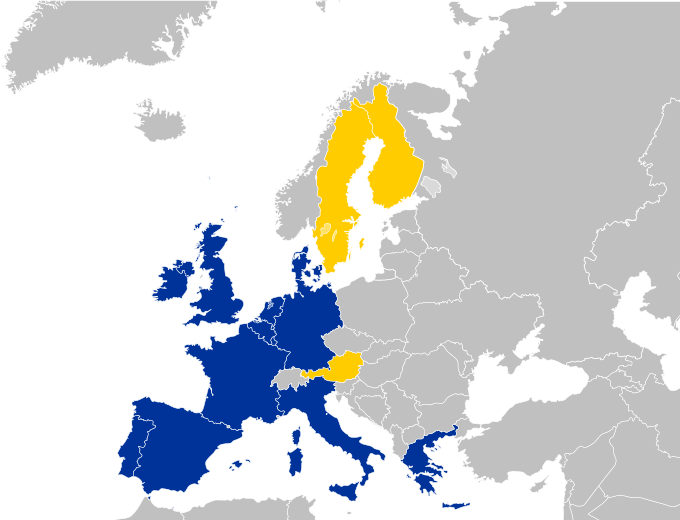
Accession of Austria, Finland and Sweden to the European Union
The 1995 enlargement of the European Union saw Austria, Finland, and Sweden accede to the European Union (EU). This was the EU's fourth enlargement and came into effect on 1 January of that year. It is also known as the EFTA Enlargement round. All these states were previous members of the European Free Trade Association (EFTA) and had traditionally been less interested in joining the EU than other European countries. Norway had negotiated to join alongside the other three, but following the signing of the treaty, membership was turned down by the Norwegian electorate in the 1994 national referendum. Switzerland also applied for membership on 26 May 1992, but withdrew it after a negative referendum result on 6 December 1992 (and that was not changed after a second negative referendum result on 4 March 2001).
Closer links
The three states, plus Norway and Switzerland (which never joined due to their referendum results) began to look at stronger ties with the EU (which was the European Economic Community (EEC) before 1993) towards the end of the 1980s for three principal reasons: the 1980s economic downturn in Europe, difficulties for EFTA companies to export to the EU and the end of the Cold War.
After the 1970s Europe experienced a downturn which led to leaders launching of the Single European Act which set to create a single market by 1992. The effect of this was that EFTA states found it harder to export to the EEC and businesses (including large EFTA corporations such as Volvo) wished to relocate within the new single market making the downturn worse for EFTA. EFTA states began to discuss closer links with the EEC despite its domestic unpopularity.
Finally, Austria, Finland and Sweden were neutral in the Cold War so membership of an organisation developing a common foreign and security policy would be incompatible with that. As that obstacle was removed, the desire to pursue membership grew stronger.
EEA
President of the European Commission Jacques Delors in 1992]] However membership was still domestically unpopular and the then-EEC was also uninterested in another enlargement. The EEC had begun working on the creation of a common currency and did not want another enlargement to divert their attention away from that project. Commission President Jacques Delors proposed the European Economic Area to give EFTA access to the EU's internal market without full membership. While they would not have a say in the creation of EU law, it would be easier to sell to their electorates.
However businesses did not accept that the EEA members would be equal members of the single market and investment flows did not return to normal. The large manufacturers in Sweden were instrumental in pushing government policy further towards membership rather than remaining with the EEA, which the export focused industries found insufficient. The economic pressures overcame long standing opposition from the social democrat governments which saw the EU as too neo-liberal and a danger to the Nordic model. Firms were only kept within Sweden by devaluations of the Swedish krona, a strategy which was unsustainable in the long term.
The EEA was damaged further when the Swiss electorate voted against it. Austria, Finland, Norway and Sweden all applied for full membership of the EU and the EU agreed to enter negotiations. The EU's change of heart was also due to predicted enlargement of the EU towards countries mostly in central Europe, invited by the European Commission in 1997 and eventually completed in 2004, and hence the wealthy EFTA members would help balance the EU budget.
Accession
On 30 March 1994, accession negotiations concluded with Austria, Sweden, Finland and Norway. Their accession treaties were signed on 25 June of that year. Each country held referendums on entry resulting on entry for all except Norway (whose second referendum failed);
- Austria (application submitted in July 1989) - 66.6% in favour (12 June 1994)
- Finland (application submitted in March 1992 and separate referendum held in Åland) - 56.9% in favour (16 October 1994)
- Sweden (application submitted in July 1991) - 52.8% in favour (13 November 1994);
- Norway (application submitted in December 1992) - 47.8% in favour (28 November 1994)
Austria, Finland and Sweden became EU members on 1 January 1995. Sweden held its elections to the European Parliament for its MEPs later that year on 17 September. The following year, Austria held its elections on 13 October and Finland on 20 October.
Deferred areas of inclusion
Austria, Sweden, Finland became members on 1 January 1995, but some areas of cooperation in the European Union were deferred to a later date. These are:
- Eurozone (see Enlargement of the eurozone; Sweden is still not a member of the Eurozone)
Impact
The impact of the 1995 enlargement was smaller than most as the members were wealthy and already culturally aligned with existing members. It did however create a Nordic bloc in the Council, with Sweden and Finland backing up Denmark on environmental and human rights issues (which Austria also backed up) and the Nordic countries also called for membership of the Baltic states. As net contributors to the EU budget, they also increased the voice for budgetary reform.
Before the 1995 enlargement, the EU had ten treaty languages: Danish, Dutch, English, French, German, Greek, Irish, Italian, Portuguese and Spanish. However, due to the 1995 enlargement, two new official languages were added: Swedish (which is an official language of both Sweden and Finland) and Finnish.
This enlargement began to show the problems with the EU's institutional structure, such as the size of the Commission (with minor jobs insulting the state receiving them) and the Council's voting rules meaning states representing 41% of the population could be outvoted. This resulted in the increase in the blocking minority in the Council and the loss of the larger states' second European Commissioner. Planning also began on new amending treaties to ready the bloc for the next enlargement.
| Member countries | Capital | Population | Area (km2) | GDP | ||||||||||||||||||||
|---|---|---|---|---|---|---|---|---|---|---|---|---|---|---|---|---|---|---|---|---|---|---|---|---|
| (billion US$) | GDP | |||||||||||||||||||||||
| per capita (US$) | Languages | Accession countries | 22,029,977 | 871,980 | 382.833 | 17,378 | 2 new | EU EU15 (1995) | 372,939,379 | |||||||||||||||
| *(+6.28%)* | 3,367,154 | |||||||||||||||||||||||
| *(+34.95%)* | 6,277.065 | |||||||||||||||||||||||
| *(+6.50%)* | 16,831 | |||||||||||||||||||||||
| *(+0.20%)* | 12 | EU EU12 (1994) | 350,909,402 | 2,495,174 | 5,894.232 | 16,797 | 10 | |||||||||||||||||
| Vienna | 9,027,999 | 83,871 | 145.238 | 18,048 | German | |||||||||||||||||||
| Helsinki | 5,635,971 | 338,145 | 80.955 | 15,859 | Finnish | |||||||||||||||||||
| Swedish | ||||||||||||||||||||||||
| Stockholm | 10,588,207 | 449,964 | 156.640 | 17,644 | Swedish |
References
References
- Nungent, Neill. (2017). "The Government and Politics of The European Union". [[Palgrave MacMillan]].
- Bache, Ian and Stephen George (2006) ''Politics in the European Union'', Oxford University Press. p543-547
This article was imported from Wikipedia and is available under the Creative Commons Attribution-ShareAlike 4.0 License. Content has been adapted to SurfDoc format. Original contributors can be found on the article history page.
Ask Mako anything about 1995 enlargement of the European Union — get instant answers, deeper analysis, and related topics.
Research with MakoFree with your Surf account
Create a free account to save articles, ask Mako questions, and organize your research.
Sign up freeThis content may have been generated or modified by AI. CloudSurf Software LLC is not responsible for the accuracy, completeness, or reliability of AI-generated content. Always verify important information from primary sources.
Report