From Surf Wiki (app.surf) — the open knowledge base
1992 Victorian state election
Australian state election

Australian state election
| Field | Value |
|---|---|
| election_name | 1992 Victorian state election |
| country | Victoria |
| type | parliamentary |
| ongoing | no |
| previous_election | 1988 Victorian state election |
| previous_year | 1988 |
| next_election | 1996 Victorian state election |
| next_year | 1996 |
| seats_for_election | All 88 seats in the Victorian Legislative Assembly |
| and 22 (of the 44) seats in the Victorian Legislative Council | |
| 45 seats needed for a majority | |
| election_date | |
| image1 | |
| leader1 | Jeff Kennett |
| leader_since1 | 23 April 1991 |
| party1 | Liberal/National coalition |
| leaders_seat1 | Burwood |
| popular_vote1 | **1,358,295** |
| percentage1 | **51.99%** |
| swing1 | 3.65 |
| last_election1 | 42 seats |
| seats1 | **61** |
| seat_change1 | 19 |
| 1data1 | **56.30%** |
| 2data1 | 5.78 |
| image2 | |
| leader2 | Joan Kirner |
| leader_since2 | 10 August 1990 |
| party2 | Australian Labor Party (Victorian Branch) |
| leaders_seat2 | Williamstown |
| popular_vote2 | 1,003,495 |
| percentage2 | 38.41% |
| swing2 | 8.14 |
| last_election2 | 46 seats |
| seats2 | 27 |
| seat_change2 | 19 |
| 1data2 | 43.70% |
| 2data2 | 5.78 |
| 1blank | TPP |
| 2blank | TPP swing |
| map_image | 1992 Victorian state election.svg |
| map_size | 320px |
| map_caption | Results in each electorate |
| title | Premier |
| before_election | Joan Kirner |
| before_party | Australian Labor Party (Victorian Branch) |
| after_election | Jeff Kennett |
| after_party | Liberal/National coalition |
and 22 (of the 44) seats in the Victorian Legislative Council 45 seats needed for a majority
The 1992 Victorian state election was held on 3 October 1992 to elect the 52nd Parliament of Victoria, including all 88 members of the Legislative Assembly and 22 of the 44 members in the Legislative Council.
The Labor government of Premier Joan Kirner, who had replaced John Cain on 10 August 1990, was defeated in a landslide by the Liberal–National Coalition led by Jeff Kennett and Pat McNamara, who had campaigned on comprehensive economic and structural reform as well as changes to industrial relations. It was the largest majority that the Coalition had ever won in Victoria.
Background
At the 1988 state election, the Labor government had won a third term, gaining 46 of the 88 Legislative Assembly seats, but was sent reeling by a budget crisis. Despite this, polling indicated that the Liberal Opposition had been unable to gain any ground under Alan Brown, who had succeeded Jeff Kennett on 23 May 1989. Brown was, however, able to persuade the Nationals to agree to contest the next election as a Coalition, the first time the two main non-Labor parties in Victoria had fought an election together since 1950. The Liberals had actually won a majority of the two-party vote in 1988, but came up five seats short of achieving government. It was believed that they had lost seats due to a number of three-cornered contests in rural areas.
Cain soon realised that Labor would be heavily defeated if he took the party into the next election. He resigned in 1990, and was succeeded by Deputy Premier and Education Minister Joan Kirner. While Kirner was able to win some respect, she was unable to change Labor's fortunes. Prospects for a fourth Labor term became even more remote when Kennett's supporters launched a party room coup that returned him to the leadership on 23 April 1991.
Kirner waited as long as she could before calling the election. While she remained more personally popular than Kennett, commentators had almost universally written off Labor by this time. The Coalition had been well ahead in opinion polling for over two years, and it was obvious almost as soon as the writs were dropped that Kennett would be Victoria's next premier.
Both the government and opposition had gone through changes during the 1988–1992 term of Parliament. The Labor government, in power since the 1982 election, was dogged in its final term by a series of scandals and major corporate collapses which, like neighbouring South Australia, extended and deepened the early 1990s recession in those states. Unemployment reached 11.6% in Victoria in March 1992, with the manufacturing and textiles sector being particularly affected, while state debt was estimated at A$30 billion. The State Bank of Victoria, the Victorian Economic Development Corporation (VEDC), Tricontinental and Pyramid Building Society failed, whilst the government-backed WorkCare insurance scheme was not in good shape. Proposed changes to the system were rejected by trade unions, leading to a state wide strike which saw gas supplies, electricity generators, public transport, most schools and government offices inoperative. A disastrous rollout of a 'scratch ticket system' for metropolitan trains and trams did not help their fortunes. The Liberal party commenced an advertising campaign in January 1992 with the slogan "Labor: the Guilty Party".
The 1990 federal election was the first major sign that all was not well for Victorian Labor, with the Coalition gaining nine seats at Labor's expense. Ultimately, John Cain resigned on 7 August 1990, and on 10 August, Joan Kirner was elected leader. Despite her own personal popularity, support for the government had fallen to 22% by December, with analysts citing concerns over the state debt, lack of confidence in Victorian financial institutions, industrial relations problems and the severity of the recession's effects in the state as the primary reasons for the low ratings.
Meanwhile, on 23 May 1989, Jeff Kennett was dumped as leader of the Liberal Party by his colleagues in favour of Alan Brown; Brown led the party until 23 April 1991 when he was himself dumped in a party room spill. During Brown's period as Opposition Leader, the Liberals negotiated the first coalition agreement with the Nationals in over forty years, in part due to a belief by some (in spite of what political scientist Brian Costar called a "lack of psephological evidence to support this assertion") that had the parties been in coalition at the election, they would have won.
Key dates
| Date | Event | ||||
|---|---|---|---|---|---|
| 14 August 1992 | year=1992 | page=S45 (Special) | title=Proroguing the Legislative Council and dissolving the Legislative Assembly: Proclamation | date=14 August 1992 | url=http://gazette.slv.vic.gov.au/view.cgi?year=1992&class=S&page_num=1&classNum=S45}} |
| 21 August 1992 | Writs were issued by the Governor to proceed with an election. | ||||
| 28 August 1992 | The electoral rolls were closed. | ||||
| 4 September 1992 | Nominations for candidates for the election closed at noon. | ||||
| 3 October 1992 | Polling day, between the hours of 8am and 6pm. | ||||
| 6 October 1992 | year=1992 | page=S53 (Special) | date=9 October 1992 | title=Ministers of the Crown | url=http://gazette.slv.vic.gov.au/view.cgi?year=1992&class=S&page_num=1&classNum=S53}} |
| 19 October 1992 | The writ was returned and the results formally declared. | ||||
| 27 October 1992 | year=1992 | page=3107 | date=21 October 1992 | title=Fixing the time for holding the first session of the Fifty-second Parliament of Victoria}} |
Results
Legislative Assembly
| turnout % = 95.13 | informal % = 3.81 |votes % = 44.16 |votes % = 38.41 |votes % = 7.83 |votes % = 1.32 |votes % = 0.47 |votes % = 0.19 |votes % = 0.15 |votes % = 0.07 |votes % = 0.04 |votes % = 7.36 |2pp % 1 = 56.30 |2pp % 2 = 43.70 |}
Legislative Council
| turnout % = 95.22 | informal % = 4.11 |votes % = 43.49 |votes % = 38.56 |votes % = 8.74 |votes % = 4.54 |votes % = 0.62 |votes % = 0.56 |votes % = 0.31 |votes % = 0.08 |votes % = 3.09 |2pp % 1 = 56.65 |2pp % 2 = 43.35 |}
The Labor government was defeated by the Coalition, with the latter winning 61 seats of 88 contested in the Assembly on an 8% swing against the Government, and 17 of 22 in the council with a swing of over 9%. It was the second-largest defeat that a sitting government has ever suffered in Victoria. This did, however, represent a considerable improvement in the Government's stocks from the 22-25% indicated in opinion polls in 1990 and 1991. The Liberals made gains primarily in the eastern suburbs of Melbourne as well as provincial Victoria. Eight members of Kirner's cabinet were defeated.
The Liberals actually won 52 seats, enough for a majority in their own right. Although Kennett thus had no need for National support, the Coalition was retained.
Maps
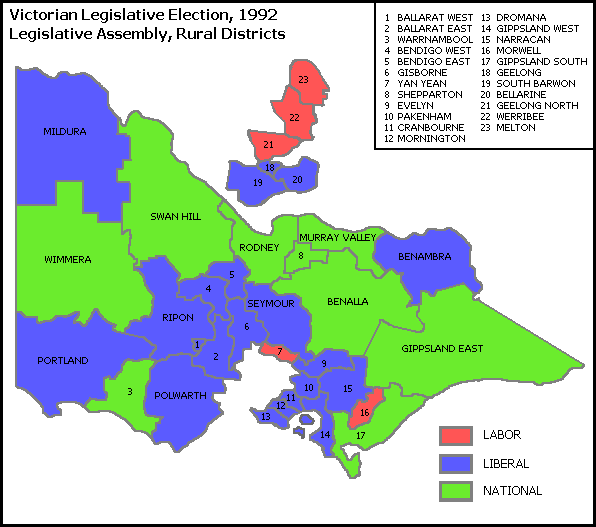
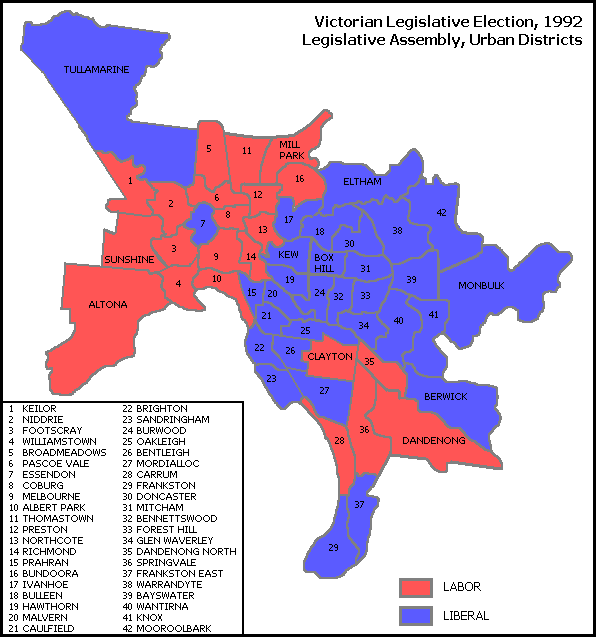
Seats changing hands
| Seat | Pre−1992 | Swing | Post−1992 | Party | Member | Margin | Margin | Member | Party | ||
|---|---|---|---|---|---|---|---|---|---|---|---|
| Ballarat East | Labor | Frank Sheehan | −0.6* | −1.1 | 1.6 | Barry Traynor | Liberal | ||||
| Bayswater | Labor | Kay Setches | 3.0 | −10.1 | 7.1 | Gordon Ashley | Liberal | ||||
| Bellarine | Labor | Graham Ernst | −1.1 | −6.8 | 7.9 | Garry Spry | Liberal | ||||
| Bendigo West | Labor | David Kennedy | 1.6 | −2.7 | 1.1 | Max Turner | Liberal | ||||
| Bentleigh | Labor | Ann Barker | 1.5 | −9.7 | 8.2 | Inga Peulich | Liberal | ||||
| Box Hill | Labor | Margaret Ray | −7.0 | −6.2 | 13.2 | Robert Clark | Liberal | ||||
| Cranbourne | Labor | *notional – new seat* | 1.4 | −6.1 | 4.7 | Gary Rowe | Liberal | ||||
| Eltham | Labor | *notional – new seat* | 4.6 | −14.6 | 10.0 | Wayne Phillips | Liberal | ||||
| Essendon | Labor | Barry Rowe | 5.5 | −6.7 | 1.2 | Ian Davis | Liberal | ||||
| Frankston East | Labor | Jane Hill | 6.5 | −6.7 | 0.2 | Peter McLellan | Liberal | ||||
| Geelong | Labor | Hayden Shell | 2.6 | −3.3 | 0.7 | Ann Henderson | Liberal | ||||
| Knox | Labor | Carolyn Hirsh | 5.0 | −11.1 | 6.1 | Hurtle Lupton | Liberal | ||||
| Mitcham | Labor | John Harrowfield | 2.3 | −10.8 | 8.5 | Roger Pescott | Liberal | ||||
| Monbulk | Labor | Neil Pope | 4.3 | −9.6 | 5.3 | Steve McArthur | Liberal | ||||
| Mooroolbark | Labor | *notional – new seat* | 1.9 | −12.0 | 10.1 | Lorraine Elliott | Liberal | ||||
| Mordialloc | Labor | Peter Spyker | 2.2 | −9.5 | 7.3 | Geoff Leigh | Liberal | ||||
| Oakleigh | Labor | Race Mathews | 5.7 | −8.6 | 2.9 | Denise McGill | Liberal | ||||
| Tullamarine | Labor | Peter Gavin | 4.9 | −6.4 | 1.5 | Bernie Finn | Liberal | ||||
| Wantirna | Labor | Peter Lockwood | 0.1 | −14.2 | 14.1 | Kim Wells | Liberal |
- Ballarat East was the new name for the abolished district of Ballarat South, of which Labor MP Frank Sheehan was the sitting member. It was a notional Liberal seat.
- Bellarine and Box Hill became notional Liberal seats in the redistribution.
References
References
- Shamshullah, Ardel. (December 1992). "Australian Political Chronicle: January–June 1992: Victoria". Australian Journal of Politics and History.
- (27 July 1989). "Victoria Stopped by Strike".
- "Search collections".
- Shamshullah, Ardel. (June 1991). "Australian Political Chronicle: July–December 1990: Victoria". Australian Journal of Politics and History.
- Costar B.J & Economou N., 'Elections and Electoral Change 1982-92' in Considine M. & Costar B.J (eds) ''Trials in Power: Cain, Kirner and Victoria 1982-1992'', Melbourne University Press, 1992 p. 261
- B. J. Costar, 'Coalition Government: An Unequal Partnership' in B. J. Costar & N. Economou (eds) ''The Kennett Revolution: Victorian Politics in the 1990s'', UNSW Press, Sydney, 1998, p. 89
- (14 August 1992). "Proroguing the Legislative Council and dissolving the Legislative Assembly: Proclamation".
- (9 October 1992). "Ministers of the Crown".
- (21 October 1992). "Fixing the time for holding the first session of the Fifty-second Parliament of Victoria".
- Hughes, Colin A.. (2002). "A Handbook of Australian Government and Politics 1985-1999". Federation Press.
- Antony Green. (September 1995). "1992 Victorian State Election - Summary of Results".
- Hughes (2002) p.317.
This article was imported from Wikipedia and is available under the Creative Commons Attribution-ShareAlike 4.0 License. Content has been adapted to SurfDoc format. Original contributors can be found on the article history page.
Ask Mako anything about 1992 Victorian state election — get instant answers, deeper analysis, and related topics.
Research with MakoFree with your Surf account
Create a free account to save articles, ask Mako questions, and organize your research.
Sign up freeThis content may have been generated or modified by AI. CloudSurf Software LLC is not responsible for the accuracy, completeness, or reliability of AI-generated content. Always verify important information from primary sources.
Report