From Surf Wiki (app.surf) — the open knowledge base
1987 Atlantic hurricane season
none
none
| Field | Value |
|---|---|
| Basin | Atl |
| Track | 1987 Atlantic hurricane season summary map.png |
| Year | 1987 |
| First storm formed | May 24, 1987 |
| Last storm dissipated | November 4, 1987 |
| Strongest storm name | Emily |
| Strongest storm winds | 110 |
| Strongest storm pressure | 958 |
| Average wind speed | 1 |
| Total depressions | 14 |
| Total storms | 7 |
| Total hurricanes | 3 |
| Total intense | 1 |
| Fatalities | 10 total |
| Damages | 90.01 |
| Season timeline | Timeline of the 1987 Atlantic hurricane season |
| East Pacific season | 1987 Pacific hurricane season |
| West Pacific season | 1987 Pacific typhoon season |
| North Indian season | 1987 North Indian Ocean cyclone season |
| five seasons | [1985](1985-atlantic-hurricane-season), [1986](1986-atlantic-hurricane-season), **1987**, [1988](1988-atlantic-hurricane-season), [1989](1989-atlantic-hurricane-season) |
The 1987 Atlantic hurricane season was a below-average hurricane season that was limited by an ongoing El Niño. The season officially began on June 1, 1987, and lasted until November 30, 1987, although activity began on May 24 when a tropical depression developed 400 mi east of the central Bahamas. The June through November dates conventionally delimit the period of each year when most tropical cyclones form in the Atlantic basin. The first cyclone to attain tropical storm status was an unnamed tropical storm which formed on August 9, nearly a month later than usual. The final storm of the year, Tropical Depression Fourteen, merged with a weak extratropical low on November 4. The season marked the first year tropical storm watches and warnings were issued; previously, gale watches and warnings were used for tropical storms, and this season was one of only a few seasons with no deaths in the United States; the last time this happened was in the 1981 season.
During this season, 14 tropical depressions formed of which seven attained tropical storm status. One tropical storm was operationally classified as a tropical depression but was reclassified in post-analysis. Three tropical cyclones reached hurricane status of which only one became a major hurricane, which is a Category 3 or greater on the Saffir–Simpson scale. Hurricane Emily was the costliest storm of the season, causing $80.3 million in damage (1987 USD) as it ravaged the Dominican Republic and Bermuda. Tropical Depression Fourteen was the deadliest storm of the season, causing six deaths as it passed across Jamaica. Of the seven cyclones that attained tropical storm status, three did not affect land.
Seasonal forecasts and activity
Forecasts of hurricane activity are issued before each hurricane season by hurricane expert Dr. William M. Gray and his associates at Colorado State University. An average season, as defined by NOAA, has 6 to 14 named storms, with 4 to 8 of those reaching hurricane strength, and with 3 hurricanes becoming major hurricanes. The June 2, 1987, report suggested that eight tropical storms would form during the 1987 season, five of them becoming hurricanes. | access-date=October 12, 2007
The forecast anticipated more tropical activity than what ultimately occurred. During the season, 14 tropical depressions formed from May 25 to November 5. Seven of the depressions strengthened into tropical storms, six of them named. Tropical Depression Two was upgraded into a tropical storm in post-season analysis, and as a result has no name. Tropical storms Arlene, Emily and Floyd all reached hurricane status during their durations, of which only Emily reached major hurricane status. | access-date=October 11, 2007
The United States was affected by four tropical cyclones in 1987, of which three struck Florida. The unnamed tropical storm struck Texas and affected much of the Gulf Coast of the United States. | access-date=October 11, 2007 | access-date=October 11, 2007
The season's activity was reflected with a cumulative accumulated cyclone energy (ACE) rating of 34, which is classified as "below normal". ACE is, broadly speaking, a measure of the power of the hurricane multiplied by the length of time it existed, so storms that last a long time, as well as particularly strong hurricanes, have high ACEs. ACE is only calculated for full advisories on tropical systems at or exceeding 34 kn or tropical storm strength. Subtropical cyclones are excluded from the total.
Systems
ImageSize = width:800 height:205 PlotArea = top:10 bottom:80 right:20 left:20 Legend = columns:3 left:30 top:58 columnwidth:270 AlignBars = early
DateFormat = dd/mm/yyyy Period = from:01/05/1988 till:01/12/1988 TimeAxis = orientation:horizontal ScaleMinor = grid:black unit:month increment:1 start:01/05/1988
Colors = id:canvas value:gray(0.88) id:GP value:red id:TD value:rgb(0.43,0.76,0.92) legend:Tropical_Depression_=≤38_mph(≤62_km/h) id:TS value:rgb(0.3,1,1) legend:Tropical_Storm_=39–73_mph(63–117_km/h) id:C1 value:rgb(1,1,0.85) legend:Category_1_=74–95_mph(118–153_km/h) id:C2 value:rgb(1,0.85,0.55) legend:Category_2_=96–110_mph(154–177_km/h) id:C3 value:rgb(1,0.62,0.35) legend:Category_3_=111–129_mph(178–208_km/h) id:C4 value:rgb(1,0.45,0.54) legend:Category_4_=130–156_mph(209–251_km/h) id:C5 value:rgb(0.55,0.46,0.90) legend:Category_5_=≥157_mph(≥252_km/h) Backgroundcolors = canvas:canvas
BarData = barset:Hurricane bar:Month
PlotData=
barset:Hurricane width:10 align:left fontsize:S shift:(4,-4) anchor:till from:24/05/1988 till:01/06/1988 color:TD text:"One (TD)" from:09/08/1988 till:17/08/1988 color:TS text:"Two (TS)" from:10/08/1988 till:23/08/1988 color:C1 text:"Arlene (C1)" from:13/08/1988 till:15/08/1988 color:TD text:"Four (TD)" from:18/08/1988 till:24/08/1988 color:TS text:"Bret (TS)" from:30/08/1988 till:02/09/1988 color:TD text:"Six (TD)" from:05/09/1988 till:10/09/1988 color:TS text:"Cindy (TS)" from:06/09/1988 till:08/09/1988 color:TD text:"Eight (TD)" barset:break from:07/09/1988 till:08/09/1988 color:TD text:"Nine (TD)" from:08/09/1988 till:20/09/1988 color:TS text:"Dennis (TS)" from:13/09/1988 till:17/09/1988 color:TD text:"Eleven (TD)" from:20/09/1988 till:26/09/1988 color:C3 text:"Emily (C3)" from:09/10/1988 till:13/10/1988 color:C1 text:"Floyd (C1)" from:31/10/1988 till:04/11/1988 color:TD text:"Fourteen (TD)" barset:skip
bar:Month width:6 align:center fontsize:S shift:(0,-20) anchor:middle color:canvas from:01/05/1988 till:01/06/1988 text:May from:01/06/1988 till:01/07/1988 text:June from:01/07/1988 till:01/08/1988 text:July from:01/08/1988 till:01/09/1988 text:August from:01/09/1988 till:01/10/1988 text:September from:01/10/1988 till:01/11/1988 text:October from:01/11/1988 till:01/12/1988 text:November
TextData = pos:(569,30) text:"(From the" pos:(617,30) text:"Saffir-Simpson scale)"
Tropical Depression One
|1-min winds=30 A low-pressure area developed into a tropical depression just east of the Turks and Caicos Islands on May 24. Operationally, the system was declared the first tropical depression of the season on May 25, following confirmation from a reconnaissance aircraft flight. Moving at about 8 mi/h, the depression was located 400 mi from the east central Bahamas. It moved towards Florida and stalled off the coast, with a prediction to cause thundershowers across the state on May 28. The Bahamian government released a storm warning for its northern islands as the system grew stronger.{{cite news| agency=Associated Press| date=May 29, 1987| title=Tropical Depression Strengthens| newspaper=San Jose Mercury News| access-date=May 11, 2021| url=http://nl.newsbank.com/nl-search/we/Archives?p_product=SJ&s_site=mercurynews&p_multi=SJ&p_theme=realcities&p_action=search&p_maxdocs=200&p_topdoc=1&p_text_direct-0=0EB72BC974E5D8DF&p_field_direct-0=document_id&p_perpage=10&p_sort=YMD_date:D&s_trackval=GooglePM |archive-url=https://web.archive.org/web/20110609192739/http://nl.newsbank.com/nl-search/we/Archives?p_product=SJ&s_site=mercurynews&p_multi=SJ&p_theme=realcities&p_action=search&p_maxdocs=200&p_topdoc=1&p_text_direct-0=0EB72BC974E5D8DF&p_field_direct-0=document_id&p_perpage=10&p_sort=YMD_date:D&s_trackval=GooglePM|archive-date=June 9, 2011}} The depression brought some heavy showers and thunderstorms to South Florida, before dissipating just south of Key West on June 1.
Tropical Storm Two
|1-min winds=40 Main article: 1987 Gulf Coast tropical storm
The second tropical depression of the season formed in the northwestern Gulf of Mexico from a tropical wave on August 9. | access-date=October 11, 2007 | archive-url= https://web.archive.org/web/20071025133416/http://www.nhc.noaa.gov/archive/storm_wallets/atlantic/atl1987-prelim/unnamed/prelim01.gif| archive-date=October 25, 2007 | url-status= live}} It quickly strengthened into a tropical storm, though the strengthening was not known until post-season analysis. Based on lack of significant organization or reports at the time, the storm remained unnamed. It traveled northwestward and neared the coast. The tropical storm made landfall near High Island, Texas, with winds of 45 mph (75 km/h) on August 10, and quickly weakened to a tropical depression as it moved northeastward. It turned to the southeast and re-emerged into the Gulf of Mexico on August 15, before striking near St. Marks, Florida, on the next day. The weakening system turned back to the northeast, continued weakening, and dissipated over Georgia on August 17. | access-date=October 11, 2007
The slow-moving system produced heavy rainfall along the Gulf Coast, particularly in southern Mississippi and Alabama, with just over 21 in of precipitation recorded in the former. | access-date=March 6, 2023 | access-date=October 11, 2007 | archive-url= https://web.archive.org/web/20071025133406/http://www.nhc.noaa.gov/archive/storm_wallets/atlantic/atl1987-prelim/unnamed/prelim03.gif| archive-date=October 25, 2007 | url-status= live}} Overall, damage from the system amounted to $7.4 million.
Hurricane Arlene
|1-min winds=65 Main article: Hurricane Arlene (1987)
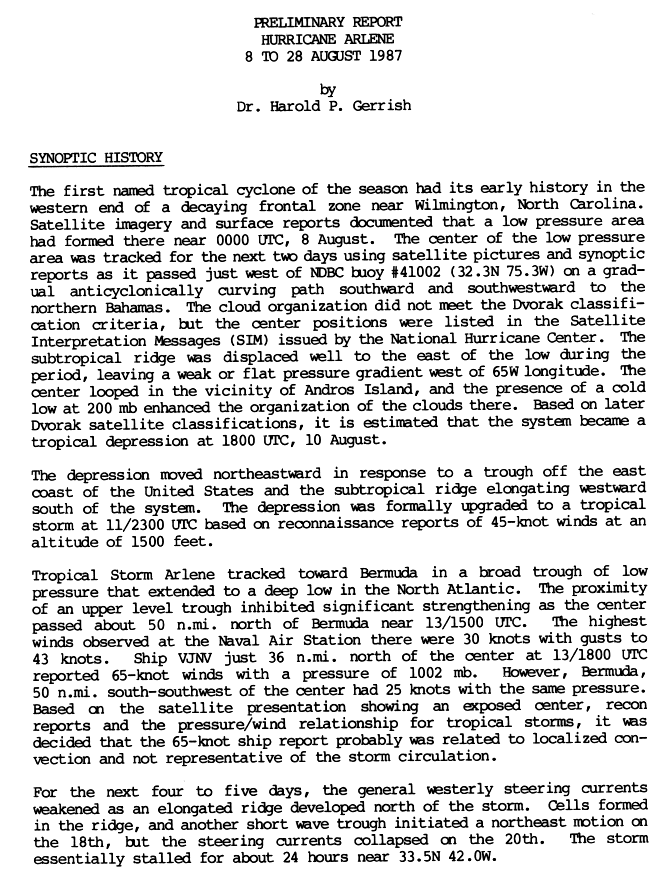
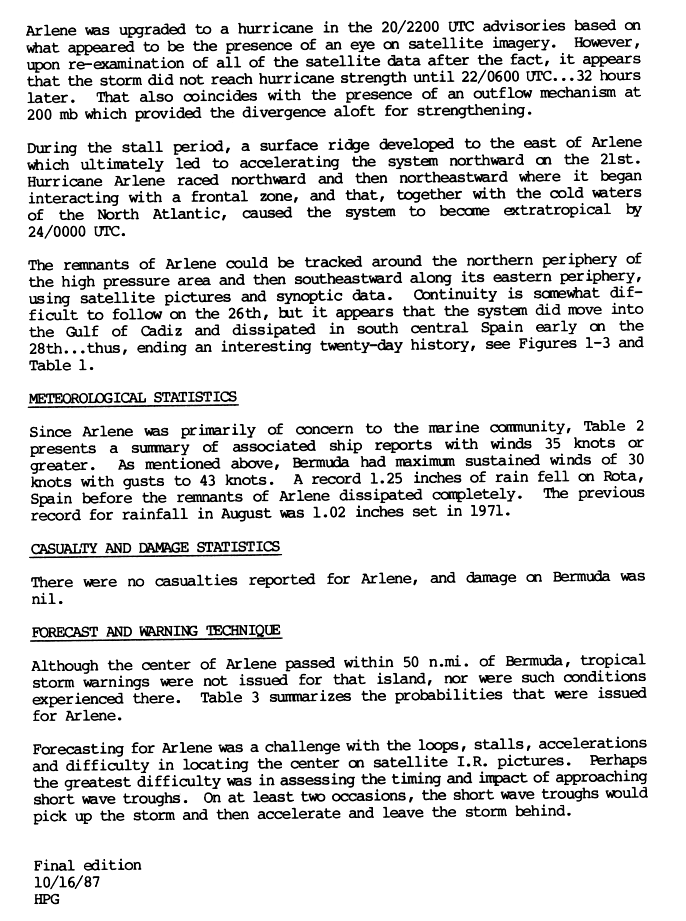
A low pressure system on the tail end of a stationary cold front organized into a subtropical depression on August 8 near the South Carolina coast, and drifted southward. Convection became more organized, and the storm was classified Tropical Depression Three on August 10 over the Bahamas. It executed an anticyclonic loop to the northeast, and was estimated to have attained tropical storm status on August 11, based on reports from hurricane hunters. Small cells in the ridge of high pressure caused Arlene to take an unusual track to the east, with two southward jogs in its path. A trough of low pressure near Bermuda initially inhibited strengthening. However, after high pressures to its east forced the storm northward, more favorable conditions allowed Arlene to intensify into a hurricane on August 22. Operationally, it was upgraded two days earlier, based on the appearance of an eye feature on satellite imagery. After becoming a hurricane, Arlene accelerated to the northeast into the cold waters of the north Atlantic Ocean, and on August 23 it became extratropical about halfway between Newfoundland and Ireland. The extratropical remnants turned to the southeast and later to the east, making landfall on the Iberian Peninsula before dissipating on August 28 over Spain.
As Arlene approached, islanders of Bermuda were warned to board up windows, with winds of 50 mi/h expected. Ultimately, the island experienced winds of 35 mi/h with gusts up to 49 mi/h. A blind sailor on a trip across the Atlantic was unable to make it to a harbor in Bermuda due to the hurricane, and rode out the storm in the open sea. The storm produced moderate rainfall to coastal areas of Spain, contributing to a monthly rainfall record at Rota. The 14.5 day total between the start of its best track and when it attained hurricane status is the largest on record for a North Atlantic hurricane.
Tropical Depression Four
|1-min winds=30 The fourth tropical depression of the season formed about 840 mi east of Barbados early on August 13. Initially, forecasters anticipated the system to intensify into a tropical storm; however, a reconnaissance mission into the depression on August 15 revealed that it was poorly organized and was declassified a tropical cyclone. Tropical Depression Four peaked with sustained winds of 35 mph and dissipated on August 15 about 25 mi northeast of Anegada in the British Virgin Islands.
Tropical Storm Bret
|1-min winds=45 A well-organized tropical disturbance formed off the African coast on August 17 and became a tropical depression the following day, as classified by satellite imagery. Later the same day, the ship S.S. Columbus Canterrury reported 40 mi/h winds and a pressure of 1004 mbar, and the depression became Tropical Storm Bret. | access-date=April 4, 2007
The cyclone moved a westward course of 20-25 mph and reached its peak intensity of 50 mph winds and 1000 mbar in pressure on August 20. A ridge of high pressure in the eastern Atlantic Ocean, north of Bret, began to weaken and drift to the east on August 20. Bret was moving at 17 mi/h to the east on August 21. It was thought that Bret would strengthen at this point. | access-date=May 11, 2021
The cyclone soon moved on a northwestward course and encountered wind shear. Bret weakened into a depression on August 23, due to the wind shear over the system. The next morning, the depression became a tropical wave with no low-level circulation left. The wave was soon absorbed by a trough of low pressure during the next few days.
Tropical Depression Six
|1-min winds=30 A tropical depression formed well west-southwest of the Cape Verde Islands on August 30. Forecasters predicted would become the third tropical storm of the season. | access-date=May 12, 2021 | access-date=May 12, 2021
The next day, Tropical Depression Six moved westward to a position more than 1000 mi away from the Cape Verde Islands and the Lesser Antilles, too far away from land for the National Hurricane Center to send a reconnaissance flight into the depression. | access-date=March 6, 2023 | access-date=May 12, 2021 | access-date=March 6, 2023
Tropical Storm Cindy
|1-min winds=45 On September 1 a tropical wave exited the African coast, and moved westward across the Atlantic Ocean. | access-date=October 11, 2007 | archive-url= https://web.archive.org/web/20071025133405/http://www.nhc.noaa.gov/archive/storm_wallets/atlantic/atl1987-prelim/cindy/prelim01.gif| archive-date=October 25, 2007 | url-status= live}} A trough of low pressure moved southeastward through the tropics, and brought the wave more towards the north. Generally favorable conditions for development allowed the wave to organize into a tropical depression on September 5, and two days later it attained tropical storm status. Cindy continued northward, and peaked at 50 mi/h winds on September 8 before turning to the northeast. Strong upper-level shear weakened the storm, and after two days of struggling as a tropical storm, Cindy became extratropical on September 10 to the northwest of the Azores. Cindy did not affect any landmasses.
Tropical Depression Eight
|1-min winds=30 A tropical depression formed in the Caribbean on September 6. It tracked westward through the body of water, and reached peak winds of 35 mph on September 7. | access-date=May 12, 2021 | access-date=April 4, 2007 | access-date=October 13, 2007
Tropical Depression Nine
|1-min winds=30 An upper-level cyclone in the northern Gulf of Mexico started tropical cyclogenesis offshore the southeast United States. Convection organized around a low-pressure area east of Florida, and it was declared Tropical Depression Nine on September 7. Initially poorly organized, | access-date=April 4, 2007 | access-date=April 4, 2007 | access-date=May 12, 2021 | access-date=April 4, 2007 | archive-url=https://web.archive.org/web/20071001005357/https://pqasb.pqarchiver.com/washingtonpost/access/73844001.html?dids=73844001:73844001&FMT=ABS&FMTS=ABS:FT&date=SEP+09%2C+1987&author=Eve+Zibart&pub=The+Washington+Post&desc=Rain-Slicked+Beltway+Spawns+Wrecks+and+Traffic+Tie-Ups&pqatl=google | archive-date=October 1, 2007
Tropical Storm Dennis
|1-min winds=45 A tropical depression formed on September 8 off the coast of Africa. It tracked westward, passing to the south of the Cape Verde islands, and based on satellite imagery was estimated to have reached tropical storm status on September 10. Tropical Storm Dennis continued to gradually intensify, and on September 11 attained peak winds of 50 mph and a minimum pressure of 1000 mbar. Subsequently, the cyclone weakened to minimal tropical storm status, | access-date=April 4, 2007 | access-date=April 4, 2007
Tropical Depression Eleven
|1-min winds=30 On September 14, a tropical depression developed about 490 mi southeast of Antigua. Tracking westward at 5 –, the depression maintained winds of about 35 mph, and was deemed "no cause for alarm" for the Lesser Antilles.{{cite news | access-date=May 12, 2021 | access-date=May 12, 2021 | access-date=May 12, 2021
Hurricane Emily
|1-min winds=110 Main article: Hurricane Emily (1987)
A tropical depression, the tenth of the season, formed on September 20. It soon became a tropical storm that day off the South American coast. Emily quickly strengthened becoming a hurricane less than 48 hours later on September 22. | access-date=May 10, 2008
The cyclone then slowly began turning north, soon making landfall in the Dominican Republic, where three people were reported dead and there was $30 million (1987 US dollars, $56.9 million in 2009 USD) in damage. Emily passed over Hispaniola, turned to the northeast, and eventually made landfall in Bermuda, where it caused $50 million (1987 USD, $94.8 million in 2009 USD) in damage, though there were no fatalities. | access-date=October 11, 2007 | archive-url= https://web.archive.org/web/20071025133410/http://www.nhc.noaa.gov/archive/storm_wallets/atlantic/atl1987-prelim/emily/prelim04.gif| archive-date=October 25, 2007 | url-status= live}} It weakened into a tropical storm after landfall, peaking at 125 mph in wind speed, a Category-3 hurricane.
After peaking at winds of 90 mph, Emily dissipated on September 26. Thousands of migratory birds took refuge on Bermuda during the storm, including ten thousand bobolinks and thousands of Connecticut warblers. After the storm passed Bermuda, Emily became the second-fastest-moving hurricane of the previous century (behind only the 1938 New England hurricane), moving at a pace of 65 mi/h or 31 m/s. Emily was the first hurricane in the Caribbean since Hurricane Katrina of the 1981 Atlantic hurricane season. | access-date=October 11, 2007 | archive-url= https://web.archive.org/web/20071025133422/http://www.nhc.noaa.gov/archive/storm_wallets/atlantic/atl1987-prelim/emily/prelim01.gif| archive-date=October 25, 2007 | url-status= live}}
Hurricane Floyd
|1-min winds=65 Main article: Hurricane Floyd (1987)
A broad area of low pressure organized into a tropical depression off the coast of Nicaragua on October 9. After drifting to the southeast, it turned to the north-northwest and organized into a tropical storm on October 10. Subsequent to crossing western Cuba, Floyd accelerated to the northeast and attained hurricane status late on October 12. It passed through the Florida Keys before entraining cooler, drier air from a stationary frontal boundary. | access-date=October 11, 2007 | archive-url= https://web.archive.org/web/20071025133425/http://www.nhc.noaa.gov/archive/storm_wallets/atlantic/atl1987-prelim/floyd/prelim01.gif| archive-date=October 25, 2007 | url-status= live}} Its convection became very disorganized, and Floyd weakened back to a tropical storm early on October 13 to the southeast of Miami; the storm crossed the Bahamas, and becoming an extratropical cyclone before being absorbed by the frontal boundary on October 14. | access-date=October 11, 2007 | archive-url= https://web.archive.org/web/20071025133420/http://www.nhc.noaa.gov/archive/storm_wallets/atlantic/atl1987-prelim/floyd/prelim02.gif| archive-date=October 25, 2007 | url-status= live}}
Damage in Florida was minimal due to the disorganized nature of the hurricane. Floyd brought up to 10.07 in of rain to the state, causing moderate crop damage in the southern portion of the state. In addition, a tornado spawned by the storm damaged portions of the Florida Keys. Overall damage amounted to around $500,000 (1987 USD), with no casualties or injuries reported.{{cite web| author=Gilbert B. Clark| date=October 27, 1987| title=Hurricane Floyd Tropical Cyclone Report – Page 3| publisher=National Hurricane Center| access-date=October 11, 2007| url=http://www.nhc.noaa.gov/archive/storm_wallets/atlantic/atl1987-prelim/floyd/prelim03.gif | archive-url= https://web.archive.org/web/20071025133415/http://www.nhc.noaa.gov/archive/storm_wallets/atlantic/atl1987-prelim/floyd/prelim03.gif| archive-date=October 25, 2007 | url-status= live}}
Tropical Depression Fourteen
|1-min winds=30 Main article: Tropical Depression Fourteen (1987)
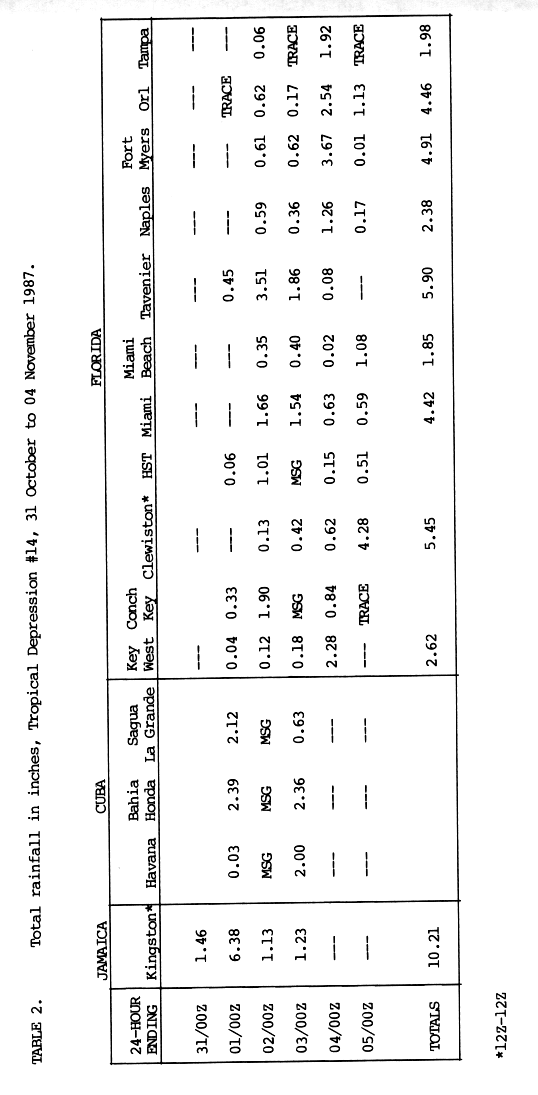
A broad area of low pressure existed in the central Caribbean in late October. It steadily organized, and was classified as Tropical Depression Fourteen on October 31. It moved northwestward, and entered a high-shear environment due to an upper-level low situated toward the end of a high pressure system. By November 1, little convection remained as the weak depression turned to the north and crossed Cuba. A burst of convection organized over the depression, and brought strong wind gusts to the Florida Keys as it passed through the area on November 2. | access-date=October 11, 2007 | archive-url= https://web.archive.org/web/20071025133409/http://www.nhc.noaa.gov/archive/storm_wallets/atlantic/atl1987-prelim/trop/prelim01.gif| archive-date=October 25, 2007 | url-status= live}} It continued to the north-northwest, paralleling the Florida west coast, and lost all of its convection on November 3. The system turned to the northeast, and merged with a weak extratropical low over northern Florida on November 4. | access-date=October 11, 2007 | archive-url= https://web.archive.org/web/20071025133413/http://www.nhc.noaa.gov/archive/storm_wallets/atlantic/atl1987-prelim/trop/prelim02.gif| archive-date=October 25, 2007 | url-status= live}}
Rainfall was experienced as far north as eastern Georgia and extreme southern South Carolina. Other parts of the United States received high to moderate rains while the aforementioned region received low amounts. | access-date=April 4, 2007
Storm names
The following list of names was used for named storms that formed in the North Atlantic in 1987. This is the same list used for the 1981 season as no names were retired from that year. No names were retired following the season, so the list was used again for the 1993 season.
Season effects
This is a table of all of the storms that formed in the 1987 Atlantic hurricane season. It includes their name, duration, peak classification and intensities, areas affected, damage, and death totals. Deaths in parentheses are additional and indirect (an example of an indirect death would be a traffic accident), but were still related to that storm. Damage and deaths include totals while the storm was extratropical, a wave, or a low, and all of the damage figures are in 1987 USD. |- | One || || bgcolor=#| || || || Bahamas, Florida || None || None || |- | Unnamed || || bgcolor=#| || || || United States Gulf Coast || || None || |- | Arlene || || bgcolor=#| || || || Bahamas, Bermuda || || None || |- | Four || || bgcolor=#| || || || None || None || None || |- | Bret || || bgcolor=#| || || || Cape Verde Islands || None || None || |- | Six || || bgcolor=#| || || || None || None || None || |- | Cindy || || bgcolor=#| || || || None || None || None || |- | Eight || || bgcolor=#| || || || Nicaragua || None || None || |- | Nine || || bgcolor=#| || || || United States East Coast || None || None || |- | Dennis || || bgcolor=#| || || || None || None || None || |- | Eleven || || bgcolor=#| || || || None || None || None || |- | Emily || || bgcolor=#| || || || Lesser Antilles, Greater Antilles, Bermuda || || || |- | Floyd || || bgcolor=#| || || || Central America, Cuba, Florida, Bahamas || || || |- | Fourteen || || bgcolor=#| || || || Jamaica, Cayman Islands, Cuba, Florida || || || |-
References
References
- (2006). "Tropical Cyclone Climatology". National Hurricane Center.
- "North Atlantic Ocean Historical Tropical Cyclone Statistics". Colorado State University.
- Hurricane Research Division. (March 2011). "Atlantic basin Comparison of Original and Revised HURDAT". National Oceanic and Atmospheric Administration.
- National Oceanic and Atmospheric Administration. (May 27, 2010). "Background information: the North Atlantic Hurricane Season". [[Climate Prediction Center]].
- David Levinson. (August 20, 2008). "2005 Atlantic Ocean Tropical Cyclones". National Climatic Data Center.
- (May 26, 1987). "Season's first depression sighted". The Miami Herald.
- Doig, Steven. (May 31, 1987). "Tropical Depression To Dampen Weekend". The Miami Herald.
- (June 1, 1987). "Tropical Depression Weakens". The Miami Herald.
- Harrold P. Gerrish. (October 10, 1987). "Preliminary Report: Hurricane Arlene – Page 1 – Storm History I". National Hurricane Center.
- Harrold P. Gerrish. (October 10, 1987). "Preliminary Report: Hurricane Arlene – Page 2 – Storm History II, Meteorological Statistics, Impact and Conclusion". National Hurricane Center.
- (August 13, 1987). "Bermuda Boards Up For Arlene". The Miami Herald.
- (August 13, 1987). "Blind sailor to ride out storm at sea". The Miami Herald.
- Robert A. Case and Harold P. Gerrish. (April 1988). "Atlantic Hurricane Season of 1987". American Meteorological Society.
- NHC Hurricane Research Division. (February 17, 2006). "Atlantic hurricane best track". NOAA.
- (August 15, 1987). "Depression dies out, Arlene moves on". Lakeland Ledger.
- David Roth. (2007). "Hurricane Floyd – October 10–13, 1987". Hydrometeorological Prediction Center.
- (November 17, 1987). "Tropical Depression Fourteen Tropical Cyclone Report – Page 4". National Hurricane Center.
- (April 1987). "National Hurricane Operations Plan". [[NOAA]] Office of the Federal Coordinator for Meteorological Services and Supporting Research.
- (May 25, 1987). "Names selected for 1987 hurricanes". [[The Spokesman-Review]].
- (May 1981). "National Hurricane Operations Plan". [[NOAA]] Office of the Federal Coordinator for Meteorological Services and Supporting Research.
- (May 29, 1981). "Meet Bret, Cindy, Dennis, Emily ...". [[The Miami News]].
- "Tropical Cyclone Naming History and Retired Names". National Hurricane Center.
- (April 1993). "National Hurricane Operations Plan". [[NOAA]] Office of the Federal Coordinator for Meteorological Services and Supporting Research.
This article was imported from Wikipedia and is available under the Creative Commons Attribution-ShareAlike 4.0 License. Content has been adapted to SurfDoc format. Original contributors can be found on the article history page.
Ask Mako anything about 1987 Atlantic hurricane season — get instant answers, deeper analysis, and related topics.
Research with MakoFree with your Surf account
Create a free account to save articles, ask Mako questions, and organize your research.
Sign up freeThis content may have been generated or modified by AI. CloudSurf Software LLC is not responsible for the accuracy, completeness, or reliability of AI-generated content. Always verify important information from primary sources.
Report