From Surf Wiki (app.surf) — the open knowledge base
1986 in video games
none
none
1986 saw many sequels and prequels in video games, such as Super Mario Bros. 2, along with new titles such as Arkanoid, Bubble Bobble, Castlevania, Dragon Quest, Ikari Warriors, The Legend of Zelda, Metroid, Out Run and R.B.I. Baseball. The year's highest-grossing arcade video games were Hang-On in Japan, Hang-On and Gauntlet in the United States, and Nemesis (Gradius) in London. The year's bestselling home system was the Family Computer and Nintendo Entertainment System for the third year in a row, while the year's best-selling home video games in Western markets were Super Mario Bros. in the United States and Yie Ar Kung-Fu in the United Kingdom.
Video game developer Masahiro Sakurai considers 1986 the most incredible year for the video game industry. He cited the release of several games that were the beginning of popular and long-lasting franchises such as The Legend of Zelda, Dragon Quest, Castlevania, and Kunio-kun. He attributed their release to new hardware like the Family Computer Disk System and megabit ROMs that afforded developers with greater memory storage, which allowed for more creative possibilities. Sakurai noted that the better games in the competitive market generated more appeal.
Financial performance
In the United States, the home video game industry recovered with the arrival of the third generation of video game consoles led by the Nintendo Entertainment System (NES).
Highest-grossing arcade games
Japan
In Japan, the following titles were the highest-grossing arcade games of 1986, according to the Game Machine charts.
| Rank | Title | Arcade cabinet | Points | January–June | July–December | Total |
|---|---|---|---|---|---|---|
| 1 | *Hang-On* | Ride-on / sit-down | ||||
| 2 | *Major League* | Table | 968 | 1678 | ||
| 3 | *Ikari* (*Ikari Warriors*) | Table | 992 | 1420 | ||
| 4 | *Real Mahjong Haihai* | Table | 1062 | 1083 | ||
| 5 | *Tehkan World Cup* | Table | 694 | 1152 | ||
| 6 | *Space Harrier* | Rolling type | 887 | 949 | ||
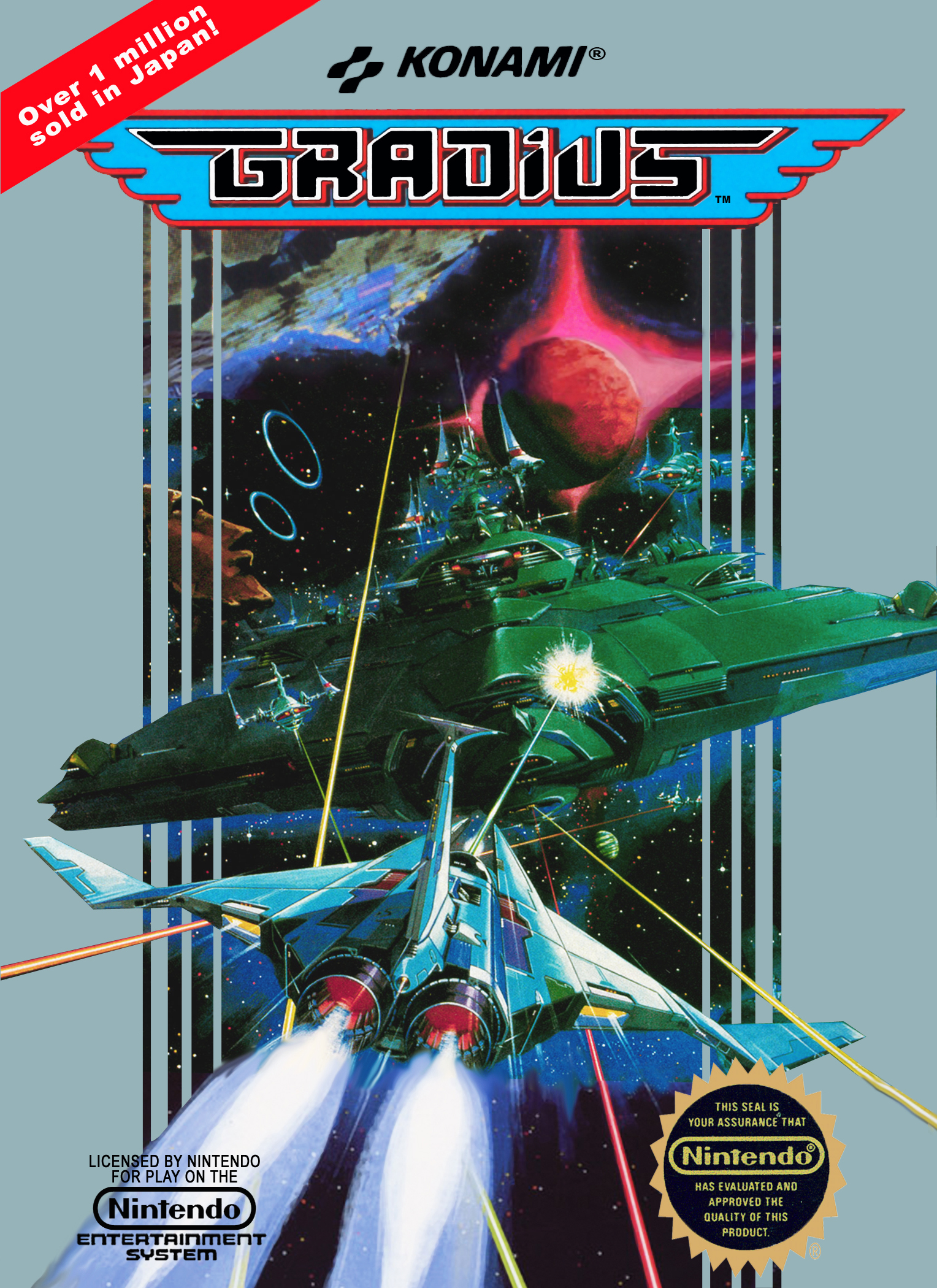
| 7 | *Gradius* | Table | 860 | 965 | ||
| 8 | *Arkanoid* | Table | 1719 | 1719 | ||
| 9 | *ASO: Armored Scrum Object* | Table | 898 | 820 | ||
| 10 | *[1942](1942-video-game)* | Table | 862 | 826 |
United Kingdom and United States
In the United Kingdom and United States, the following titles were the highest-grossing arcade video games of 1986.
| Rank | United Kingdom | United States | Electrocoin (London) | *RePlay* | AMOA | *Play Meter* | Dedicated | Conversion |
|---|---|---|---|---|---|---|---|---|
| 1 | *Nemesis* (*Gradius*) | *Hang-On* | *Gauntlet* | *Mat Mania* | *Gauntlet* | |||
| 2 | *Hang-On* | *Gauntlet* | *Hang-On*, | |||||
| *Ikari Warriors*, | ||||||||
| *Speed Buggy*, | ||||||||
| *World Series* | *Choplifter*, | |||||||
| *Hogan's Alley*, | ||||||||
| *[1942](1942-video-game)*, | ||||||||
| *Rush'n Attack* | rowspan="9" | |||||||
| 3 | *Ikari Warriors* | *Mat Mania* | ||||||
| 4 | *Arkanoid* | *World Series* | ||||||
| 5 | *Super Sprint* | *Spy Hunter* | ||||||
| 6 | *Salamander* | *Pole Position II* | rowspan="5" | rowspan="5" | ||||
| 7 | *Rampage* | *Mania Challenge* | ||||||
| 8 | *Enduro Racer* | *Ikari Warriors* | ||||||
| 9 | *Konami GT* (*GT Racer*) | *Ghosts 'n Goblins* | ||||||
| 10 | *Jail Break* | *Super Sprint* |
Best-selling home systems
| Rank | System(s) | Manufacturer | Type | Generation | Sales | Japan | USA | Worldwide | |||||||||||||
|---|---|---|---|---|---|---|---|---|---|---|---|---|---|---|---|---|---|---|---|---|---|
| 1 | Family Computer / Nintendo Entertainment System | Nintendo | Console | 8-bit | last1=Tanaka | first1=Tatsuo | url=http://www.stat.go.jp/english/info/meetings/iaos/pdf/tanaka.pdf#page=2 | title=Network Externality and Necessary Software Statistics | date=August 2001 | publisher=Statistics Bureau of Japan | page=2}} | 3,000,000 | 6,900,000+ | ||||||||
| 2 | Commodore 64 (C64) | Commodore | Computer | [8-bit](8-bit) | last=Reimer | first=Jeremy | date=2005-12-15 | title=Total share: 30 years of personal computer market share figures | url=https://arstechnica.com/features/2005/12/total-share/ | url-status=live | access-date=2021-11-27 | website=Ars Technica | language=en-us | archive-url=https://web.archive.org/web/20120607023023/http://arstechnica.com:80/features/2005/12/total-share/ | archive-date=June 7, 2012}} | ||||||
| 3 | Family Computer Disk System | Nintendo | Console | 8-bit | last1=McFerran | first1=Damien | date=20 November 2010 | title=Feature: Slipped Disk - The History of the Famicom Disk System | url=http://www.nintendolife.com/news/2010/11/feature_slipped_disk_the_history_of_the_famicom_disk_system | url-status=live | archive-url=https://web.archive.org/web/20191219221055/http://www.nintendolife.com/news/2010/11/feature_slipped_disk_the_history_of_the_famicom_disk_system | archive-date=19 December 2019 | access-date=20 January 2020 | website=Nintendo Life}} | 2,000,000 | ||||||
| 4 | Commodore 128 (C128) | Commodore | Computer | 8-bit | 1,000,000 | ||||||||||||||||
| 5 | Apple II | Apple Inc. | Computer | 8-bit | 700,000 | ||||||||||||||||
| 6 | NEC PC-88 / PC-98 | NEC | Computer | 8-bit / [16-bit](16-bit) | last1=Methe | first1=David | last2=Mitchell | first2=Will | last3=Miyabe | first3=Junichiro | last4=Toyama | first4=Ryoko | date=January 1998 | title=Overcoming a Standard Bearer: Challenges to NEC's Personal Computer in Japan | url=https://www.researchgate.net/publication/5160396 | journal=Research Papers in Economics (RePEc) | page=35 | via=ResearchGate}} | ,000+ | ||
| 7 | Sega SG-1000 / Master System | Sega | Console | 8-bit | 280,000 | date=February 1987 | title=Comparing the New Videogame Systems | url=https://www.ataricompendium.com/archives/newsletters/video_game_update/computer_entertainer_feb87.pdf | magazine=Computer Entertainer | volume=5 | issue=11 | page=13}} | 405,000+ | ||||||||
| 8 | Mac | Apple Inc. | Computer | [16-bit](16-bit) | 380,000 | ||||||||||||||||
| 9 | Amiga | Commodore | Computer | 16-bit | 200,000 | ||||||||||||||||
| Atari ST | Atari Corporation | Computer | 16-bit | 200,000 |
Best-selling home video games
Japan
In Japan, home video games that sold at least one million copies in 1986 include The Hyrule Fantasy: Zelda no Densetsu (The Legend of Zelda), which sold 1 million copies for the Family Computer Disk System (FDS) on its first day of release in February; Dragon Quest, which sold over 1 million cartridges for the Famicom (Nintendo Entertainment System) within six months between May and November; and Gradius, which sold over 1 million between April and December.
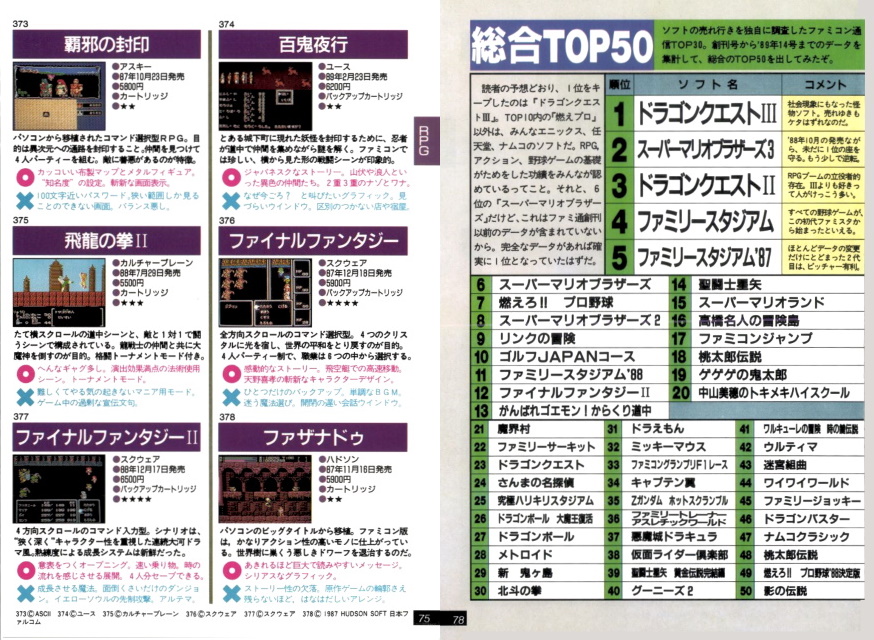
According to Famicom Tsūshin (Famitsu) magazine, the following titles were the top ten best-selling 1985-1986 releases during the three-year sales tracking period between May 1986 (when Famitsu began tracking sales) and mid-1989.
| Rank | Title | Developer | Publisher | Genre | Platform | Sales | |||||
|---|---|---|---|---|---|---|---|---|---|---|---|
| 1 | *Pro Yakyū: Family Stadium* (*R.B.I. Baseball*) | Namco | Namco | Sports (baseball) | Family Computer | title=Japan Platinum Game Chart | url=http://www.the-magicbox.com/Chart-JPPlatinum.shtml | website=The Magic Box | access-date=23 August 2019 | archive-url=https://web.archive.org/web/20080101043949/www.the-magicbox.com/Chart-JPPlatinum.shtml | archive-date=2008-01-01}} |
| 2 | *Super Mario Bros.* | Nintendo | Nintendo | Platformer | Family Computer | ||||||
| 3 | *Super Mario Bros. 2* (*The Lost Levels*) | Nintendo | Nintendo | Platformer | Family Computer Disk System | ||||||
| 4 | *Ganbare Goemon! Karakuri Dōchū* | Konami | Konami | Action-adventure | Family Computer | ||||||
| 5 | *Takahashi Meijin no Bōken Jima* (*Adventure Island*) | Hudson Soft | Hudson Soft | Platformer | Family Computer | ||||||
| 6 | *Gegege no Kitaro: Youkai Daimakyou* (*Ninja Kid*) | TOSE | Bandai | Action | Family Computer | rowspan="2" | |||||
| 7 | *Makaimura* (*Ghosts 'n Goblins*) | Capcom | Capcom | Platformer | |||||||
| 8 | *Dragon Quest* (*Dragon Warrior*) | Chunsoft | Enix | Role-playing | Family Computer | 1,000,000+ | |||||
| 9 | *Dragon Ball: Shenlong no Nazo* (*Dragon Power*) | TOSE | Bandai | Action | Family Computer | rowspan="2" | |||||
| 10 | *Metroid* | Nintendo | Action-adventure | Family Computer Disk System |
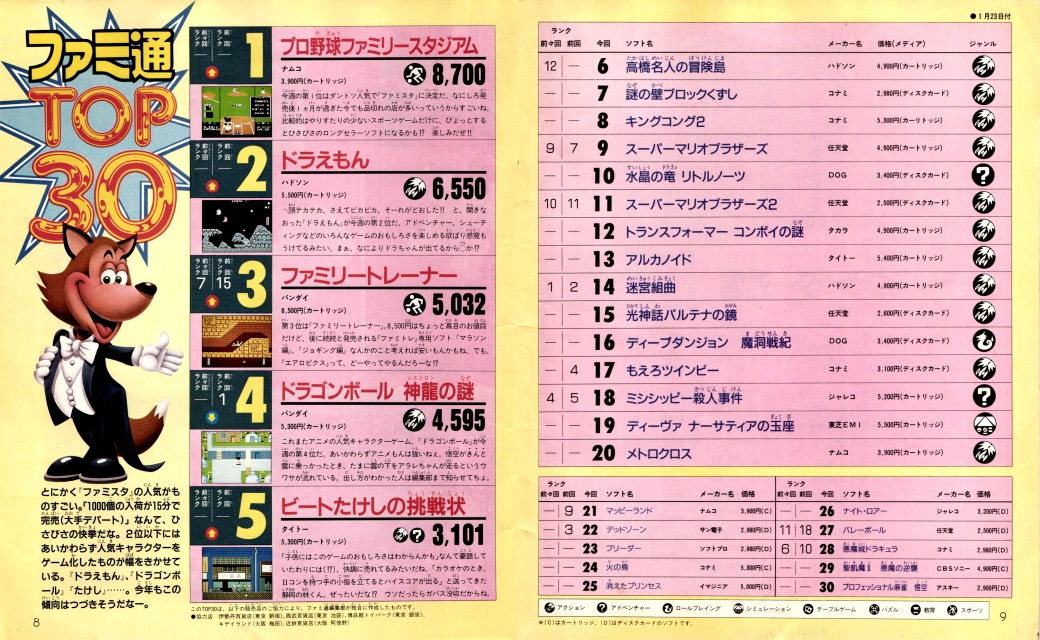
The following titles were the best-selling home video games on the bi-weekly Famitsu charts in 1986. Famicom Tsūshin magazine began tracking sales from May 1986.
| Month | Weeks 1-2 | Weeks 3-4 | Ref | ||||||||
|---|---|---|---|---|---|---|---|---|---|---|---|
| {{dts | May | }} | *Gegege no Kitaro: Youkai Daimakyou* (Famicom) | title=ファミ通 TOP 30: 6月6日 | trans-title=Famitsū Top 30: June 6 | magazine=Famicom Tsūshin | date=20 June 1986 | issue=1 | pages=6–7 | url=https://archive.org/details/bi-weekly-famitsu-no.-1-june-20th-1986-600DPI/Bi-Weekly%20Famitsu%20-%20No.%201%20June%2020th%201986/page/n7/mode/2up | lang=ja}} |
| {{dts | June | }} | *Super Mario Bros.* (Famicom) | *Super Mario Bros. 2* (FDS) | |||||||
| {{dts | July | }} | *Makaimura* (Famicom) | ||||||||
| {{dts | August | }} | *Volleyball* (FDS) | *Ganbare Goemon! Karakuri Dōchū* (Famicom) | |||||||
| {{dts | September | }} | *Ganbare Goemon! Karakuri Dōchū* (Famicom) | ||||||||
| {{dts | October}} | *Takahashi Meijin no Bōken Jima* (Famicom) | *Akumajō Dracula* (FDS) | ||||||||
| {{dts | November}} | *Takahashi Meijin no Bōken Jima* (Famicom) | *Pro Wrestling - Famicom Wrestling Association* (FDS) | ||||||||
| {{dts | December}} | *Dragon Ball: Shenlong no Nazo* (Famicom) | *Meikyū Kumikyoku* (Famicom) |
United Kingdom
In the United Kingdom, the following titles were the top ten best-selling home video games of 1986, according to the annual Gallup software sales chart. The top ten titles were all home computer games. The best-selling game was Yie Ar Kung-Fu, making it the second year in a row that a fighting game topped the annual charts, after The Way of the Exploding Fist in 1985.
| Rank | Title | Developer | Publisher | Genre |
|---|---|---|---|---|
| 1 | *Yie Ar Kung-Fu* | Konami | Imagine Software | Fighting |
| 2 | *Formula 1 Simulator* | Spirit Software | Mastertronic | Racing |
| 3 | *Commando* | Capcom | Elite Systems | Run-and-gun shooter |
| 4 | *Green Beret* | Konami | Imagine Software | |
| 5 | *Thrust* | Superior Software | Superior Software | Multi-directional shooter |
| 6 | *Ghosts 'n Goblins* | Capcom | Elite Systems | Platformer |
| 7 | *Paperboy* | Atari Games | Elite Systems | Action |
| 8 | *Rambo* | Ocean Software | Ocean Software | Run-and-gun shooter |
| 9 | *Kik Start* | Mastertronic | Mastertronic | Racing |
| 10 | *Ninja Master* | Tron Software | Firebird Software | Action |
United States
In the United States, Super Mario Bros. for the Nintendo Entertainment System (NES) was the best-selling home video game of 1986. The following titles were the best-selling home video games on the bi-weekly FAO Schwarz charts in 1986, reported by Famicom Tsūshin (Famitsu) magazine from June 1986 onwards.
| Month | Weeks 1-2 | Weeks 3-4 | Platform | Sales | Ref | 1986 | *Super Mario Bros.* | Nintendo Entertainment System | 1,000,000+ | title=Count Down Hot 100: USA Hot 10! | magazine=Famicom Tsūshin | date=16 April 1993 | issue=226 | page=83 | lang=ja | url=https://archive.org/details/famitsu-issue-226-apr-1993/page/83}} |
|---|---|---|---|---|---|---|---|---|---|---|---|---|---|---|---|---|
| {{dts | June | }} | *Super Mario Bros.* | Nintendo Entertainment System | ||||||||||||
| {{dts | July | }} | *Kung Fu* | Nintendo Entertainment System | ||||||||||||
| {{dts | August | }} | *Super Mario Bros.* | Nintendo Entertainment System | rowspan="2" | |||||||||||
| {{dts | September | }} | *Kung Fu* | |||||||||||||
| {{dts | October}} | rowspan="3" | rowspan="3" | |||||||||||||
| {{dts | November}} | |||||||||||||||
| {{dts | December}} |
Top-rated games
Major awards
| Award | Amusement Players Association Awards | |||||||||||||||||||||||||||
|---|---|---|---|---|---|---|---|---|---|---|---|---|---|---|---|---|---|---|---|---|---|---|---|---|---|---|---|---|
| (United States, January 1987) | *Famitsu* Best Hit Game Awards | |||||||||||||||||||||||||||
| (Japan, February 1987) | 5th Golden Joystick Awards | |||||||||||||||||||||||||||
| (United Kingdom, March 1987) | Arcade | Console | Computer | Game of the Year | Critics' Choice Awards | Best Scenario / Story | Best Graphics / Visuals | Best Music / Soundtrack | Best Audio | Best Character Design | Best Port | Original / Innovative | Best Hardware | Best Software House | Best Programmer | Best Arcade-Style Game | Best Action Game | Best Platform Game | Best Shooting Game | Best Adventure Game | Best RPG | Best Sports Game | Best Puzzle Game | Best Strategy Game | ||||
| *Super Mario Bros.* | *Dragon Quest* (Family Computer) | *Gauntlet* | ||||||||||||||||||||||||||
| *Meikyuu Kumikyoku* (Famicom) | ||||||||||||||||||||||||||||
| *Nazo no Kabe* (Famicom) | ||||||||||||||||||||||||||||
| *Volleyball* (Famicom) | ||||||||||||||||||||||||||||
| *Zanac* (Famicom Disk System) | ||||||||||||||||||||||||||||
| *Dragon Quest* (Yuji Horii) | ||||||||||||||||||||||||||||
| *Out Run* | *Akumajō Dracula* (*Castlevania*) | |||||||||||||||||||||||||||
| *The Hyrule Fantasy: Zelda no Densetsu* (Koji Kondo) | *Sanxion* | |||||||||||||||||||||||||||
| *Gauntlet* | ||||||||||||||||||||||||||||
| *Dragon Quest* (Akira Toriyama) | ||||||||||||||||||||||||||||
| *Ghosts 'n Goblins* (Famicom) | ||||||||||||||||||||||||||||
| *Gauntlet* | *The Sentinel* | |||||||||||||||||||||||||||
| Family Trainer (Power Pad) | ||||||||||||||||||||||||||||
| Elite Systems | ||||||||||||||||||||||||||||
| Koichi Nakamura (*Dragon Quest*) | Andrew Braybrook | |||||||||||||||||||||||||||
| *Uridium* | ||||||||||||||||||||||||||||
| *Metroid* (Famicom) | ||||||||||||||||||||||||||||
| *Super Mario Bros. 2* (Famicom Disk System) | ||||||||||||||||||||||||||||
| *Gradius* (Famicom) | ||||||||||||||||||||||||||||
| *The Pawn* | ||||||||||||||||||||||||||||
| *Dragon Quest* (Famicom) | ||||||||||||||||||||||||||||
| *Pro Yakyū: Family Stadium* (*R.B.I. Baseball*) | ||||||||||||||||||||||||||||
| *Kineko* (Famicom Disk System) | ||||||||||||||||||||||||||||
| *Vietnam* |
''Famitsu'' Platinum Hall of Fame
The following 1987 video game release entered Famitsu magazine's "Platinum Hall of Fame" for receiving a Famitsu score of at least 35 out of 40.
| Title | Platform | Score (out of 40) | Developer | Publisher | Genre |
|---|---|---|---|---|---|
| *Pro Yakyū: Family Stadium* (*R.B.I. Baseball*) | Family Computer | 35 | Namco | Namco | Baseball |
Business
- New companies: Majesco Entertainment, Ubi Soft, Bethesda Softworks, Famitsu, FromSoftware
- Defunct: Imagic.
- June 13 – Activision merges with Infocom.
- Activision acquires Gamestar Software.
- Sinclair Research Ltd. is acquired by Amstrad.
Notable releases
;Arcade
- February – Namco releases Sky Kid Deluxe, their first game to use a Yamaha YM2151 FM sound chip.
- February – SNK releases Ikari Warriors, which shares many elements with Taito's Front Line from 1982, but adds two-player simultaneous play and visuals closer to 1985's Commando. It is SNK's breakthrough game in the US.
- April – Sega releases Wonder Boy, the first in the series.
- July 8 – Namco releases The Return of Ishtar, which is the sequel to The Tower of Druaga.
- July – Ten years after Atari's Breakout, Taito releases Arkanoid, which adds power-ups and unique levels and generally reinvigorates the concept.
- August – Taito releases Bubble Bobble.
- September 20 – Sega releases the Out Run racing game.
- October 1 – Namco releases Genpei Tōma Den.
- December – Namco releases Rolling Thunder, distributed outside Japan by Atari Games.
;Console
- February 21 – Nintendo releases The Legend of Zelda (designed by Shigeru Miyamoto for the Family Computer Disk System), the first game in The Legend of Zelda series.
- May 27 – Enix releases Dragon Quest for the Famicom, which is usually considered the foremost Japanese role-playing video game, and is the first game in a series that has been phenomenally successful in Japan.
- June 3 – Nintendo releases Super Mario Bros.: The Lost Levels as the sequel to the Super Mario Bros.. The game was not released in North America, partially because it was deemed too difficult.
- August 6 – Nintendo releases Metroid by Makoto Kano, the first in the Metroid series.
- September 12 – Hudson Soft releases Adventure Island.
- September 26 – Konami releases Akumajō Dracula for the Famicom Disk System, the first game in the Castlevania series.
- November 1 – Sega releases Alex Kidd in Miracle World. It is the first game in the Alex Kidd series created for this character, and the most popular of all Alex Kidd games.
- December 10 – Namco releases Pro Baseball: Family Stadium for the Famicom, the first in the Famista series.
- December 19 – Nintendo releases Kid Icarus.
;Computer
- January 1 – Commodore releases Mind Walker for the Amiga. It keeps running, unmodified, on all versions of the Amiga hardware and OS.
- May 6 – Infocom releases the highly regarded Trinity.
- July 8 – Llamasoft's founder Jeff Minter releases Iridis Alpha, a shoot 'em up game for the Commodore 64 computer
- August 15 – Electronic Arts releases open-ended space exploration adventure game Starflight, which goes on to sell a million copies.
- October – Sierra On-Line expands their "Quest" line with King's Quest III: To Heir Is Human and Space Quest I: The Sarien Encounter.
- New World Computing releases Might and Magic Book One: The Secret of the Inner Sanctum for the Apple II, the first installment in the Might and Magic series.
- Activision releases Labyrinth: The Computer Game. Developed by Lucasfilm Games, this is the first of the LucasArts adventure games.
- Froggy Software releases La femme qui ne supportait pas les ordinateurs, one of the first video games about cyber harassment and female experience on the internet, and one of the first games with an overtly feminist message.
Hardware
- September, Apple releases the final computer in the Apple II line, the 16-bit Apple IIGS with professional synthesizer-quality audio.
- Namco releases the Namco System 86 arcade system board.
- Atari Corporation releases:
- The 1040ST personal computer, the second in the ST line. With a megabyte of RAM and a price of US$999, it is the first computer with a cost-per-kilobyte of under $1.
- The Atari 7800 console two years after its original test market date.
- A smaller model Atari 2600 for under US$50. The TV campaign proclaims "The fun is back!"
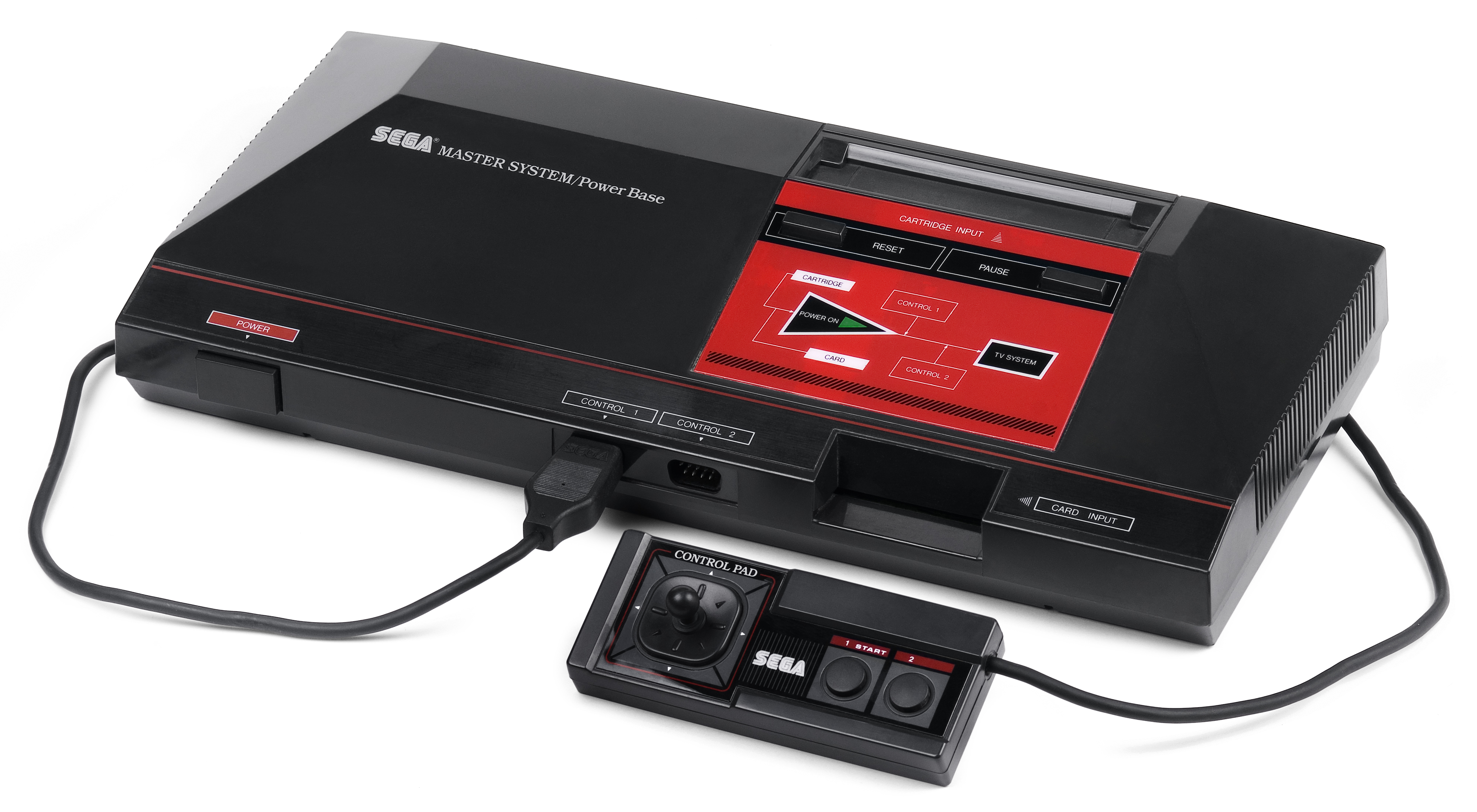
- Sega releases the Master System console in the US.
- Sharp releases the Twin Famicom home console only in Japan.
- Nintendo releases the Family Computer Disk System (an add-on for the Famicom) in Japan only.
- Texas Instruments releases the TMS34010, a CPU with graphics-oriented instructions. Eventually it powers arcade games such as Hard Drivin', Smash TV, Mortal Kombat, and NBA Jam.
References
References
- (2024-04-19). "1986: The Year of Legend [Grab Bag]". Masahiro Sakurai on Creating Games.
- (1990). "Video Games: Past, Present and Future; An Industry Overview". [[Nintendo of America]].
- (15 July 1986). "Game Machine's Best Hit Games 25: '86 上半期". [[:ja:アミューズメント通信社.
- (15 January 1987). "Game Machine's Best Hit Games 25: '86 下半期". Amusement Press, Inc..
- (18 January 1987). "1986 Top Ten Coin-Ops".
- (July-August 1987). "Top 20 of 1986". Amusement Players Association.
- (August 23, 1986). "Coin Machine: AMOA Announces Awards Nominations".
- (December 6, 1986). "AMOA JB, Games & Cig Vending Awards Winners".
- (December 1994). "1986".
- (August 2001). "Network Externality and Necessary Software Statistics". [[Statistics Bureau of Japan]].
- Kent, Steven L.. (2010-06-16). "The Ultimate History of Video Games, Volume 1: From Pong to Pokemon and Beyond . . . the Story Behind the Craze That Touched Our Lives and Changed the World". [[Crown Publishing Group]].
- (20 November 2010). "Feature: Slipped Disk - The History of the Famicom Disk System".
- Mansfield, Richard. (April 1987). "Editor's notes".
- (January 1998). "Overcoming a Standard Bearer: Challenges to NEC's Personal Computer in Japan". Research Papers in Economics (RePEc).
- (1990). "The Computer Industry Almanac 1991". Pearson P T R.
- (February 1987). "Comparing the New Videogame Systems".
- (15 December 1988). "All that glitters is not sold: New consoles and computers may sound wonderful – but they're often just too good, argues Barnaby Page".
- (2006). "Japan on the Upswing: Why the Bubble Burst and Japan's Economic Renewal". Algora Publishing.
- (December 1986). "Gradius (North American NES front cover)".
- (16 June 2010). "The Ultimate History of Video Games, Volume 1: From Pong to Pokemon and Beyond... the Story Behind the Craze That Touched Our Lives and Changed the World". [[Crown Publishing Group]].
- (15 September 1989). "ファミコン通信 〜 '89全ソフトカタログ".
- "Japan Platinum Game Chart".
- (16 April 1993). "Count Down Hot 100".
- (20 June 1986). "ファミ通 TOP 30: 6月6日".
- (4 July 1986). "ファミ通 TOP 30: 6月20日".
- (18 July 1986). "ファミ通 TOP 30: 7月4日".
- (August 1, 1986). "ファミ通 TOP 30".
- (August 22, 1986). "ファミ通 TOP 30".
- (19 September 1986). "ファミ通 TOP 30: 9月5日".
- (October 3, 1986). "ファミ通 TOP 30".
- (October 31, 1986). "ファミ通 TOP 30".
- (November 14, 1986). "ファミ通 TOP 30".
- (November 28, 1986). "ファミ通 TOP 30".
- (December 12, 1986). "ファミ通 TOP 30".
- (6 February 1987). "ファミコン通信 TOP 30: 1月23日".
- (12 February 1987). "Yie Ar tops charts for 1986".
- (20 June 1986). "U.S.A. TOP 10: 6月6日".
- (4 July 1986). "U.S.A. TOP 10: 6月20日".
- (18 July 1986). "U.S.A. TOP 10: 7月4日".
- (19 September 1986). "U.S.A. TOP 10: 9月5日".
- (16 April 1993). "Count Down Hot 100: USA Hot 10!".
- (1991). "Super Mario World Game Secrets". [[Prima Publishing]].
- (Winter 1987). "Amusement Players Association's Players Choice Awards". Amusement Players Association.
- (30 July 2020). "Beyond Donkey Kong: A History of Nintendo Arcade Games". [[McFarland & Company]].
- (6 February 1987). "1986 ベストヒットゲーム大賞".
- (16 March 1987). "Golden Joystick Awards". [[EMAP]].
- "週刊ファミ通クロスレビュープラチナ殿堂入りソフト一覧".
- (1989). "Zzap Iridis Alpha review".
- Hoffman, Erin. (January 19, 2010). "When the Stars Align". [[The Escapist (magazine).
- Jankowski, Filip. (2019-04-15). "The Presence of Female Designers in French Video Game Industry, 1985–1993". Games and Culture.
- Jankowski, Filip. (2017). "Political and Social Issues in French Digital Games, 1982–1993". TransMissions.
- (March 1986). "The Atari 1040ST". BYTE.
This article was imported from Wikipedia and is available under the Creative Commons Attribution-ShareAlike 4.0 License. Content has been adapted to SurfDoc format. Original contributors can be found on the article history page.
Ask Mako anything about 1986 in video games — get instant answers, deeper analysis, and related topics.
Research with MakoFree with your Surf account
Create a free account to save articles, ask Mako questions, and organize your research.
Sign up freeThis content may have been generated or modified by AI. CloudSurf Software LLC is not responsible for the accuracy, completeness, or reliability of AI-generated content. Always verify important information from primary sources.
Report