From Surf Wiki (app.surf) — the open knowledge base
1985 Wales v Scotland football match
Association football match
Association football match
| Field | Value |
|---|---|
| title | 1986 FIFA World Cup qualification |
| event | [1986 FIFA World Cup qualification – UEFA Group 7](1986-fifa-world-cup-qualification-uefa-group-7) |
| team1 | Wales |
| team1association | WAL |
| team1score | 1 |
| team2 | Scotland |
| team2association | SCO |
| team2score | 1 |
| date | |
| stadium | Ninian Park |
| city | Cardiff |
| referee | Jan Keizer (Netherlands) |
| attendance | 34,247 |
On 10 September 1985, the Welsh and Scottish national teams played each other during the qualifying stages of the 1986 FIFA World Cup at Ninian Park, the home of Cardiff City. The game was both teams' final match of the qualifying tournament, and both were still able to gain a place at the finals in Mexico; Wales needed to win the game, while Scotland knew that a draw would be enough.
The game was played against the backdrop of escalating football hooliganism; English clubs had been banned from European competition as a result of the Heysel Stadium disaster over three months prior, and fears were being raised, notably by Scotland's manager Jock Stein, that the British government, led by Margaret Thatcher, was seeking to lead a "crackdown" on football supporters generally, and that trouble at the highly charged game at Ninian Park would give them an excuse to extend this from just England to the other Home Nations.
Despite Scotland having the advantage in the group, thanks to a superior goal difference, they went into the game as underdogs due to some of their senior players being unavailable due to either injury or suspension, and because they had lost to Wales in the return fixture at Hampden Park in Glasgow the previous March. Despite this, Scotland achieved the draw they needed to go to the next stage of qualifying, while at the same time virtually eliminating Wales from the competition.
Scotland's celebrations at gaining the point they needed from the game were marred by Stein's collapse moments before the final whistle, and his subsequent death in the stadium's treatment room.
Background
Home Internationals
Main article: British Home Championship
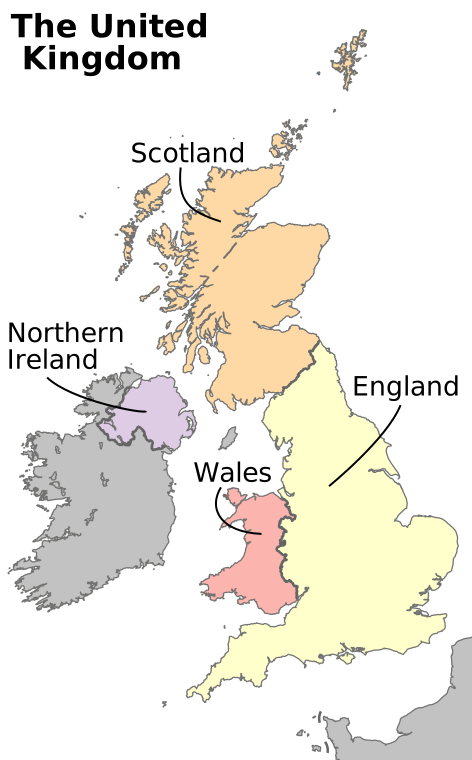
The four Home Nations of the United Kingdom (England, Scotland, Wales and Northern Ireland) had played regular international football matches against each other since 1872, when the first such game between England and Scotland was played. Initially, these were simply exhibition games, with only sporting and national pride being played for. As time went on, and a full fixture list between all four teams was established, discussion about a championship began, with points awarded for wins and draws, and a league table to determine a champion. This ultimately evolved into what became the British Home Championship, which was regularly played towards the end of the season. Into the 20th century, the tournament, which was the oldest international football competition, gained in prestige – the first list of "International Champions" was published in 1908, while a trophy was first awarded in 1935. As international football expanded, and new tournaments were established, such as the World Cup and European Championships, the prestige of the tournament began to wane.
The British Home Championship had ended in the 1983–84 season, with England having announced their decision to withdraw from the competition on 19 August 1983, citing an increasingly congested international fixture list and waning interest from supporters, especially for the games against Wales and Northern Ireland. Although Scotland said nothing publicly about also pulling out, it was accepted that, if any of the four withdrew from the competition, that would bring it to an end. Despite the withdrawal of England from the Home Championship, the annual England vs Scotland game would continue, with the two playing for a new trophy, the Rous Cup.
The Home Internationals had been a fixture in the calendar for 100 years, with the British Home Championship played every year (outside of the two World Wars) since the 1883–84 season. As a result, there was some level of disappointment felt by Wales and Northern Ireland over the decision. As a way of retaining the tournament, Alun Evans, the Secretary of the Football Association of Wales (FAW), had proposed making it biennial instead of annual, with the top two contesting a final game. In his programme notes for the first game of the 1984 tournament, Harry Cavan, the president of the Irish Football Association, said "We are gravely disappointed and sad that 100 years of genuine friendship, sporting traditions and close co-operation seems to have been sacrificed for financial expediency."
At the draw for the qualifying competition for the 1986 World Cup, which took place in Zürich on 7 December 1983 (six days before Harry Cavan's words were published), the four Home Nations were drawn against each other, with England and Northern Ireland in Group 3, and Scotland and Wales in Group 7.
World Cup qualification
Scotland and Wales, having been drawn together in the same qualifying group for the 1986 World Cup, had been evenly matched throughout the competition, although Wales had secured a 1–0 win over Scotland in what turned out to be a controversial and bad-tempered game at Hampden Park in March 1985. This game, Wales' first win at Hampden for 34 years, saw Scottish complaints over what appeared to be a foul by Welsh striker Mark Hughes on defender Alex McLeish in the buildup to the goal scored by Ian Rush. The booking that Souness received would prove expensive as he was subsequently booked in Scotland's next qualifying game against Iceland. This led to his receiving a suspension for the final qualifying game away to Wales. Going into the final round of games, both teams were equal on points with Spain, with Scotland ahead thanks to a superior goal difference; Spain's final game at home to Iceland was scheduled to be played two weeks after Wales and Scotland had played each other. With this in mind, a draw for Scotland would be sufficient to virtually guarantee second place in Group 7 and advance at the very least through to the two legged play-off against the winner of the Oceania qualifying tournament, while a win would likely see them top the group and qualify automatically. For Wales, anything less than a win would end their hopes of qualification unless Spain failed to beat Iceland.
;Group 7 table prior to Wales v Scotland
| Team | Pld | W | D | L | GF | GA | GD | Pts |
|---|---|---|---|---|---|---|---|---|
| 5 | 3 | 0 | 2 | 7 | 3 | +4 | **6** | |
| 5 | 3 | 0 | 2 | 6 | 5 | +1 | **6** | |
| 5 | 3 | 0 | 2 | 6 | 7 | -1 | **6** | |
| 5 | 1 | 0 | 4 | 3 | 8 | –5 | **2** |
The matchup was similar to the qualification for the 1978 World Cup, when Scotland and Wales were drawn together in the same group. On that occasion, the two played each other in the penultimate group game at Anfield, with Scotland knowing a point would be enough to guarantee qualification for the final tournament in Argentina, while Wales needed a victory to maintain their chance of qualifying going into their final game. In the event, a controversial penalty from Don Masson and a late header by Kenny Dalglish gave Scotland the victory.
Head-to-head
The World Cup qualifier between Wales and Scotland at Ninian Park was the 101st meeting between the two since 1876, encompassing games in the British Home Championship, World Cup and friendlies. Wales had a poor record against Scotland having won only 18 games up to that point, with Scotland successful in 60. The two teams had played each other 22 times at Ninian Park; Scotland had a 9–6 advantage over Wales, with the remaining seven games drawn.
| WAL | |||
|---|---|---|---|
| Wales | |||
| Draw | SCO | ||
| Scotland | At Ninian Park | ||
| British Home Championship | 16 | 22 | 50 |
| FIFA World Cup | 1 | 0 | 2 |
| Friendly | 1 | 0 | 8 |
| **Total** | **18** | **22** | **60** |
| 6 | 7 | 9 |
Build-up
Recent results
The game would be the first of the 1985–86 season for both teams. Since the first fixture at Hampden Park on 27 March, both teams had played twice, with each playing one of the other teams in the qualifying group and a friendly. Wales had secured a comfortable home win against Spain in the World Cup qualifying tournament, but had gone down to defeat away to Norway. Scotland went into the match on the back of a pair of wins; the Rous Cup victory against England, and the World Cup qualifier away to Iceland.
| Previous Scotland results 1985 | Date | Venue | Opponents | Attendance | Score | Competition | Scotland scorers |
|---|---|---|---|---|---|---|---|
| 25 May 1985 | Hampden Park, Glasgow (H) | 66,489 | 1–0 | [Rous Cup](1985-rous-cup) | Gough | ||
| 28 May 1985 | Laugardalsvöllur, Reykjavík (A) | 16,000 | 1–0 | [WCQ7](1986-fifa-world-cup-qualification-uefa-group-7) | Bett |
| Previous Wales results 1985 | Date | Venue | Opponents | Attendance | Score | Competition | Wales scorers |
|---|---|---|---|---|---|---|---|
| 30 April 1985 | Racecourse Ground, Wrexham (H) | 23,494 | 3–0 | [WCQ7](1986-fifa-world-cup-qualification-uefa-group-7) | Rush (2), Hughes | ||
| 5 June 1985 | Brann Stadion, Bergen (A) | 5,596 | 2–4 | Friendly | Lovell, Hughes |
Choice of venue
In 1985, the FAW did not have access to a large national stadium. The National Stadium at Cardiff Arms Park had opened the previous year, but was then for the exclusive use of the Welsh Rugby Union; there was no football game played there until 1989. The FAW instead took the national team to one of the stadia of Cardiff City, Swansea City or Wrexham, three of the four clubs who then played in the English football league system.}}
In the buildup to the game, the Welsh manager Mike England was unhappy that the game was to be played at Ninian Park in Cardiff instead of the Racecourse Ground in Wrexham. Wales at the time had an excellent record at the Racecourse, both in qualifying tournaments for the World Cup and European Championships, and in the British Home Championship. During the early 1970s, Wrexham had embarked on making significant improvements to the Racecourse, with two new stands built and a new roof installed over the Kop End. Ninian Park had undergone a cut to its capacity, as a result of various safety inspections, until improvements were made. The smaller capacity of the Racecourse meant that home games were more likely to sell out. This had led to the FAW choosing the Racecourse for the majority of the national team's home games from 1977 onwards. Before the game against Scotland, Wales had played twenty home games since the beginning of 1980, with eight each of those played at Cardiff and Wrexham. Of those, Wales had won 6 and drawn 2, including two wins against England, and the 3–0 victory over Spain earlier in the qualifying tournament at the Racecourse, while they had won 3, drawn 2 and lost 3 at Ninian Park.
| Welsh home record | ||||||||||
|---|---|---|---|---|---|---|---|---|---|---|
| January 1977 – June 1985 | Welsh stadium capacity | Overall record | Ninian Park | |||||||
| (Cardiff) | Racecourse Ground | |||||||||
| (Wrexham) | Vetch Field | |||||||||
| (Swansea) | Stadium | Total | Seats | |||||||
| Played | 31 | 10 | 15 | 5 | Ninian Park | 43,000 | 7,040 | |||
| Won | 17 | 4 | 10 | 3 | Racecourse Ground | 28,500 | 7,000 | |||
| Drawn | 8 | 2 | 4 | 2 | Inglis | 1983 | p=162}} | 26,490 | 5,300 | |
| Lost | 6 | 4 | 1 | 0 | ||||||
| Win % | ||||||||||
| (overall) | 54.83% | 12.9% | 32.26% | 9.68% |
Pressure on Jock Stein

Jock Stein had been the manager of Scotland since the resignation of Ally MacLeod in 1978, and had ensured qualification for the 1982 World Cup in Spain. Over the period there had been little other success, either in the European Championships, which Scotland had failed to qualify for twice, or the British Home Championship, which had led to criticism leading into the next competition, the 1986 World Cup. As a consequence, Stein was facing significant pressure to ensure qualification for his team for the tournament, given the route that had been provided to Scotland by the qualifying draw. Group 7 was one of three UEFA qualifying groups with only four teams – in each of these groups, the second placed teams would advance to a play-off round. For the second placed team in Group 7, this meant a two-legged play-off against the winner of the OFC tournament, likely to be Australia, which was seen as a much easier proposition than the runners up in Group 1 and Group 5, who would have to face each other. As a consequence, the defeat to Wales in Glasgow had led to significant criticism directed at Stein, who was aware that failure to get a result in the return game against Wales would likely cost him his job.
Stein was not helped by the fact that several of his senior players, including Graeme Souness (his captain), Kenny Dalglish, Alan Hansen and Steve Archibald would all miss the game through injury or suspension. Stein was also taking diuretics to manage heart failure at the time but had, in the build-up to the game, decided to stop taking them to try and remain focused and negate any potential side-effects the medication might have. Despite his enthusiasm for the job and for football, the strain on Stein, combined with his poor health, had led to him indicating that he would step down after the World Cup finals in Mexico.
Potential for government intervention
English football had gone through some serious incidents related to football hooliganism in 1985. In March, a major riot had occurred during an FA Cup tie between Luton Town and Millwall; on the final day of the English domestic season, the Second Division game between Birmingham City and Leeds United was marred by the death of a 14-year-old Birmingham fan during rioting before the game; while just two days after Scotland's qualifying game in Iceland, the Heysel Stadium disaster had occurred prior to the 1985 European Cup Final, which had led to English clubs being banned from European competition by UEFA.
The action taken by UEFA had no effect on England's participation in international football, although there were discussions over their participation in the 1988 European Championships, nor did it have any implication for either the Scottish Football Association (SFA) or FAW over their clubs' participation in European competition.
Television broadcast
The importance of the match meant it was selected for live broadcast by ITV across their entire network, with on-site presentation by Jim Rosenthal, by then one of ITV Sport's main presenters, who shared the studio with Jimmy Greaves. Two separate commentary teams were used: one, consisting of ITV's senior commentator Brian Moore, Terry Yorath and Ian St. John, covered the game for the English and Welsh regions of the network, while the other, with Jock Brown and Joe Jordan, was for viewers in the Scottish ITV areas.
Referee
Dutch referee Jan Keizer was chosen to officiate the game. Up to that point, he had taken charge of two games in the qualifying competition, including Wales' home game against Spain the previous April. Although regarded highly enough by FIFA to be chosen for the 1984 Olympic Final, he had a reputation for being strict in his interpretation of the rules.
Match
Several people, including midfielder Gordon Strachan, had noticed that Stein did not appear to be well prior to the start of the game. Roddy Forsyth of BBC Scotland had conducted an interview with Stein on the afternoon of the match for a documentary series, Only A Game?. Although appearing in good spirits in his conversation with Forsyth, the journalist also noted during a break in filming that Stein appeared pallid and was sweating heavily. This was in spite of it being a warm day but not, in Forsyth's opinion, being so hot as to cause someone to perspire significantly.
Nevertheless, Stein appeared to be in good spirits; during the warm-up, Wales goalkeeper Neville Southall found that the Scottish fans in the crowd kept all of the balls he and Eddie Niedzwiecki were using. On returning to the dressing room he spoke about it to Stein, who then went out onto the pitch and gestured to the fans to return all the balls. Prior to the start he took his place in the dugout and the game kicked off without incident.
First half
In the return game at Hampden Park, the Welsh strikers, Ian Rush and Mark Hughes, had been more than a match for Scotland's defensive set-up, with even Stein declaring that they had been "magnificent". It had been a challenge from Hughes on defender Alex McLeish that had ultimately allowed Rush to score the winner on that night.
The game began at a furious pace, with both teams prepared to fight hard; after only two minutes, Hughes made a heavy tackle on McLeish that incensed the Scotland players, while only a minute later McLeish was booked for a challenge on Rush. Scotland's defence was unable to prevent Wales taking the lead after thirteen minutes, when Peter Nicholas made a low cross, despite the attention of both Aitken and Steve Nicol, for Hughes to score past goalkeeper Jim Leighton. Wales almost scored again in the twentieth minute when Joey Jones crossed for Robbie James, whose header went just over the bar. In the 38th minute, a Welsh free kick was blocked twice by Leighton, with the second falling at the feet of Hughes, whose shot went just wide. Then, just before half-time, Leighton misjudged the flight of a cross that caused the ball to drop again to Hughes; the Scottish keeper prevented Wales scoring a second by diving at Hughes' feet.
Half-time
Once half-time was reached, it was clear that Scotland, and Jim Leighton in particular, were in difficulty. In the dressing room, Leighton admitted that the reason he had missed the cross at the end of the first half, which led to the last-ditch save at the feet of Mark Hughes, was that he was shortsighted and, having lost one of his contact lenses, did not have a spare pair with him. Leighton had not been forthcoming about his eyesight because of fears that it might harm his career. As a consequence, the fact that the goalkeeper even needed lenses was something that his teammates, Alex Ferguson (who was also Leighton's club manager at Aberdeen) or, most importantly, a furious Jock Stein did not know.
During the half-time interval, Stein gave Gordon Strachan notice that he planned to bring him off during the second half and replace him with winger Davie Cooper. Stein's five-man defensive set-up meant that his midfielders were outnumbered by the Welsh, and consequently Strachan had failed to make an impact on the game up to then. Despite this, Strachan was prepared to argue with Stein that he should remain on, until Alex Ferguson cautioned him to be aware that the manager was clearly not well, and should not cause too much stress with a confrontation.
Second half
The situation with Leighton meant that Scotland were forced to make a half-time substitution, replacing the goalkeeper with Alan Rough, whose last international had been against the Soviet Union during the 1982 World Cup finals. The second half began with Wales remaining in control of the game as they had been during the first half, with their best chance coming when Ian Rush mis-hit what appeared to be a simple tap-in, causing it to pass wide. As a consequence, with an hour of the game gone, Stein made his second and final substitution, withdrawing Strachan and replacing him with Davie Cooper on the left-hand side. Cooper had a reputation for being somewhat mercurial; he was considered to be one of the most gifted Scottish players of his generation, but was regarded as the type of player who could be anonymous throughout games. On this occasion, Cooper's introduction had an impact and caused the home side to look vulnerable for the first time. Scotland were gaining in confidence, but they were running out of time, with the Welsh defenders able to absorb the pressure and use the long clearance to get the ball upfield towards Hughes and Rush, who held the ball and waited for reinforcement from their midfielders. Scotland had already had a penalty claim turned down for an apparent push on David Speedie when, with nine minutes left, Nicol crossed into the Welsh box. The ball was nodded down by Graeme Sharp into Speedie's path; his shot, which appeared to be heading over the crossbar, struck defender David Phillips on the elbow and led to the Dutch referee awarding Scotland a penalty. With the majority of the Scottish team electing to leave the ball, it was Cooper who stepped up to assume responsibility to take the spot kick. Striking it low and hard to the right, Cooper's penalty was successful despite the efforts of Welsh goalkeeper Neville Southall, and the score was brought level. Immediately, Mike England made a substitution, withdrawing midfielder Robbie James and bringing on forward Steve Lovell in an effort to regain the advantage. Two minutes later he made his second and final substitution, bringing off Mickey Thomas for Clayton Blackmore.
At the time the penalty was taken, the Welsh dugout was surrounded by press and photographers, as the home team were still leading 1–0. With the scores levelled, the pack switched their attention to the Scottish bench, which led to Stein remonstrating with at least one photographer to move out of the way of his view of the game. Both Professor Stewart Hillis, the Scotland team doctor (who was also Stein's consultant), and Welsh manager Mike England stated that there appeared to be nothing wrong at this point.
While the rest of the Scottish bench were celebrating Cooper's successful penalty, Stein was unanimated. It was thought that he was merely following the advice he had given to his staff and players throughout the evening - "keep your dignity". Ferguson had noted that the manager appeared even more pallid, and was sweating profusely.
With approximately two minutes of normal time left, the referee's whistle blew for an infringement. Stein appeared to think that the final whistle had been blown, as he rose from his seat and began to make his way towards the Welsh bench to shake hands with England. As he got up, he fell to his knees before collapsing to the ground. He was immediately carried to the away dressing room where attempts were made to resuscitate him.
Post-match
The final whistle blew with the score remaining at 1–1. The Scottish players began celebrating their achievement with the estimated 12,000 Scotland fans who had made the trip to Cardiff, but were immediately aware that something was not right on the touchline. It was Alex Ferguson, who went onto the pitch after the final whistle, who began informing some of the players of Stein's collapse, news of which began to filter through to all of them as they made their way back to the dressing room.
Reports were confused initially – television pictures broadcast on ITV showed Stein, who appeared to be conscious and alert, being carried down the tunnel by police officers, with commentator Brian Moore speculating that he had been overcome with the emotion of the result. Martin Tyler of ITV Sport, who had been working as the pitchside reporter, and had been standing near Stein when he collapsed, reported that, despite the apparently alarming scenes, Stein was telling everyone that he was OK. BBC Radio commentator Peter Jones, who had no access to the television pictures and was relying on information from other people in the press box, also speculated that the tension of the result and the night had led to Stein's collapse.
In the treatment room, Stein, who had remained conscious throughout, was on the table being supported by Ernie Walker and Bill Dickie, two senior members of the SFA, while the on site medical team led by Stewart Hillis tried to keep his heart beating. Hillis at one point administered an injection to try to make Stein more comfortable, with Stein saying to him "that feels better Doc". Seconds later, Stein slipped into unconsciousness; despite the efforts of Stewart Hillis, he was pronounced dead approximately half an hour after the final whistle.
Aftermath

As the crowd began making their way home from Ninian Park, the news began to filter out slowly. Some Scottish fans had elected to remain in Cardiff and were celebrating the achievement of guaranteeing the play-off spot when they saw and heard what had happened. Others had boarded trains or were in cars heading home – many fans did not hear the news until they got home the following day.
The death of Jock Stein cast a pall over the Scottish team that had gained the point they needed to ensure their continued participation in qualification for the World Cup. The squad returned to Edinburgh the same night, reflecting on the loss of their manager, while the celebrations of the fans was cut short by the news. While being interviewed on television after the news broke, one said:
Stein's body was returned to Glasgow, where his funeral took place on 13 September 1985. In later years it became known that it was not a heart attack, but rather pulmonary oedema (fluid in the lungs) as a result of heart disease that caused Stein's death. Stein had stopped taking the diuretic medication prescribed for this in the days leading up to the game, which has been suggested as a contributory factor to his eventual collapse.
Scotland
Two weeks after Scotland had secured the point they needed against Wales, Spain played their final qualifier at home to Iceland, winning the game 2–1 to top the group and qualify automatically for the World Cup, leaving Scotland in second to go into the play-off.
;Final Group 7 table
| Team | Pld | W | D | L | GF | GA | GD | Pts |
|---|---|---|---|---|---|---|---|---|
| 6 | 4 | 0 | 2 | 9 | 8 | +1 | **8** | |
| 6 | 3 | 1 | 2 | 8 | 4 | +4 | **7** | |
| 6 | 3 | 1 | 2 | 7 | 6 | +1 | **7** | |
| 6 | 1 | 0 | 5 | 4 | 10 | −6 | **2** |
Following Stein's death, his assistant Alex Ferguson agreed to take charge of the national team. Initially, this was intended to be a one-off for the friendly that was planned for the free date on 16 October. The lack of time available in the lead up to the play-off meant finding a permanent replacement would prove difficult, and so Ferguson was officially appointed on 1 October at least until after the World Cup. While waiting to find out who they would play, Ferguson's first game in charge saw the team take on East Germany in a friendly at Hampden Park on 16 October. Their opponents were finally confirmed on 3 November, when Australia beat New Zealand to take an unassailable lead at the top of the four team Oceania group. Scotland came through the two-legged tie thanks to a 2–0 home win in Glasgow and a 0–0 draw in Melbourne, which saw them become the 24th and final team to qualify for the World Cup finals in Mexico.
.jpg)
Ferguson remained in charge through the remainder of the 1985–86 season and into their World Cup campaign, which saw them eliminated in the group stage, gaining only a single point, before stepping down at the end of June 1986, to be replaced by the SFA's Director of Coaching Andy Roxburgh. Ferguson's record saw him in charge for a total of ten games, of which five were competitive games and five (including the 1986 Rous Cup match) were friendlies. Of those, the team won three, lost three and drew four.
| Subsequent Scotland results 1985–86 | Date | Venue | Opponents | Attendance | Score | Competition | Scotland scorers |
|---|---|---|---|---|---|---|---|
| 16 October 1985 | Hampden Park, Glasgow (H) | 41,114 | 0–0 | Friendly | |||
| 20 November 1985 | Hampden Park, Glasgow (H) | 61,920 | 2–0 | [WCQPO](1986-fifa-world-cup-qualification-intercontinental-play-offs) | Cooper, McAvennie | ||
| 4 December 1985 | Olympic Park, Melbourne (A) | 32,000 | 0–0 | [WCQPO](1986-fifa-world-cup-qualification-intercontinental-play-offs) | |||
| 28 January 1986 | National Stadium, Ramat Gan (A) | 7,000 | 1–0 | Friendly | McStay | ||
| 27 March 1986 | Hampden Park, Glasgow (H) | 53,589 | 3–0 | Friendly | Strachan, Gough, Aitken | ||
| 23 April 1986 | Wembley Stadium, London (A) | 68,357 | 1–2 | Rous Cup | Souness | ||
| 29 April 1986 | Philips Stadion, Eindhoven (A) | 14,500 | 0–0 | Friendly | |||
| 4 June 1986 | Neza Stadium, Nezahualcóyotl (N) | 18,000 | 0–1 | [WCGE](1986-fifa-world-cup-group-e) | |||
| 8 June 1986 | Estadio la Corregidora, Querétaro (N) | 30,000 | 1–2 | [WCGE](1986-fifa-world-cup-group-e) | Strachan | ||
| 13 June 1986 | Neza Stadium, Nezahualcóyotl (N) | 36,000 | 0–0 | [WCGE](1986-fifa-world-cup-group-e) |
Wales
For the third successive tournament, Wales had missed out on qualification by a slender margin, having missed the 1982 World Cup on goal difference, and the 1984 European Championship by a single point. Despite this setback, which was followed by a 3–0 home defeat to Hungary in October, the team went through the rest of the season with only one other defeat, against Canada in May 1986. There was also the sense of history repeating itself in that, just as in 1977, it was a controversial penalty decision that ended up costing them dearly. Despite this, there was also a feeling that, given the group of players available to them, they would qualify for the next tournament. As it was, Wales failed to qualify for a major tournament until the 2016 European Championships.
Mike England was convinced that choosing Ninian Park as the venue was a factor in Wales failing to secure the win they needed, given the team's record when playing at Wrexham, and criticised the FAW for making the choice. Wales played two more home games that season against teams that had qualified for the World Cup by finishing top of their qualifying groups. On 16 October, Hungary came to Ninian Park and won 3–0, while on 21 April 1986, Wales's final home game that season saw them gain a 0–0 draw against Uruguay at the Racecourse Ground in Wrexham.
| Subsequent Wales results 1985–86 | Date | Venue | Opponents | Attendance | Score | Competition | Wales scorers |
|---|---|---|---|---|---|---|---|
| 16 October 1985 | Ninian Park, Cardiff (H) | 3,505 | 0–3 | Friendly | |||
| 25 February 1986 | Fahd Stadium, Dhahran (A) | 20,000 | 2–1 | Friendly | Davies, Slater | ||
| 26 March 1986 | Lansdowne Road, Dublin (A) | 16,500 | 1–0 | Friendly | Rush | ||
| 21 April 1986 | Racecourse Ground, Wrexham (H) | 11,154 | 0–0 | Friendly | |||
| 10 May 1986 | North York Civic Stadium, Toronto (A) | 13,142 | 0–2 | Friendly | |||
| 19 May 1986 | Empire Stadium, Vancouver (A) | 9,007 | 3–0 | Friendly | Saunders (2), Allen |
England oversaw a further qualifying campaign, for the 1988 European Championships, which Wales again failed to qualify for. As a consequence of this, the FAW terminated his contract at the beginning of 1988. England admitted that the death of Jock Stein had significantly affected him and, following his dismissal from his post as Wales manager, he never worked in football again, instead focusing on the timber business he founded in 1969, before buying and managing two care homes in North Wales.
Welsh home venues
In 1989, the FAW reached agreement with the Welsh Rugby Union to play at the National Stadium in Cardiff, with the majority of home games being played there for the next decade, interspersed with occasional visits to Wrexham. In 1997, demolition of the National Stadium began, to be replaced on the same site by the Millennium Stadium, intended to serve as a home for both the football and rugby union teams. Since 2000, as well as continued improvements to the Racecourse Ground, both Cardiff City (the Cardiff City Stadium; opened 2009) and Swansea City (the Swansea.com Stadium; opened 2005) have built new grounds. The new Parc y Scarlets (opened 2008) in Llanelli has also been constructed to meet UEFA's international criteria. This, added to the difficulty the FAW have had in filling the 74,000 seat Millennium Stadium in recent years, has led them to come full circle, with the majority of home games in recent years taking place at venues other than the national stadium.
| Welsh home venues 2000–2024 | Millennium Stadium | Cardiff City Stadium | Racecourse Ground | Swansea.com Stadium | Parc y Scarlets | Total | 37 | 58 | 6 | 8 | 3 |
|---|---|---|---|---|---|---|---|---|---|---|---|
| Capacity | 72,500 | 33,280 | 12,600 | 21,088 | 14,547 | ||||||
| 2000–2004 | 19 | N/A | 1 | N/A | N/A | ||||||
| 2005-2009 | 16 | 1 | 3 | 3 | 1 | ||||||
| 2010-2014 | 1 | 14 | 0 | 4 | 2 | ||||||
| 2015-2019 | 1 | 18 | 1 | 0 | 0 | ||||||
| 2020-2024 | 0 | 25 | 1 | 1 | 0 |
Recollections
In the years since Jock Stein's death, some, including Alex Ferguson, have said that they noticed changes in him in the days and weeks prior to the game against Wales. Gordon Strachan found it difficult to understand what Stein was saying during his team-talk. Strachan came to accept that the final decision Stein made, to replace him with Davie Cooper, was the correct one given Cooper's subsequent impact on the game.
On the 20th anniversary of Stein's death, Cardiff City unveiled a plaque commemorating the night at Ninian Park, located in the away dugout:
In 2009, the memorial was removed from the stadium when it was demolished and transferred to the "Ninian Park Gates" at the new Cardiff City Stadium. In 2010, to mark the 25th anniversary of Stein's death, the original plaque was removed and taken to the Celtic museum at Celtic Park in Glasgow, and was replaced at the Cardiff City Stadium by a replica bearing the same inscription.
Match details
| {{Football kit | pattern_la = _manutdh8688 | pattern_b = _wales84h | pattern_ra = _manutdh8688 | pattern_sh = _adidasred | pattern_so = _color_3_stripes_red | leftarm = FF0000 | body = FF0000 | rightarm = FF0000 | shorts = FFFFFF | socks = FFFFFF | title = Wales | {{Football kit | pattern_la = _sco8588h | pattern_b = _sco8588h | pattern_ra = _sco8588h | pattern_sh = _sco8588h | pattern_so = _redstripe | leftarm = 000060 | body = 000060 | rightarm = 000060 | shorts = FFFFFF | socks = FFFFFF | title = Scotland |
|---|
| WAL Mike England |
|---|
| SCO Jock Stein |
|---|
Notes
References
References
- Byrne, Peter. (1996). "Football Association of Ireland: 75 years". Sportsworld.
- Mitchell, Paul. (16 October 2014). "The first international football match". BBC.
- (28 February 2004). "Fifa limits substitutions". BBC Sport.
- (1908). "Sport and Athletics in 1908". Chapman and Hall.
- "British Home Championship Trophy, 1935".
- Miller, David. (8 October 2004). "FA sold Welsh down the river in dumping British Championship". Daily Telegraph.
- Reyes, Macario. (1 October 1999). "British Home Championship Overview". Rec.Sport.Soccer Statistics Foundation.
- Cavan, Harry. (December 1983). "Programme Notes". Irish Football Association Match Programme.
- (13 October 2012). "World Cup 1986". ITV Football 1968–83.
- Paul, Ian. (29 March 1985). "Scotland again choose to do it the hardest way". Glasgow Herald.
- Paul, Ian. (28 March 1985). "Scotland are Rushed into the doldrums". Glasgow Herald.
- Reynolds, Jim. (28 May 1985). "Bett's late goal earns hard victory". Glasgow Herald.
- (25 September 1985). "Spain have pace for fast route to Mexico". Glasgow Herald.
- "Wales national football team: record v Scotland". Association of Football Statisticians.
- "Wales national football team statistics and records: all-time record – 1985". Association of Football Statisticians.
- "Scotland national football team statistics and records: all-time record – 1985". Association of Football Statisticians.
- Pursey, Ivor. (May 1989). "History in the Making: Wales V. West Germany. A Message from the President of the F.A.W". Football Association of Wales Match Programme.
- "Wales national football team statistics and records: venues". Association of Football Statisticians.
- {{harvnb. Inglis. 1983
- {{harvnb. Inglis. 1983
- "Wales national football team statistics and records". Association of Football Statisticians.
- Bascombe, Chris. (9 October 2012). "Jock Stein's death at Cardiff's Ninian Park left a scar on both nations". Daily Telegraph.
- . (12 October 2002). ["Jordan's handiwork 25 years on"](https://news.bbc.co.uk/sport2/hi/wales/2322845.stm). *BBC*.
- {{harvnb. Inglis. 1983
- {{harvnb. MacPherson. 2005
- {{harvnb. MacPherson. 2005
- Reynolds, Jim. (28 January 1984). "Backing for Jock Stein". Glasgow Herald.
- Keevins, Hugh. (7 September 2004). "The Jock Stein Story - Jock refused to take vital pills before the Welsh match as they hampered his ability to manage - it was a risk that cost his life". Daily Record.
- Paul, Ian. (11 September 1985). "Sacrifice of a Football Manager with the Midas Touch". Glasgow Herald.
- (15 February 2013). "Luton Town v Millwall 1985 – the night football died a slow death". The Guardian.
- (20 June 2022). "Remembering Birmingham City's darkest day vs. Leeds - and the young life that was tragically lost". Birmingham Mail.
- (27 May 2015). "Heysel stadium disaster: ‘I saw the rows of bodies piled high’". The Guardian.
- (2 June 2008). "1985: Uefa bans English clubs from Europe". BBC News.
- . (4 April 2005). ["Heysel and the tragic aftermath"](https://news.bbc.co.uk/sport2/hi/football/europe/4400953.stm).
- (10 September 1985). "England face further ban". Glasgow Herald.
- McIlvanney, William (writer/narrator). "The Manager".
- (1 June 1985). "Brussels closes door on all teams from UK". Glasgow Herald.
- (17 December 1986). "Belgium lifts football ban on Scots". Glasgow Herald.
- Grondhuis, Francis. (7 July 2012). "Jan Keizer, altijd met strakke hand". voetbal.nl.
- McCoy, Eric. (15 April 2018). "Achieving Immortality: Jock Stein, Helenio Herrera and the 1967 European Cup Final".
- Spencer, Ben. (12 October 2012). "Goalie legend Neville Southall reveals magical memories of Jock Stein". Daily Record.
- Paul, Ian. (28 March 1985). "Nerves beat us — Stein". Glasgow Herald.
- . ["Wales v Scotland, 10 September 1985"](https://www.11v11.com/matches/wales-v-scotland-10-september-1985-239438/). *Association of Football Statisticians*.
- McLean, Euan. (6 September 2016). "Steve Nicol: As we celebrated on the pitch none of us realised Jock Stein had collapsed in the dugout".
- . (22 October 2008). ["Scots' tragedy in triumph"](http://www.fifa.com/classicfootball/news/newsid=875294.html).
- Reynolds, Jim. (11 September 1985). "Welsh hand Scots second World Cup Chance". Glasgow Herald.
- Moynihan, Leo. (2007). "Gordon Strachan: The Biography". Virgin Books.
- Hamilton, Sean. (16 August 2012). "Leighton's vision for a better season". PR Web UK.
- McLeod, Keith. (10 September 2010). "The night 'Big Jock' Stein died: Scotland players, staff and fans remember the tragedy 25 years on". Daily Record.
- Hugh MacDonald. (5 September 2015). "You are on you fat b******: Jock Stein's last words to Alan Rough". Herald Scotland.
- Drysdale, Neil. (23 March 2025). "Super Cooper". Sunday Post.
- (11 September 1985). "Manager Stein dies at match". Glasgow Herald.
- Ferguson, Alex. "Homage to the Master". Opus World.
- . (8 September 2010). ["Scotland and Celtic honour the late Jock Stein"](https://news.bbc.co.uk/sport2/hi/football/teams/c/celtic/8976397.stm).
- Crist, Matthew. (10 September 2017). "Triumph & Tragedy: The Night Football Lost Jock Stein".
- (1985). "World Cup Soccer Special: Wales v Scotland".
- Wilson, Fraser. (17 January 2018). "The night we lost a legend - how the Record reported that tragic evening Jock Stein died".
- Grant, Michael. (23 July 2010). "Scotland doctor Professor Stewart Hillis has spent 40 years in the game, but knows he will always be remembered for Daniel Prodan's transfer". Herald Scotland.
- Pougatch, Mark. (9 October 2012). "Big Jock". BBC Radio 5 Live.
- (10 September 2012). "27 Years since Jock Stein died". Jambos Kickback.
- Drysdale, Neil. (7 September 2020). "Football great Jock Stein died in Cardiff in 1985 and left the Scottish game ‘shattered’".
- Gault, Matt. (18 February 2016). "Jock Stein: The Ordinary Man Who Was Anything But".
- "Legends forged in European qualifiers". FIFA.
- (12 September 1985). "Fans' good behaviour 'watershed for football'". Glasgow Herald.
- . ["Spain v Iceland, 25 September 1985"](https://www.11v11.com/matches/spain-v-iceland-25-september-1985-239462/). *Association of Football Statisticians*.
- Reynolds, Jim. (12 September 1985). "SFA face problem of finding new leader for final World Cup hurdle". Glasgow Herald.
- "Managers - Alex Ferguson". Scottish Football Association.
- Reynolds, Jim. (5 December 1985). "Defence now policy as Ferguson reshapes plan". Glasgow Herald.
- (16 June 1986). "Fergie Steps Down". Evening Times.
- (17 July 1986). "Scotland on a Winner". Evening Times.
- . ["1984 UEFA European Championship Standings – Group 4"](http://www.uefa.com/uefaeuro/season=1984/standings/round=205/group=57/index.html). *UEFA*.
- Dafydd Pritchard. (10 October 2015). "Bosnia-Herzegovina 2-0 Wales". BBC Sport.
- "Wales national football team statistics and records: all-time record - 1986". Association of Football Statisticians.
- (4 February 1988). "England is fired after seven years". Glasgow Herald.
- Phillips, Terry. (6 January 2007). "England's Finest". South Wales Echo.
- {{harvnb. Stead. 2013
- {{harvnb. Stead. 2013
- . ["About the venue"](https://www.principalitystadium.wales/information/about-the-venue/).
- . (22 April 2009). ["Celtic to open new Cardiff ground"](https://news.bbc.co.uk/sport2/hi/football/teams/c/cardiff_city/8012041.stm).
- . (22 July 2005). ["City stadium ready for kick-off"](https://news.bbc.co.uk/2/hi/uk_news/wales/south_west/4704083.stm).
- . (29 May 2009). ["Wales 1–0 Estonia"](https://news.bbc.co.uk/sport2/hi/football/internationals/8046478.stm).
- Burt, Jason. (25 March 2011). "Wales v England: Gary Speed keen to fire up sell-out crowd at Millennium Stadium". Daily Telegraph.
- . (18 October 2005). ["City stadium takes sponsor's name"](https://news.bbc.co.uk/2/hi/uk_news/wales/south_west/4352630.stm).
- . ["Principality Stadium"](https://footballgroundguide.com/leagues/others/principality-stadium-cardiff.html).
- "Cardiff City Stadium".
- "Racecourse Stadium – Wrexham".
- . (3 February 2025). ["Wrexham unveil revised 'unique design' Kop stand"](https://www.bbc.co.uk/sport/football/articles/c2d31018pndo).
- "Swansea.com Stadium".
- "Scarlets".
- (10 September 2005). "Preview: Celtic v Aberdeen". ESPN.
- (19 January 2010). "Plaque commemorating Jock Stein 'moving to Celtic FC'". BBC News.
- (6 May 2009). "Jock Stein memorial to be saved when Cardiff City's Ninian Park faces bulldozer". Daily Record.
This article was imported from Wikipedia and is available under the Creative Commons Attribution-ShareAlike 4.0 License. Content has been adapted to SurfDoc format. Original contributors can be found on the article history page.
Ask Mako anything about 1985 Wales v Scotland football match — get instant answers, deeper analysis, and related topics.
Research with MakoFree with your Surf account
Create a free account to save articles, ask Mako questions, and organize your research.
Sign up freeThis content may have been generated or modified by AI. CloudSurf Software LLC is not responsible for the accuracy, completeness, or reliability of AI-generated content. Always verify important information from primary sources.
Report