From Surf Wiki (app.surf) — the open knowledge base
1978 Atlantic hurricane season
none
none
| Field | Value |
|---|---|
| Basin | Atl |
| Year | 1978 |
| Track | 1978 Atlantic hurricane season summary map.png |
| First storm formed | January 18, 1978 |
| Last storm dissipated | November 1, 1978 |
| Strongest storm by winds name | Ella |
| Strongest storm by winds winds | 120 |
| Strongest storm by winds pressure | 956 |
| Strongest storm by pressure name | Greta |
| Strongest storm by pressure winds | 115 |
| Strongest storm by pressure pressure | 947 |
| Average wind speed | 1 |
| Total depressions | 24 |
| Total storms | 12 |
| Total hurricanes | 5 |
| Total intense | 2 |
| Fatalities | 42 total |
| Damages | 141 |
| Season timeline | Timeline of the 1978 Atlantic hurricane season |
| five seasons | [1976](1976-atlantic-hurricane-season), [1977](1977-atlantic-hurricane-season), **1978**, [1979](1979-atlantic-hurricane-season), [1980](1980-atlantic-hurricane-season) |
| East Pacific season | 1978 Pacific hurricane season |
| North Indian season | 1978 North Indian Ocean cyclone season |
| West Pacific season | 1978 Pacific typhoon season |
| Strongest storm by winds name=Ella | Strongest storm by winds winds = 120 | Strongest storm by winds pressure = 956 | Strongest storm by pressure name=Greta | Strongest storm by pressure winds=115 | Strongest storm by pressure pressure=947 The 1978 Atlantic hurricane season was a slightly above average hurricane season in terms of number of named storms. Eleven tropical cyclones were named in all, and five of these became hurricanes; two of the five became a major hurricane (Category 3 or higher on the Saffir–Simpson scale). This was also the last Atlantic hurricane season to use an all-female naming list. The season officially began on June 1, 1978, and ended on November 30, 1978. These dates, adopted by convention, denote the period in each year when most tropical cyclogenesis occurs in the Atlantic basin. However, the formation of subtropical or tropical cyclones is possible at any time of the year, as shown by the formation of an unnamed subtropical storm on January 18.
Three storms made landfall along the coast of the western Gulf of Mexico during the season. At the end of July and into early August, short-lived Tropical Storm Amelia and its remnants caused extensive flooding in Texas after dropping as much as 48 in of rain. There were 33 deaths and US$110 million (equivalent to $ million in ) in damage. Also in August, Tropical Storm Bess made landfall in Veracruz, and later, Tropical Storm Debra did so in Louisiana. Neither caused significant damage, though Debra or its remnants spawned multiple tornadoes that killed two people. Hurricanes Ella and Greta each reached Category 4 strength. Though remaining out at sea, Ella did lash the East Coast of the United States and Atlantic Canada with gusty winds and rip currents in early September. Greta brought strong winds, high tides, and flooding to Central America, particularly Belize and Honduras, resulting in about $25 million in damage and at least five fatalities. The storm crossed intact into the eastern Pacific Ocean and was renamed Olivia. Overall, the storms of this season collectively caused $141 million in damage and 42 fatalities.
Season summary
ImageSize = width:800 height:240 PlotArea = top:10 bottom:80 right:20 left:20 Legend = columns:3 left:30 top:58 columnwidth:270
AlignBars = early DateFormat = dd/mm/yyyy Period = from:01/01/1978 till:01/12/1978 TimeAxis = orientation:horizontal ScaleMinor = grid:black unit:month increment:1 start:01/01/1978 Colors = id:canvas value:gray(0.88) id:GP value:red id:TD value:rgb(0.43,0.76,0.92) legend:Tropical_Depression_=≤38_mph(≤62_km/h) id:TS value:rgb(0.3,1,1) legend:Tropical_Storm_=39–73_mph(63–117_km/h) id:C1 value:rgb(1,1,0.85) legend:Category_1_=74–95_mph(118–153_km/h) id:C2 value:rgb(1,0.85,0.55) legend:Category_2_=96–110_mph(154–177_km/h) id:C3 value:rgb(1,0.62,0.35) legend:Category_3_=111–129_mph(178–208_km/h) id:C4 value:rgb(1,0.45,0.54) legend:Category_4_=130–156_mph(209–251_km/h) id:C5 value:rgb(0.55,0.46,0.90) legend:Category_5_=≥157_mph(≥252_km/h) Backgroundcolors = canvas:canvas BarData = barset:Hurricane bar:Month
PlotData= barset:Hurricane width:10 align:left fontsize:S shift:(4,-4) anchor:till from:18/01/1978 till:23/01/1978 color:TS text:"One" (SS) from:21/06/1978 till:23/06/1978 color:TD text:"TD" from:10/07/1978 till:12/07/1978 color:TD text:"TD" from:30/07/1978 till:01/08/1978 color:TS text:"Amelia (TS)" from:06/08/1978 till:08/08/1978 color:TS text:"Bess" (TS) from:07/08/1978 till:12/08/1978 color:C1 text:"Cora (C1)" from:07/08/1978 till:11/08/1978 color:TD text:"Four" (TD) from:09/08/1978 till:10/08/1978 color:TD text:"TD" from:26/08/1978 till:29/08/1978 color:TS text:"Debra (TS)" from:30/08/1978 till:05/09/1978 color:C4 text:"Ella (C4)" barset:break from:30/08/1978 till:01/09/1978 color:TD text:"TD" from:03/09/1978 till:11/09/1978 color:TD text:"Eight" (TD) from:04/09/1978 till:15/09/1978 color:C2 text:"Flossie" (C2) from:08/09/1978 till:10/09/1978 color:TD text:"Nine" (TD) from:12/09/1978 till:21/09/1978 color:TS text:"Hope" (TS) from:13/09/1978 till:20/09/1978 color:C4 text:"Greta (C4)" from:18/09/1978 till:29/09/1978 color:TD text:"Twelve" (TD) from:21/09/1978 till:23/09/1978 color:TD text:"TD" from:02/10/1978 till:05/10/1978 color:TS text:"Irma" (TS) from:07/10/1978 till:11/10/1978 color:TS text:"Juliet" (TS) barset:break from:15/10/1978 till:19/10/1978 color:TD text:"TD" from:26/10/1978 till:29/10/1978 color:TD text:"TD" from:28/10/1978 till:01/11/1978 color:C1 text:"Kendra" (C1) from:03/11/1978 till:04/11/1978 color:TD text:"TD"
bar:Month width:5 align:center fontsize:S shift:(0,-20) anchor:middle color:canvas from:01/01/1978 till:01/02/1978 text:January from:01/02/1978 till:01/03/1978 text:February from:01/03/1978 till:01/04/1978 text:March from:01/04/1978 till:01/05/1978 text:April from:01/05/1978 till:01/06/1978 text:May from:01/06/1978 till:01/07/1978 text:June from:01/07/1978 till:01/08/1978 text:July from:01/08/1978 till:01/09/1978 text:August from:01/09/1978 till:01/10/1978 text:September from:01/10/1978 till:01/11/1978 text:October from:01/11/1978 till:01/12/1978 text:November
TextData = pos:(570,30) text:"(From the" pos:(617,30) text:"Saffir-Simpson Hurricane Scale)"
The Atlantic hurricane season officially began on June 1, 1978. Although 24 tropical cyclones developed, only twelve of them reached tropical storm intensity, which is slightly above the 1966-2009 average of 11.3 named storms per season. Of the twelve tropical storms, five of them strengthened into a hurricane, which is slightly below the 1966-2009 average of 6.2. Two of the five hurricane became major hurricanes, which is Category 3 or greater on the Saffir–Simpson hurricane wind scale. Three tropical storms and two hurricanes made landfall during the season. Collectively, the tropical cyclones of the 1978 season caused at least 42 fatalities and $141 million,
- {{cite news|agency=Associated Press
- with $6 million in damage and one death in Puerto Rico from the precursor of Hurricane Kendra. The season officially ended on November 30, 1978.
Tropical cyclogenesis began very early, with the development of a subtropical storm on January 18. It dissipated about five days later. However, the next tropical cyclone, an unnumbered depression, did not develop until June 21. In July, there were two systems, including an unnumbered tropical depression and Tropical Storm Amelia. Seven tropical cyclones formed in August, including Tropical Depression Four, tropical storms Bess and Debra and hurricanes Cora and Ella. There were also seven systems in September – tropical depressions Eight, Nine, and Twelve, Tropical Storm Hope, and hurricanes Flossie and Greta. During the month of October, there were five tropical cyclones, with two unnumbered tropical depressions, tropical storms Irma and Juliet, and Hurricane Kendra. There was another unnumbered tropical depression in November, which dissipated on November 5.
The season's activity was reflected with an accumulated cyclone energy (ACE) rating of 63. ACE is a metric used to express the energy used by a tropical cyclone during its lifetime. Therefore, a storm with a longer duration will have high values of ACE. It is only calculated at six-hour increments in which specific tropical and subtropical systems are either at or above sustained wind speeds of 39 mph (63 km/h), which is the threshold for tropical storm intensity.
Systems
Unnamed subtropical storm
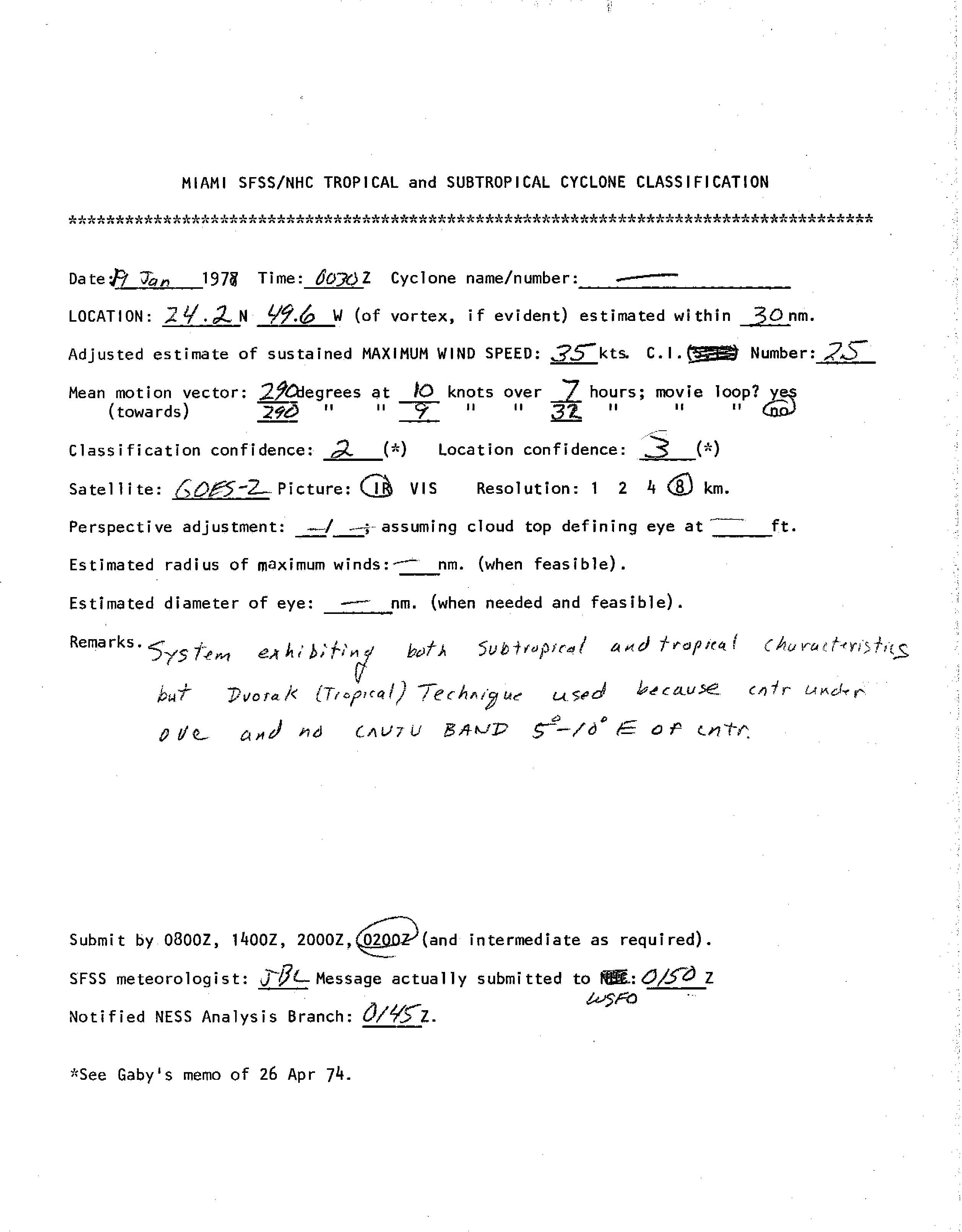
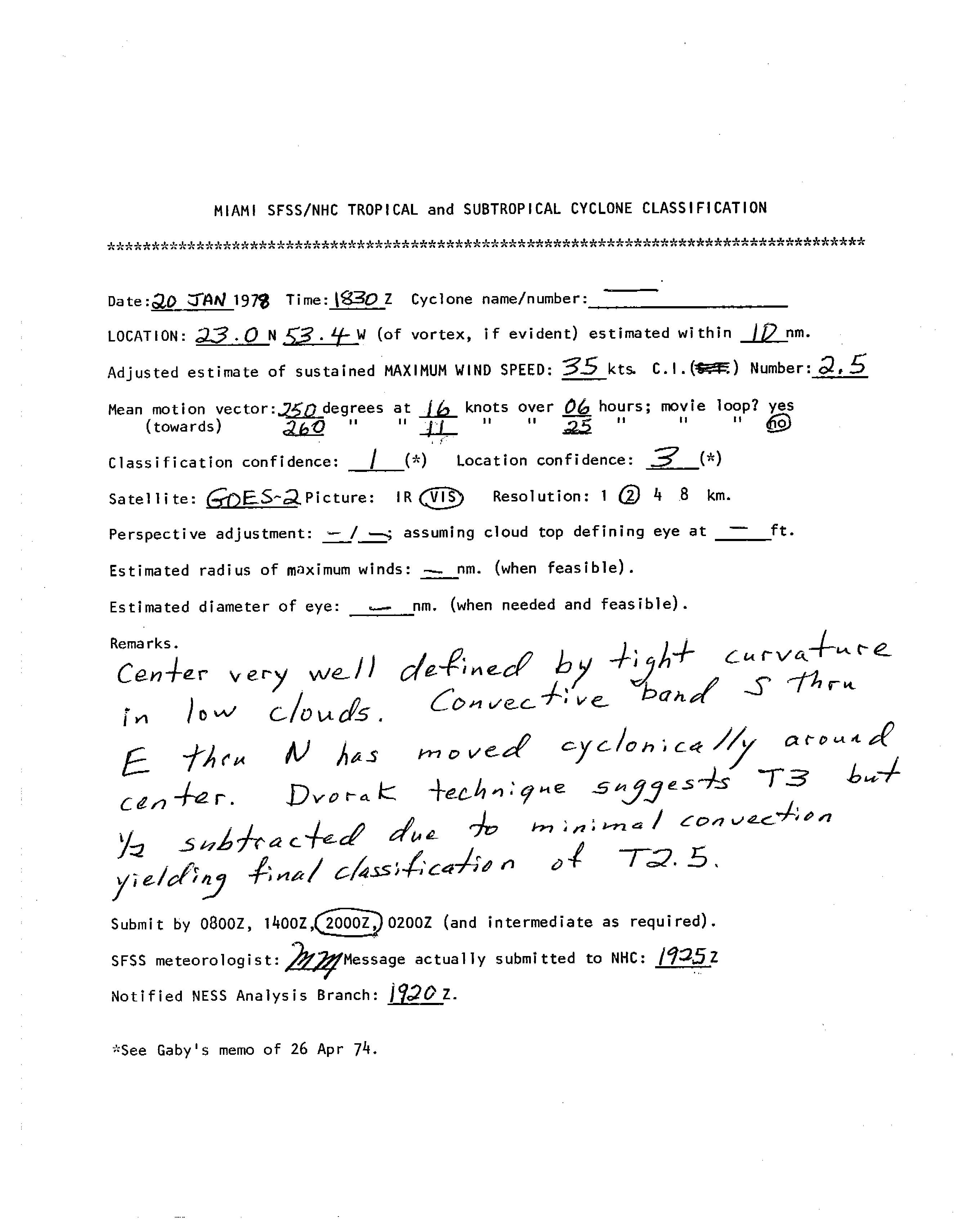
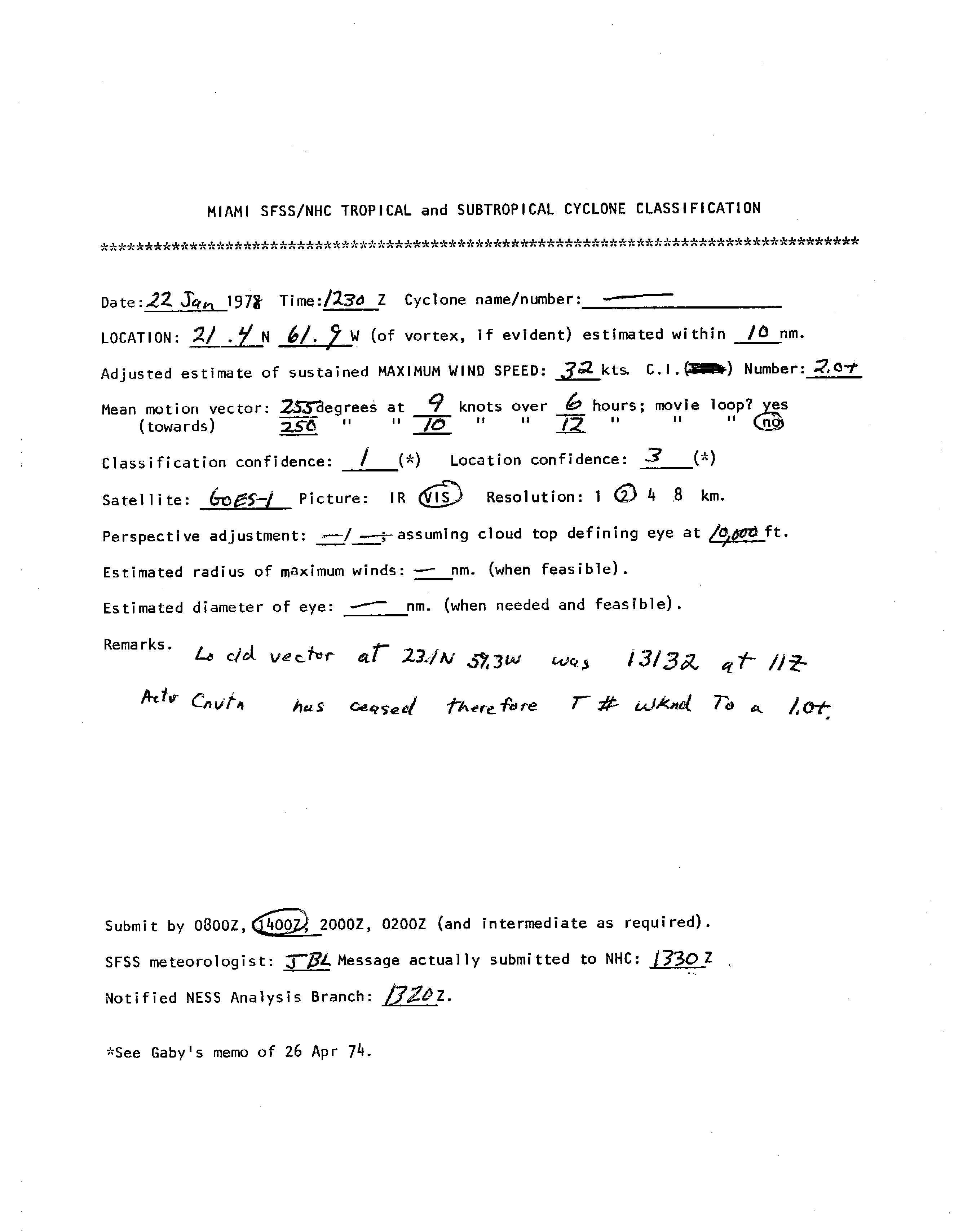
|1-min winds=40 In the middle of January, an upper-level trough in the westerlies spawned a surface low-pressure area to the east-northeast of the Lesser Antilles and to the south of a subtropical ridge. Isolated from the detrimental effects of the westerlies, it was initially non-tropical in nature and intensified through a baroclinic energy source, or one that derives energy from the interaction of cold and warm air. Convection increased slightly despite cool sea surface temperatures of around 75 °F. At 1200 UTC on January 18, it organized into a subtropical depression about 1725 mi east-northeast of Puerto Rico while moving in a general westward track, which it would maintain for much of its duration. The National Hurricane Center (NHC) initiated Dvorak classifications on the cyclone at 0000 UTC on January 19, assessing a Dvorak number of T2.5, suggesting both tropical and subtropical characteristics. On the same day, the pressure gradient between the storm and the ridge produced gale-force winds. By early on January 20, the storm maintained minimal convection near its center, with its primary rainband revolved in a cyclonic formation around its well-defined center. Later that day, the storm strengthened into a subtropical storm and attained peak winds of 45 mph, supported by both ship and Hurricane Hunters reports.
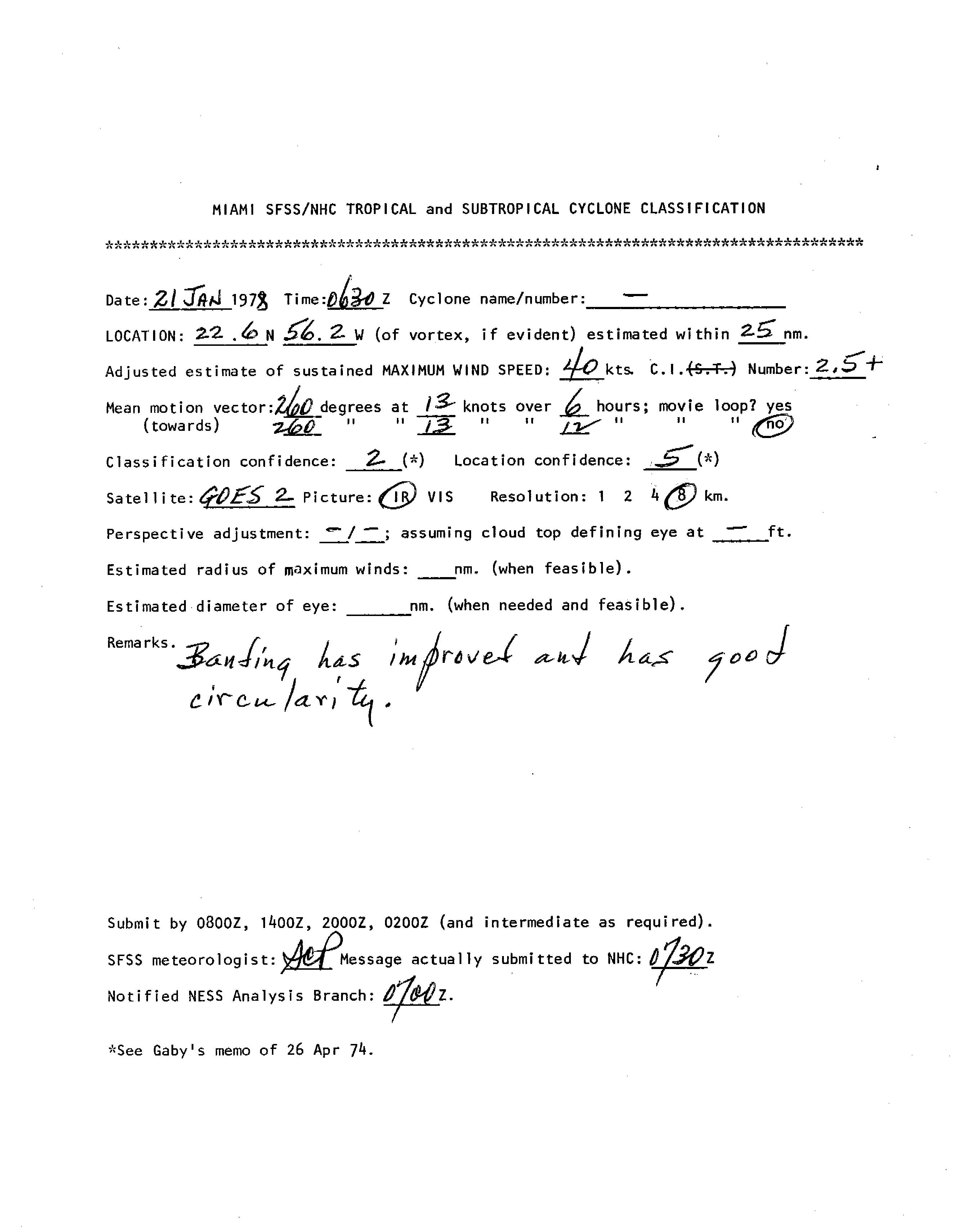
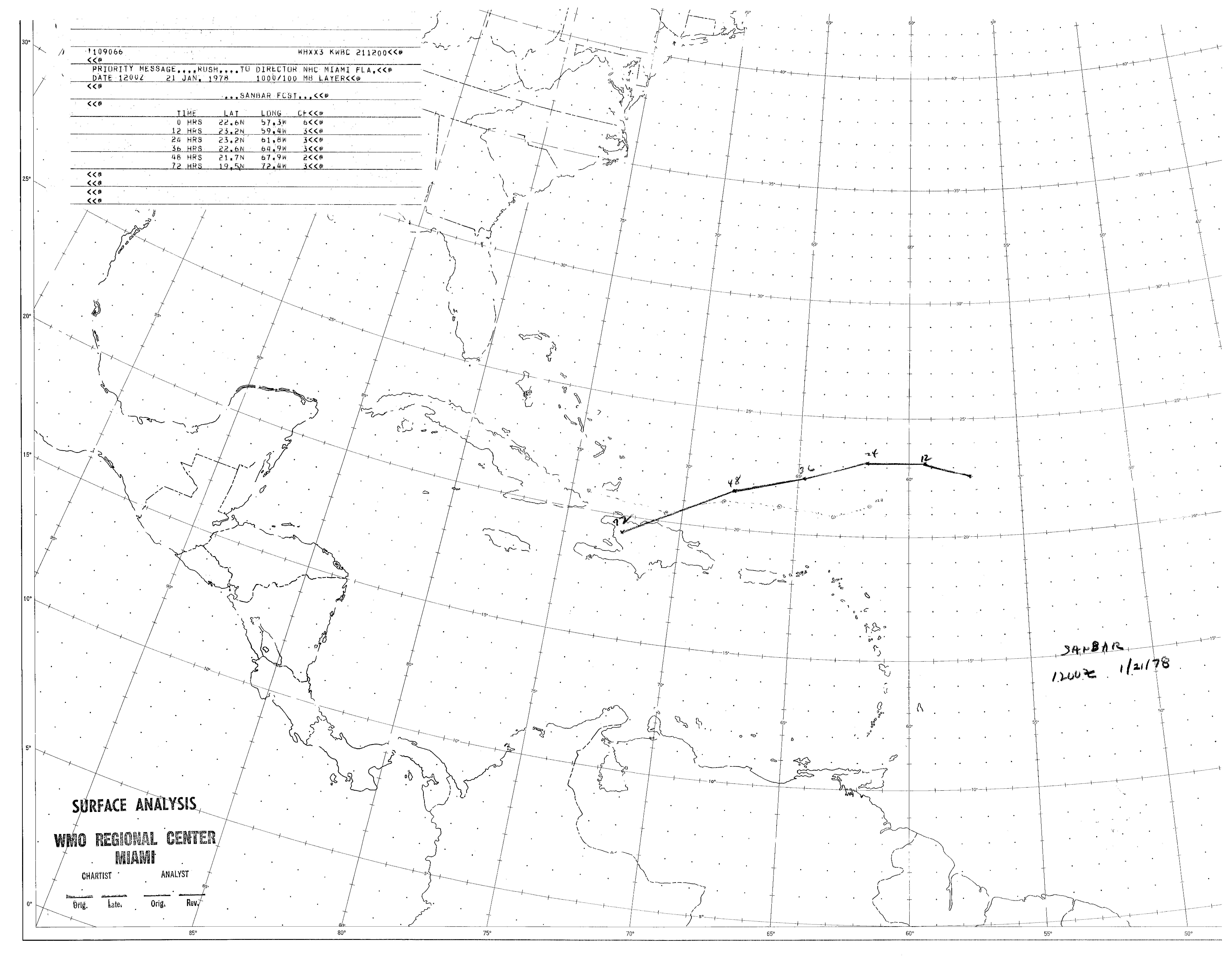
After the storm maintained peak winds for about 36 hours, the outer rainbands to the south and east of the center began diminishing late on January 21, which began a weakening trend. At around that time, the cyclone was moving west-southwestward, and within 72 hours was forecast by one hurricane forecast model to be located over Hispaniola. By midday on January 22, the winds decreased to below gale force after the convection dissipated near the center. Subsequently, it turned more to the west away from land, and by January 23 the circulation degenerated into a remnant trough about 185 mi north of the Lesser Antilles. The storm was one of six tropical or subtropical cyclones on record to be active in the month of January, and one of four to have formed in the month.
Tropical Storm Amelia
|1-min winds=45 Main article: Tropical Storm Amelia (1978)
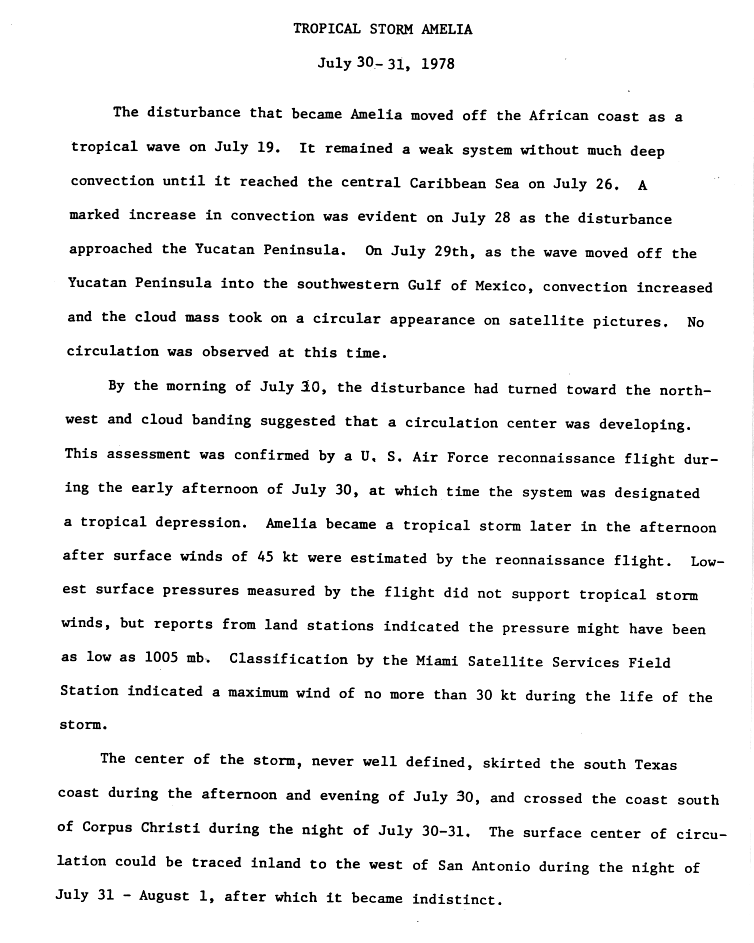
A tropical wave emerged into the Atlantic Ocean from the west coast of Africa on July 19. The wave did not develop significantly while crossing the Atlantic Ocean and Caribbean Sea. The disturbance then entered an area of the Gulf of Mexico that was conducive to tropical cyclogenesis and became a tropical depression while located about 30 mi south of Brownsville, Texas on July 30. Despite its proximity to land, the depression strengthened into Tropical Storm Amelia on July 31 and peaked with winds of 50 mph. Around that time, Amelia made landfall near Port Isabel, Texas. Later on July 31, the storm weakened to a tropical depression and dissipated early the following day.
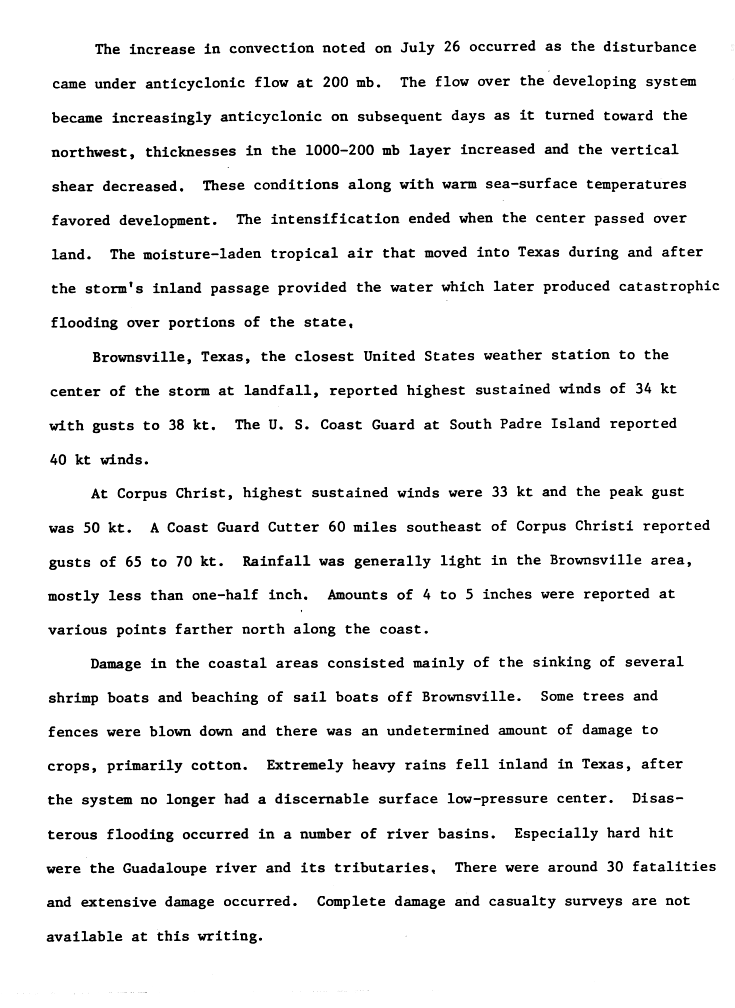
Amelia affected the Texas coast for two days, causing several shipping incidents and minor damage in Corpus Christi and South Padre Island. While active, there were no deaths linked to the storm. However, the biggest impact from the storm followed its dissipation, when its remnants contributed to record rainfall totals over the state. The state, already suffering from a previous drought, believed that the rain would help alleviate the conditions. However, the dry ground aided the flooding from the storm.{{cite news|agency=United Press International|date=August 7, 1978|title=Texans Keep Eyes on Sky and Gulf Storm|newspaper=Beaver County Times|access-date=June 3, 2014|url=https://news.google.com/newspapers?id=bvgjAAAAIBAJ&sjid=fNsFAAAAIBAJ&pg=2587,1688411&dq| location=Graham, Texas}} The rainfall caused several rivers and creeks to flood, especially around the Texas Hill Country and northern Texas, leading to severe damage. Overall, Amelia caused 33 fatalities with an estimated $110 million in damages.
Tropical Storm Bess
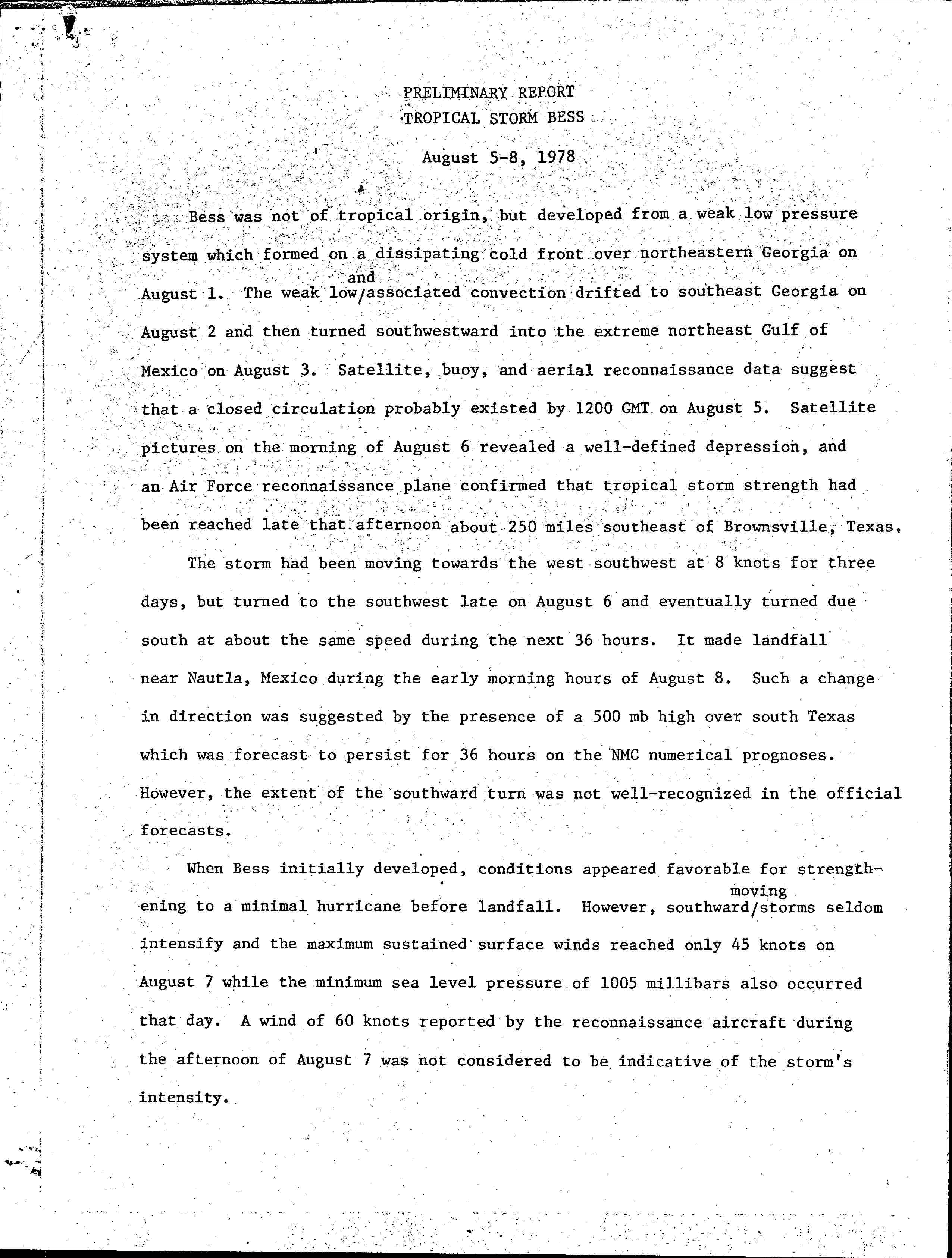
|1-min winds=45 A low-pressure area developed in Georgia along a dissipating cold front on August 1. The system detached from the cold front and drifted southwestward, reaching northeastern Gulf of Mexico on August 3. Satellite imagery, buoys, and reconnaissance aircraft flights indicated that by August 5, the system likely acquired a closed circulation. Thus, the National Hurricane Center estimated that a tropical depression developed in the central Gulf of Mexico at 1200 UTC that day. On August 6, a reconnaissance flight into the depression resulted in an upgrade to Tropical Storm Bess, while located about 250 mi southeast of Brownsville, Texas. The storm had initially headed west-southwestward at 8 mph, before moving southwestward at nearly the same speed.
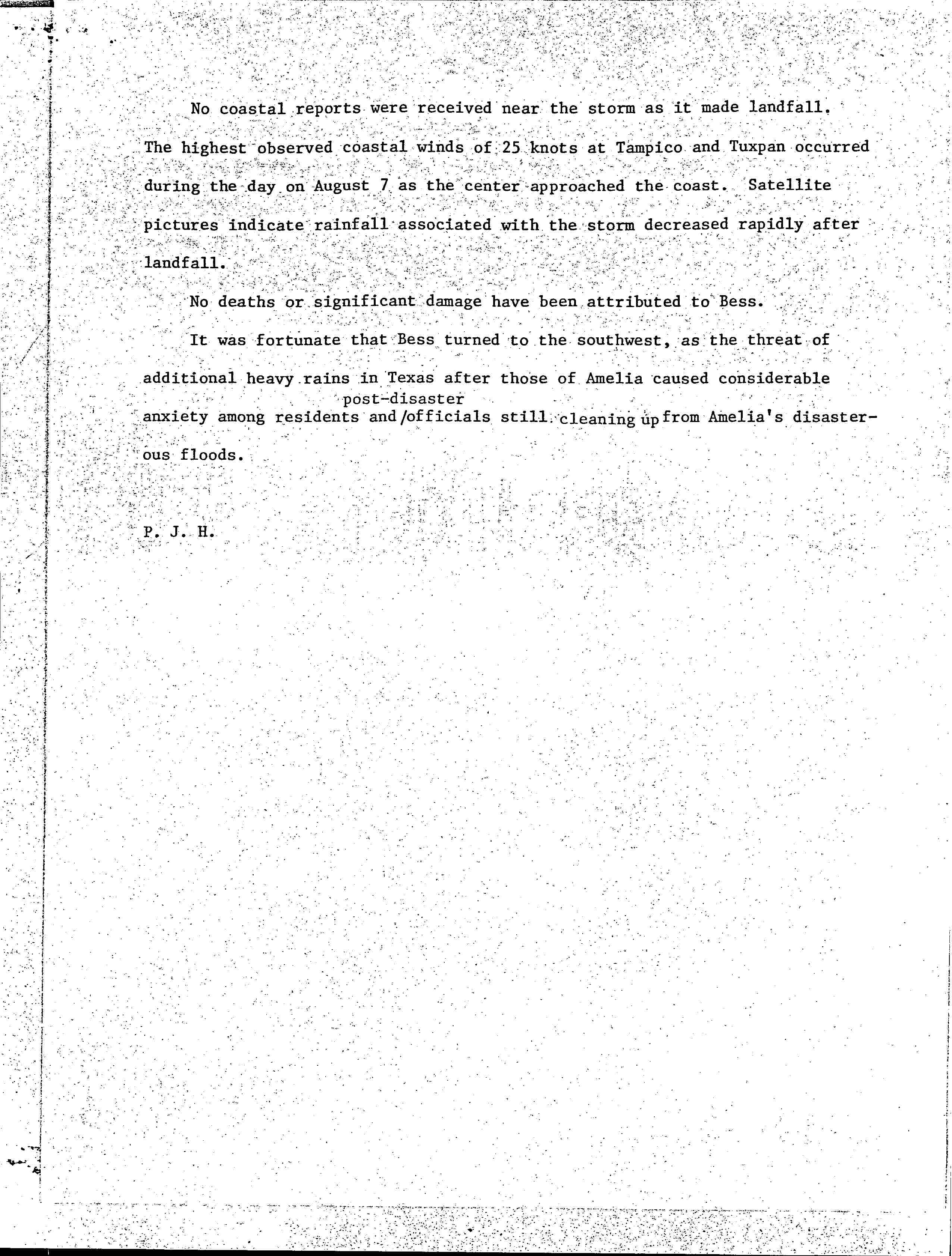
At 1200 UTC on August 7, Bess attained its minimum barometric pressure of 1005 mbar. Thereafter, Bess began to turn nearly due southward under the influence of a high-pressure area over southern Texas. Later on August 7, the storm reached its maximum sustained winds of 50 mph. Early on August 8, Bess made landfall near Nautla, Veracruz, at the same intensity and then rapidly dissipated inland. In Tuxpan, Veracruz and Tampico, Tamaulipas, sustained winds reached only 29 mph. The storm also produced heavy rainfall, peaking at 12.04 in in La Estrella. However, no flooding occurred and no damage or fatalities were reported. Its remnants emerged into the Pacific Ocean, leading to the formation of Hurricane Iva.
Hurricane Cora
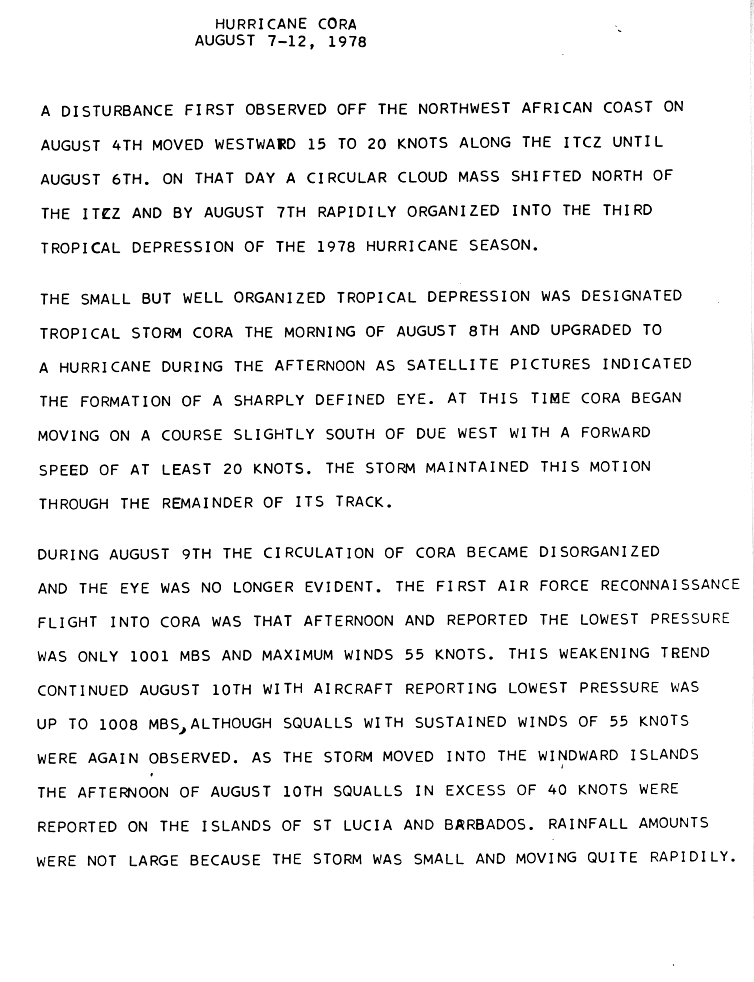
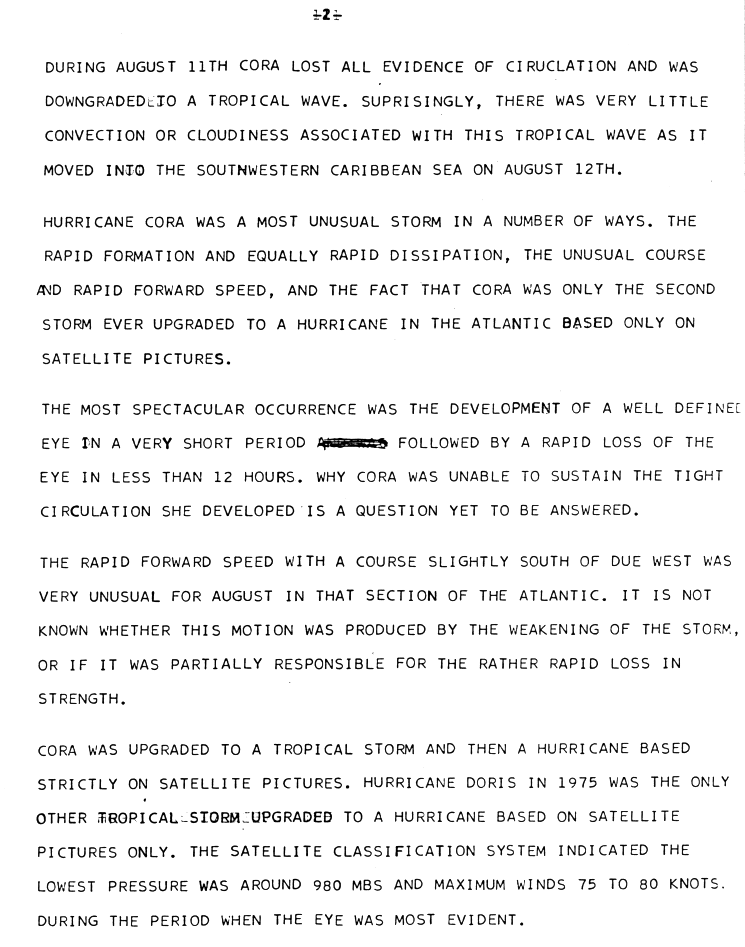
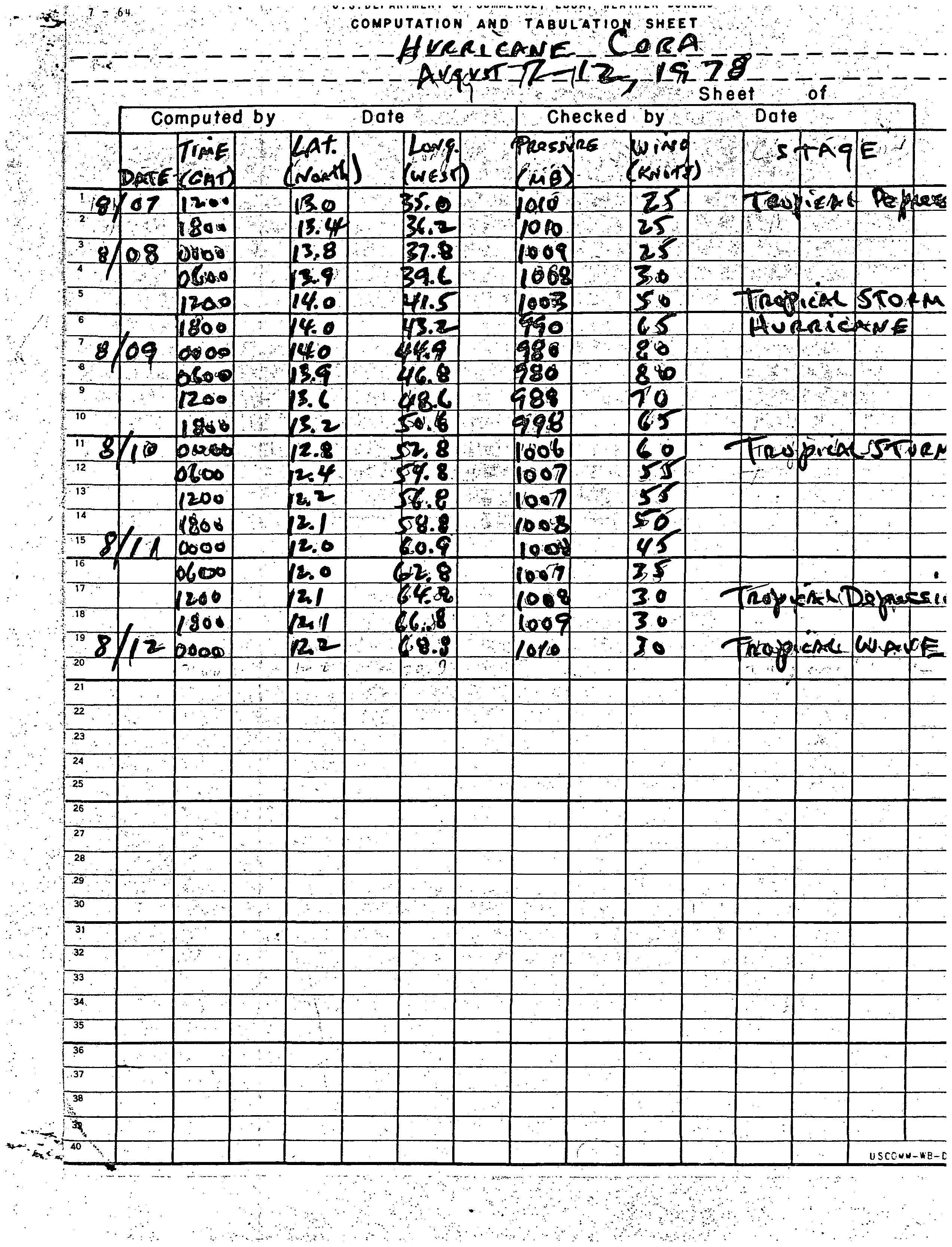
|1-min winds=80 On August 4, a disturbance exited the west coast of Africa and moved quickly westward within the Intertropical Convergence Zone. Two days later, the system broke away from the ICTZ, when it started organizing. It developed into Tropical Depression Three late on August 7. A day later it intensified into Tropical Storm Cora on August 8. The storm quickly intensified and developed a well-defined eye feature. The NHC upgraded Cora to hurricane status, marking only the second time that an Atlantic hurricane was upgraded solely based on satellite photography; the first was Doris in 1975. The NHC estimated that Cora attained peak winds of 90 mi/h early on August 9. For much of its duration, Cora moved quickly to the west-southwest toward the Lesser Antilles. Possibly as a result of the fast forward motion, the hurricane weakened soon after reaching its peak intensity, dropping to tropical storm status on August 10. That day, a Hurricane Hunter aircraft encountered the weakening storm. Cora struck the island of Grenada on August 11 while weakening to a tropical depression. Cora degenerated into a tropical wave on August 12 in the eastern Caribbean. The remnant crossed over Central America into the Pacific Ocean, where it regenerated into Hurricane Kristy.
While passing through the Lesser Antilles, Cora produced wind gusts to 45 mi/h, along with light rainfall in Barbados and Saint Lucia. In the latter, a person died after stepping on a high tension power line that was downed in Castries. Approximately two to four percent of trees on the island were toppled.{{cite news|agency=Associated Press
Tropical Storm Debra
|1-min winds=50 Main article: Tropical Storm Debra (1978)
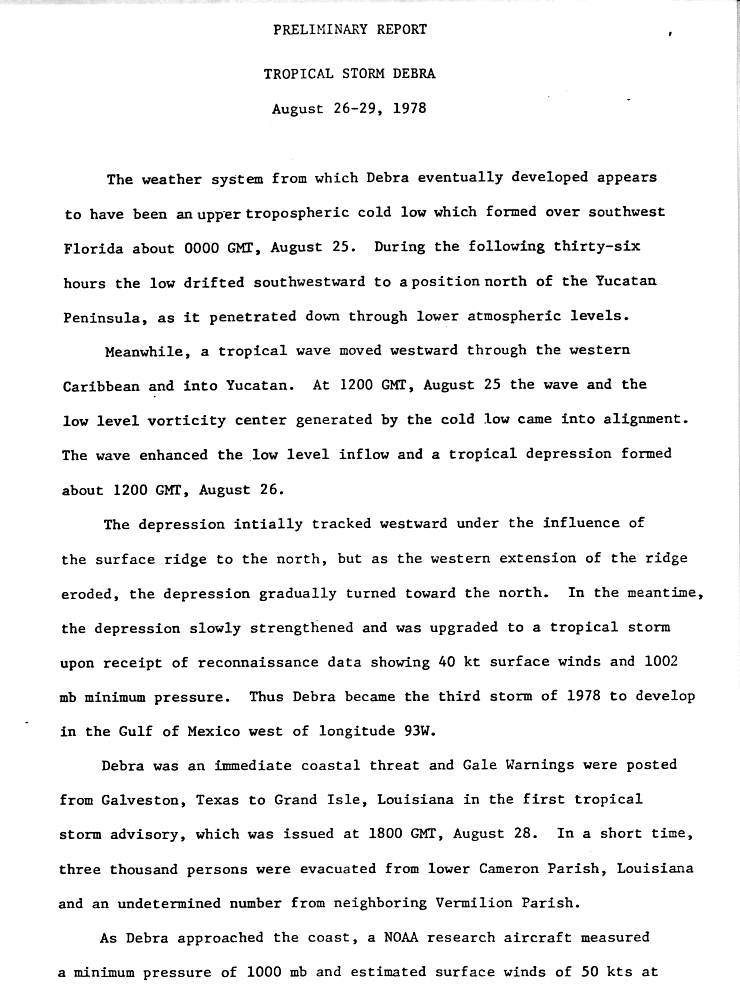
A low-pressure area that developed over southeast Florida and an area of convection near the Yucatán Peninsula merged and resulted in the formation of a tropical depression over the southern Gulf of Mexico on August 26. Tacking west-northwestward around a high-pressure ridge, the depression gradually intensified began and was upgraded to Tropical Storm Debra on August 28. Debra turned to the north and reached its peak intensity of 60 mph on August 29, shortly before making landfall in southwestern Louisiana. It was a disorganized storm, with most of the convection located to the east of the center. The system weakened rapidly and dissipated over Arkansas on August 29, though its remnants continued into the Ohio Valley.
One person died while attempting to evacuate an oil rig to the south of Cameron, Louisiana. Damage caused by Debra was considered minimal. In Louisiana, rainfall peaked at 10.81 in in Freshwater Bayou. However, no flooding was reported. Wind impacts were light and mainly limited to down trees and damage to roofs in Lake Charles and New Orleans. The storm spawned several tornadoes in Arkansas, Mississippi, Louisiana, Tennessee, and Texas. In Mississippi, a tornado in Crystal Springs destroyed three mobile homes and a house, killing one person and seriously injuring another.
Hurricane Ella
|1-min winds=120 Main article: Hurricane Ella (1978)
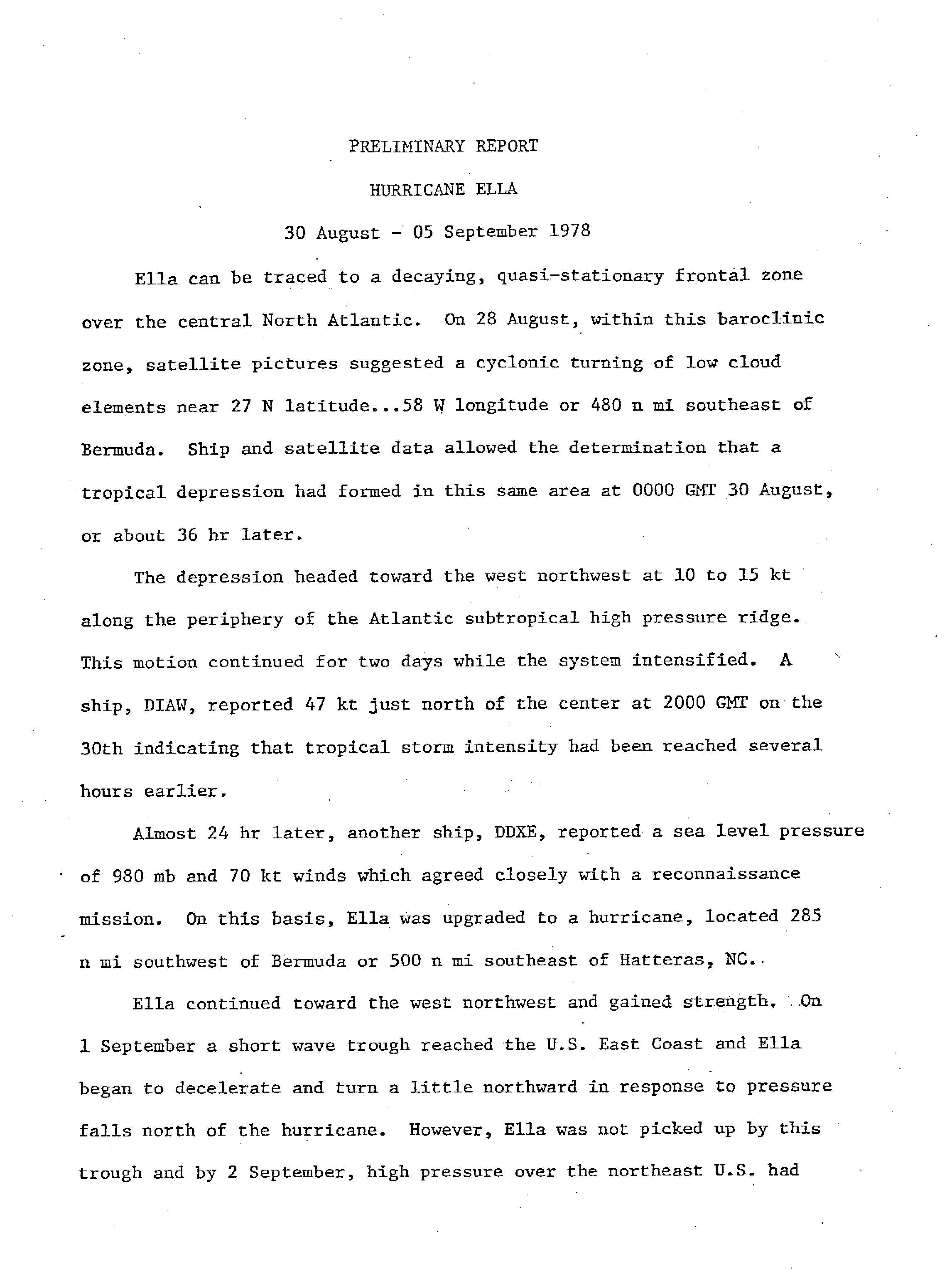
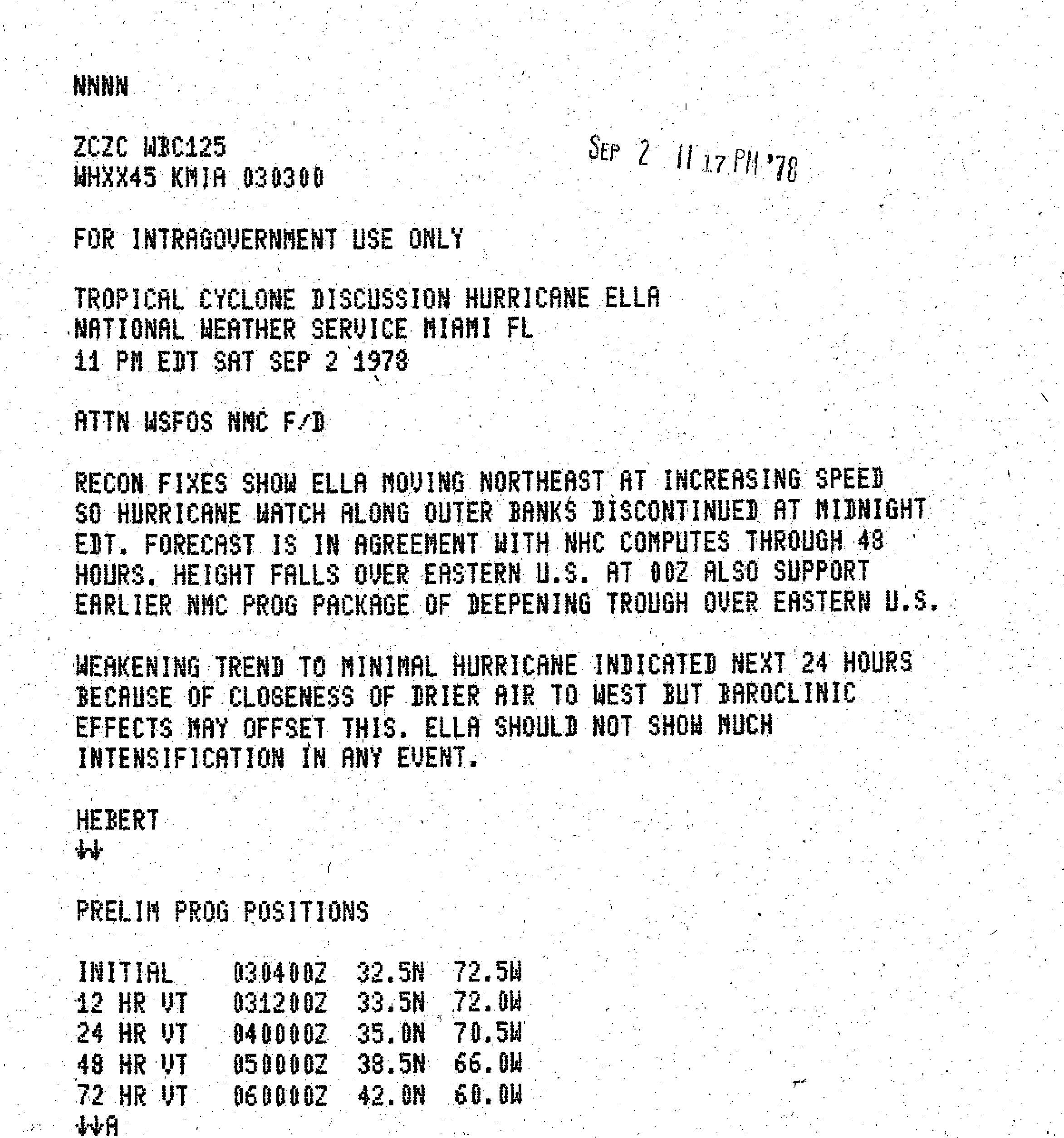
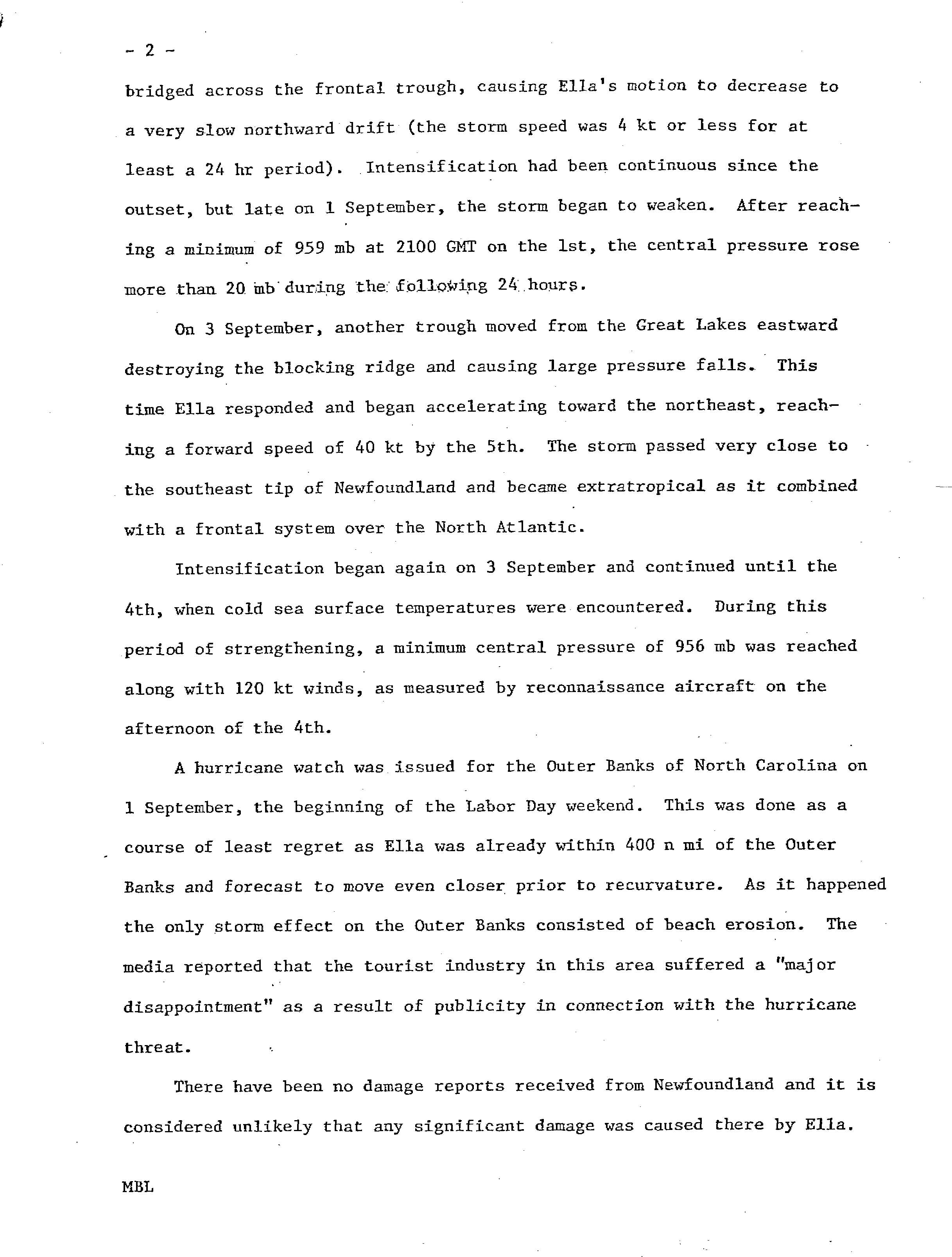
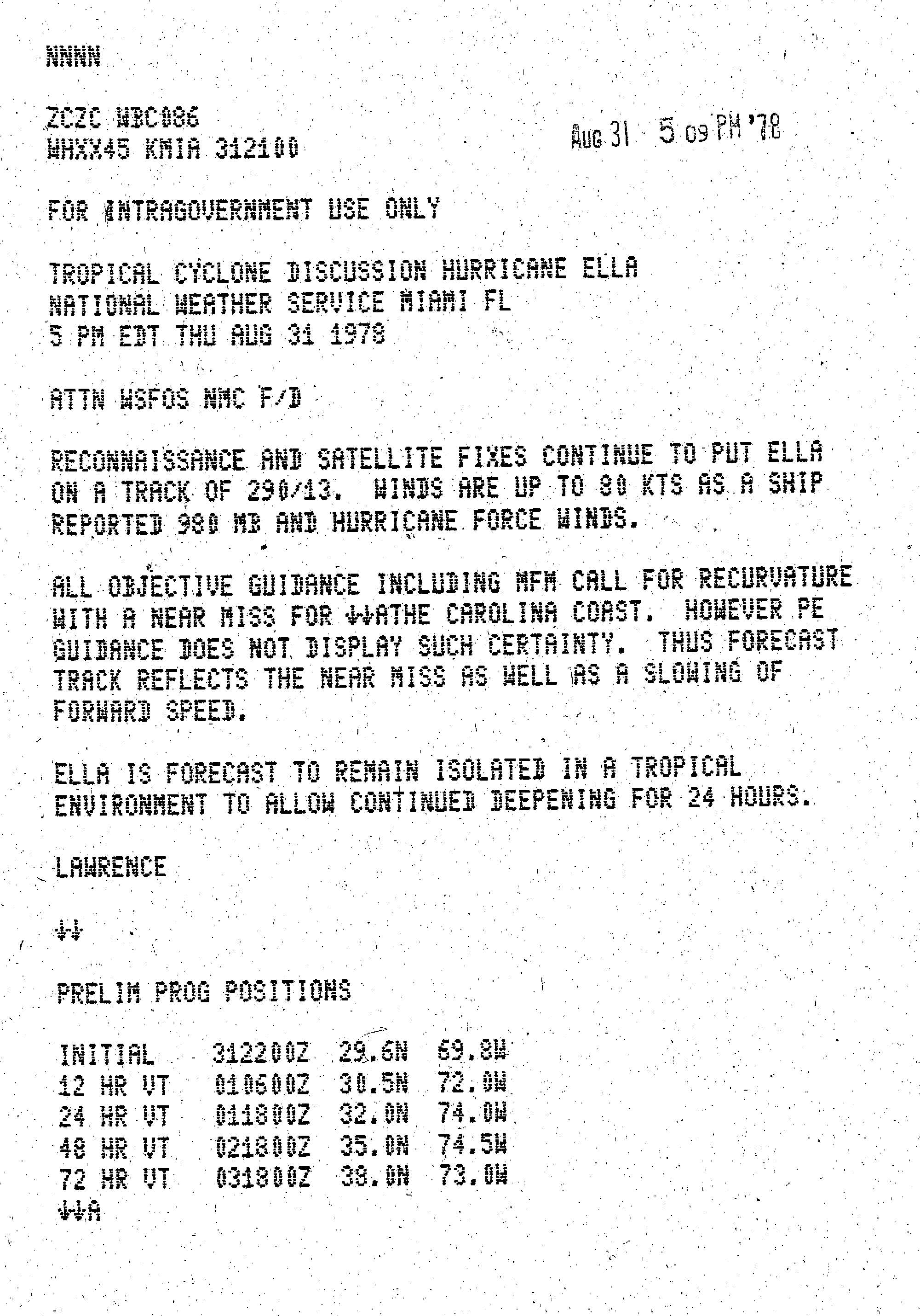
A cold front spawned a tropical disturbance near Bermuda, which became a tropical depression on August 30. The depression strengthened, and by early on August 31, it was upgraded to Tropical Storm Ella. Ship reports indicated that Ella became a hurricane later that day. Further significant intensification occurred, and the storm reached a preliminary peak intensity of 125 mph. A short-wave trough over the Eastern United States caused Ella to decelerate and turn north. Simultaneously, dry air diminished convection on September 2, which in turn resulted in weakening. Eventually, another trough forced Ella to re-curve northeastward, thereby remaining well offshore the East Coast of the United States.
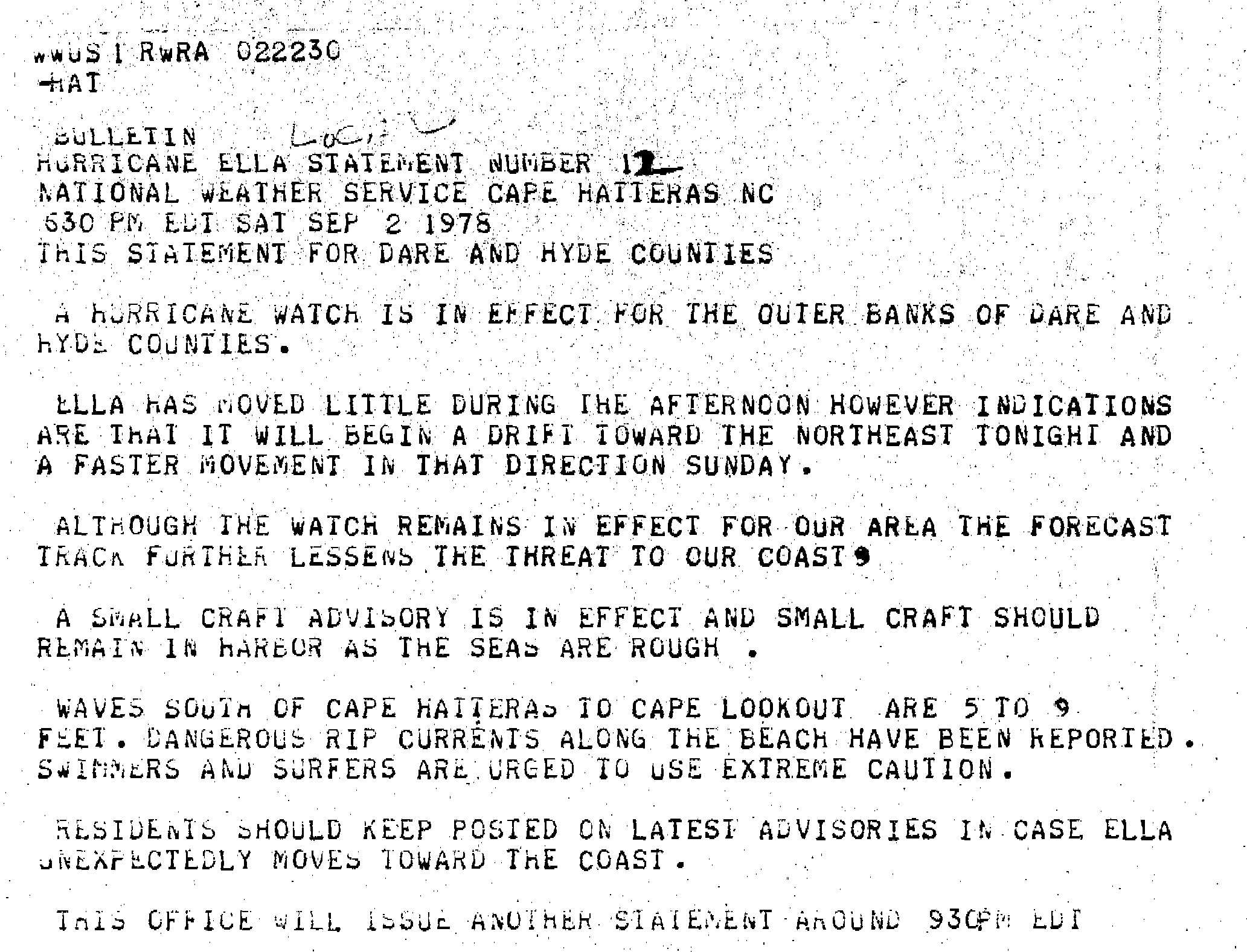
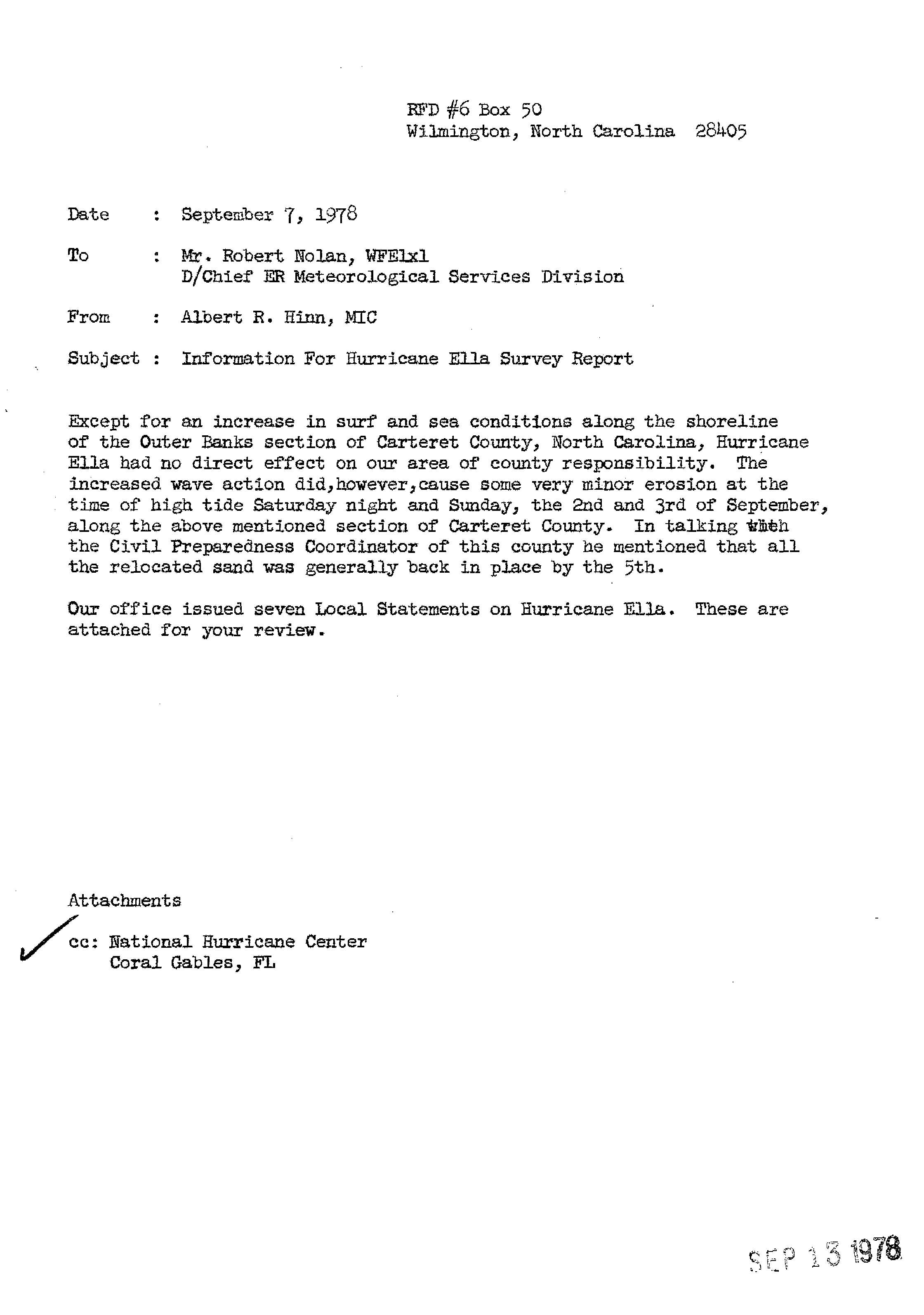
The storm then re-intensified and by 1200 UTC on September 4, Ella peaked as a Category 4 hurricane with winds of 140 mph. Thereafter, Ella rapidly weakened as it passed offshore Atlantic Canada, before being absorbed by an extratropical storm while located more than 700 mi northeast of St. John's on September 5. Ella threatened to pass within 50 mi of North Carolina. Because of this, a hurricane watch was issued for the Outer Banks of North Carolina during Labor Day Weekend, resulting in a significant decrease in tourism. However, because the storm veered northeastward, little effects other than 5 to waves, minor beach erosion, and light winds in coastal portions of North Carolina. In Newfoundland, Ella produced rainfall amounts reaching 2.39 in and wind gusts up to 71 mph.
Hurricane Flossie
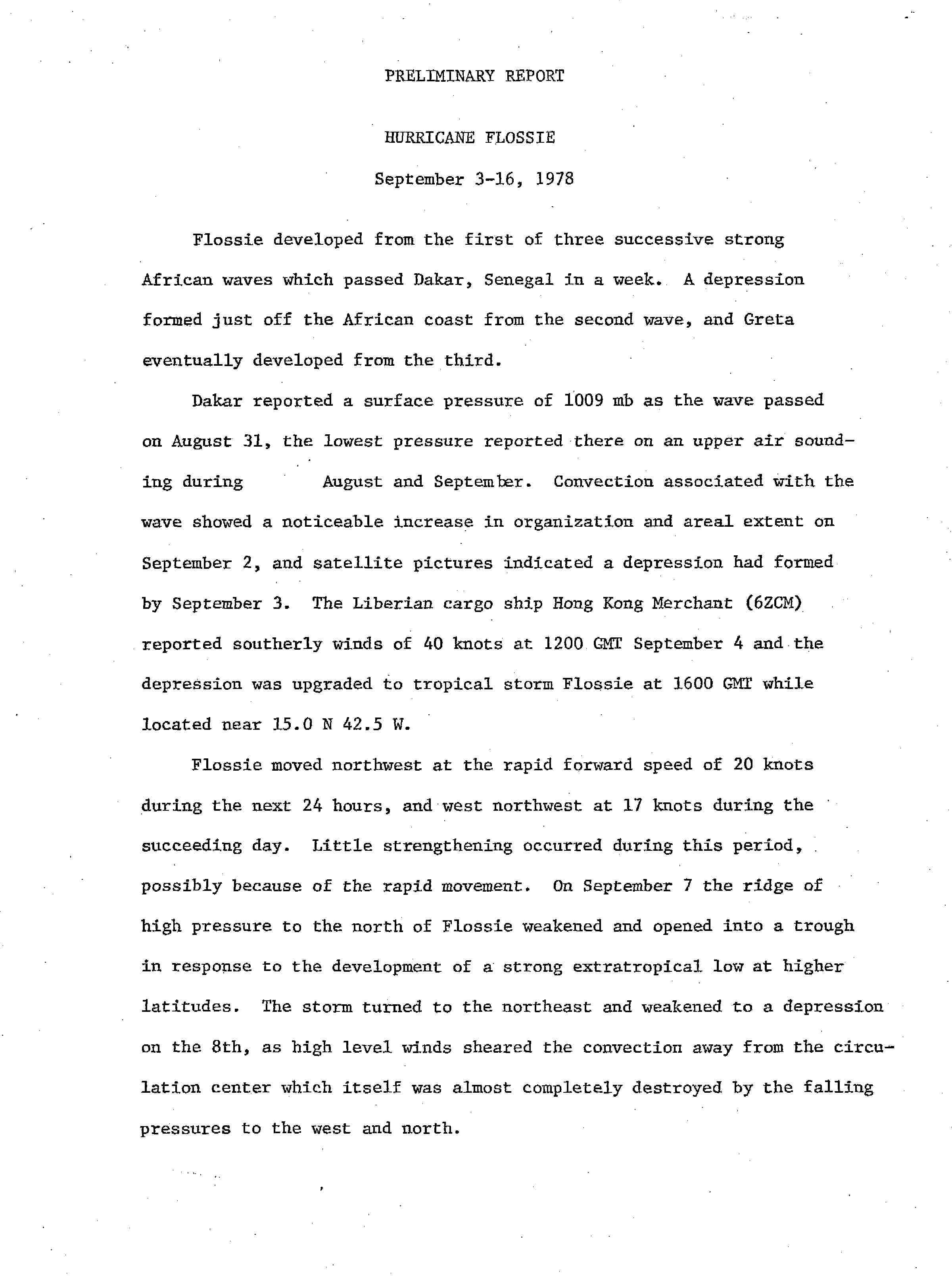
|1-min winds=85 A tropical wave passed westward across Dakar, Senegal on August 31 and entered the Atlantic Ocean later that day. Convection markedly increased over the next few days and by 0000 UTC on September 4, the wave developed into a tropical depression while located about midway between Africa and the Lesser Antilles. Later that day, the Hong Kong Merchant reported tropical storm force winds, thus the depression was upgraded to Tropical Storm Flossie. It initially tracked northwestward at 23 mph and minimal strengthening occurred, possibly due to rapid forward speeds. On September 5, the storm curved westward, until turning north on September 7. A high-pressure area transitioned into a trough, causing Flossie to re-curve northeastward and generating strong upper-level winds.
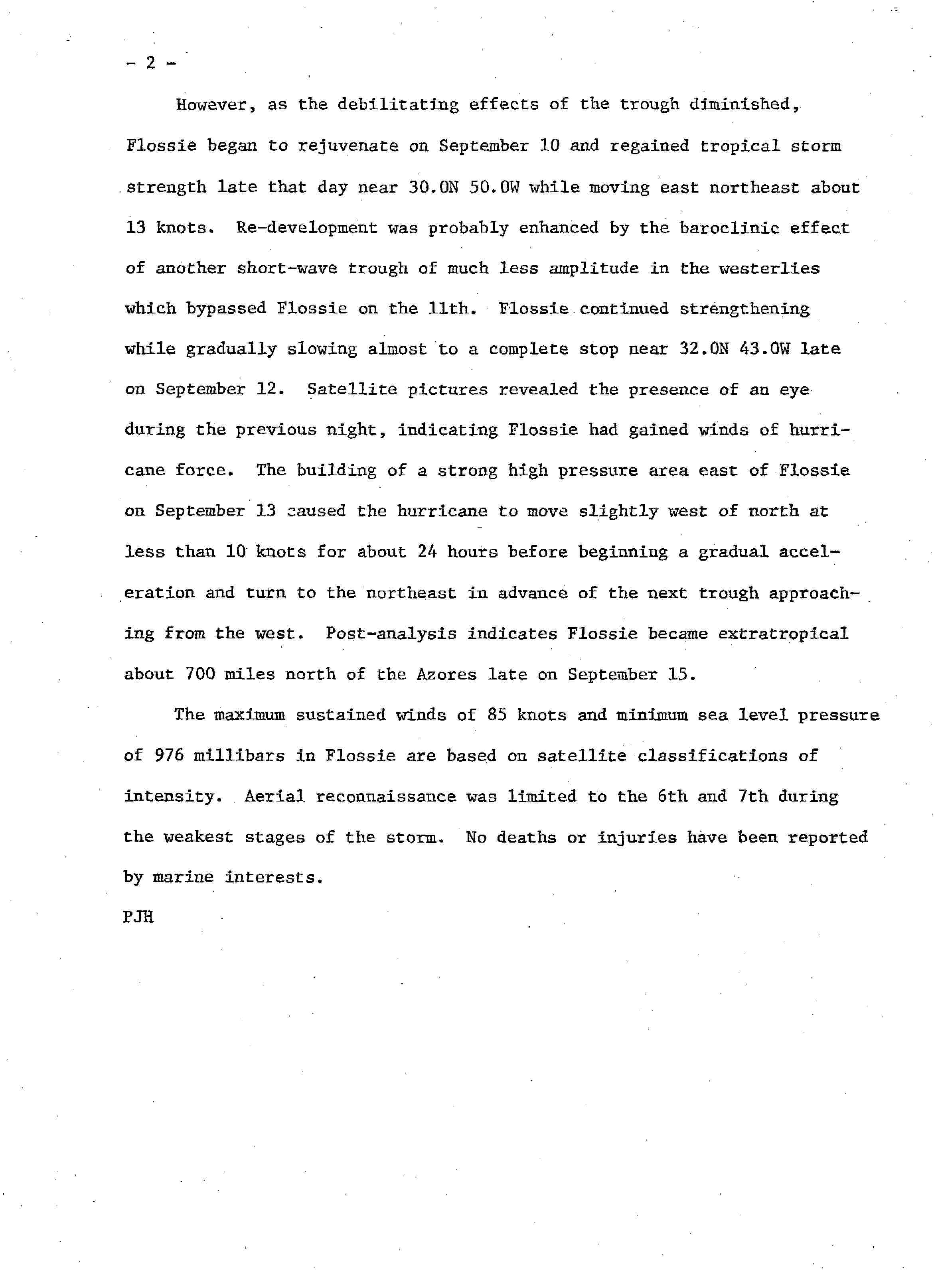
On September 8, Flossie was downgraded to a tropical depression. After the trough began weakening, favorable conditions returned, allowing Flossie to re-strengthen into a tropical storm on September 10. Flossie then decelerated and became nearly stationary on September 12. Around that time, the storm was upgraded to a hurricane. Further intensification continued, and Flossie peaked with winds of 100 mph early on September 13. The storm began turned nearly due northward and began weakening. Flossie accelerated to the northeast and eventually transitioned into an extratropical cyclone while 700 mi north of the Azores on September 15. The strong extratropical cyclone brought winds as high as 104 mph to Fair Isle, Great Britain.
Hurricane Greta
|1-min winds=115 Main article: Hurricane Greta–Olivia
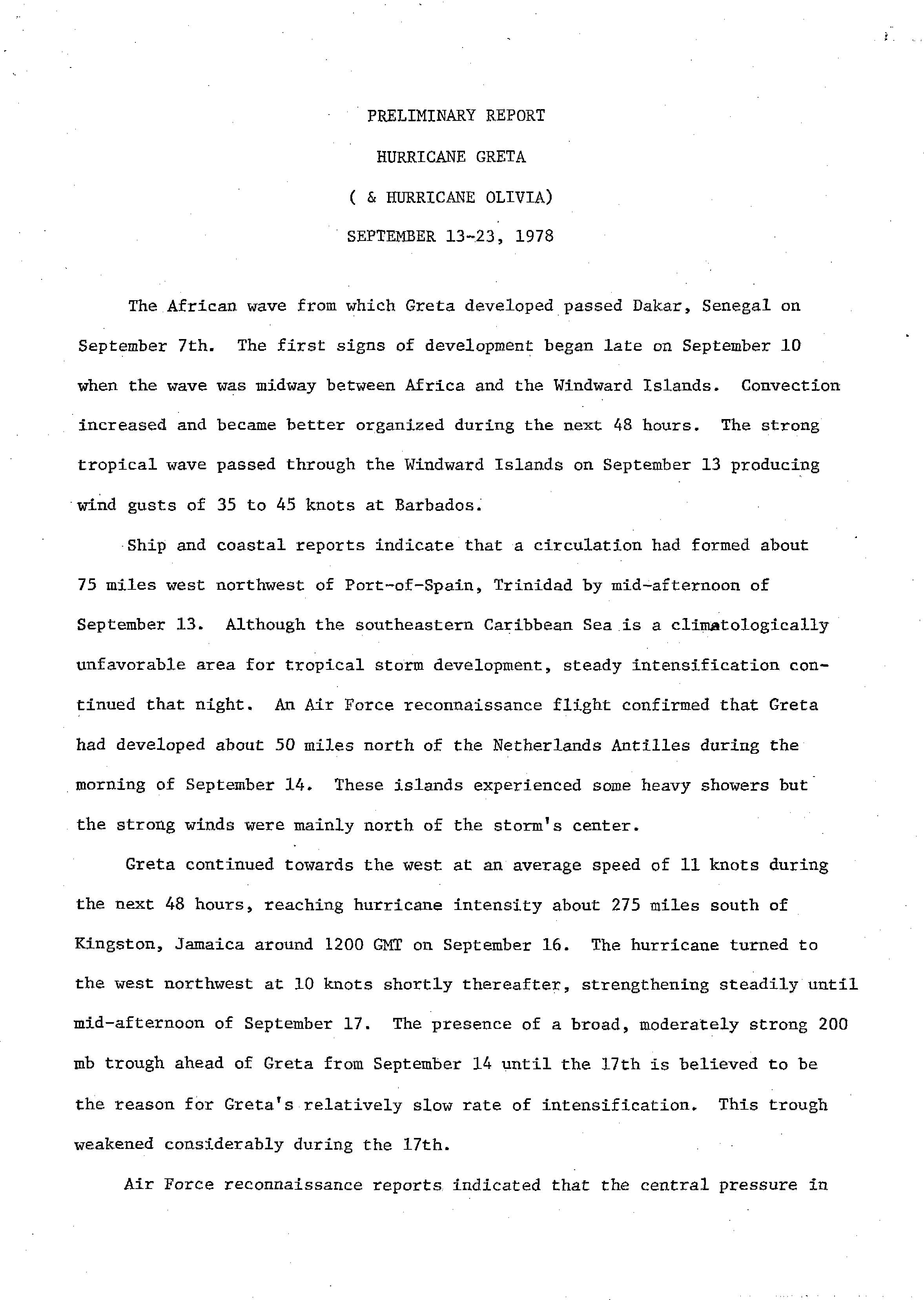
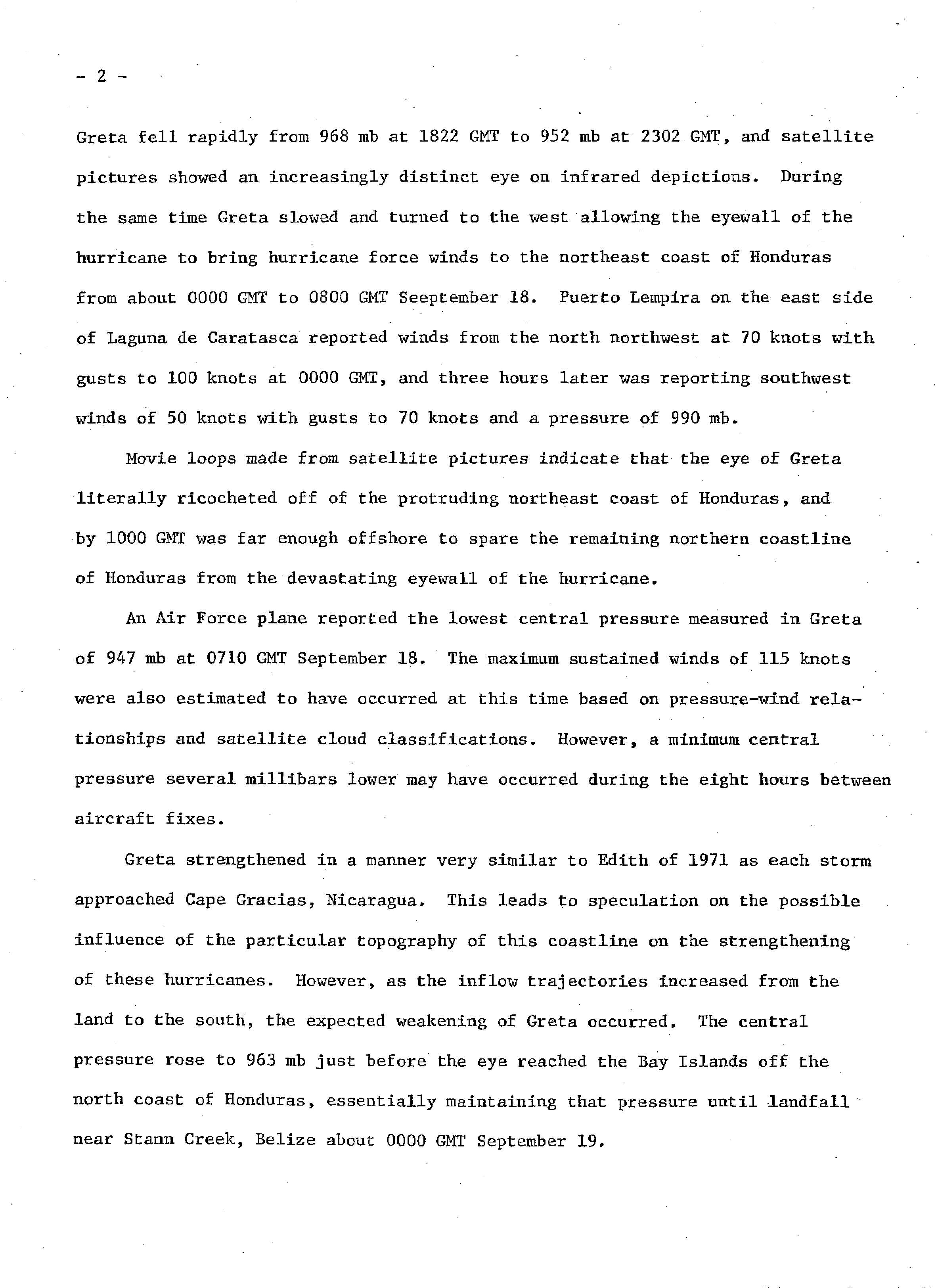
A tropical wave developed into a tropical depression near Trinidad on September 13. By the following day, the depression strengthened into Tropical Storm Greta. It headed westward to west-northwestward across the Caribbean Sea and slowly intensified, becoming a hurricane on September 16. The rate of intensification increased as Greta was approaching the northwestern Caribbean Sea. Greta briefly peaked as a Category 4 hurricane with maximum sustained winds of 130 mph and a minimum barometric pressure of 947 mbar, while brushing northeastern Honduras. Although the storm remained offshore, land interaction caused significant weakening. On September 19, Greta made landfall in Stann Creek District, Belize with winds of 110 mph. The storm rapidly weakened inland over Central America, but survived its passage and eventually became Hurricane Olivia in the Eastern Pacific Ocean.
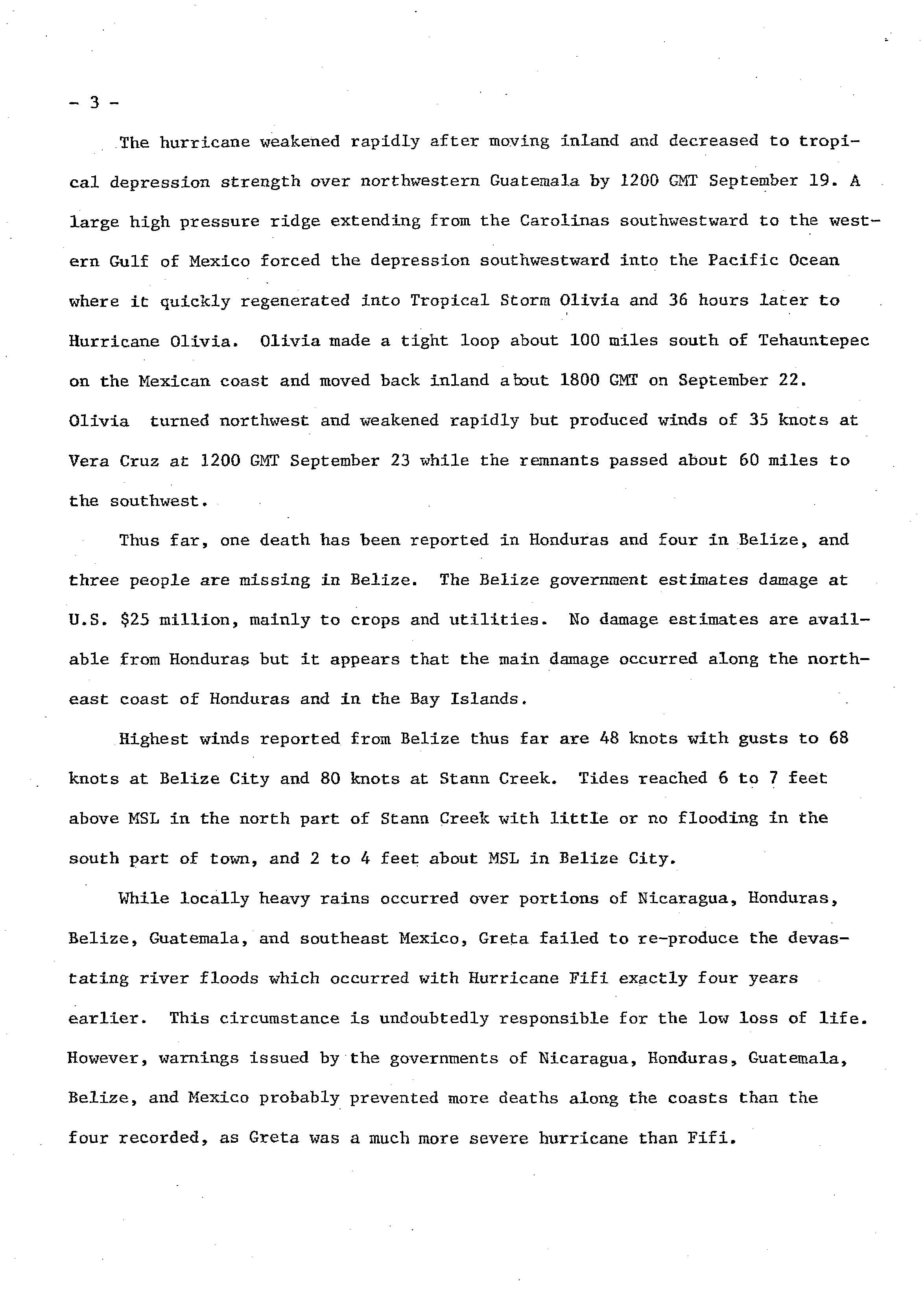
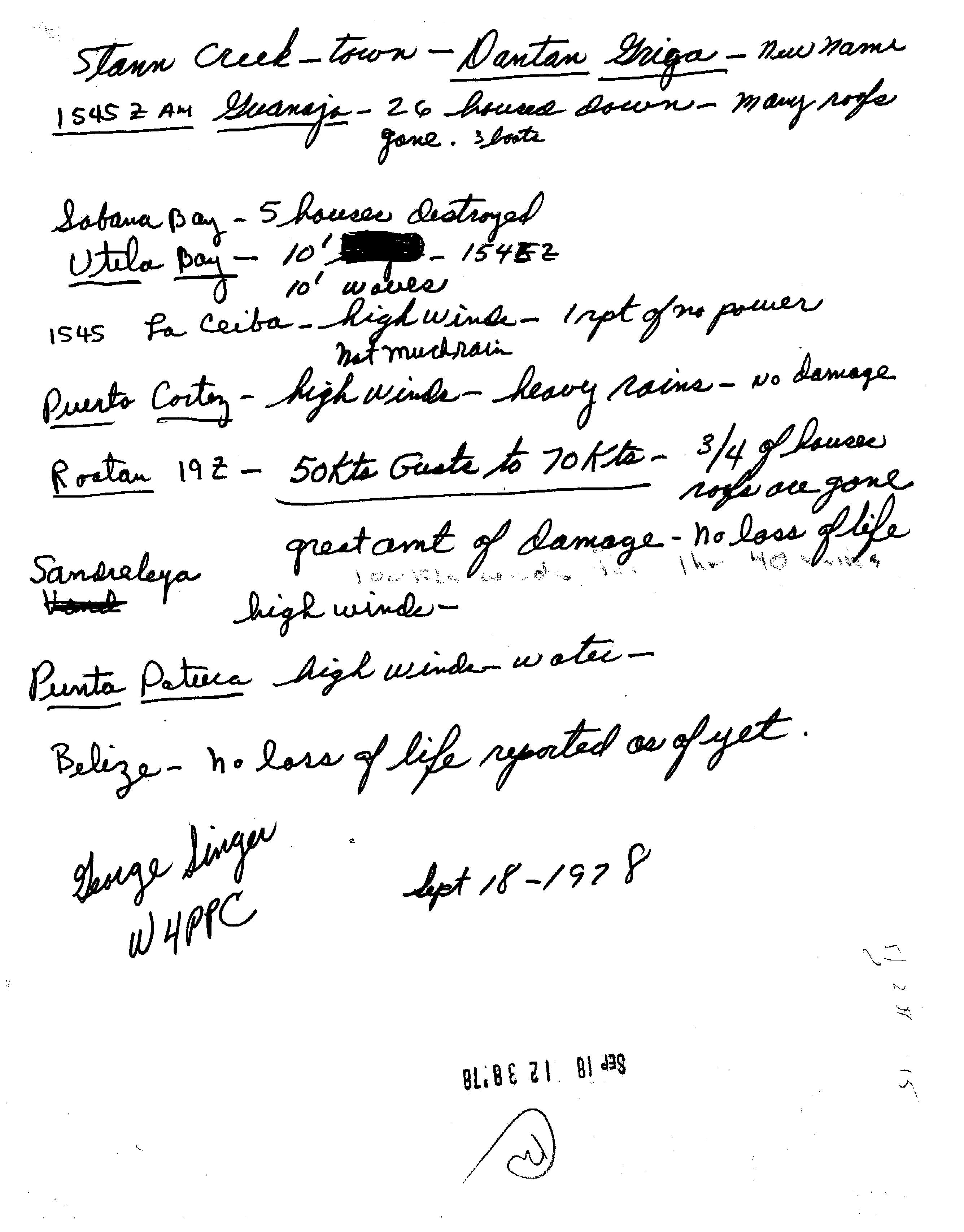
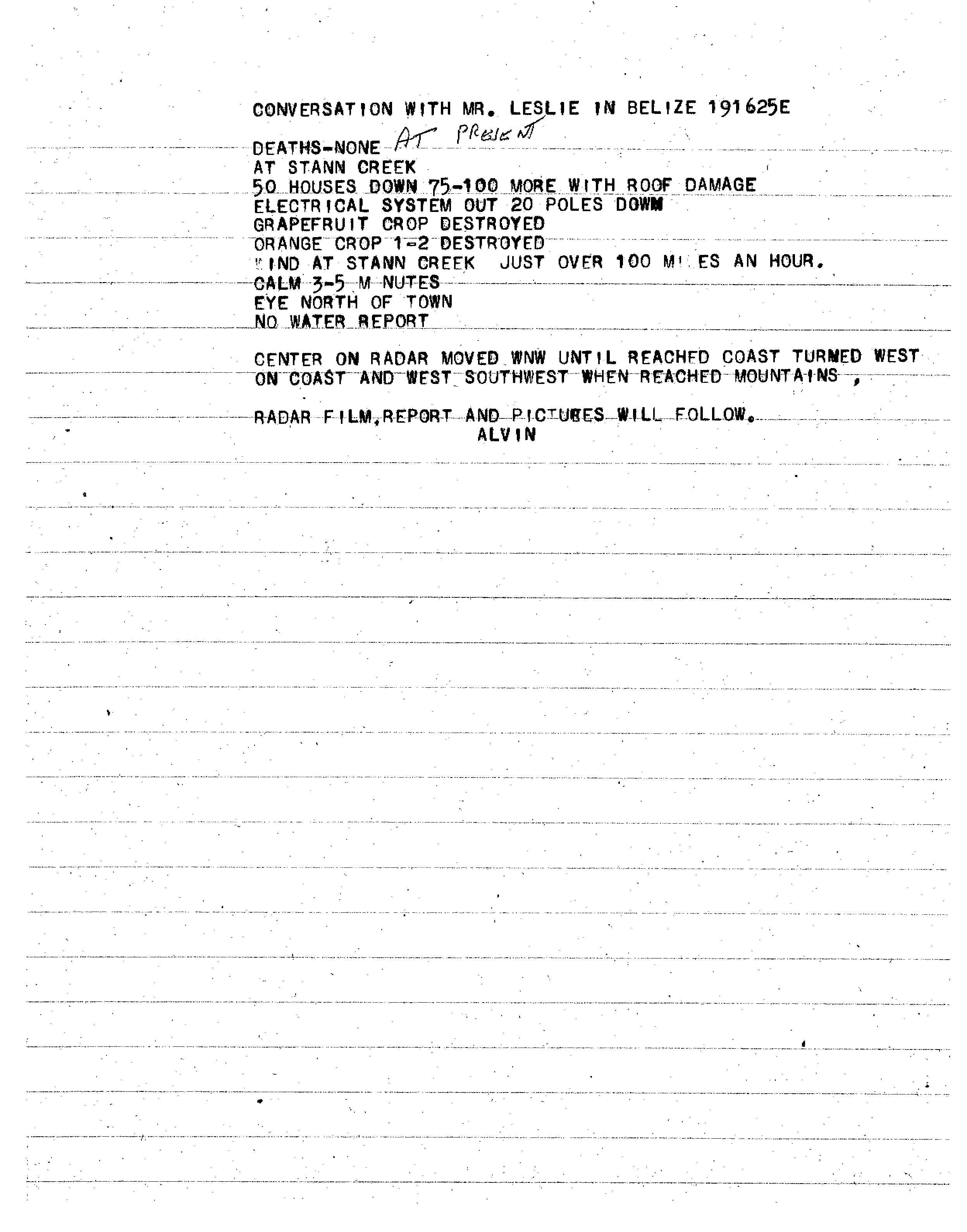
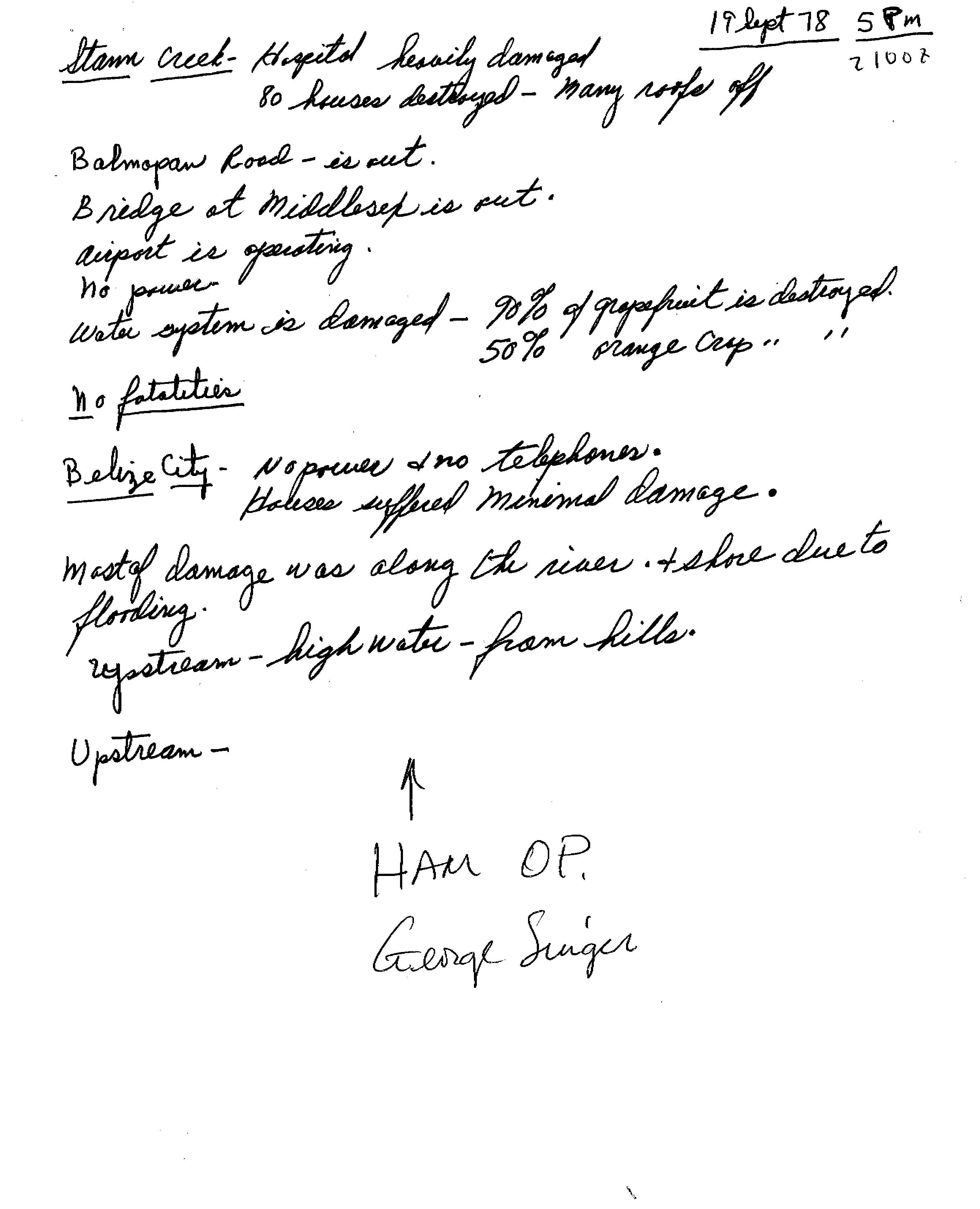
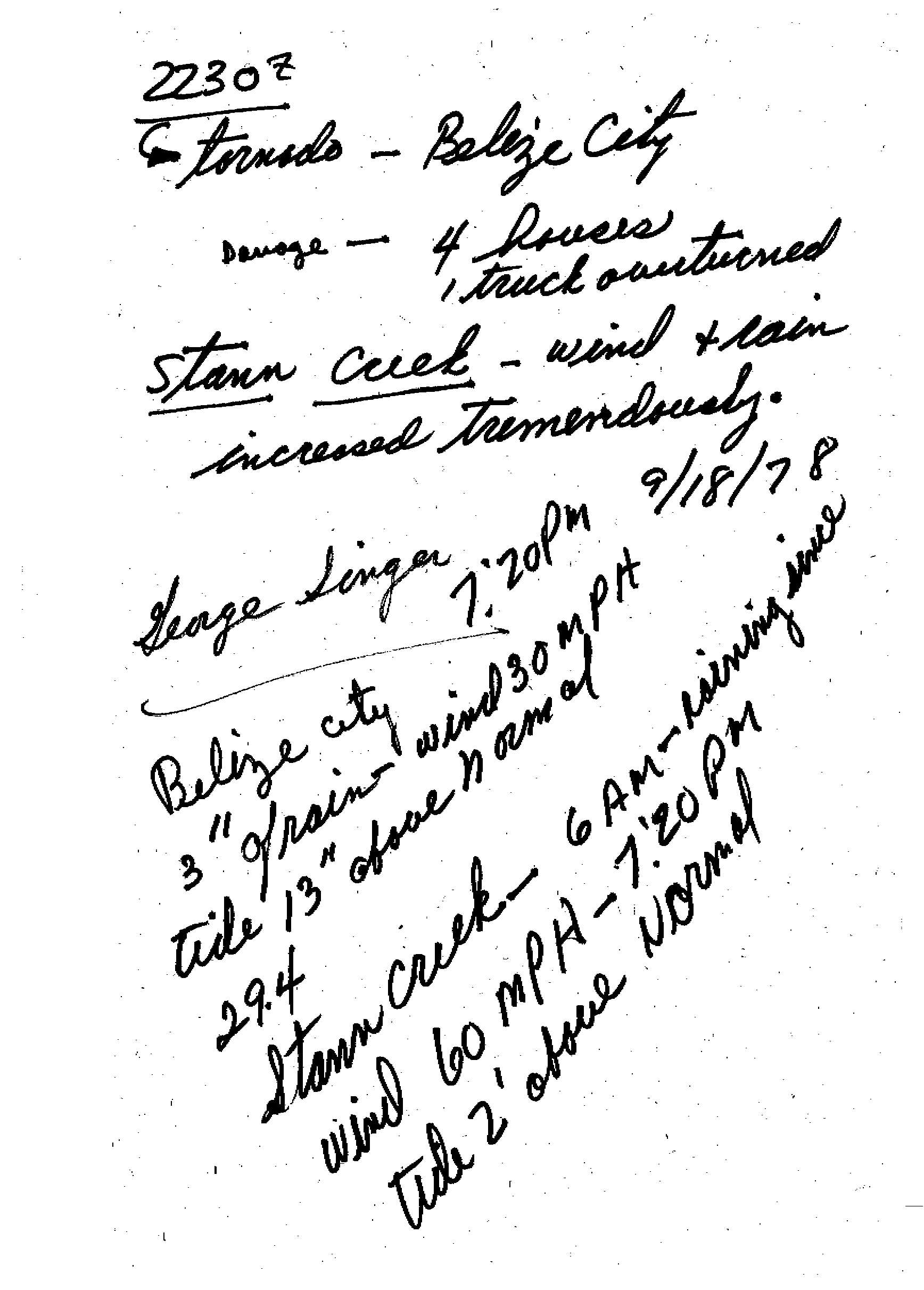
Early in its duration, Greta produced heavy rainfall in the Netherlands Antilles. With a similar path to Hurricane Fifi four years prior, Greta threatened to reproduce the devastating effects of the catastrophic storm; however, damage and loss of life was significantly less than feared. In Honduras, about 1,200 homes were damaged, about half of which in towns along the coastline. The storm damaged about 75% of the houses on Roatán along the offshore Bay Islands, and there was one death in the country. In the Belize Barrier Reef, Greta downed trees and produced high waves, while on the mainland, there was minimal flooding despite a high storm surge. In Dangriga where it made landfall, the hurricane damaged or destroyed 125 houses and the primary hospital. In Belize City, a tornado flipped over a truck and damaged four houses. Damage in Belize was estimated at $25 million, and there were four deaths.
Tropical Storm Hope
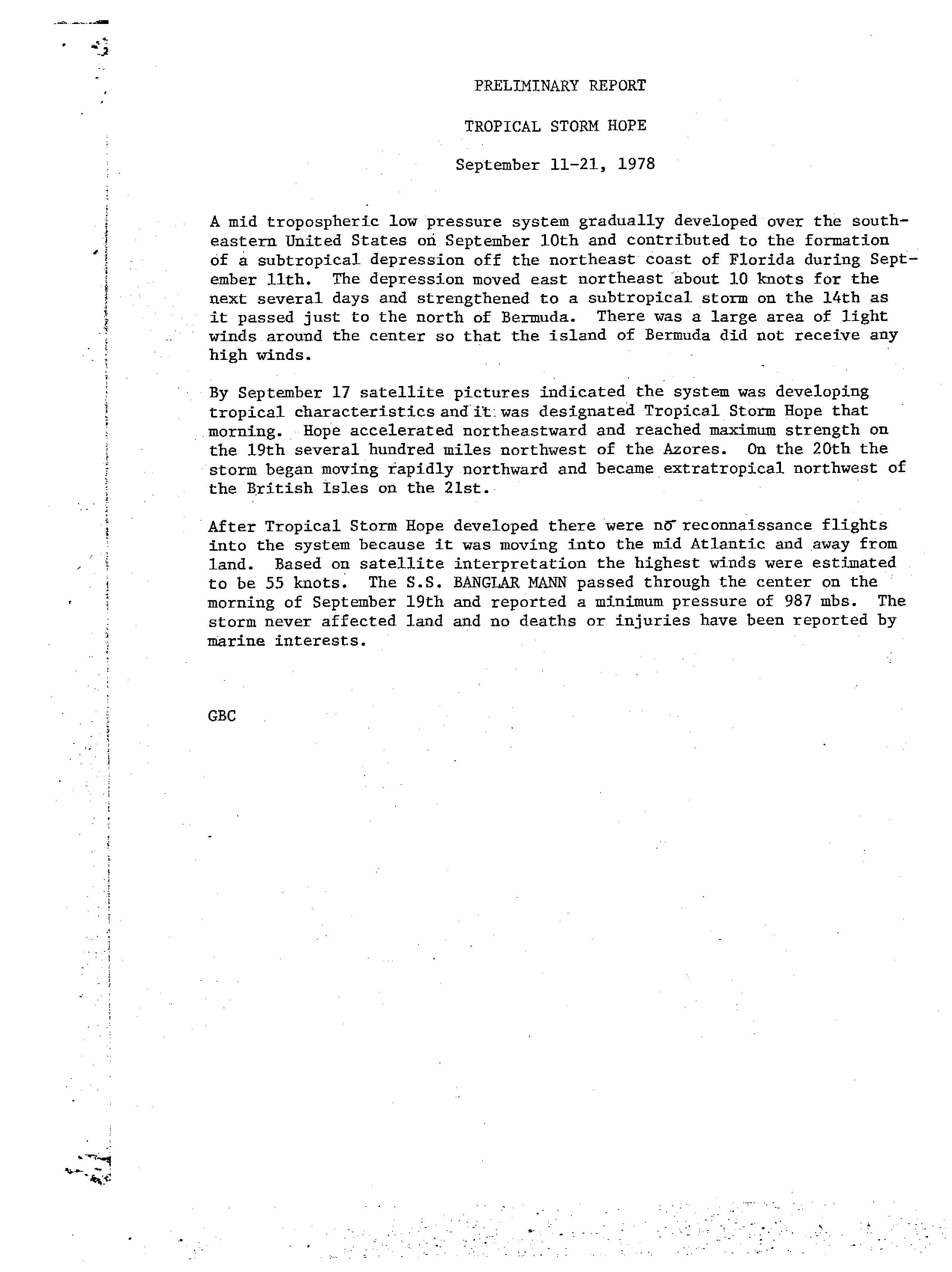
|1-min winds=55 A mid-tropospheric low-pressure area developed over the Southeastern United States on September 10. The system developed into a subtropical depression early on September 12, while located about 75 mi east of St. Augustine, Florida. Over the next few days, the depression tracked east-northeastward to eastward. While strengthening into a subtropical storm on September 15, it passed just north of Bermuda, but produced only 1.07 in of rain on the island. The storm then made a brief dip to the east-southeast, before resuming its east-northeastward course on September 16. Beginning on the following day, satellite imagery indicated that the system was acquiring tropical characteristics. As a result, it was reclassified as Tropical Storm Hope at 0600 UTC on September 17.
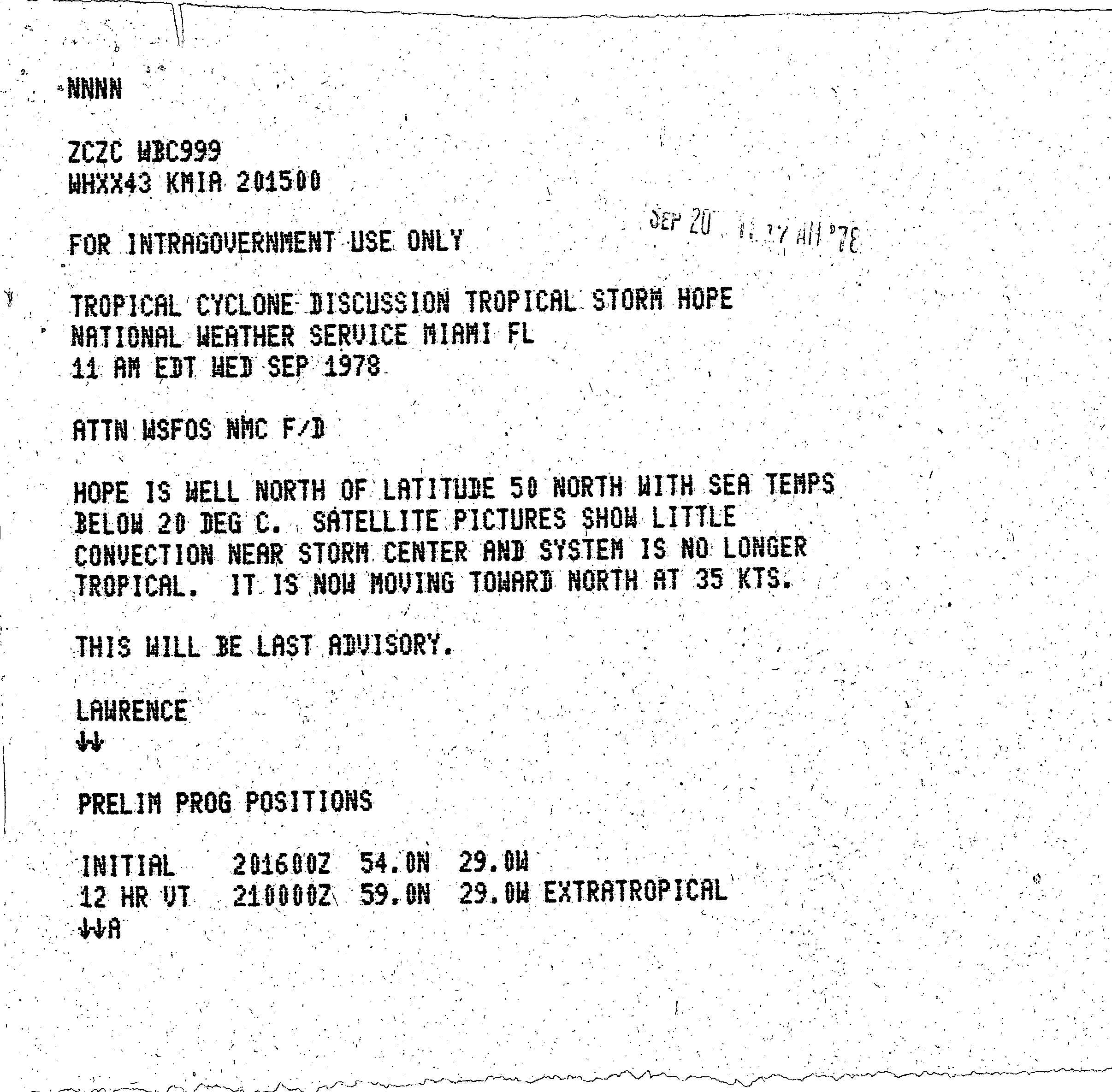
Because Hope remained out of range of reconnaissance aircraft flights, the National Hurricane Center relied on ships and satellite estimates. After becoming a tropical cyclone, Hope began to accelerate while slowly intensifying. Satellite estimates at 1200 UTC on September 19 indicated that the storm attained its peak intensity with maximum sustained winds of 65 mph and a minimum pressure of 987 mbar, recorded by the S.S. Banglar Mann. While located hundreds of miles north of the Azores on September 20, the storm turned northward and began crossing into sea surface temperatures of 68 F. By 1200 UTC on September 21, Hope transitioned into an extratropical cyclone and was absorbed by another extratropical storm while situated about 220 mi south of Reykjavík, Iceland.
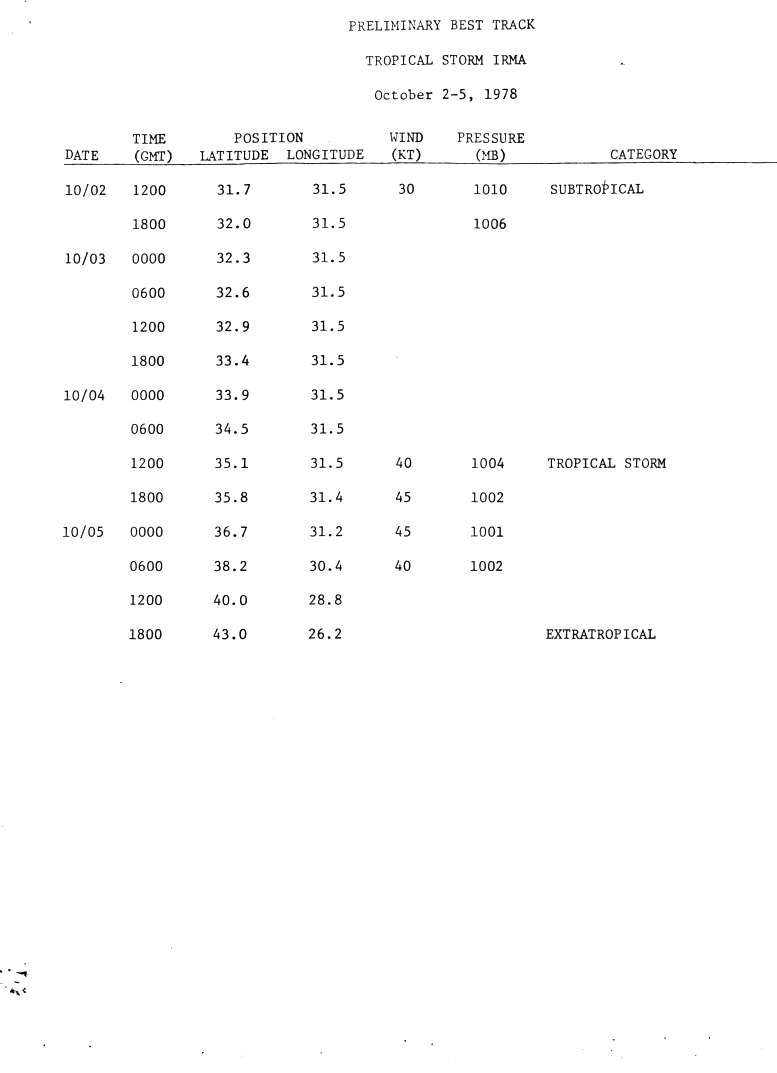
Tropical Storm Irma
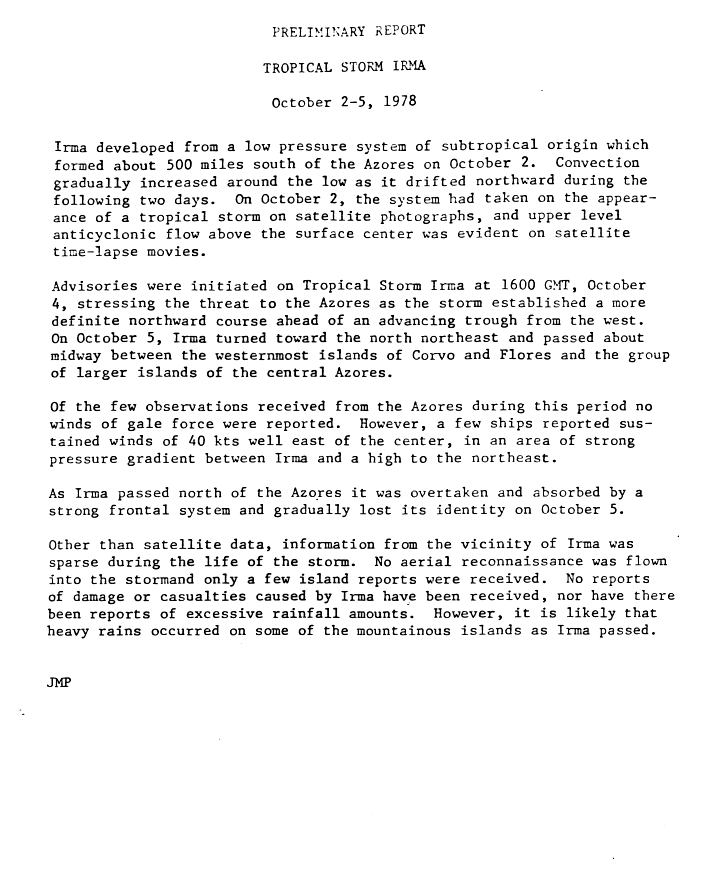
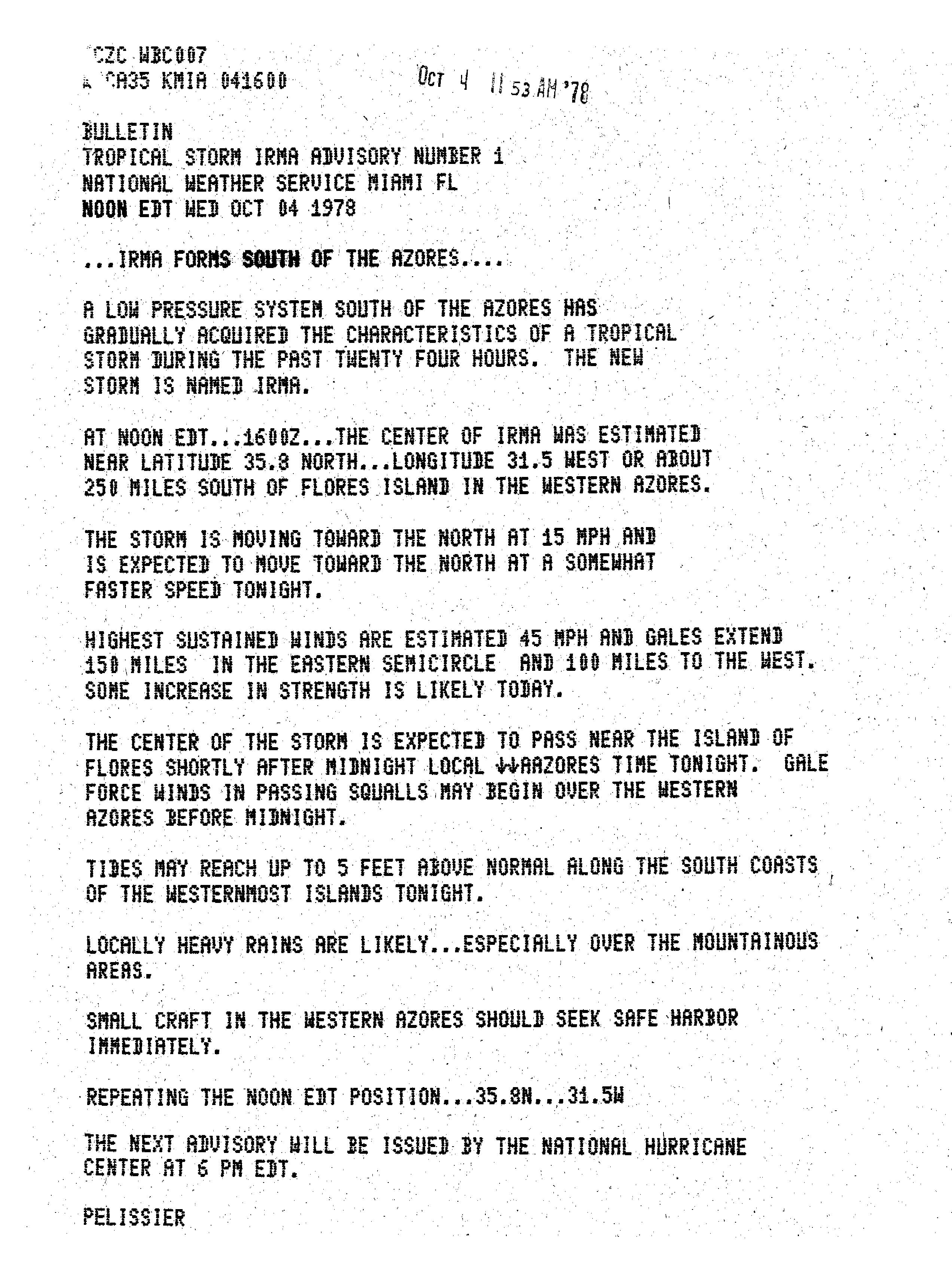
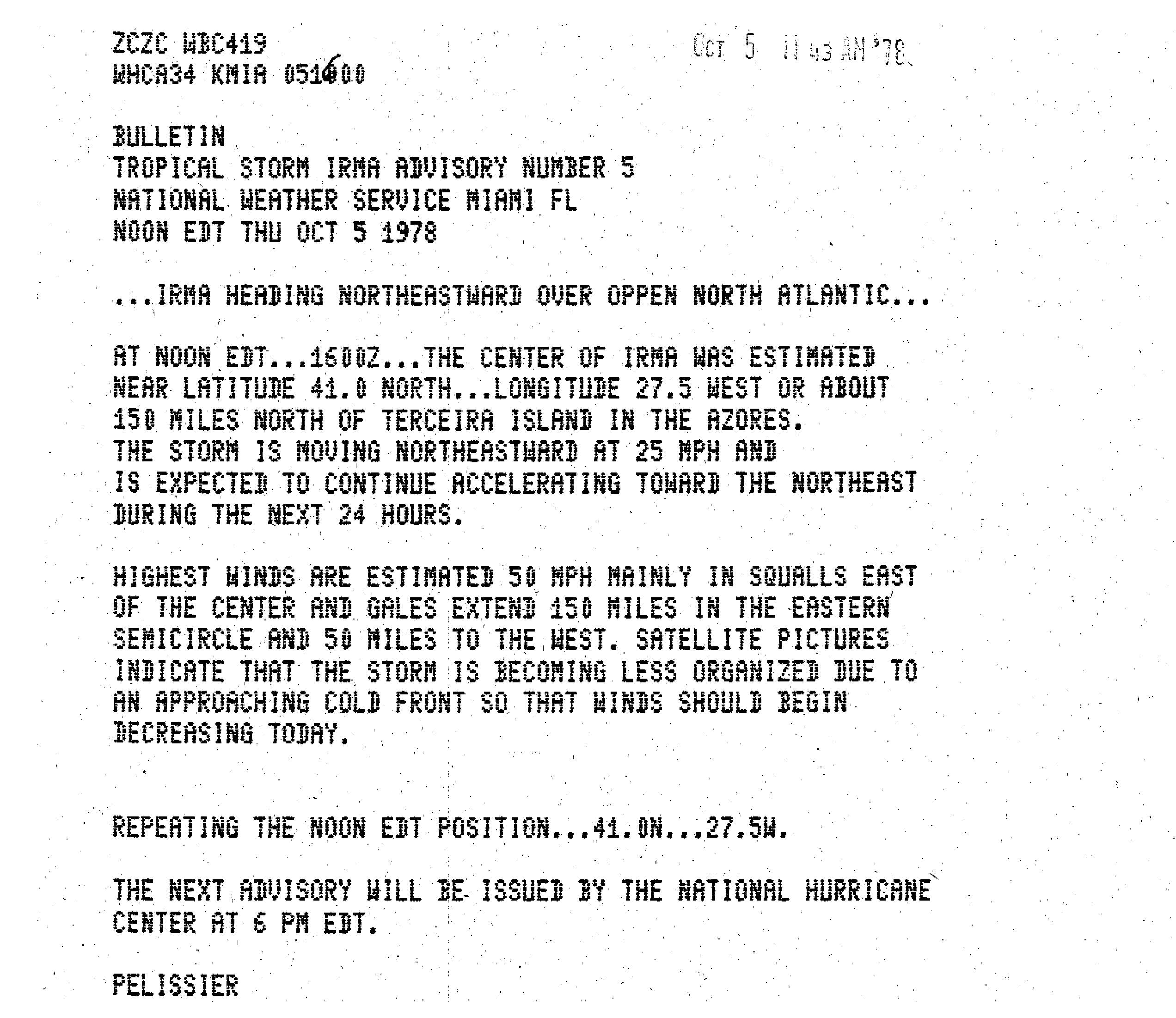
|1-min winds=45 The origins of Tropical Storm Irma were from a subtropical depression that formed about 500 mi south of the Azores on October 2. During the next two days, thunderstorm activity gradually increased around the circulation center as the storm drifted northward. On October 2, the storm had taken the appearance of a tropical storm on satellite photographs, and upper-level anticyclonic flow over the center of the storm was evident on satellite time-lapse movies. By the afternoon of October 4, the system had acquired the characteristics of a tropical storm and was named Irma; gale-force winds extended 150 mi from the center of circulation.
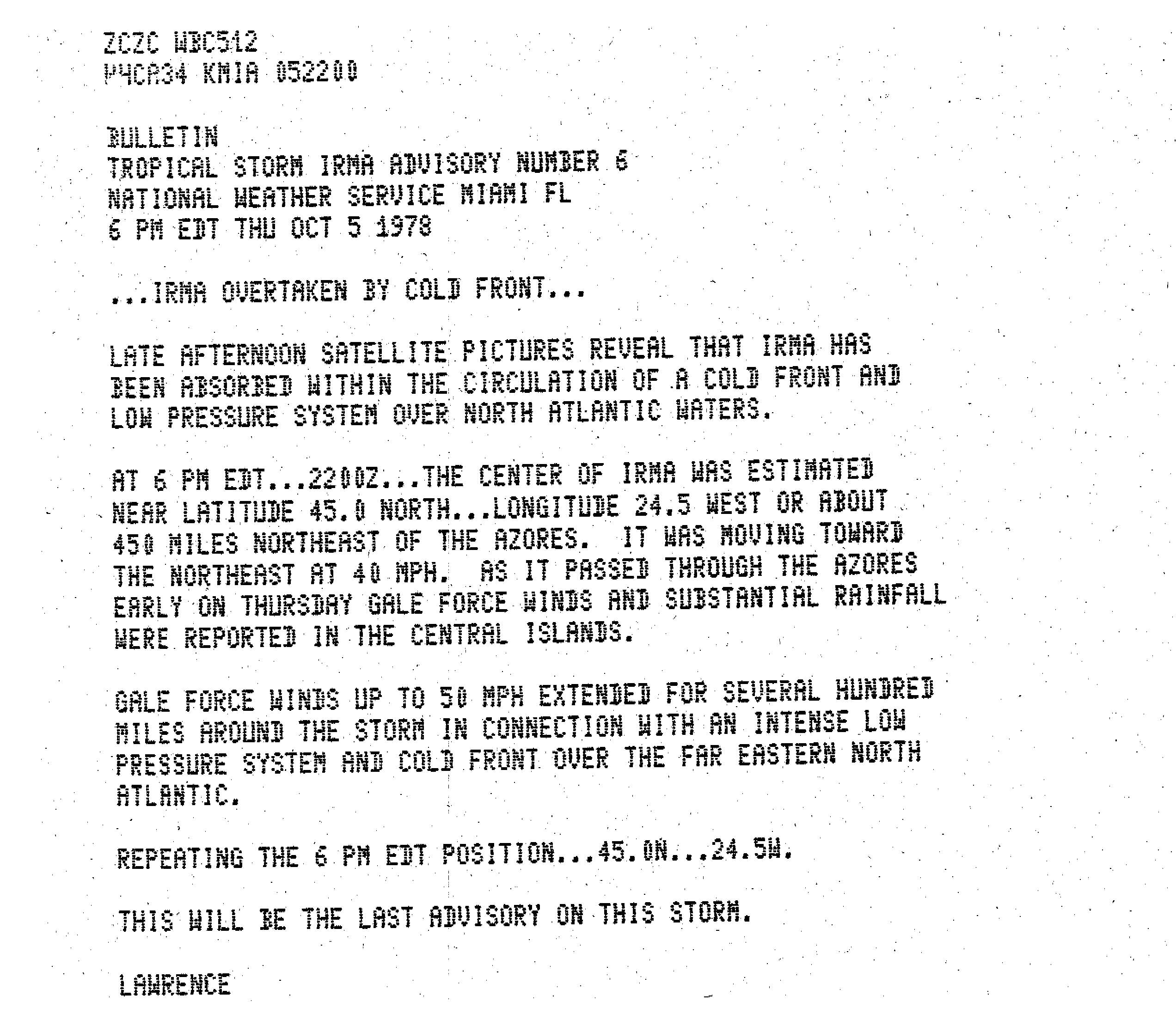
Six hours after being named, Irma reached its peak intensity of 50 mph. On October 5, Irma turned towards the north-northeast and passed about midway between the central and western Azores. Shortly thereafter, Irma became less organized, and that evening was absorbed into an approaching cold front, about 450 mi northeast of the Azores. Although Irma passed near parts of the western and central Azores with gale-force winds in some areas, no reports of damage or casualties caused by Irma were received. Several nearby ships reported winds around 46 mph. It was noted that heavy rains may have occurred on some of the mountainous islands as Irma passed.
Tropical Storm Juliet
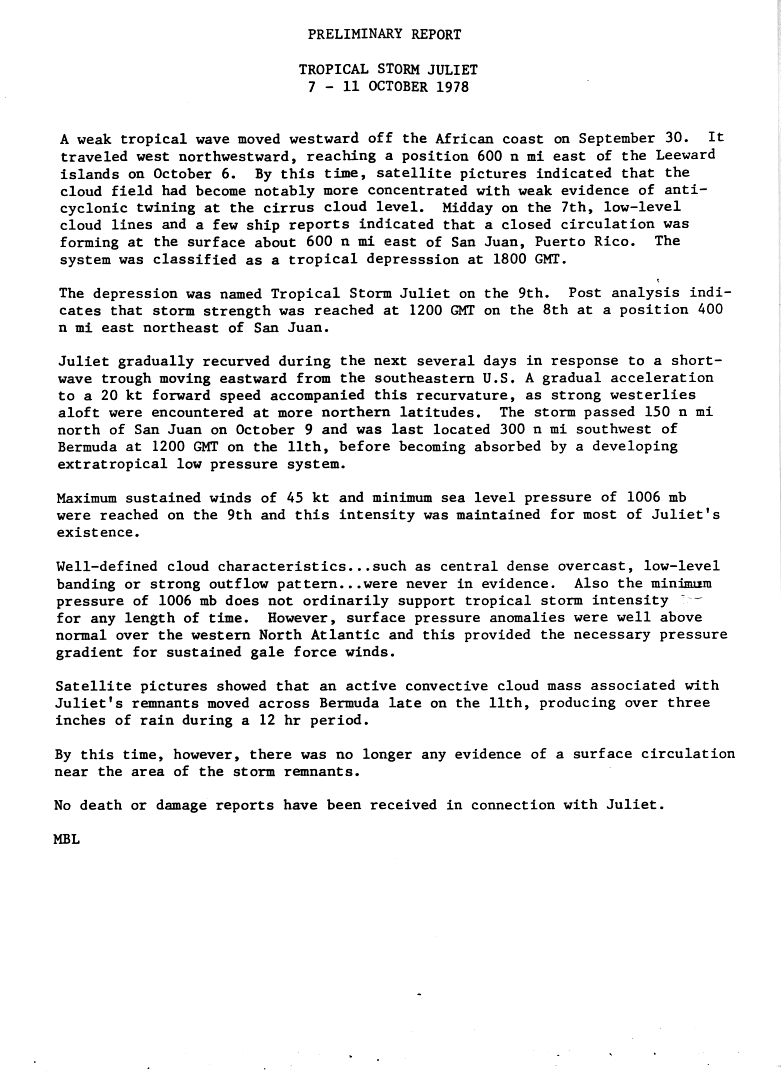
|1-min winds=45 A weak tropical wave emerged into the Atlantic Ocean from the west coast of Africa on September 30. The wave moved west-northwestward and was centered well east of the Leeward Islands on October 6, when satellite imagery indicated that deep convection became much more concentrated. The following day, ship reports noted that a closed circulation was developing. The system was classified as a tropical depression beginning at 1800 UTC on October 7, while located about 600 mi east of Puerto Rico. Around midday on October 8, the depression strengthened into Tropical Storm Juliet.
After peaking with maximum sustained winds of 50 mph and a minimum barometric pressure of 1006 mbar early on October 9, Juliet passed north of Puerto Rico. The storm brought light rainfall to the island, peaking at 4.51 in at Toro Negro Plant. The storm then accelerated and curved northwestward, northward, and then northeastward. On October 11, Juliet merged with a frontal zone, while located west-southwest of Bermuda. Later that day, the remnants moved across the island and produced up to 3 in of rainfall.
Hurricane Kendra
|1-min winds=70 In late October, a tropical wave and an area of disturbed weather combined in the northwestern Caribbean, before crossing Puerto Rico. The system moved northwest and by late on October 28, it became a tropical depression while located about 80 mi north of Mayaguana in The Bahamas. Early on the following day, it strengthened into Tropical Storm Kendra. The storm quickly intensified while moving either north or north-northwestward and became a hurricane late on October 29. After peaking with winds of 80 mph on October 30, Kendra weakened significantly to a 50 mph tropical storm in only 12 hours. Kendra continued north-northeastward or northeastward, before being absorbed by an extratropical cyclone while located west-northwest of Bermuda early on November 1.
The precursor system dropped rainfall across much of southern Puerto Rico was at least 7 in, with a peak at 20.43 in in Pico del Este. Mudslides and flooding from the heavy precipitation left many roads impassable, washed out or collapsed several bridges, and caused considerable damage to agriculture, especially livestock. Additionally, one fatality occurred and 1,710 families fled their homes for shelters. Damage in Puerto Rico reached $6 million. A high-pressure area and Kendra combined produced strong winds and abnormally high tides along the East Coast of the United States, though no damage was reported.
Other systems
In addition to the 12 other tropical cyclones, there were several tropical depressions that developed during the season. The first of which formed over the central Gulf of Mexico on June 21. The depression moved northeastward toward Florida and strengthened slightly. It dissipated by late on June 22. Another tropical depression developed about 175 mi southwest of Porto Novo, Cape Verde on July 10. The system moved generally westward and intensified into a strong tropical depression, before dissipating two days later. Tropical Depression Four formed about 465 mi east of Barbados on August 7. It tracked westward without significantly intensifying, and passed through the Windward Islands over Bequia on the following day. The depression continued westward and passed near Aruba on August 9. It eventually traversed the Caribbean Sea, and made landfall to the south of Bluefields, Nicaragua on August 11. The depression dissipated shortly thereafter.
A tropical depression formed in the central Gulf of Mexico on August 9. The storm moved northward and struck southeastern Plaquemines Parish, Louisiana before dissipating the next day. By August 30, another depression developed in the north-central Gulf of Mexico. The system tracked generally eastward and avoided landfall. It dissipated around midday on September 1. Tropical Depression Eight developed over western Senegal around 1200 UTC on September 3. The depression initially headed west-southwestward and soon entered the Atlantic Ocean. Between late on September 4 and early on September 5, the system passed south of Cape Verde. Later that day, the storm began curving west-northwestward. By early on September 7, it was heading northwestward and then turned to the north-northwest the next day. The depression moved northward between September 9 and September 10, before re-curving to the northeast. It dissipated about 440 mi of Flores Island in the Azores around midday on September 11.
At 1200 UTC on September 8, Tropical Depression Nine developed over the west-central Gulf of Mexico. Moving generally westward, the depression made landfall south of La Pesca, Tamaulipas, around midday on September 10. The system rapidly weakened inland and dissipated later that day. Another tropical depression formed over western Senegal on September 18. It moved westward across the Atlantic Ocean before curving west-northwestward about three days later. On September 25, the depression moved northwestward and then northward by September 28. It dissipated about 550 mi east-northeast of Bermuda at 1200 UTC the following day. The next tropical depression developed in the Gulf of Mexico just offshore Campeche on September 21. Moving west-northwestward, the depression made landfall near Tampico on September 23, shortly before dissipating.
A tropical depression formed at 1200 UTC on October 13, while located about 55 mi north of Corvo Island in the Azores. The depression initially moved south-southwestward, before curving southwestward by the following day. It then turned west-northwestward on October 15. Late the next day, the depression turned abruptly northward. The system dissipated about 500 mi west-northwest of Flores Island. The next tropical depression developed at 1200 UTC on October 26, while located about 490 mi south-southwest of the southernmost islands of Cape Verde. It moved generally westward and dissipated about halfway between the Lesser Antilles and the west coast of Africa on October 29. The final tropical depression of the season formed about 265 mi northeast of North Abaco in the Bahamas on November 3. Moving north-northeastward, the depression turned northeastward by the next day. It dissipated about 275 mi east of Virginia Beach, Virginia on November 5.
Storm names
The following list of names was used for named storms that formed in the North Atlantic in 1978. Storms were named Amelia, Bess, Cora, Flossie, Hope, Irma, and Juliet for the first time in 1978. This was the last Atlantic hurricane season to utilize only female names for tropical storms. A new set of six annual lists utilizing both female and male names came into use in 1979.
Retirement
The name Greta was retired after the 1978 season.
Season effects
This is a table of all of the storms that formed in the 1978 Atlantic hurricane season. It includes their name, duration, peak classification and intensities, areas affected, damage, and death totals. Deaths in parentheses are additional and indirect (an example of an indirect death would be a traffic accident), but were still related to that storm. Damage and deaths include totals while the storm was extratropical, a wave, or a low, and all of the damage figures are in 1978 USD.
Notes
References
References
- Miles B. Lawrence. (April 1979). "Atlantic Hurricane Season of 1978". National Hurricane Center; National Weather Service; National Oceanic and Atmospheric Administration.
- (May 13, 1978). "Hurricane Bob?". [[Star-News.
- (June 1, 2023). "Hurricanes Frequently Asked Questions". [[Atlantic Oceanographic and Meteorological Laboratory]].
- (March 19, 2014). "Tropical Cyclone Climatology". National Oceanic and Atmospheric Administration.
- (May 23, 2013). "Saffir-Simpson Hurricane Wind Scale". National Oceanic and Atmospheric Administration.
- (September 2021). "Atlantic basin Comparison of Original and Revised HURDAT". National Oceanic and Atmospheric Administration.
- JBL. (January 19, 1978). "Tropical and Subtropical Cyclone Classification on Subtropical Storm One (1)". National Oceanic and Atmospheric Administration.
- MM. (January 20, 1978). "Tropical and Subtropical Cyclone Classification on Subtropical Storm One". National Oceanic and Atmospheric Administration.
- SCT. (January 20, 1978). "Tropical and Subtropical Cyclone Classification on Subtropical Storm One". National Oceanic and Atmospheric Administration.
- MM. (January 21, 1978). "Tropical and Subtropical Cyclone Classification on Subtropical Storm One". National Oceanic and Atmospheric Administration.
- (January 21, 1978). "SANBAR Model Forecast for Subtropical Storm One". National Oceanic and Atmospheric Administration.
- JBL. (January 21, 1978). "Tropical and Subtropical Cyclone Classification on Subtropical Storm One". National Oceanic and Atmospheric Administration.
- Christopher W. Landsea. (December 2012). "Documentation of Atlantic Tropical Cyclones Changes in HURDAT (1938)". National Oceanic and Atmospheric Administration; Atlantic Oceanographic and Meteorological Laboratory.
- John R. Hope. (1978). "Tropical Storm Amelia July 30–31, 1978". National Oceanic and Atmospheric Administration.
- John R. Hope. (1978). "Tropical Storm Amelia July 30–31, 1978". National Oceanic and Atmospheric Administration.
- (July 31, 1978). "Tropical Storm Sinks Three Boats". Toledo Blade.
- George W. Bomar. (1983). "Texas Weather". [[University of Texas]] Press.
- (August 2, 1978). "Floods in Aftermath of Tropical Storm Sweep Away Texas Homes, Cars". Times-Union.
- David M. Roth. (January 17, 2010). "Texas Hurricane History". National Oceanic and Atmospheric Administration.
- (December 2, 1978). "U.S. Escaped Direct Hit in 'Average' Season This Year, But That Could Change". The Evening Independent.
- Paul J. Hebert. (1978). "Preliminary Report Tropical Storm Bess". National Oceanic and Atmospheric Administration.
- Paul J. Hebert. (1978). "Preliminary Report Tropical Storm Bess". National Oceanic and Atmospheric Administration.
- David M. Roth. (April 27, 2010). "Tropical Storm Bess - August 7–8, 1978". National Oceanic and Atmospheric Administration.
- Neil L. Frank and Gilbert B. Clark. (August 1979). "Atlantic Tropical Systems of 1978". National Oceanic and Atmospheric Administration.
- (1978). "Preliminary Report: Hurricane Cora Page 1". NOAA.
- (1978). "Preliminary Report: Hurricane Cora Page 2". NOAA.
- Gilbert B. Clark. (1978). "Hurricane Cora August 7–12, 1978". National Oceanic and Atmospheric Administration.
- (1978). "Balloon Launch Awaited". Associated Press.
- Miles B. Lawrence. (April 1979). "Atlantic Hurricane Season of 1978". National Oceanic and Atmospheric Administration; Atlantic Oceanographic and Meteorological Laboratory.
- Joseph M. Plessier. (1978). "Preliminary Report Tropical Storm Debra August 26–29, 1978". National Oceanic and Atmospheric Administration.
- (August 29, 1978). "Storm Hits Louisiana". [[Spokane Daily Chronicle]].
- "Tornado History Project: 19780829.5.35". Tornado History Project.
- "Tornado History Project: 19780829.47.7". Tornado History Project.
- (August 29, 1978). "Debra lumbers inland, causes minor flooding". [[Deseret News]].
- Miles B. Lawrence. (1978). "Preliminary Report Hurricane Ella 30 August – 5 September 1978". National Oceanic and Atmospheric Administration.
- Paul J. Hebert. (September 3, 1978). "Tropical Cyclone Discussion Hurricane Ella". National Oceanic and Atmospheric Administration.
- Miles B. Lawrence. (1978). "Preliminary Report Hurricane Ella". National Oceanic and Atmospheric Administration.
- Miles B. Lawrence. (August 31, 1978). "Hurricane Ella Discussion". National Oceanic and Atmospheric Administration.
- (September 2, 1978). "Hurricane Ella Local Statement Number 12". National Oceanic and Atmospheric Administration; National Hurricane Center.
- Albert R. Hinn. (September 7, 1978). "Information for Hurricane Ella Survey Report". National Oceanic and Atmospheric Administration; National Hurricane Center.
- (September 14, 2010). "1978-Ella". [[Environment Canada]].
- Paul J. Hebert. (1978). "Preliminary Report Hurricane Flossie". National Oceanic and Atmospheric Administration.
- Paul J. Hebert. (1978). "Preliminary Report Hurricane Flossie". National Oceanic and Atmospheric Administration.
- [[Trevor Harley. (2012). "The British weather in September". [[University of Dundee]].
- (1978). "Preliminary Report Hurricane Greta (& Hurricane Olivia) September 13–23, 1978". National Oceanic and Atmospheric Administration.
- (1978). "Preliminary Report Hurricane Greta (& Hurricane Olivia) September 13–23, 1978". National Oceanic and Atmospheric Administration.
- (1978). "Preliminary Report Hurricane Greta (& Hurricane Olivia) September 13–23, 1978". National Oceanic and Atmospheric Administration.
- (September 18, 1978). "Hurricane Greta Pounds Honduras Coast". Kingman Daily Miner.
- (December 1978). "Bundles for Bolivia". The Patriot.
- George Singer. (September 18, 1978). "HWDamage7". National Hurricane Center; National Oceanic and Atmospheric Administration.
- B. Kjerfve. (May 1983). "Hindcast hurricane characteristics on the Belize barrier reef". Coral Reefs.
- George Singer. (September 19, 1978). "HWDamage6". National Hurricane Center; National Oceanic and Atmospheric Administration.
- George Singer. (September 19, 1978). "HWDamage7". National Hurricane Center; National Oceanic and Atmospheric Administration.
- George Singer. (September 18, 1978). "HWDamage2". National Hurricane Center; National Oceanic and Atmospheric Administration.
- Gilbert B. Clark. (1978). "Preliminary Report Tropical Storm Hope September 11–21, 1978". National Oceanic and Atmospheric Administration.
- Miles B. Lawrence. (September 20, 1978). "Tropical Cyclone Discussion Tropical Storm Hope". National Oceanic and Atmospheric Administration.
- "Preliminary Report Tropical Storm Irma October 2–5, 1978". National Oceanic and Atmospheric Administration.
- Joseph M. Pelissier. (October 4, 1978). "Tropical Storm Irma Advisory 1". National Oceanic and Atmospheric Administration.
- "Preliminary Best Track Tropical Storm Irma October 2–5, 1978". National Oceanic and Atmospheric Administration.
- Joseph M. Pelissier. (5 October 1978). "Tropical Storm Irma Advisory 5". National Oceanic and Atmospheric Administration.
- Miles B. Lawrence. (October 5, 1978). "Tropical Storm Irma Advisory 6". National Oceanic and Atmospheric Administration.
- Miles B. Lawrence. (1978). "Preliminary Report Tropical Storm Juliet 7 – 11 1978". National Oceanic and Atmospheric Administration.
- "Storm Data and Unusual Weather Phenomena". National Oceanic and Atmospheric Administration.
- (May 1978). "National Hurricane Operations Plan". [[NOAA]] Office of the Federal Coordinator for Meteorological Services and Supporting Research.
- "Tropical Cyclone Naming History and Retired Names". National Hurricane Center.
This article was imported from Wikipedia and is available under the Creative Commons Attribution-ShareAlike 4.0 License. Content has been adapted to SurfDoc format. Original contributors can be found on the article history page.
Ask Mako anything about 1978 Atlantic hurricane season — get instant answers, deeper analysis, and related topics.
Research with MakoFree with your Surf account
Create a free account to save articles, ask Mako questions, and organize your research.
Sign up freeThis content may have been generated or modified by AI. CloudSurf Software LLC is not responsible for the accuracy, completeness, or reliability of AI-generated content. Always verify important information from primary sources.
Report