From Surf Wiki (app.surf) — the open knowledge base
1971 Atlantic hurricane season
none

none
| Field | Value |
|---|---|
| Basin | Atl |
| Year | 1971 |
| Track | 1971 Atlantic hurricane season summary map.png |
| First storm formed | July 4, 1971 |
| Last storm dissipated | November 22, 1971 |
| Strongest storm name | Edith |
| Strongest storm winds | 140 |
| Strongest storm pressure | 943 |
| Average wind speed | 1 |
| Total depressions | 22 |
| Total storms | 13 |
| Total hurricanes | 6 |
| Total intense | 1 |
| Fatalities | 52 total |
| Damages | 220 |
| five seasons | [1969](1969-atlantic-hurricane-season), [1970](1970-atlantic-hurricane-season), **1971**, [1972](1972-atlantic-hurricane-season), [1973](1973-atlantic-hurricane-season) |
| East Pacific season | 1971 Pacific hurricane season |
| North Indian season | 1971 North Indian Ocean cyclone season |
| West Pacific season | 1971 Pacific typhoon season |
The 1971 Atlantic hurricane season was an active Atlantic hurricane season overall, producing 13 named storms (including a nameable system that went unnamed), of which 6 strengthened into hurricanes. The season officially began on June 1, 1971, and lasted until November 30, 1971. These dates conventionally delimit the period of each year when most tropical cyclones form in the Atlantic basin. This season, the first storm, Arlene, developed on July 4, while the last, Laura, dissipated on November 22.
Activity was steady through most of the season. Hurricane Edith was its strongest system, reaching Category 5 on the Saffir–Simpson scale. It struck Nicaragua at peak intensity, killing dozens, and later hit southern Louisiana. Hurricane Ginger was its longest-lived system, lasting 27 days from early September to early October, setting a record for the longest known duration of a North Atlantic tropical cyclone (not surpassed until 2003). Ginger moved ashore in North Carolina, producing heavy rains and damaging winds. An unnamed storm in August attained hurricane status further north than any other Atlantic hurricane on record. On September 11–12, there were five active Atlantic tropical cyclones at one time. Despite the activity, damage in the United States totaled about $235 million (1971 USD$, USD), which National Hurricane Center forecaster Paul Hebert noted was "pretty small considering we had five storms in a row strike the U.S." Most of the damage came from Tropical Storm Doria, which affected much of the East Coast of the United States. Hurricane Fern struck Texas after executing an unusual track, dropping heavy rainfall and producing flooding.
TOC
Systems
ImageSize = width:800 height:250 PlotArea = top:10 bottom:80 right:20 left:20 Legend = columns:3 left:30 top:58 columnwidth:270 AlignBars = early
DateFormat = dd/mm/yyyy Period = from:01/07/1971 till:03/12/1971 TimeAxis = orientation:horizontal ScaleMinor = grid:black unit:month increment:1 start:01/07/1971
Colors = id:canvas value:gray(0.88) id:GP value:red id:TD value:rgb(0.43,0.76,0.92) legend:Tropical_Depression_=≤38_mph(≤62_km/h) id:TS value:rgb(0.3,1,1) legend:Tropical_Storm_=39–73_mph(63–117_km/h) id:C1 value:rgb(1,1,0.85) legend:Category_1_=74–95_mph(118–153_km/h) id:C2 value:rgb(1,0.85,0.55) legend:Category_2_=96–110_mph(154–177_km/h) id:C3 value:rgb(1,0.62,0.35) legend:Category_3_=111–129_mph(178–208_km/h) id:C4 value:rgb(1,0.45,0.54) legend:Category_4_=130–156_mph(209–251_km/h) id:C5 value:rgb(0.55,0.46,0.90) legend:Category_5_=≥157_mph(≥252_km/h) Backgroundcolors = canvas:canvas
BarData = barset:Hurricane bar:Month
PlotData=
barset:Hurricane width:10 align:left fontsize:S shift:(4,-4) anchor:till from:04/07/1971 till:07/07/1971 color:TS text:"Arlene (TS)" from:06/07/1971 till:08/07/1971 color:TD text:"Two (TD)" from:10/07/1971 till:11/07/1971 color:TD text:"Three (TD)" from:03/08/1971 till:07/08/1971 color:C1 text:"Unnamed (C1)" from:06/08/1971 till:09/08/1971 color:TD text:"Five (TD)" from:10/08/1971 till:16/08/1971 color:C1 text:"Beth (C1)" from:12/08/1971 till:16/08/1971 color:TD text:"Seven (TD)" from:18/08/1971 till:25/08/1971 color:TS text:"Chloe (TS)" from:20/08/1971 till:28/08/1971 color:TS text:"Doria (TS)" from:28/08/1971 till:01/09/1971 color:TD text:"Ten (TD)" from:03/09/1971 till:13/09/1971 color:C1 text:"Fern (C1)" barset:break from:03/09/1971 till:08/09/1971 color:TD text:"Twelve (TD)" from:05/09/1971 till:18/09/1971 color:C5 text:"Edith (C5)" from:06/09/1971 till:03/10/1971 color:C2 text:"Ginger (C2)" from:08/09/1971 till:11/09/1971 color:TD text:"Fifteen (TD)" from:10/09/1971 till:14/09/1971 color:TD text:"Sixteen (TD)" from:11/09/1971 till:15/09/1971 color:TS text:"Heidi (TS)" from:11/09/1971 till:20/09/1971 color:C1 text:"Irene (C1)" from:21/09/1971 till:24/09/1971 color:TS text:"Janice (TS)" from:06/10/1971 till:14/10/1971 color:TD text:"Twenty (TD)" from:18/10/1971 till:21/10/1971 color:TS text:"Kristy (TS)" from:12/11/1971 till:22/11/1971 color:TS text:"Laura (TS)"
bar:Month width:5 align:center fontsize:S shift:(0,-20) anchor:middle color:canvas from:01/07/1971 till:01/08/1971 text:July from:01/08/1971 till:01/09/1971 text:August from:01/09/1971 till:01/10/1971 text:September from:01/10/1971 till:01/11/1971 text:October from:01/11/1971 till:30/11/1971 text:November
TextData = pos:(570,30) text:"(From the" pos:(618,30) text:"Saffir-Simpson Hurricane Scale)"
Tropical Storm Arlene
|1-min winds=55 The origins of Arlene were from a cold front that exited the East Coast of the United States on July 2 and stalled offshore. A frontal wave developed the next day, steadily developing due to thermal instability. On July 4, the system organized into a tropical depression about 120 mi (195 km) southeast of Cape Hatteras, North Carolina. While in its formative stages, it dropped rainfall along the coast of the Carolinas, peaking at 4.11 in in Pinopolis, South Carolina. The depression tracked northeastward due to a ridge over New England, and the cyclone passed just southeast of the Outer Banks. After a Hurricane Hunters plane observed gale-force winds, the depression was upgraded to Tropical Storm Arlene late on July 5; in the post-season summary, meteorologist Neil Frank noted, "the surprising element in the development of Arlene was the rapidity of the transformation process."
Upon being named, Arlene continued northeastward, possessing a circular mass of convection with spiral rainbands. Late on July 6, the storm attained peak winds of 65 mph (100 km/h), based on a ship report. It weakened thereafter, and Arlene transitioned into an extratropical cyclone late on July 7 just south of Newfoundland. The cyclone last observed early the following day. The storm capsized a boat in the Grand Banks of Newfoundland, and the crew of 12 was rescued.
Unnamed hurricane
|1-min winds=75 A hybrid-type depression formed east of Bermuda on July 29. It moved rapidly southwestward before turning to a northwest drift. On August 3, it was classified as a tropical depression, and the next day the system passed near Bermuda. The depression accelerated to the northeast, strengthening into a tropical storm on August 5. It intensified further due to baroclinity, or enhanced instability through different levels of the atmosphere caused by temperature and moisture gradients. On August 6, a drilling rig about 230 mi southeast of Newfoundland recorded sustained winds of 90 mph with gusts to 126 mph (204 km/h) at an altitude of 325 ft; this suggested the storm attained hurricane status at 46° North, which is the northernmost location for a tropical storm to intensify into a hurricane.
Despite the intensity, the cyclone was not purely tropical; although the radius of maximum winds was only 35 mi, the thermal structure did not resemble a tropical cyclone, and there was no precipitation or convection near the center. It continued northeastward and dissipated on August 7 to the southwest of Greenland. It was not named operationally, but it was later added to the Atlantic hurricane database.
Hurricane Beth
Main article: Hurricane Beth
|1-min winds=75 On August 9, an upper-level low developed off the coast of Florida, and the next day spawned a tropical depression. The newly developed cyclone tracked slowly northeastward, eventually encountering conditions favorable for development. On August 14, the depression intensified into Tropical Storm Beth off the coast of North Carolina, and it quickly strengthened into a hurricane by August 15. After reaching peak winds of 85 mph off the coast of Cape Cod, Beth slightly weakened and later moved ashore near Copper Lake, Nova Scotia. Shortly thereafter, Beth was swept up by a nearby cold front and transitioned into an extratropical cyclone.
The hurricane left extensive damage in its wake, especially to crops and infrastructure. Halifax International Airport reported 10.49 in (266 mm) of rainfall in a 30‑hour span, which caused widespread flooding. Several bridges in the region were washed out, while railways were covered by water, forcing trains to suspend their operation. Overall monetary damage from Beth is estimated up to $5.1 million (1971 USD$, USD). One person was indirectly killed by the hurricane in a traffic accident induced by heavy rainfall.
Tropical Depression Seven
|1-min winds=25 On August 12, a tropical depression developed southwest of Fort Myers, Florida. It quickly moved ashore, reaching Lake Okeechobee before looping to the northwest. While moving across the state, it dropped heavy rainfall of around 10 in along the west coast. In Pinellas Park, the heavy rains led to flash flooding that forced 200 families from their house, including one that required evacuation from a helicopter. Damage in the region was estimated at $250,000 (1971 USD$, USD).
The depression emerged into the Gulf of Mexico on August 15 near Tampa, and later turned to the northeast ahead of an upper-level low. On August 16, it intensified as it moved ashore near Cedar Key, where hurricane-force wind gusts were briefly observed. The depression dissipated on August 17 over South Carolina, although in that state it produced its heaviest rainfall, totaling 14.11 in in Sullivan's Island. In nearby Savannah, Georgia, the rainfall forced about 100 families from their houses in low-lying areas. The remnants continued northeastward through the Mid-Atlantic States and New England, crossing into Canada on August 20.
Tropical Storm Chloe
|1-min winds=55 A tropical wave moved off the coast of Africa on August 13, moving westward for several days before organizing into a tropical depression on August 18 about 460 mi east of Barbados. It quickly moved through the Lesser Antilles, where it produced wind gusts up to 58 mph. The cyclone also dropped heavy rainfall up to 6 in on Barbados and Martinique. After entering the eastern Caribbean Sea, the depression intensified into Tropical Storm Chloe on August 20. About 18 hours after attaining tropical storm status, Chloe quickly strengthened to peak winds of 65 mph about 215 mi (345 km) south of the Mona Passage, as reported by reconnaissance aircraft.
After reaching peak intensity, Chloe began weakening as it turned to the west-southwest, and late on August 22, it was downgraded to a tropical depression as a weakening ridge to its north cut off the low-level inflow. For several days it continued generally westward, gradually losing organization. While passing south of Jamaica, the storm prompted the evacuation of the SS Hope, a hospital ship, at Kingston. On August 25, Chloe moved ashore in Belize as a weak tropical depression, and dissipated shortly thereafter without ever having caused significant damage or deaths. The remnants of Chloe later spawned Hurricane Lily in the eastern Pacific Ocean.
Tropical Storm Doria
|1-min winds=55 Main article: Tropical Storm Doria
Tropical Storm Doria, the costliest storm of the season, developed from a tropical wave on August 20 to the east of the Lesser Antilles, and after five days without development attained tropical storm status to the east of Florida. Doria turned to the north, and reached peak winds of 65 mph (105 km/h) as it was making landfall near Morehead City, North Carolina. It turned to the northeast, and moved through the Mid-Atlantic and New England as a tropical storm before becoming an extratropical storm over Maine on August 29.
In North Carolina, Doria produced moderate rainfall, resulting in localized flooding and damage. The storm spawned a tornado near Norfolk, Virginia, damaging twelve houses and downing hundreds of trees. Tropical Storm Doria dropped heavy precipitation in New Jersey, peaking at 10.29 in (261 mm) in Little Falls. The rainfall led to record-breaking river levels and flooding in several houses, resulting in damage to dozens of houses across the state. Moderate damage and rainfall continued along its path into New England and southeastern Canada. In all, Tropical Storm Doria caused seven deaths and $147.6 million (1971 USD$, USD).
Hurricane Fern
|1-min winds=80 Main article: Hurricane Fern
Hurricane Fern was the first of four tropical systems to develop in association with an extended surface trough across the Gulf of Mexico into the open Atlantic, along with Ginger, Heidi, and a strong tropical depression. Fern developed on September 3 in the central Gulf of Mexico. It moved over southern Louisiana the next day, but due to increased ridging to the north the depression moved southwestward back over water. On September 7, the depression intensified into Tropical Storm Fern; it is rare for a tropical depression to move over land in the continental United States (excluding Florida) and later attain tropical storm status. Fern later turned to the northwest, intensifying into a hurricane on September 8. It quickly reached peak winds of 90 mph, but later weakened as it curved to the southwest, moving ashore on September 10 between Freeport and Matagorda, Texas as a tropical storm. Fern dissipated on September 13 over northeastern Mexico.
The precursor of Fern dropped rainfall up to 5 in of rainfall across South Florida, while totals of up to 10 in were reported in southeastern Louisiana where it made its first landfall. As it struck Texas, Fern produced strong winds up to 86 mph, along with 5 to storm tides and heavy rainfall; the highest precipitation total was 26.0 in in Beeville. The heavy rainfall caused severe flash flooding that isolated numerous small towns in the southeastern portion of the state, damaging 7,500 buildings. In all, Fern left two indirect deaths and moderate damage totaling $30.2 million (1971 USD$, USD).
Hurricane Edith
|1-min winds=140 Main article: Hurricane Edith (1971)
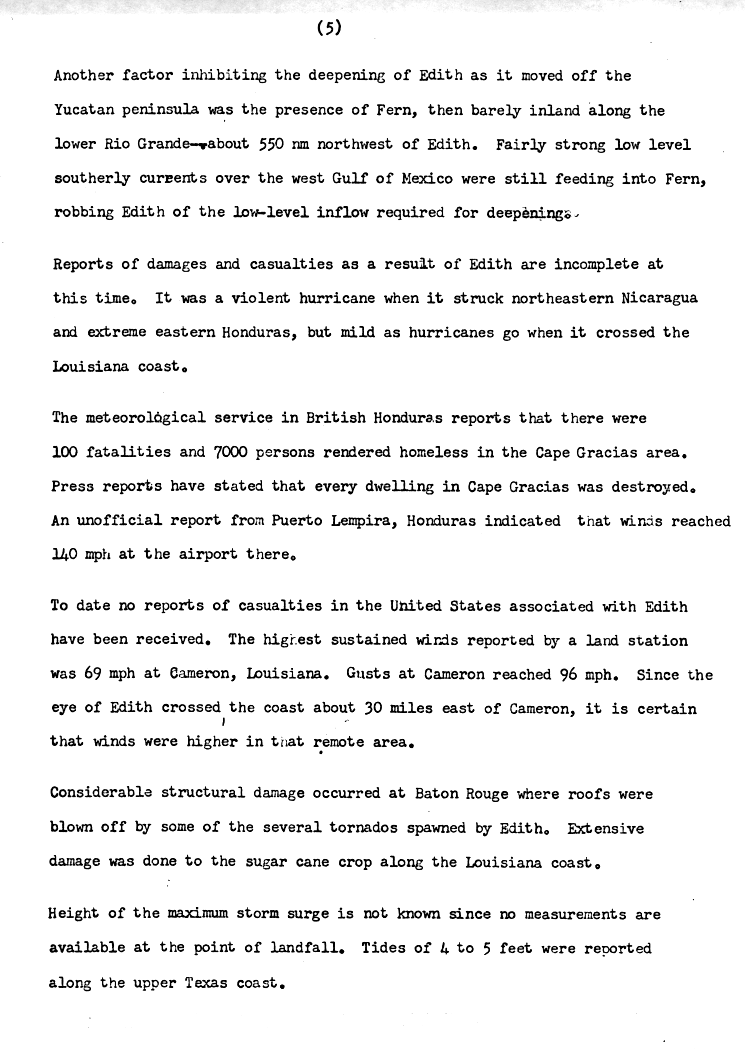
Hurricane Edith, the strongest storm of the season, developed from a tropical wave on September 5 to the east of the southern Lesser Antilles. It moved quickly across the southern Caribbean Sea, intensifying into a hurricane just off the north coast of South America. Edith rapidly intensified on September 9 and made landfall on Cape Gracias a Dios as a Category 5 hurricane on the Saffir-Simpson Hurricane Scale. It quickly lost intensity over Central America and after briefly entering the Gulf of Honduras it crossed the Yucatán Peninsula in Mexico. After moving across the Gulf of Mexico, a trough turned the storm to the northeast and Edith, after having restrengthened while accelerating towards the coast, made landfall on Louisiana with winds of 105 mph (170 km/h) on September 16. Edith steadily weakened over land and dissipated over Georgia on September 18.
The hurricane killed two people when it passed near Aruba. Striking northeastern Central America as a Category 5 hurricane, Edith destroyed hundreds of homes and killed at least 35 people. In Texas high tides caused coastal flooding but little damage. Edith caused moderate to heavy damage in portions of Louisiana due to flooding and a tornado outbreak from the storm. One tornado, rated F3 on the Fujita Scale, damaged several homes and injured multiple people in Baton Rouge. The tornado outbreak extended eastward into Florida. Damage in the United States totaled $25 million (1971 USD$, USD).
Hurricane Ginger
|1-min winds=95 Main article: Hurricane Ginger
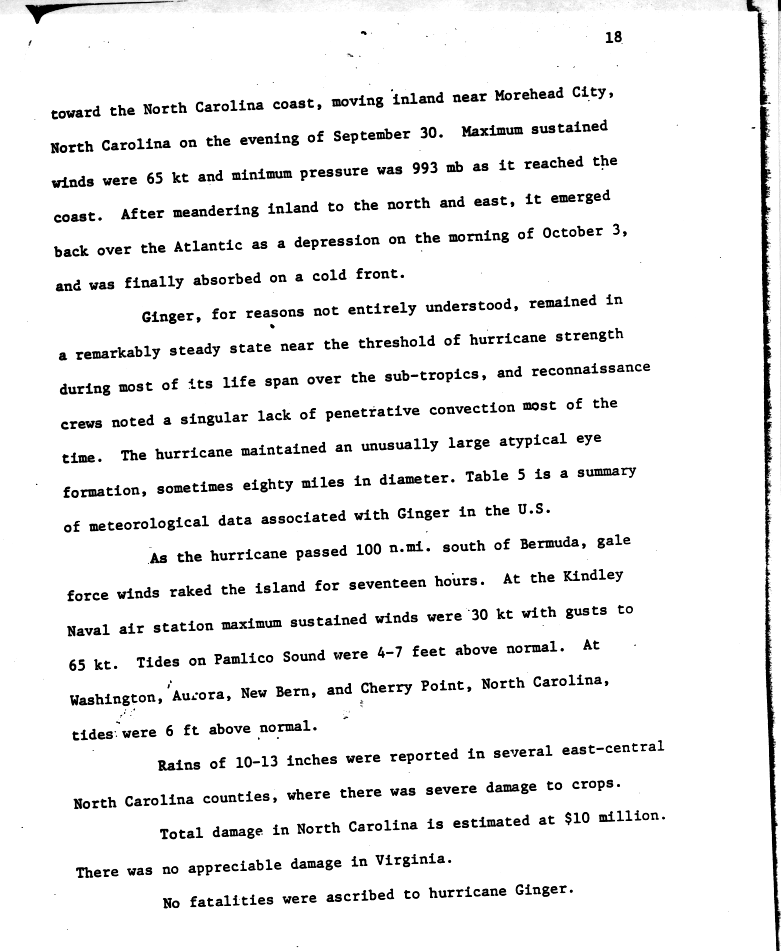
Hurricane Ginger was thought to be the longest lasting Atlantic hurricane on record until 2003, when the 1899 San Ciriaco hurricane was retroactively found to have lasted longer. The eighth tropical cyclone and fifth hurricane of the season, Ginger spent 27.25 days as a tropical cyclone, and lasted from September 6 to October 3. The storm developed in a large region of convection across the Gulf of Mexico and western Atlantic, and for the first nine days of its duration tracked generally east- or northeastward while gradually strengthening to peak winds of 110 mph (175 km/h). On September 14 Ginger slowed and turned to a general westward track, passing near Bermuda on September 23; there, the hurricane produced gusty winds and high waves, but no damage.
While over the western Atlantic Ocean, Ginger became the last target of Project Stormfury, which sought to weaken hurricanes by depositing silver iodide into tropical cyclone rainbands. The plane dropped silver iodide into the center of Ginger, although there was no effect due to Ginger's large eye and diffuse nature; Ginger was the last seeding done by the project. Ginger ultimately struck North Carolina on September 30 as a minimal hurricane, lashing the coastline with gusty winds that caused power outages across the region. Heavy rainfall flooded towns and left heavy crop damage, with 3 million bushels of corn and 1 million bushels of soybean lost. Damage in the state was estimated at $10 million (1971 USD$, USD). Further north, moderate rainfall and winds spread through the Mid-Atlantic states, although no significant damage was reported outside of North Carolina.
Tropical Storm Heidi
|1-min winds=55 Tropical Storm Heidi was the last of the four tropical systems to develop from the extended surface trough of low pressure, forming on September 11 northeast of the Bahamas and intensifying into a tropical storm the next day. After initially moving to the northwest, Heidi curved northeastward and attained its peak intensity of 65 mph (100 km/h) on September 14 off the coast of Virginia. The storm failed to become a well-organized system, and it gradually weakened while accelerating north-northeastward. On September 15, shortly after Heidi moved ashore in Maine, it was absorbed by a broad extratropical cyclone over the northern Appalachians.
Heidi did not directly cause any fatalities or severe damage. However, the larger extratropical storm drew in moisture from Heidi, producing rainfall from North Carolina through northern New England, including a peak of 9.38 in in southeastern Pennsylvania. The heavy rains triggered extensive flooding that caused over a dozen fatalities and left thousands of residents homeless in Pennsylvania and New Jersey. In Chester, Pennsylvania a stone dam collapsed, forcing hundreds of families to evacuate and damaging homes, businesses, roads, and bridges. Governor Milton Shapp declared a state of emergency in several Pennsylvania counties following the floods.
Hurricane Irene
|1-min winds=70 Main article: Hurricane Irene–Olivia
A tropical wave spawned a tropical depression on September 11 about 800 mi (1300 km) east of the Windward Islands. The cyclone tracked nearly due westward at a low latitude, passing through the southern Windward Islands and later over northern South America. In the southwest Caribbean Sea, it intensified to a tropical storm and later a hurricane. Irene made landfall on southeastern Nicaragua on September 19, and maintained its circulation as it crossed the low-lying terrain of the country. Restrengthening after reaching the Pacific, Irene was renamed Hurricane Olivia, which ultimately attained peak winds of 115 mph (185 km/h) before weakening and dissipating over northwestern Mexico.
In the Atlantic, Irene produced moderate rainfall and winds along its path, although impact was greatest in Nicaragua where it moved ashore as a hurricane. A total of 96 homes were destroyed, and 1,200 people were left homeless. The rainfall resulted in widespread flooding, killing three people in Rivas. In neighboring Costa Rica, Hurricane Irene caused more than $1 million (1971 USD$, USD) in damage to the banana crop. The hurricane was the first actively tracked tropical cyclone that moved into the eastern Pacific Ocean from the Atlantic Ocean.
Tropical Storm Janice
|1-min winds=55 The origins of Janice were from a tropical wave that moved off the coast of Africa on September 18. It developed into a tropical depression on September 21 about 1050 mi (1700 km) west-southwest of Cape Verde, which was the easternmost formation of the named storms this season. The next day, the depression intensified into Tropical Storm Janice, and quickly reached peak winds of 65 mph. The storm never became well-organized, with its peak winds located east of the broad center. Despite being in a climatologically favored region for further development, Janice weakened due to increased wind shear from Hurricane Ginger. The circulation became elongated and separated from the convection, and on September 24 the storm weakened to a tropical depression. Later that day Janice dissipated just northeast of the Lesser Antilles as it was absorbed by Ginger. Around that time, it produced rainfall in the northeastern Caribbean, reaching 4 in on Saint Kitts; no damage or fatalities were reported.
Tropical Storm Kristy
|1-min winds=45 The interaction between a tropical wave and an upper-level trough led to the development of a tropical depression on October 18, about 685 mi (1100 km) northeast of Puerto Rico. It moved quickly north-northeastward, followed by a curve to the northeast. On October 20, a ship reported winds of 45 mph, indicating the depression intensified into Tropical Storm Kristy. As it reached this strength, an approaching cold front produced cooler, drier air over the storm. Kristy intensified slightly further to peak winds of 50 mph (85 km/h) before becoming indistinguishable from the cold front. By October 21 it transitioned into an extratropical cyclone before dissipating near the Azores.
Tropical Storm Laura
|1-min winds=60 A large area of convection persisted across the southwest Caribbean Sea in mid-November. On November 12, a tropical depression formed about 175 mi north of Panama. It moved northwestward, slowly organizing and becoming Tropical Storm Laura on November 14. The storm continued to intensify as it turned northward toward western Cuba. Late on November 15, Laura attained peak winds of 70 mph. A ridge over the southeastern United States caused Laura to drift and execute a clockwise loop off the west coast of Cuba. By late on November 17, the storm was weakening and moving southwestward away from Cuba. The track shifted but continued generally to the southwest, as the intensity fluctuated from 50–70 mph (80–110 km/h). On November 21, Laura made landfall at peak intensity near Punta Gorda, Belize. It dissipated the next day over Guatemala.
When Tropical Storm Laura first passed the Cayman Islands, it produced 3 in of rainfall on Grand Cayman. As it was slowly moving off of the coast of Cuba, Laura dropped heavy rainfall, including nearly 20 in across most of the Isle of Youth. The highest total in the country was 32.5 in, and overall the storm impacted four provinces, including Isle of Youth, Pinar del Río, La Habana, and the city of Havana. On the Isle of Youth, Laura produced winds of 70 mph, with gusts to 80 mph. On the mainland, the storm destroyed 20 homes and several tobacco sheds, with damage also reported to the coffee, sugar, fruit, and vegetable crops. Due to the flooding, officials forced 26,000 people from their homes in Pinar del Río, and one person in that province drowned while crossing a river. The storm's passage was believed to have diverted a flock of great black-backed gulls toward Central America and north-coastal South America; the species is usually found in the Mid-Atlantic states, and were migrating to the Gulf Coast or Cuba when they were affected by the storm. Heavy rainfall was reported across Central America. Laura was one of only four November storms to affect Belize. On Glover's Reef offshore, the storm stranded a group of about 20 scientists affiliated with the Smithsonian Institution who required rescue. The storm damaged several buildings on the Belize mainland.
Other systems
In addition to the named storms and otherwise notable cyclones, there were several weak depressions during the season. After a June devoid of activity, three tropical depressions developed within the first ten days of July. The first became Tropical Storm Arlene on July 4, and the second formed off the coast of Louisiana on July 6. Tropical Depression Two moved westward due to a ridge to its northeast, and it struck just west of the Texas-Louisiana border before dissipating on July 8. Its precursor dropped 3.90 in near Carrabelle, Florida, but much less along its path. Just two days later, another tropical depression formed in the northwestern Gulf of Mexico, quickly moving ashore in southern Texas before dissipating on July 11; it dropped light rainfall along its path.
In August, there were two tropical depressions, in addition to the named storms and the notable Tropical Depression Seven. The first, Tropical Depression Five, developed in the central Gulf of Mexico on August 6. It made landfall in Louisiana three days later, eventually dissipating over Mississippi. The other, designated Tropical Depression Ten, formed over the Bahamas on August 28. It moved westward, crossing Florida and the Gulf of Mexico before dissipating over southeastern Louisiana on September 1. The depression dropped moderate rainfall along the Gulf Coast, peaking at 6.82 in at Gulf Shores, Alabama.
There were three non-developing tropical depressions in September, the first of which just off the coast of Africa on September 3. It moved west-northwestward, passing near Cape Verde before dissipating on September 8. The next, Tropical Depression Fifteen, originated on September 8 east of Florida from the same trough that also spawned Fern, Ginger, and Heidi. It initially moved northward before curving to the west, making landfall near the Georgia-South Carolina border on September 11 before dissipating the following day. The other, Tropical Depression Sixteen, developed off the coast of Africa on September 10, moving westward before dissipating on September 14.
The final non-developing tropical depression of the season formed on October 6 in the western Caribbean Sea. It crossed the Yucatán Peninsula the next day, dropping heavy rainfall up to 9.09 in. The depression turned to the northeast due to an approaching upper-level trough, and it transitioned into a frontal wave on October 10. As the trough advanced ahead of the storm, a ridge built across the southeast United States, causing the cyclone to turn northward and parallel the west coast of Florida. It regained tropical characteristics before moving ashore near Apalachicola and dissipating on October 14.
Storm names
The following list of names was used for named tropical storms that formed in the North Atlantic in 1971. This is the same list used in the 1967 season, with the exception of Beth, which replaced Beulah. Storms were named Beth, Kristy, and Laura for the first time in 1971. No names were retired following the season; however, an overhaul of the naming system in 1979 to include male names resulted in this list being discarded.
Season effects
This is a table of all of the storms that formed in the 1971 Atlantic hurricane season. It includes their name, duration, peak classification and intensities, areas affected, damage, and death totals. Deaths in parentheses are additional and indirect (an example of an indirect death would be a traffic accident), but were still related to that storm. Damage and deaths include totals while the storm was extratropical, a wave, or a low, and all of the damage figures are in 1971 USD.
References
References
- Staff Writer. (June 1, 1971). "National Hurricane Center Has Good News for Season". Sarasota Journal.
- Staff Writer. (December 1, 1971). "Winter Winds Signal End of 1971 Hurricane Season". The Evening Independent.
- Erdman, John. (August 27, 2015). "Six Tropical Cyclones At Once in the Pacific Ocean: How Rare Is That?".
- David M. Roth. (November 3, 2008). "Tropical Storm Arlene – July 3–5, 1971". Hydrometeorological Prediction Center.
- Canadian Hurricane Centre. (November 3, 2010). "1971-Arlene".
- John M. Wallace and Peter V. Hobbs. (1977). "Atmospheric Science: An Introductory Survey". Academic Press, Inc..
- Natural Resources Canada. "Major Hurricanes". The Atlas of Canada.
- The Associated Press. (August 17, 1971). "Hurricane Beth Pours Rain on Nova Scotia; One Killed". The Spokesman-Review.
- The Canadian Press. (August 16, 1971). "Nova Scotia awash as rain, storms hit". The Windsor Star.
- Staff Writer. (August 17, 1971). "Tropical Depression Brings Flash Floods". The Palm Beach Post.
- Staff Writer. (August 17, 1971). "Fla. Storm Hits Carolina Coast; 100 Families Flee". Ocala Star-Banner.
- David M. Roth. (August 28, 2008). "Tropical Depression – August 11–20, 1971". Hydrometeorological Prediction Center.
- Staff Writer. (August 23, 1971). "S.S. Hope a Shadow for Chloe". The Windsor Star.
- James E. Hudgins. (April 2000). "Tropical cyclones affecting North Carolina since 1586: An historical perspective". Blacksburg, Virginia National Weather Service Office.
- David Roth & Hugh Cobb. (2001). "Virginia Hurricane History". National Oceanic and Atmospheric Administration.
- U.S. Department of Agriculture. (1999). "Weekly Weather and Crop Bulletin for September 21, 1999".
- Lesley-Ann Dupigny-Giroux. (2002). "Climate Variability and Socioeconomic Consequences of Vermont's Natural Hazards: A Historical Perspective". Vermont Historical Society.
- Réjean Couture. (2006). "Flash floods in the Bois Francs region, Quebec". Geological Survey of Canada.
- David M. Roth. (October 26, 2007). "Hurricane Fern – September 1–13, 1971". Hydrometeorological Prediction Center.
- National Weather Service. (2006). "Upper Texas Coast Tropical Cyclones in the 1970s". National Oceanic and Atmospheric Administration.
- John Hope. (1971). "Hurricane Edith Preliminary Report Page 5". National Hurricane Center.
- David Roth. (2000). "Texas Hurricane History: Late 20th century". National Weather Service.
- Lon Curtis. (2004). "Mid-Level Dry Intrusions as a Factor in Tornado Outbreaks Associated with Landfalling Tropical Cyclones from the Atlantic and Gulf of Mexico".
- National Climatic Data Center. (1971). "Event Report for Louisiana".
- (April 1972). "Atlantic Hurricane Season of 1971". Monthly Weather Review.
- Staff Writer. (September 23, 1971). "Ginger Hits Bermuda". The Deseret News.
- (1971). "Hurricane Ginger September 5 – October 5 (Page 2)". National Hurricane Center.
- H. E. Willoughby. (May 1985). "Project STORMFURY: A Scientific Chronicle 1962–1983". Bulletin of the American Meteorological Society.
- Staff Writer. (October 1, 1971). "Ginger Rakes North Carolina". The Palm Beach Post.
- Melvin Lang. (September 30, 1971). "Ginger largest storm since '36". The Free Lance-Star.
- Robert Gordon. (October 13, 1971). "Farmers Hit in the Pocketbook". The Times-News.
- David Roth. "Tropical Storm Heidi – September 12–15, 1971". Hydrometeorological Prediction Center.
- Staff Writer. (September 15, 1971). "Thousands Left Homeless in Wake of Rain, Flood". The Bangor Daily News.
- Staff Writer. (September 15, 1971). "Flooding emergency declared". The Miami News.
- R.H. Simpson and John R. Hope. (April 1972). "Atlantic Tropical Systems of 1971". [[Monthly Weather Review]].
- William J. Denny. (April 1972). "Eastern Pacific hurricane season of 1971". [[Monthly Weather Review]].
- Staff Writer. (September 21, 1971). "Irene Reforming in Pacific Ocean".
- Dirección General de Meteorología. (July 7, 2008). "Huracán Irene (1971)". Instituto Nicaragüense de Estudios Territoiales.
- Staff Writer. (September 23, 1971). "Banana Crop is Hit by Hurricane Irene". The Chillicothe Constitution-Tribune.
- Joint Typhoon Warning Center. (1971). "Annual Typhoon Report".
- (1971-11-13). "Tropical Storm Laura Could Become Hurricane".
- Instituto Nacional de Recursos Hidráulicos. (2003). "Lluvias intensas observadas y grandes inundaciones reportadas".
- (November 19, 1971). "Laura Weakens off Yucatan Coast". The Evening Independent.
- V.H. Voous. "Northern Gulls in Aruba". University of Amsterdam.
- (1971-11-21). "Tropical Storm Hits Honduras".
- 7 News Belize. (November 5, 2009). "Ida Weakens".
- Saint Petersburg Times Wire Services. (1971-11-22). "Laura Hits Honduras, Strands 20".
- David M. Roth. (November 6, 2008). "Tropical Depression Two – July 5–8, 1971". Hydrometeorological Prediction Center.
- David M. Roth. (November 5, 2008). "Tropical Depression Three – July 9–12, 1971". Hydrometeorological Prediction Center.
- David M. Roth. (2011). "Extended Best Track Database for CLIQR program". Hydrometeorological Prediction Center.
- David M. Roth. (November 28, 2008). "Tropical Depression Eleven – August 29 – September 1, 1971". Hydrometeorological Prediction Center.
- David M. Roth. (October 27, 2008). "Tropical Depression Twenty-Two – October 6–14, 1971". Hydrometeorological Prediction Center.
- (May 1971). "National Hurricane Operations Plan". [[NOAA]] Office of the Federal Coordinator for Meteorological Services and Supporting Research.
- (May 1967). "National Hurricane Operations Plan". [[NOAA]] Office of the Federal Coordinator for Meteorological Services and Supporting Research.
- "Tropical Cyclone Naming History and Retired Names". National Hurricane Center.
- (1991). "Primer on Natural Hazard Management in Integrated Regional Development Planning". Department of Regional Development; Environment Executive Secretariat for Economic and Social Affairs Organization of American States.
This article was imported from Wikipedia and is available under the Creative Commons Attribution-ShareAlike 4.0 License. Content has been adapted to SurfDoc format. Original contributors can be found on the article history page.
Ask Mako anything about 1971 Atlantic hurricane season — get instant answers, deeper analysis, and related topics.
Research with MakoFree with your Surf account
Create a free account to save articles, ask Mako questions, and organize your research.
Sign up freeThis content may have been generated or modified by AI. CloudSurf Software LLC is not responsible for the accuracy, completeness, or reliability of AI-generated content. Always verify important information from primary sources.
Report