From Surf Wiki (app.surf) — the open knowledge base
1966 Pulitzer Prize
Awards for journalism and related fields

Awards for journalism and related fields
The following are the Pulitzer Prizes for 1966.
Journalism awards
- Public Service:
- The Boston Globe, for its campaign to prevent confirmation of Francis X. Morrissey as a federal district judge in Massachusetts.
- Local General or Spot News Reporting:
- Staff of the Los Angeles Times, for its coverage of the Watts Riots.
- Local Investigative Specialized Reporting:
- John Anthony Frasca of The Tampa Tribune, for his investigation and reporting of two robberies that resulted in the freeing of an innocent man.
- National Reporting:
- Haynes Johnson of the Washington Evening Star, for his distinguished coverage of the civil rights conflict centered about Selma, Alabama, and particularly his reporting of its aftermath.
- International Reporting:
- Peter Arnett of the Associated Press, for his coverage of the Vietnam War.
- Editorial Writing:
- Robert Lasch of the St. Louis Post-Dispatch, for his distinguished editorial writing in 1965, exemplified by "The Containment of Ideas".
- Editorial Cartooning:
- Don Wright of The Miami News, for "You Mean You Were Bluffing?"
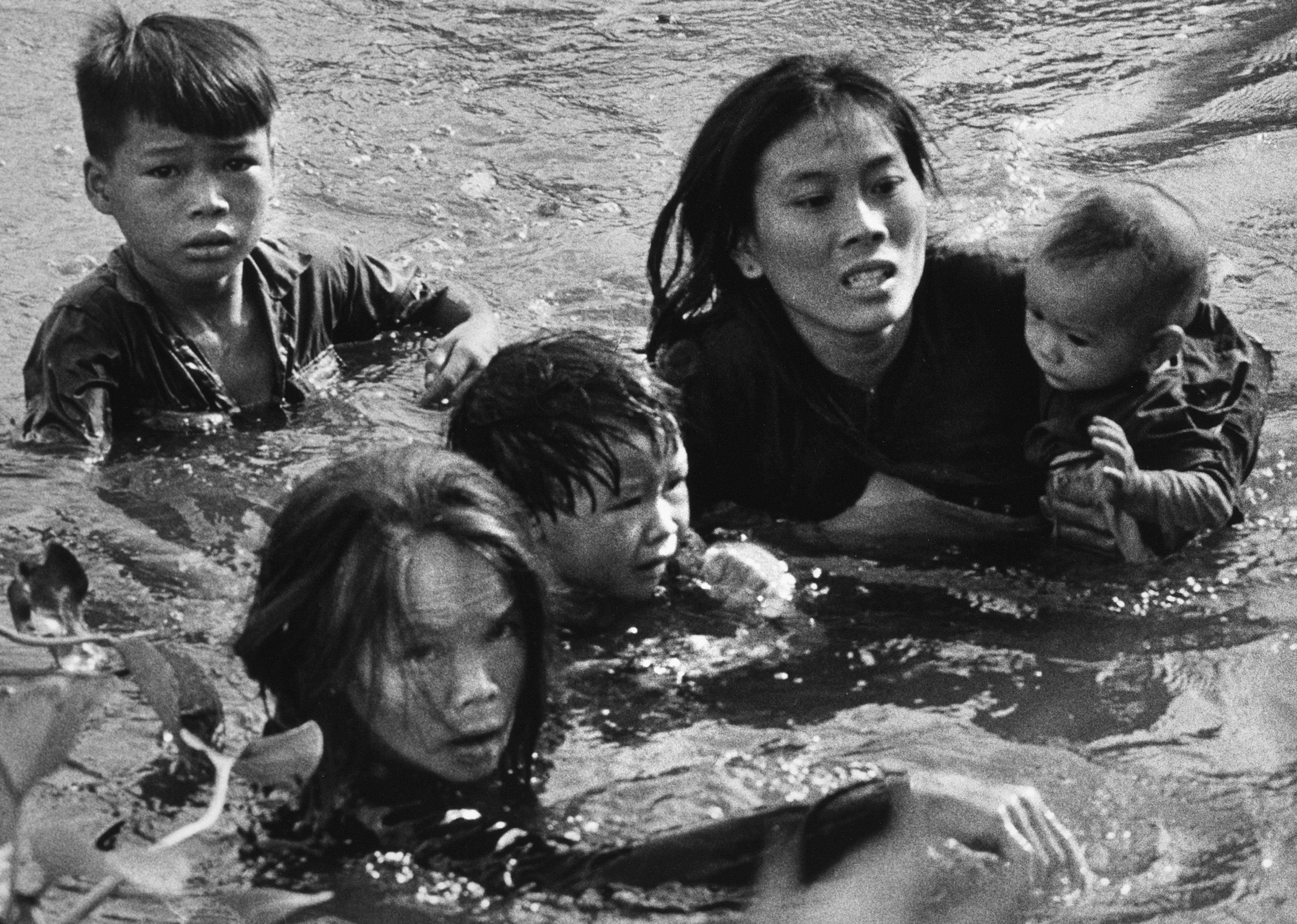
- Photography:
- Kyoichi Sawada of United Press International, for his combat photography of the Vietnam War during 1965. A photo entitled "Flee to Safety", depicting a Vietnamese family wading across a river after their village was attacked, was cited as a noted example of his work.
Letters, Drama and Music Awards
- Fiction:
- Collected Stories by Katherine Anne Porter (Harcourt).
- Drama:
- No award given.
- History:
- The Life of the Mind in America by Perry Miller (Harcourt).
- Biography or Autobiography:
- A Thousand Days by Arthur Schlesinger, Jr. (Houghton).
- Poetry:
- Selected Poems by Richard Eberhart (New Directions).
- General Nonfiction:
- Wandering Through Winter by Edwin Way Teale (Dodd).
- Music:
- Variations for Orchestra by Leslie Bassett (Peters) It was first performed in the United States by Eugene Ormandy and the Philadelphia Orchestra at the Academy of Music in Philadelphia on October 22, 1965.
References
References
- (May 3, 1966). "Globe Pulitzer team effort". The Boston Globe.
- (May 3, 1966). "'66 Pulitzer fifth for The Times since 1942". Los Angeles Times.
- (May 3, 1966). "Tribune's John Frasca wins Pulitzer Prize". The Tampa Tribune.
- "Haynes Johnson of Washington Evening Star". The Pulitzer Prizes.
- "Peter Arnett of Associated Press". The Pulitzer Prizes.
- Donal Grant. (May 3, 1966). "Editorials on Viet Nam helped win Pulitzer Prize for Lasch". St. Louis Post-Dispatch.
- Robert Lasch. (January 17, 1965). "The Containment of Ideas". St. Louis Post-Dispatch.
- Haines Colbert. (May 3, 1966). "Don Wright took just four years to win Pulitzer". The Miami News.
- (May 3, 1966). "Pulitzer winner Don Wright". The Miami News.
- (May 3, 1966). "Boston newspaper wins Pulitzer Prize". Quad-City Times.
- Kevin Kelly. (May 4, 1966). "No Pulitzer for drama—A perceptive decision". The Boston Globe.
This article was imported from Wikipedia and is available under the Creative Commons Attribution-ShareAlike 4.0 License. Content has been adapted to SurfDoc format. Original contributors can be found on the article history page.
Ask Mako anything about 1966 Pulitzer Prize — get instant answers, deeper analysis, and related topics.
Research with MakoFree with your Surf account
Create a free account to save articles, ask Mako questions, and organize your research.
Sign up freeThis content may have been generated or modified by AI. CloudSurf Software LLC is not responsible for the accuracy, completeness, or reliability of AI-generated content. Always verify important information from primary sources.
Report