From Surf Wiki (app.surf) — the open knowledge base
1963 Iranian referendum
Iranian referendum
Iranian referendum
| Field | Value |
|---|---|
| name | White Revolution referendum |
| country | Imperial State of Iran |
| flag_year | 1933 |
| title | "White Revolution of the Shah and the People": |
| date | |
| yes | 5,589,711 |
| no | 4,115 |
| total | 5,593,826 |
| electorate | 6,098,277 |
| notes | 271,179 announced additional votes cast by women were counted separately but not considered in the official results |
A referendum was held in Iran on 26 January 1963 by the decree of Mohammad Reza Shah, with an aim to show popular support for him, asking voters to approve or veto the reforms of the White Revolution.
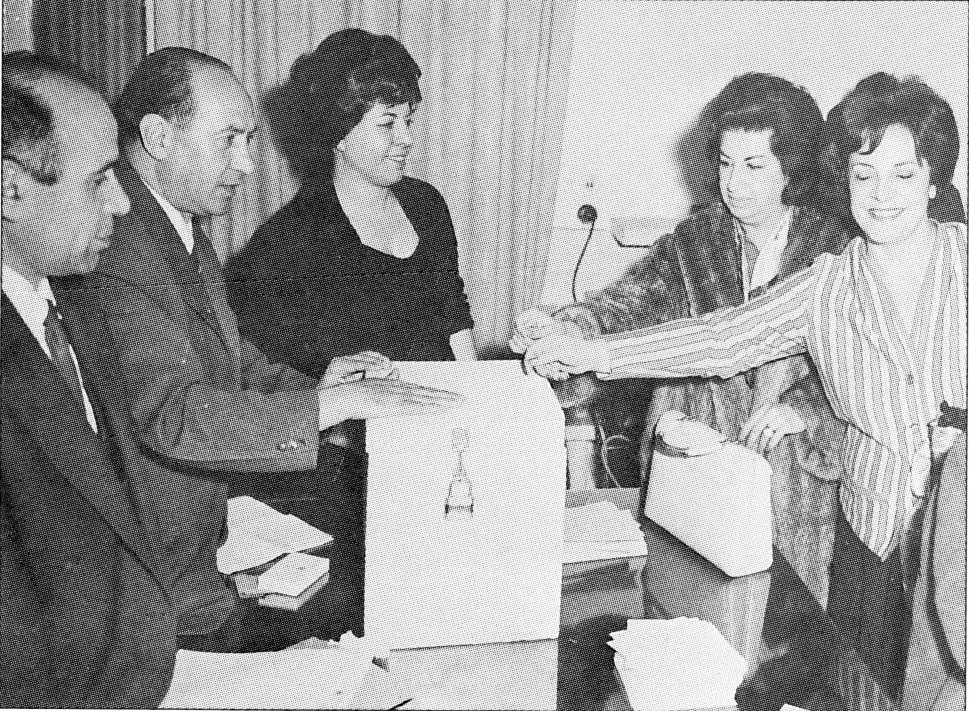
Women were not officially allowed to vote, but were set up to vote at their own balloting counters and dedicated boxes, at the suggestion of Ministry of Agriculture Hasan Arsanjani. The results gave Iranian women the right to vote.
Criticism
Despite the apparent benign nature of the proposals in the referendum, there was significant opposition.{{cite book |author=Elton L. Daniel |author-link=Elton L. Daniel |title=The History of Iran
Ayatollah Ruhollah Khomeini called for boycotting the referendum as "un-Islamic".
National Front boycotted the referendum, criticizing that the measures did not come from the parliament.
Voters were asked six questions, but had only the option to vote yes or no to the total package.
The ballots for 'Yes' were white, while the negative ones were green.
Similar to the previous referendum, polling places lacked secrecy and there were two separate voting booths: one for the supporters and one for the opponents. "No sane man would enter the opposition booth", according to Mohammad Gholi Majd.
Party policies
| Position | Organization | Ref | |
|---|---|---|---|
| Nationalists’ Party | |||
| People's Party | |||
| Pan-Iranist Party | |||
| National Front | |||
| Freedom Movement |
Results
| Choice | Votes | % | Registered voters | **6,098,277** | — | ||
|---|---|---|---|---|---|---|---|
| For | 5,589,711 | 99.9 | |||||
| Against | 4,115 | 0.1 | |||||
| Abstain | 0 | 0 | |||||
| **Total votes** | **5,593,826** | **100** | |||||
| Source: Nohlen *et al.* and Zonis |
Aftermath
Following the referendum, dissension and riots broke out in almost all major urban areas, most significantly in Tehran and Qom. The Shah gave orders for the immediate suppression of the opposition. The National Front, the Freedom Movement, the Tudeh Party, as well as religious activists were imprisoned. The unrest made Ayatollah Ruhollah Khomeini the regime's principal opponent in the minds of many Iranians.
References
References
- Lloyd Ridgeon. (2005). "Religion and Politics in Modern Iran: A Reader". I.B.Tauris.
- (2004). "Women in Iran from 1800 to the Islamic Republic". University of Illinois Press.
- Edward Willett. (2003). "Ayatollah Khomeini". The Rosen Publishing Group.
- E. A. Bayne. (1965). "Four Ways of Politics: State and Nation in Italy, Somalia, Israel, Iran: The Dynamics of Political Participation as Exhibited in Four Countries Caught Up in the Process of Modernization". American Universities Field Staff.
- Majd, Mohammad Gholi. (2000). "Resistance to the Shah: Landowners and Ulama in Iran". University Press of Florida.
- (2013). "Iran Under the Ayatollahs (Routledge Revivals)". Routledge.
- (2001). "Elections in Asia: A Data Handbook". Oxford University Press.
- Marvin Zonis. (2015). "Political Elite of Iran". Princeton University Press.
This article was imported from Wikipedia and is available under the Creative Commons Attribution-ShareAlike 4.0 License. Content has been adapted to SurfDoc format. Original contributors can be found on the article history page.
Ask Mako anything about 1963 Iranian referendum — get instant answers, deeper analysis, and related topics.
Research with MakoFree with your Surf account
Create a free account to save articles, ask Mako questions, and organize your research.
Sign up freeThis content may have been generated or modified by AI. CloudSurf Software LLC is not responsible for the accuracy, completeness, or reliability of AI-generated content. Always verify important information from primary sources.
Report