From Surf Wiki (app.surf) — the open knowledge base
1962 Singaporean integration referendum
Referendum on the terms of integration of Singapore into the Federation of Malaysia
Referendum on the terms of integration of Singapore into the Federation of Malaysia
| Field | Value |
|---|---|
| country | Singapore |
| date | 1 September 1962 |
| title | **OPTION A** |
| I support merger giving Singapore autonomy in labour, education and other agreed matters as set out in Command Paper No. 33 of 1961, with Singapore citizens automatically becoming citizens of Malaysia. | |
| **OPTION B** | |
| I support complete and unconditional merger for Singapore as a state on an equal basis with the other eleven states in accordance with the Constitutional documents of the Federation of Malaya. | |
| **OPTION C** | |
| I support Singapore entering Malaysia on terms no less favourable than those given to the Borneo territories. | |
| yes_text | Option A |
| no_text | Option B |
| othertype | **Option C** |
| yes | 397,626 |
| no | 9,422 |
| other | 7,911 |
| invalid | 146,600 |
| electorate | 619,867 |
I support merger giving Singapore autonomy in labour, education and other agreed matters as set out in Command Paper No. 33 of 1961, with Singapore citizens automatically becoming citizens of Malaysia.
OPTION B I support complete and unconditional merger for Singapore as a state on an equal basis with the other eleven states in accordance with the Constitutional documents of the Federation of Malaya.
OPTION C I support Singapore entering Malaysia on terms no less favourable than those given to the Borneo territories.
A referendum on the terms of integration into the Federation of Malaya was held in Singapore on 1 September 1962. There were three options. At the time of the referendum, Singapore was a self-governing country since 1959, although the British Empire still controlled external relations.
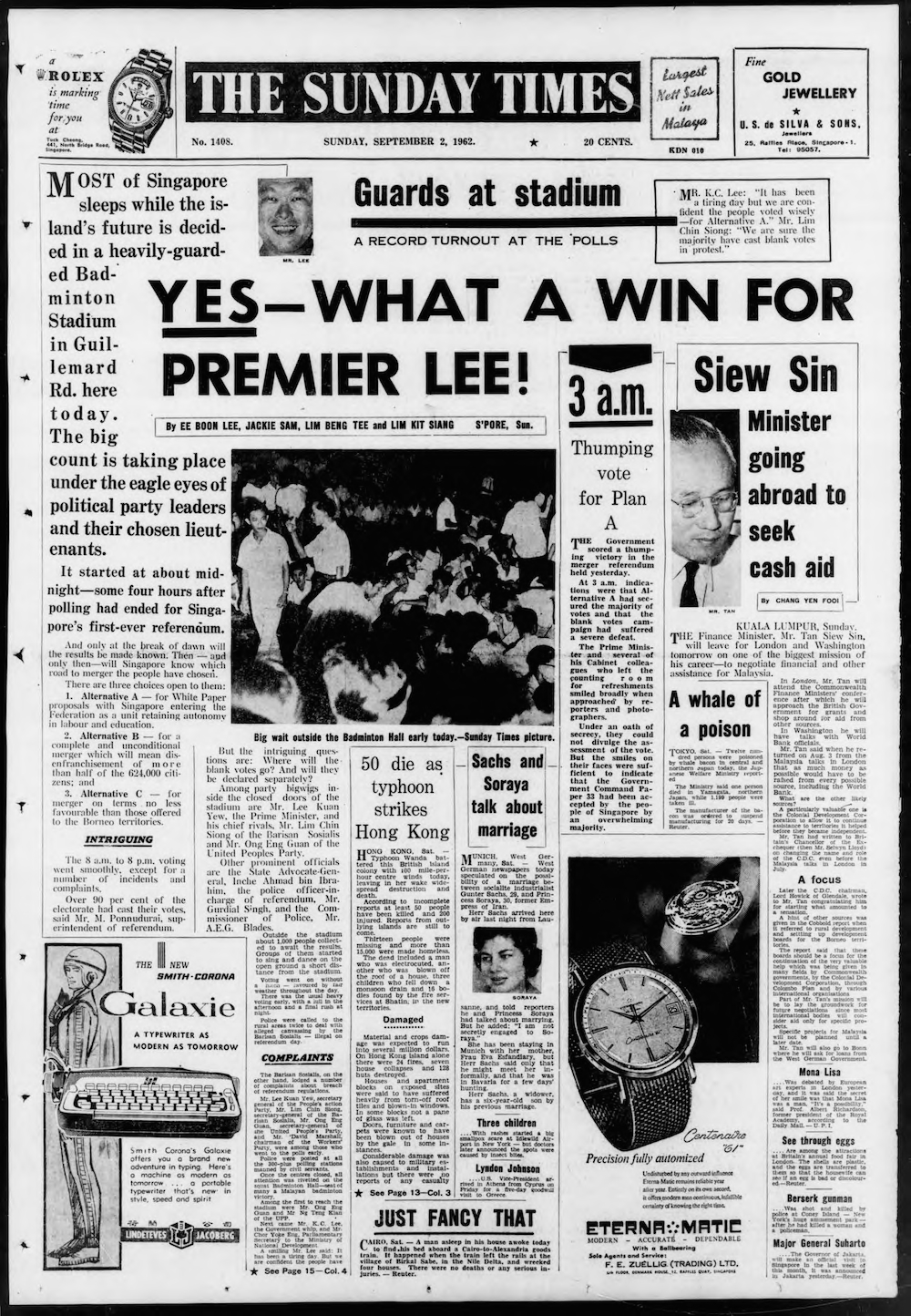
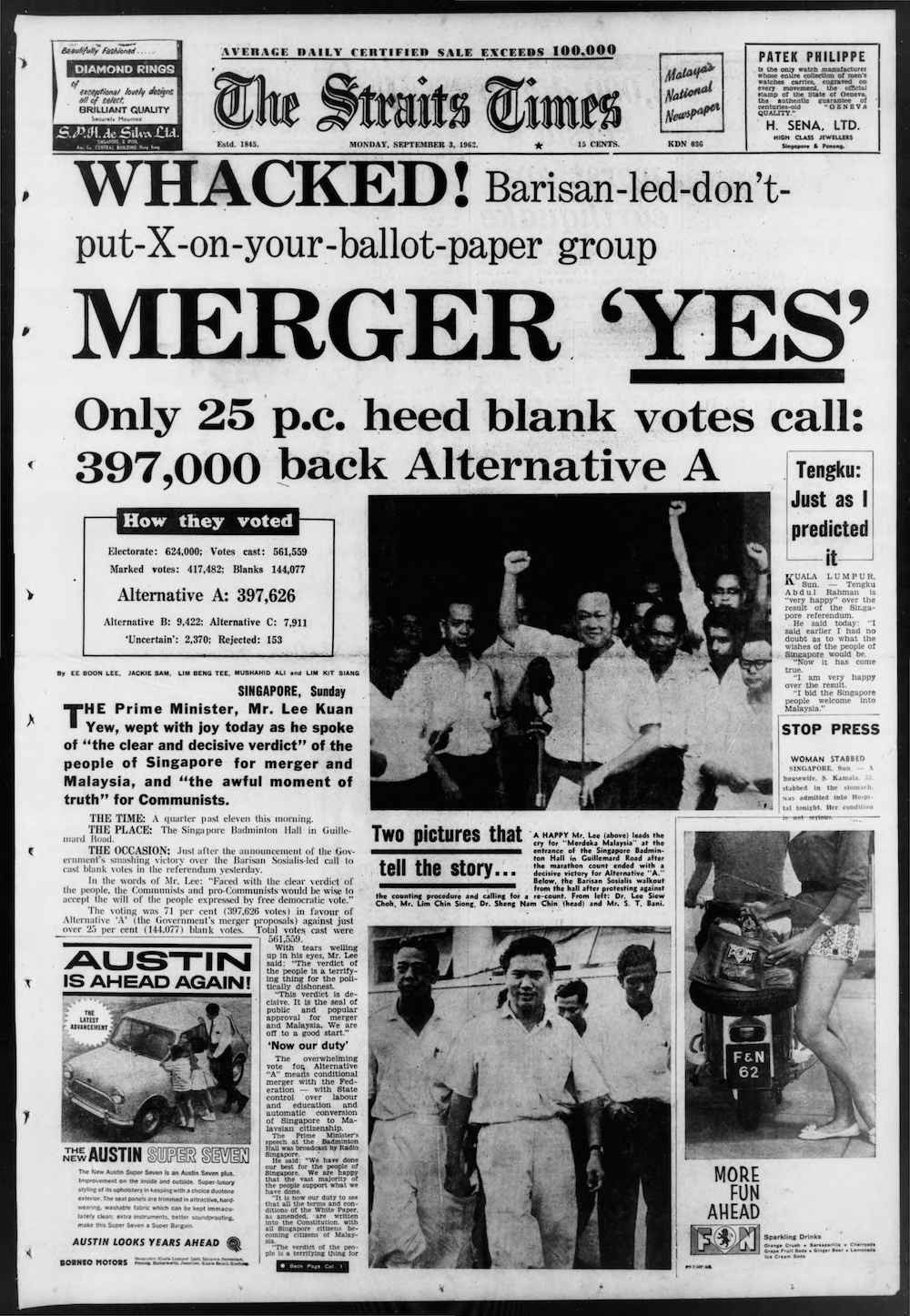
Option A, which provided for the highest level of autonomy with special status, was the option selected on nearly 96% of valid ballots. 26% of voters cast blank or invalid ballots – mostly the former – meaning that Option A was selected by 71% of those who participated in the referendum, or by 64% of registered voters. The high number of blank votes are due to an attempted boycott by the Barisan Sosialis (Socialist Front) as there was no option that rejected integration entirely.
With the results of the referendum, the states of Malaya, Singapore as well as the crown colonies of North Borneo and Sarawak merged to form the Federation of Malaysia. The union would prove tenuous due to various factors, and would end up lasting for just one year, ten months and 24 days before Singapore ultimately became a fully sovereign country.
Background
The first internal challenge to merger with the Federation of Malaya came from and grew out of a political struggle between the People's Action Party (PAP) and their opponents included the Barisan Sosialis (Socialist Front), the Liberal-Socialist Party, the Workers' Party, the United People's Party and the Partai Rakyat (People's Party).
In Singapore, the PAP sought formation of Malaysia on the basis of the strong mandate it obtained during the general elections of 1959 when PAP won 43 of the 51 seats. However, this mandate became questionable when dissension within the party led to a split. In July 1961, following a debate on a vote of confidence in the government, 13 PAP Assemblymen were expelled from the PAP for abstaining from voting. Subsequently, they formed a new political party, Barisan Sosialis, reducing the PAP's majority in the Legislative Assembly to 26 of the 51 seats.
The ruling PAP was not legally obliged to call for a referendum, but did so to secure the mandate of the people. However, the Barisan Sosialis, a left-wing socialist party consisting of former PAP members were alleged that the people did not support merger, but Lee Kuan Yew declared that people did.
The referendum did not have an option of objecting to the idea of merger because no one had legitimately raised the issue in the Legislative Assembly before then. However, the methods had been debatable. The referendum was therefore called to resolve the issue as an effort to decide objectively which option the people backed. The legitimacy of the referendum was often challenged by Singaporean left-wingers, due to the lack of an option to vote against the merger.
Council of Joint Action
The Council of Joint Action (CJA) founded by 19 members of the Assembly to block the merger and scuttle the referendum by taking the issue before the UN Committee on Colonialism. On 6 July 1962, The CJA signed a memorandum condemning the referendum on the grounds that the proposed constitutional changes and to assure its continued right to bases in Singapore, and to protect its privileged economic position. The CJA also criticized the terms, and the lack of choice in the referendum. In the memorandum, The CJA concluded that the transfer of sovereignty would be contrary to the spirit and resolution of the United Nations General Assembly's Declaration on the Granting of Independence to Colonial Countries and Peoples.
Proposed
| Option and symbols | Description of status |
|---|---|
| **Option A** | Singapore Singapore |
| **Option B** | Penang Penang (equivalent) |
| Flag of Malacca.svg Malacca (equivalent) | |
| **Option C** | (equivalent) |
| Flag of Sarawak (1947–1963).svg Sarawak (equivalent) |
Campaign
Strongly against the referendum, the Barisan Sosialis called for a boycott of the referendum, telling supporters to submit blank votes in protest of the "rigged" referendum. Over 144,000 blank votes were cast, over a quarter of all votes.
The mass media campaign fielded by both sides was extremely heated, many of the leaders on both sides broadcast radio shows in several languages.
Results
| Choice | Votes | % |
|---|---|---|
| Option A | 397,626 | 95.82 |
| Option B | 9,422 | 2.27 |
| Option C | 7,911 | 1.91 |
| **Total votes** | **414,959** | **100** |
| Valid votes | 414,959 | 73.89 |
| Invalid votes | 153 | 0.03 |
| Blank votes | 144,077 | 25.66 |
| Unclear votes | 2,370 | 0.42 |
| **Total votes cast** | **561,559** | **100** |
| Registered voters/turnout | 619,867 | 90.59 |
| Source: [Direct Democracy](http://www.sudd.ch/event.php?lang=en&id=sg011962) |
Aftermath
Backed by the official mandate, the Agreement relating to Malaysia between the United Kingdom of Great Britain and Northern Ireland, Federation of Malaya, North Borneo, Sarawak and Singapore was signed on 9 July 1963.
Singapore entered into merger with Malaya on 16 September 1963, marking the birth of Malaysia. However, this union would be short-lived due to constant disagreements between the central government of Malaysia and the state government of Singapore. With the Independence of Singapore Agreement 1965, Singapore ceased to be a state of Malaysia on 9 August 1965 when it became a fully sovereign independent country.
Notes
References
References
- de
- (2 September 1962). "Yes – What a win for Premier Lee". [[Singapore Press Holdings]].
- (3 September 1962). "Merger "Yes"". [[Singapore Press Holdings]].
- Singapore Legislative Assembly Debates, 24 November 1961, pp689–692
- ''Lee Kuan Yew, The Singapore Story: Memoirs of Lee Kuan Yew'' (Singapore: Singapore Press Holdings, 1998) p393
- [https://www.sudd.ch/doku.php?lang=en&item=sg011962-zettel.jpg Image of ballot paper], Database and Search Engine for Direct Democracy
- The UK Statute Law Database: Formation of the [[Malay States]] and of the [http://www.legislation.gov.uk/ukpga/Eliz2/5-6/60/contents Settlements of Penang and Malacca] into a new independent Federation of States under [[Constitution of Malaysia. Federation of Malaya Constitution]].
- That move had been anticipated by the ruling PAP government, as seen by the insertion of a clause that stated that all blank would be counted as a vote for the option that wins the most votes if there was no outright majority or that blank votes would be counted as Option A.Singapore National Referendum Ordinance 1961.
- link. (28 June 2017 and the Acts of the Parliament of the United Kingdom [http://www.legislation.gov.uk/ukpga/1966/29/contents Singapore Act 1966].)
This article was imported from Wikipedia and is available under the Creative Commons Attribution-ShareAlike 4.0 License. Content has been adapted to SurfDoc format. Original contributors can be found on the article history page.
Ask Mako anything about 1962 Singaporean integration referendum — get instant answers, deeper analysis, and related topics.
Research with MakoFree with your Surf account
Create a free account to save articles, ask Mako questions, and organize your research.
Sign up freeThis content may have been generated or modified by AI. CloudSurf Software LLC is not responsible for the accuracy, completeness, or reliability of AI-generated content. Always verify important information from primary sources.
Report