From Surf Wiki (app.surf) — the open knowledge base
1953 Atlantic hurricane season
none
none
| Field | Value |
|---|---|
| Basin | Atl |
| Year | 1953 |
| Track | 1953 Atlantic hurricane season summary map.png |
| First storm formed | May 25, 1953 |
| Last storm dissipated | December 9, 1953 |
| Strongest storm name | Carol |
| Strongest storm winds | 140 |
| Strongest storm pressure | 929 |
| Total depressions | 19 |
| Total storms | 14 |
| Total hurricanes | 7 |
| Total intense | 3 |
| Fatalities | 14+ |
| Damages | 3.75 |
| Average wind speed | 1 |
| five seasons | [1951](1951-atlantic-hurricane-season), [1952](1952-atlantic-hurricane-season), **1953**, [1954](1954-atlantic-hurricane-season), [1955](1955-atlantic-hurricane-season) |
| East Pacific season | 1953 Pacific hurricane season |
| West Pacific season | 1953 Pacific typhoon season |
| North Indian season | 1950s North Indian Ocean cyclone seasons |
The 1953 Atlantic hurricane season was an active season, with fourteen tropical storms, seven of which developed into hurricanes; three of the hurricanes attained major hurricane status (Category 3 or greater on the Saffir-Simpson scale). This was the first season in which an official list of female names was used to name storms in the basin. The season officially began on June 15, and lasted until November 15, although activity occurred both before and after the season's limits.
The strongest hurricane of the season was Carol, although by the time it struck Atlantic Canada it was much weaker. Both hurricanes Barbara and Florence struck the United States; the former crossed the Outer Banks and impacted much of the east coast, and Florence struck a sparsely populated region of the Florida Panhandle without causing much damage. Bermuda was threatened by three hurricanes within two weeks. In addition to the hurricanes, Tropical Storm Alice developed in late May and left several fatalities in Cuba. The final hurricane of the season, Hazel, produced additional rainfall in Florida after previous flooding conditions. The season's last tropical storm, Irene, dissipated north of the Lesser Antilles on December 9.
Timeline
ImageSize = width:800 height:210 PlotArea = top:10 bottom:80 right:20 left:20 Legend = columns:3 left:30 top:58 columnwidth:270 AlignBars = early
DateFormat = dd/mm/yyyy Period = from:01/05/1953 till:01/01/1954 TimeAxis = orientation:horizontal ScaleMinor = grid:black unit:month increment:1 start:01/05/1953
Colors = id:canvas value:gray(0.88) id:GP value:red id:TD value:rgb(0.43,0.76,0.92) legend:Tropical_Depression_=≤38_mph(≤62_km/h) id:TS value:rgb(0.3,1,1) legend:Tropical_Storm_=39–73_mph(63–117_km/h) id:C1 value:rgb(1,1,0.85) legend:Category_1_=74–95_mph(118–153_km/h) id:C2 value:rgb(1,0.85,0.55) legend:Category_2_=96–110_mph(154–177_km/h) id:C3 value:rgb(1,0.62,0.35) legend:Category_3_=111–129_mph(178–208_km/h) id:C4 value:rgb(1,0.45,0.54) legend:Category_4_=130–156_mph(209–251_km/h) id:C5 value:rgb(0.55,0.46,0.90) legend:Category_5_=≥157_mph(≥252_km/h)
Backgroundcolors = canvas:canvas
BarData = barset:Hurricane bar:Month
PlotData=
barset:Hurricane width:10 align:left fontsize:S shift:(4,-4) anchor:till from:25/05/1953 till:07/06/1953 color:TS text:"Alice (TS)" from:11/07/1953 till:15/07/1953 color:TS text:"Two (TS)" from:11/08/1953 till:15/08/1953 color:C1 text:"Barbara (C1)" from:28/08/1953 till:09/09/1953 color:C5 text:"Carol (C5)" from:29/08/1953 till:01/09/1953 color:TS text:"Five (TS)" from:08/09/1953 till:12/09/1953 color:C1 text:"Dolly (C1)" from:15/09/1953 till:18/09/1953 color:C3 text:"Edna (C3)" barset:break from:15/09/1953 till:21/09/1953 color:TS text:"Eight (TS)" from:23/09/1953 till:27/09/1953 color:C3 text:"Florence (C3)" from:02/10/1953 till:12/10/1953 color:C1 text:"Gail (C1)" from:03/10/1953 till:06/10/1953 color:TS text:"Eleven (TS)" from:07/10/1953 till:10/10/1953 color:C1 text:"Hazel (C1)" from:23/11/1953 till:26/11/1953 color:TS text:"Thirteen (TS)" from:07/12/1953 till:09/12/1953 color:TS text:"Irene (TS)"
bar:Month width:5 align:center fontsize:S shift:(0,-20) anchor:middle color:canvas from:01/05/1953 till:01/06/1953 text:May from:01/06/1953 till:01/07/1953 text:June from:01/07/1953 till:01/08/1953 text:July from:01/08/1953 till:01/09/1953 text:August from:01/09/1953 till:01/10/1953 text:September from:01/10/1953 till:01/11/1953 text:October from:01/11/1953 till:01/12/1953 text:November from:01/12/1953 till:31/12/1953 text:December TextData = pos:(570,30) text:"(From the" pos:(617,30) text:"Saffir-Simpson scale)"
Systems
Tropical Storm Alice
|1-min winds=60 In May and June 1953, an unusually long-lasting upper-level low persisted across Mexico and Central America. On May 25, a weak warm-core surface circulation developed east of Nicaragua. It moved around the upper-level low, bringing it to the northwest and later looping to the south through Honduras and Central America. The system weakened over land, but it re-intensified over the western Caribbean Sea, moving over western Cuba as a 50 mph tropical storm on May 31. Advisories for Alice did not begin until June 1, when the storm entered the Gulf of Mexico. Alice was the first North Atlantic tropical cyclone to have a female name. Around the time of the cyclone's naming, reconnaissance aircraft reported winds of around 65 mph, and subsequently Alice executed another loop off the northwest coast of Cuba. Alice weakened quickly to minimal tropical storm status, due to interaction with a cold front off Florida. It deteriorated so much that advisories were discontinued, with Miami Weather Bureau meteorologist James George remarking that "no danger [existed there] whatsoever." After again passing near the Cuban coast, Alice turned to the northwest and began re-strengthening. On June 5, reconnaissance aircraft estimated 70 to winds in brief squalls northeast of the center, along with a pressure of 997 hPa; this would be its peak intensity. The storm again weakened as it approached the Florida peninsula, and Alice made landfall just west of Panama City Beach on June 6 as a minimal tropical storm. It dissipated shortly thereafter.
While the storm was in the vicinity of western Cuba, it produced heavy rainfall, which broke a nine-month drought. The rainfall caused flooding, and there were unconfirmed reports of several deaths due to drowning. When advisories first began on the storm, the National Hurricane Center issued storm warnings from Key West through Tarpon Springs on the west coast of Florida; at the same time, the agency posted small craft warnings for the east coast up through Palm Beach. Alice brought heavy rainfall to Florida, peaking at 13.48 in in Lake Placid in the central portion of the state. The rains ended a dry spell in the state. Along the Florida panhandle, workers tied down planes in local Air Force and Naval bases. The primary impact was in the form of light rain. Alice quickly weakened due to a cold front, and advisories were discontinued by June 3. While near Cuba, Alice produced drought-breaking rainfall that caused flooding and several unofficial drowning deaths.
Tropical Storm Two
|1-min winds=40 A tropical depression developed over southwestern Florida on July 11. It moved northeastward toward a trough across northern Florida. The depression intensified into a tropical storm on July 12 and reached peak winds of 45 mph (75 km/h). On July 15, the storm began interacting with a nearby cold front, signaling that it transitioned into an extratropical storm. On the next day, the storm brushed Nantucket with 31 mph winds before the storm was absorbed by the front.
Hurricane Barbara
Main article: Hurricane Barbara (1953)
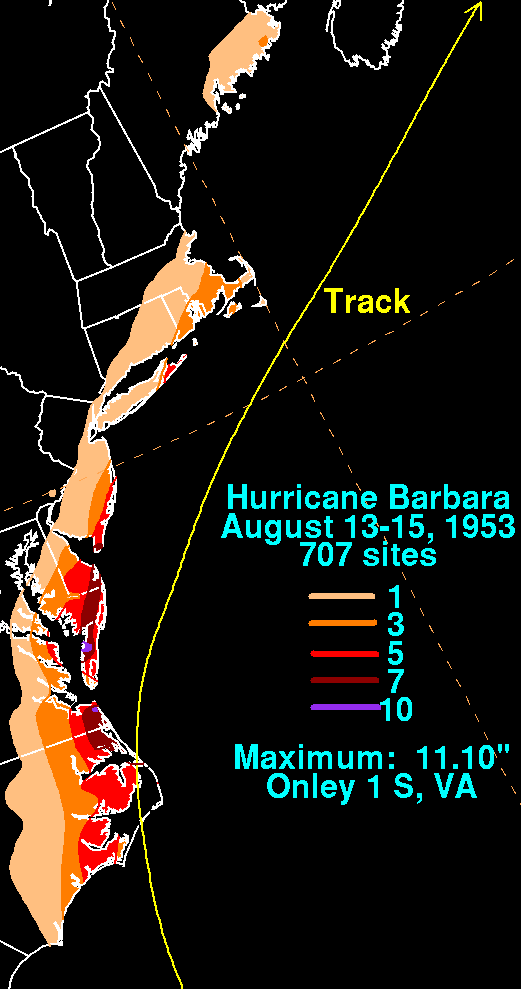
|1-min winds=80 A tropical wave developed into Tropical Storm Barbara over the Bahamas on August 11. It intensified as it moved north-northwestward, becoming a hurricane by the next day, and reaching peak winds of 90 mph (150 km/h) just south of Cape Hatteras on August 13. Barbara moved over the Outer Banks, passing between Morehead City and Ocracoke, and it turned and accelerated to the northeast. Steadily weakening and losing tropical characteristics, the hurricane transitioned into an extratropical cyclone late on August 15. It turned northward, crossing eastern Nova Scotia and dissipating over Labrador on August 16.
Before Barbara struck the Outer Banks, officials ordered evacuations for a few islands, and several thousand tourists voluntarily left the region. Wind gusts reached 90 mph at Hatteras and Nags Head. Torrential rainfall fell across the state and extended northward into Virginia, peaking at 11.1 in near Onley along the Eastern Shore of Virginia. Across the region, the hurricane left flooding and downed trees, some of which survived the Great Atlantic Hurricane of 1944. Monetary damage from Barbara was estimated around $1.3 million (1953 USD, $ USD), mostly from the crop damage. Newspaper reports indicated there were seven deaths in the country; two additional deaths occurred offshore Atlantic Canada when a dory sunk.
Hurricane Carol
|1-min winds=140 Main article: Hurricane Carol (1953)
On August 28, a tropical wave developed into a tropical depression near Cape Verde. After moving west-southwestward, it turned to the northwest, intensifying into a tropical storm on August 31 and into a hurricane on September 2. Passing northeast of the Lesser Antilles, Carol rapidly intensified to Category 5 intensity, reaching peak winds of 160 mph (260 km/h) on September 3, making it the strongest hurricane of the season. It gradually weakened, bypassing Bermuda on September 6 and producing high waves. Carol later turned to the north-northeast, brushing Cape Cod and causing boating accidents across New England. Four people were killed in the region. Fishing losses totaled around $1 million (1953 USD, $ USD).
After bypassing New England, Carol brushed western Nova Scotia before moving ashore near Saint John, New Brunswick as a minimal hurricane. As the storm moved ashore, it produced hurricane conditions in eastern Maine, one of only six Atlantic hurricanes to do so. In Nova Scotia, several boats were wrecked or washed ashore, with one drowning death reported. High seas caused coastal flooding, while strong winds downed large areas of trees. Heavy losses to the apple crop occurred in Annapolis Valley, totaling $1 million (1950 CAD, $ USD). Carol later dissipated southwest of Greenland on September 9.
Tropical Storm Five
|1-min winds=35 On August 29, a tropical storm developed over southern Florida. While moving through the state, the storm dropped heavy rainfall, reaching 4.67 in at Fort Lauderdale Beach; similar rainfall was observed in the northern Bahamas. Described by one Weather Bureau forecaster as "wide and flat", the storm gradually organized over the western Atlantic Ocean. On August 31, the storm turned to the northwest, with maximum sustained winds of 40 mph (65 km/h). The system weakened to a tropical depression before moving ashore near Savannah, Georgia on September 1. It dissipated that day over land.
Hurricane Dolly
|1-min winds=65 The origins of Dolly were from a tropical wave that moved through the eastern Caribbean Sea, producing 10 in in Saint Thomas in the U.S. Virgin Islands. The rains closed schools and government buildings around San Juan, Puerto Rico, and flooding was reported in Guayama, Yabucoa, and Patillas. On September 8, a tropical storm developed north of Puerto Rico, which moved slowly west-southwestward before turning to the north. It quickly intensified, and after Hurricane Hunters reported an eye, Dolly reached hurricane status on September 9. At that time, hurricane warnings were issued in the Bahamas, although the storm turned away from the archipelago. It intensified to peak winds of 75 mph (120 km/h) on September 10, as reported by aircraft.
Dolly weakened as it accelerated northeastward, although it still threatened to strike Bermuda with strong winds. As a result, the United States Air Force ordered all of the planes on the island to fly to the mainland. After continued weakening, Dolly passed over the island on September 11, producing only gale-force winds, rains, and little to no damage. It deteriorated into a tropical storm on September 12 and transitioned into an extratropical cyclone later that day. The remnants of Dolly later turned eastward, dissipating just west of Portugal on September 17.
Hurricane Edna
|1-min winds=100 Shortly behind Dolly, another tropical wave spawned a tropical depression over the Lesser Antilles on September 15. As it moved through the region, it produced unsettled conditions across the northeast Caribbean. Edna quickly intensified as it tracked northwestward, attaining hurricane status on September 15 and peak winds of 115 mph (185 km/h) the next day. After peaking, the hurricane turned to the northeast and maintained most of its intensity for a few days. It passed just north of Bermuda early on September 18 with winds of 115 mph (185 km/h), before beginning a steady weakening trend as it accelerated. By September 19, Edna completed the transition into an extratropical cyclone, lasting another day before dissipating west of Ireland.
Before Edna struck Bermuda, the islanders were well-prepared due to being previously impacted by hurricanes Carol and Dolly, and they boarded up their homes. The hurricane caused "considerable damage", with wind gusts reaching 120 mph. The winds downed trees, blocking roads, and also caused disruptions to the power and water services. During its passage, Edna produced heavy rainfall and also damaged several roofs. There were three injuries on the island.
Tropical Storm Eight
|1-min winds=45 A tropical depression formed in the central Gulf of Mexico on September 15 and moved northeastward. The storm produced heavy seas across the region, which damaged two small boats. The storm reached peak winds of 50 mph (75 km/h) while moving in a small clockwise loop southeast of Louisiana. The storm weakened into a tropical depression on September 17, but re-intensified to a tropical storm three days later. On September 20, the storm moved ashore in Taylor County, Florida and dissipated the next day over the state, bringing 2 to of rainfall to coastal areas.
Hurricane Florence
Main article: Hurricane Florence (1953)
|1-min winds=100 Florence developed on September 23 near Jamaica from a tropical wave. While passing that island, it produced heavy rainfall that blocked roads. It intensified to hurricane status on September 24 while passing through the Yucatán Channel, and while doing so left heavy damage in western Cuba. After turning north and entering the Gulf of Mexico, Florence quickly intensified to peak winds of 115 mph (185 km/h). It gradually weakened before making landfall on September 26 as a minimal hurricane in a sparsely populated region of the Florida Panhandle.
Before Florence hit the United States Gulf Coast, about 10,000 people evacuated Panama City, Florida, and the Weather Bureau issued timely warnings that was credited in preventing any deaths or major injuries. Winds reached 84 mph at Eglin Air Force Base, and the heaviest rainfall was 14.71 in in Lockhart, Alabama. The combination of winds and heavy rainfall left crop damage in the Florida panhandle and southeastern Alabama, although coastal damage was not severe. Overall, 421 houses were damaged and another three were destroyed, with monetary damage estimated around $200,000 (1953 USD, $ USD). After landfall, Florence quickly transitioned into an extratropical cyclone, and as it continued across the southeastern United States it produced moderately heavy rainfall. It dissipated on September 28 southeast of New England.
Hurricane Gail
|1-min winds=70 On October 2, a tropical wave spawned a tropical depression about 815 mi (1310 km) west-southwest of the Cape Verde islands. The depression quickly intensified into Tropical Storm Gail, and the next day, a ship encountered the storm, reporting a minimum pressure of 986 mbar (29.12 inHg). As the ship crossed through the center, it reported winds of 80 mph (130 km/h), indicating Gail attained hurricane status. Initially, the Weather Service believed that Gail dissipated and a new storm formed in the same region on October 5, but a reanalysis in 2015 indicated that they were the same storm. The confusion resulted from Gail turning to the northeast on October 4, steered by an approaching trough. On October 6, Gail turned back to the west-northwest, remaining a moderate tropical storm for several days. On October 11, the cold front that absorbed Hurricane Hazel turned Gail to the north, and absorbed it the next day in the central Atlantic.
Tropical Storm Eleven
|1-min winds=40 On October 3, a tropical storm developed near the southern coast of Cuba. It moved northwestward, crossing the island before turning to the northeast. Early on October 5, the storm brushed southeastern Florida, producing gusty winds and rainfall. The threat of the storm prompted small craft warnings from the Florida Keys through South Carolina. As it accelerated northeastward, the storm strengthened slightly to maximum sustained winds of 45 mph (75 km/h), before becoming extratropical on October 6. Two days later, the remnants moved over Atlantic Canada with winds of 70 mph (120 km/h), producing flooding rainfall that washed out several roads. The storm caused two deaths after it wrecked a boat in Broad Cove, Nova Scotia. Later, the cyclone passed south of Greenland before dissipating southwest of Iceland on October 10.
Hurricane Hazel
|1-min winds=75 The twelfth tropical storm and the final hurricane of the season formed in the Yucatán Channel on October 7. Given the name Hazel, the storm tracked north-northeastward, then northeastward through the Gulf of Mexico while gradually intensifying. On October 9, Hazel strengthened into a hurricane and made landfall just north of Fort Myers, Florida at its peak intensity of 85 mph (140 km/h). The storm crossed the state in about six hours, during which it weakened slightly back to a tropical storm. Over the western Atlantic Ocean, Hazel re-intensified to its peak winds, although by late on October 10 it transitioned into an extratropical storm between North Carolina and Bermuda. The remnants continued northeastward, dissipating southeast of Newfoundland on October 12. On Sable Island, the storm produced heavy winds and rain.
Due to the fairly light winds across Florida, damage from Hazel was minor, estimated around $250,000 (1953 USD, $ USD). During its passage, the storm spawned a tornado in St. James City that destroyed several homes, and there were indications of another tornado in Okeechobee City. The primary impact from Hazel was from its rainfall, peaking at 10.53 in in Daytona Beach. The rains added to previous flooding conditions across the state, causing a record flood stage along the St. Johns River that flooded 6 mi of highway. Overall flooding damage was estimated up to $10 million (1953 USD, $ USD), but it was impossible to determine how much was due to Hazel.
Tropical Storm Thirteen
|1-min winds=45 A tropical storm developed from a dissipating cold front on November 23, about 460 mi (740 km) northeast of Barbuda in the Lesser Antilles. It moved northeastward, strengthening to peak winds of 50 mph (85 km/h) on November 24. It later turned sharply to the west as it began a weakening trend, followed by a curve to the north. The cyclone dissipated on November 26 about 450 mi (725 km) east-northeast of Bermuda, without ever affecting land.
Tropical Storm Irene
|1-min winds=55 The final tropical cyclone of the season developed on December 7 about 705 mi (1735 km) east-northeast of the Lesser Antilles, from the end of a dissipating cold front. Given the name Irene, the storm moved to the northwest and later to the west. Based on ship observations, it is estimated that Irene intensified to a peak of 65 mph (100 km/h) on December 8, before weakening the next day. Late on December 9, Irene dissipated about 270 mi (435 km) north of the Lesser Antilles.
Storm names
The following list of names was used for named storms that formed in the North Atlantic in 1953. This was the first season in which systems that attained at least tropical storm status were given female names. This list was used again the following season, except for Gail, which was replaced with Gilda, due to the former name's confusion with the term gale.
References
References
- Staff Writer. "Tiny Hurricane Training Medium for Observers". The Times-News.
- Staff Writer. (1954-11-14). "Hurricane Season Closes Tonight, Scores Better Than Average". Sarasota Herald-Tribune.
- Grady Norton. (1953). "Hurricanes of 1953". [[National Oceanic and Atmospheric Administration]].
- (1953-06-01). "Season's First Storm Develops in Gulf as Winds Increase Rate". [[The Florence Times]].
- United Press International. (1953-06-01). "Tropical Storm Whips Cuban Coast". [[Reading Eagle]].
- United Press International. (1953-06-03). "Cold Gulf Air Cools 'Cane Alice". [[Sarasota Herald-Tribune]].
- Staff Writer. (1953-06-03). "Storm 'Alice' Fizzles in Gulf". Palm Beach Post.
- United Press International. (1953-06-07). "Florida Storm Buffets Beaches". [[Sarasota Herald-Tribune]].
- United Press International. (1953-06-03). "Cold Gulf Air Cools 'Cane Alice". [[Sarasota Herald-Tribune]].
- Staff Writer. (1953-06-03). ["Storm 'Alice' Fizzles in Gulf"](https://news.google.com/newspapers?id=tX4yAAAAIBAJ&pg=6518,1138090&dq=tropical+storm+alice&hl=en}}{{Dead link). Palm Beach Post.
- Chris Landsea. (May 2018). "Documentation of Atlantic Tropical Cyclones Changes in HURDAT (1953)". Hurricane Research Division.
- R. P. James and C. F. Thomas. (August 1953). "Hurricane Barbara, 1953". National Hurricane Center.
- Staff Writer. (1953-08-13). ["Vacationers Flee Carolina Hurricane"](https://news.google.com/newspapers?id=uXIxAAAAIBAJ&pg=6109,7880869&dq=hurricane&hl=en}}{{Dead link). The Milwaukee Sentinel.
- David M. Roth. (2011-02-07). "Rainfall Summary of Hurricane Barbara". Hydrometeorological Prediction Center.
- Staff Writer. (1953-08-15). "Storm Turns Out to Sea, 7 Lose Lives". The Miami News.
- Staff Writer. (1953-08-14). "Hurricane Veers into Atlantic After Killing 7 Along Coast". The Daily Times.
- Canadian Hurricane Centre. (2010-11-09). "1953-Barbara".
- Staff Writer. (1953-09-05). "Edge of Hurricane Buffets Bermuda". The Pittsburgh Press.
- Staff Writer. (1953-09-07). "Four New England Drownings Due to Carol". Lawrence Journal.
- (2010-09-14). "1953-Carol". Canadian Hurricane Centre.
- Hurricane Research Division. (December 2010). "Chronological List of All Hurricanes which Affected the Continental United States: 1851-2010". National Oceanic and Atmospheric Administration.
- Staff Writer. (1953-08-29). "Another Area of Suspicion Found on Florida Coast". Times Daily.
- Staff Writer. (1953-09-10). "Rain Part of Tropical Storm in Area". The Virgin Islands Daily News.
- Staff Writer. (1953-09-12). "New Storm Bears Down on Bermuda". Schenectady Daily Times.
- (May 2007). "Hurricanes - General Information for Bermuda". Bermuda Weather Service.
- Staff Writer. (1953-09-14). "Atlantic Storm Gathers Force". The Victoria Advocate.
- Staff Writer. (1953-09-18). "Bodacious Edna Blasts Bermuda". St. Petersburg Times.
- Staff Writer. (1953-09-18). "Hurricane Hits Bermuda, Moves On To Shipping Lanes". The Miami News.
- Staff Writer. (1953-09-15). "Tropical Storm Believed Brewing in Gulf of Mexico". The Victoria Advocate.
- Staff Writer. (1953-09-24). "Jamaica Warned of Nearby Hurricane". St. Joseph Gazette.
- David Longshore. (2008). "Encyclopedia of hurricanes, typhoons, and cyclones". Facts on File, Inc..
- E. L. Quarantelli. (May 1982). "Inventory of Disaster Field Studies in the Social and Behaviroal Sciences 1919 - 1979". University of Delaware.
- Staff Writer. (1953-09-27). "Hurricane Florence Dies Over Northwest Florida". St. Petersburg Times.
- David M. Roth. (2008-09-23). "Hurricane Florence - September 24-28, 1953". Hydrometeorological Prediction Center.
- Staff Writer. (1953-10-04). "Hurricane Gail Is Found Week Off U. S. Coast". The Tampa Tribune.
- (2009-11-09). "1953-NN-3". Environment Canada.
- (2009-11-09). "Hazel-1953". Environment Canada.
- David M. Roth. (2010-08-17). "Tropical Storm Hazel - October 6-10, 1953". Hydrometeorological Prediction Center.
- Gary Padgett. (June 2007). "History of the Naming of Atlantic Tropical Cyclones, Part 1 - The Fabulous Fifties". Australian Severe Weather.
- (September 10, 1954). "Plenty of Names Left for Hurricane Season". The Victoria Advocate.
This article was imported from Wikipedia and is available under the Creative Commons Attribution-ShareAlike 4.0 License. Content has been adapted to SurfDoc format. Original contributors can be found on the article history page.
Ask Mako anything about 1953 Atlantic hurricane season — get instant answers, deeper analysis, and related topics.
Research with MakoFree with your Surf account
Create a free account to save articles, ask Mako questions, and organize your research.
Sign up freeThis content may have been generated or modified by AI. CloudSurf Software LLC is not responsible for the accuracy, completeness, or reliability of AI-generated content. Always verify important information from primary sources.
Report