From Surf Wiki (app.surf) — the open knowledge base
1938 Amateur World Series
| Field | Value |
|---|---|
| country | Great Britain |
| image | John Moores Cup 1939.jpg |
| caption | The John Moores Cup |
| dates | 13–20 August |
| num_teams | 2 |
| venues | 5 |
| cities | 5 |
| champion | Great Britain |
| num_championships | 1 |
| second | United States |
| second-flagvar | 1912 |
| games | 5 |
| nextseason | [1939](1939-amateur-world-series) |
| second-flagvar = 1912 The 1938 Amateur World Series was the inaugural Amateur World Series, the first edition of the tournament that would eventually become the Baseball World Cup. Originally known as the John Moores Cup, it was contested by the United States and Great Britain over a series of five games from August 13 to 20 in five different cities in England. The tournament was won by Great Britain, four games to one.
Two future Major League Baseball players, Mike "Lefty" Schemer and Mizell "Whitey" Platt, participated in the tournament on the United States team.
It was Britain's last international gold medal in baseball for 87 years, when the national under-23 team won the 2025 European Under-23 Baseball Championship.
Background
After managing to include baseball as a demonstration sport at the 1936 Berlin Olympics, International Baseball Federation (IBF) president Leslie Mann, sought to establish an international tournament for national teams (which, at that time, were entirely composed of non-professional amateur players, in the spirit of the Olympics). Mann had first tried to set up a tournament between the national teams of the United States and Japan in 1937, but was prevented by the outbreak of the Second Sino-Japanese War that same year.
Instead, Mann wrote to John Moores, president of the British National Baseball Association (the precursor to the modern British Baseball Federation) to organize a tournament between the U.S. and Great Britain teams. Though baseball was not overwhelmingly popular in Britain, Moores' efforts to develop baseball in Britain had earned the admiration of many prominent American baseball executives, including National League president John Heydler.
Moores had established a friendly working relationship with the U.S Amateur Baseball Congress (USABC) sent six players across the Atlantic as baseball instructors the year before. Mann had long hoped to establish an international tournament "that would be emblematical of the World's title, the same as the Davis Cup is to Tennis; the Ryder Cup to Golf; the Stanley Cup to Hockey."
The USABC held trials for the United States national team in Lincoln, Nebraska, with over fifty young players in attendance. England selected their team mostly from the professional Yorkshire-Lancashire League, which in those days was attracting crowds of 10,000 people, though many of the players were Canadian. Until the advent of the Canadian Citizenship Act, 1946, Canadians had the status of British subjects and would be eligible to compete for Great Britain.
Participants
Venues
| City | Stadium | |
|---|---|---|
| {{Location map+ | England | |
| [[File:Location dot red.svg | 15px]] Liverpool | Wavertree Stadium |
| [[File:Location dot green.svg | 15px]] Kingston upon Hull | Old Craven Park |
| [[File:Location dot blue.svg | 15px]] Rochdale | Spotland Stadium |
| [[File:Location dot orange.svg | 15px]] Halifax | The Shay |
| [[File:Location dot purple.svg | 15px]] Leeds | Headingley Stadium |
Tournament summary
Game 1
The first "test match" was played at Wavertree Stadium in Liverpool on August 13. Before a crowd of 10,000, Canadian-born ace Ross Kendrick struck out 16 American batters, out-dueling curveballer Virgil Thompson. Britain's Danny Wright hit a home run in the seventh inning; in the eighth, Sam Hanna doubled off of Thompson to knock in Sid Bissett, and Larry Marsh singled to bring in player-manager McNeil for a 3–0 Great Britain win.
Game 2
On August 15, the series moved to Old Craven Park in Kingston upon Hull, the home of Hull Kingston Rovers rugby league club. The US opened the scoring with two runs from George Binger and Tommy O'Rourke. Great Britain's Danny Cadorette scored in the second, and a five-run fifth inning, highlighted by a two-run homer by shortstop Sam Hanna, saw Britain firmly take the lead. The U.S. scored two more runs in the seventh and eighth, but a rally in the ninth was cut short when O'Rourke was caught out, leaving two men on base, and delivering Britain the 8–6 win and putting them on the cusp of a series victory.
Game 3
The third game of the series was played at Spotlands, home of Rochdale A.F.C., and turned out to be the United States' sole victory. However, this game attracted only about 1,000 spectators, due to uncertain weather and the lack of Britain's U.S.-born players. The U.S. shut out Great Britain 5–0, in a game noted for its defensive plays on the side of the Americans.
Game 4
The best-of-five series then moved to The Shay in Halifax, home of Halifax Town Football Club. Despite hopes of the biggest crowd to date, the game drew only 5,000 spectators. Again, Kendrick shone for the British side, striking out 12 and allowing only three singles. McNeil homered in the second to put Britain ahead. In the fourth, Hanna walked, Kendrick singled, Cadorette got on base through an error. Wright singled to bring home Hanna and Kendrick, then Benson singled to score Cadorette. Controversially, the game was called during the ninth inning due to bad light, giving Great Britain the 4–0 win and clinching the title.
Game 5
The fifth game of the series was played the next day in Leeds at the Headingley Stadium, the home of Leeds Rugby League Club. The game did not attract much interest, and Britain won 5–3 in six innings, after which the game was called due to rain.
Final standings
Rosters
{{bb|Great Britain}}
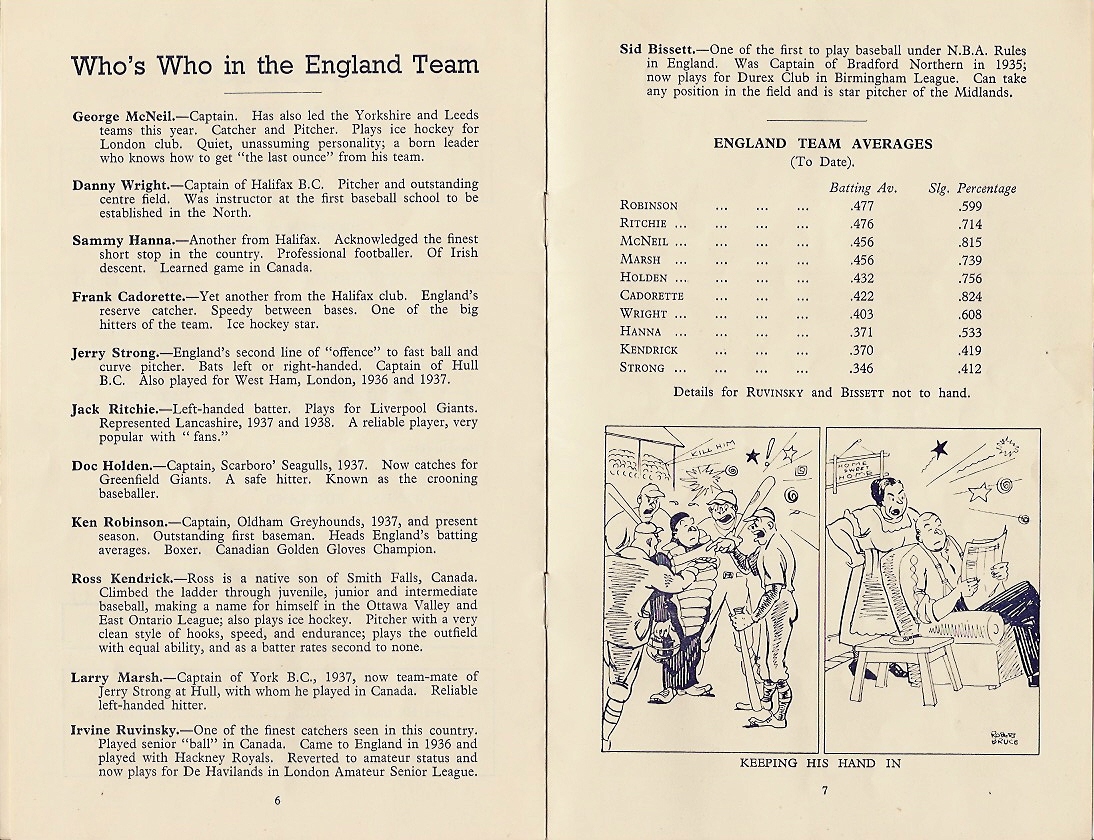
Player/manager: Chummy McNeil
| Pos. | Player | Club |
|---|---|---|
| C | Irvine Ruvinsky | London |
| 1B | Ken Robinson | Oldham |
| 2B | Sid Bissett | Birmingham |
| 3B | Chummy McNeil (mgr.) | Leeds |
| SS | Sam Hanna | Halifax |
| RF | Frank Cadorette | Halifax |
| CF | Danny Wright | Halifax |
| LF | Jack Ritchie | Liverpool |
| P | Ross Kendrick | Oldham |
| — | Jerry Strong | Hull |
| — | Doc Holden | Bradford |
| — | Larry Marsh | Hull |
{{bb|United States}}
Manager: Leslie Mann
| Pos. | Player |
|---|---|
| C | Dean Graff (cpt.) |
| 1B | Lefty Schemer |
| 2B | Leo Benson |
| 3B | John McDermott |
| SS | Tommy O'Rourke |
| RF | George Binger |
| CF | Lloyd Johnson |
| LF | Whitey Platt |
| P | Virgil Thompson |
| P | Clyde "Dizzy" Dean |
| — | Charles Tate |
| — | Ora Linda |
| — | Wendell Ringland |
Notes
References
Bibliography
References
- Duda, Jeff. (11 August 2025). "Great Britain Claims Historic Gold Medal in U-23 European Championship". World Baseball Network.
- (2012). "Transpacific Field of Dreams: How Baseball Linked the United States and Japan in Peace and War". University of North Carolina Press.
- (2019). "The Game We Love". World Baseball Softball Confederation.
- (1940). "Baseball Around the World". International Amateur Baseball Federation.
- Mann, p. 23
- Bjarkman, Peter. (2007). "A History of Cuban Baseball, 1864-2006". McFarland.
- Mann, p. 26
- (23 August 1938). "Airmen to test U.S. baseball side".
- "Baseball Put to the Test — And England beats the U.S.". Society for American Baseball Research.
- Schiroli, p. 21
- "Who's Who in the England Team".
- (14 March 2022). "Doc Holden".
- (1940). "Baseball Around the World". International Amateur Baseball Federation.
This article was imported from Wikipedia and is available under the Creative Commons Attribution-ShareAlike 4.0 License. Content has been adapted to SurfDoc format. Original contributors can be found on the article history page.
Ask Mako anything about 1938 Amateur World Series — get instant answers, deeper analysis, and related topics.
Research with MakoFree with your Surf account
Create a free account to save articles, ask Mako questions, and organize your research.
Sign up freeThis content may have been generated or modified by AI. CloudSurf Software LLC is not responsible for the accuracy, completeness, or reliability of AI-generated content. Always verify important information from primary sources.
Report