From Surf Wiki (app.surf) — the open knowledge base
1930 FA Cup final
| Field | Value |
|---|---|
| title | 1930 FA Cup final |
| image | 1930 fa cup final programme.jpg |
| image_size | 200 |
| caption | Programme cover |
| event | [1929–30 FA Cup](1929-30-fa-cup) |
| team1 | Arsenal |
| team1score | 2 |
| team2 | Huddersfield Town |
| team2score | 0 |
| date | 26 April 1930 |
| stadium | Wembley Stadium |
| city | Middlesex |
| referee | T. Crew (Leicester) |
| attendance | 92,499 |
| previous | [1929](1929-fa-cup-final) |
| next | [1931](1931-fa-cup-final) |
The 1930 FA Cup final was a football match contested by Arsenal and Huddersfield Town at Wembley Stadium on 26 April 1930. It was the final match of the 1929–30 FA Cup, the 55th season of the world's oldest football knockout competition, the FA Cup.
Arsenal won 2–0, with goals from Alex James and Jack Lambert. As a result, Arsenal won their first FA Cup after a defeat in their FA Cup final debut in 1927.
Background
The 1930 Final was the first Cup Final in which both teams entered the pitch side by side, led by Tom Parker and Tom Wilson, in honour of Arsenal manager Herbert Chapman, who had managed Huddersfield to great success in the 1920s. When Chapman arrived at Arsenal in 1925, he claimed it would take him five years to build a winning team. Five years later, Arsenal's cup final performance proved him right.
Historically, Huddersfield Town had been a more dominant team, winning the 1921-22 FA Cup. Coached by Chapman, Huddersfield won the league in 1923-4, 1924-25, and 1925-26, making them the first club to win three successive league titles. In 1927-28, Huddersfield Town had finished runners-up in both the league and the FA Cup. Meanwhile, Arsenal had won nothing in nearly fifty years with only a runners-up performance in the 1926-27 FA Cup to speak of.
Arsenal came into the game following a 6–6 draw at Leicester City, the highest-scoring draw in English top-flight history, five days prior. Dave Halliday, who scored four of Arsenal's goals that game, was omitted from the Cup Final squad in favour of Jack Lambert.
The 1930 FA Cup Final is remembered for the Graf Zeppelin passing over the stadium. The Zeppelin was, at the time, the largest airship ever and was around 776 ft in length. Prior to the match, King George V was also introduced to the players, a surprise outing as he had been recovering from illness for eighteen months. The airship saluted him as it passed by.
After first being broadcast on BBC Radio in 1928, the 1930 final was the first for which a fee was paid for the rights. It was also only the fifth time that a game had been broadcast live. George Allisson, an Arsenal director and shareholder, would provide commentary.
The rest of the Cup day programming included a 4-4 draw between Wolves and Bradford Park Avenue, Fred Cheesmuir scoring six goals for Gillingham in their 6-0 defeat of Merthyr town, Lincoln City beating New Brighton 5-2, and Sheffield Wednesday holding their lead at the top of the First Division, beating Grimsby Town 1-0.
Arsenal's Bill Seddon, who died in January 1993 at the age of 91, was the last surviving player to appear in the game.
Road to the final
Arsenal
Huddersfield Town
Match summary
Both teams began the match in Chapman's now-famous W-M formation. Arsenal wore red shirts while Huddersfield wore blue and white striped shirts.
Arsenal scored the first goal in the sixteenth minute. Allegedly, inside left Alex James had said to Cliff Bastin on the way to the match: "If we get a free-kick in their half early on, I'll slip it out to you on the wing. You give it me back and I'll have a crack at goal." During the match, referee Tom Crew awarded Arsenal a free-kick as James was fouled 40 yards from goal. James took the free kick immediately, a move which was controversial at the time. He passed to Bastin, who slipped it back through to James who then scored the first goal for Arsenal.
Huddersfield attacked for the rest of the match. Despite the aggressive and risky goaltending by Charlie Preedy, Arsenal's backup goalkeeper, no goals were let in. Alex Jackson had two excellent chances, a header and an excellent left-footed drive that went just wide. Arsenal's defense also effectively to shut down Huddersfield forwards. The Huddersfield defense also performed well, with Roy Goodall preventing Cliff Bastin from threatening the goal.
Towards the end of the match, a long clearance from James found centre forward Jack Lambert. Lambert slipped between Huddersfield defenders Goodall and Bon Spence to rush at goalkeeper Hugh Turner. Lambert scored, though had no teammates to celebrate with, and had to clap for himself as he ran back to his own half. Arsenal had won the cup for the first time.
After the game, the two sides dined together at Cafe Royal, an innovation from Chapman which did not stick.
Match details
Lambert
| {{Football kit | pattern_la = | pattern_b = _collar | pattern_ra = | pattern_so = | leftarm = CC0000 | body = CC0000 | rightarm = CC0000 | shorts = FFFFFF | socks = CC0000 | title = Arsenal | {{Football kit | align = right | pattern_la = _white_stripes | pattern_b = _whitestripes | pattern_ra = _white_stripes | pattern_so = _arg3036h | leftarm = 0099FF | body = 0099FF | rightarm = 0099FF | shorts = ffffff | socks = 000000 | Huddersfield Town}} |
|---|
| England Herbert Chapman |
|---|
| England Clem Stephenson |
|---|
|}
References
References
- Scott Murray & Rowan Walker. (2008). "Day of the Match: A History of Football in 365 Days". Pan Macmillan.
- (1995). "Arsenal: Official History". Hamlyn.
- Rundle, Richard. "Huddersfield Town".
- Tony Matthews. (2005). "Football Oddities". The History Press.
- Steve Tongue. (2016). "Turf Wars: A History of London Football". Pitch Publishing.
- (13 August 2006). "1930 FA Cup Semi's + Final".
- "The 1930 final - how Arsenal won the cup".
- Stefan Szymanski, Andrew S. Zimbalist. (2006). "National Pastime: How Americans Play Baseball and the Rest of the World Plays Soccer". Brookings Institution Press.
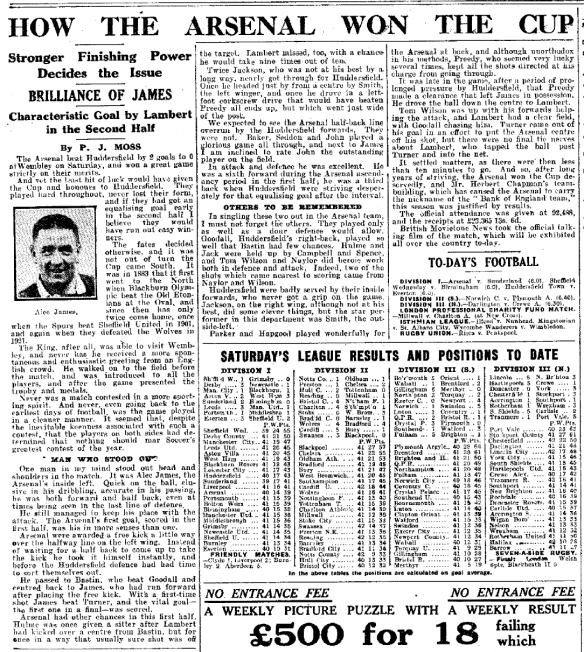
- Moss, P.J.. (27 April 1930). "How Arsenal Won The Cup".
This article was imported from Wikipedia and is available under the Creative Commons Attribution-ShareAlike 4.0 License. Content has been adapted to SurfDoc format. Original contributors can be found on the article history page.
Ask Mako anything about 1930 FA Cup final — get instant answers, deeper analysis, and related topics.
Research with MakoFree with your Surf account
Create a free account to save articles, ask Mako questions, and organize your research.
Sign up freeThis content may have been generated or modified by AI. CloudSurf Software LLC is not responsible for the accuracy, completeness, or reliability of AI-generated content. Always verify important information from primary sources.
Report