From Surf Wiki (app.surf) — the open knowledge base
1924 Winter Olympics medal table
| Field | Value |
|---|---|
| name | 1924 Winter Olympics medals |
| location | Chamonix, FRA |
| award2_type | Most total medals |
| award2_winner | NOR |
| award1_type | Most gold medals |
| award1_winner | FIN and |
| NOR | |
| award3_type | Medalling NOCs |
| award3_winner | 10 |
| main | Olympics medal tables |
| next | [1928](1928-winter-olympics-medal-table) |
NOR
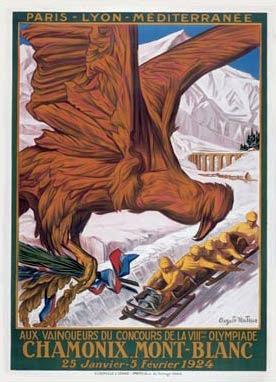
The 1924 Winter Olympics, officially known as the I Olympic Winter Games, and known at the time as Semaine Internationale des Sports d'Hiver ("International Winter Sports Week"), was a winter multi-sport event held in Chamonix, France, from 25 January to 5 February 1924. Norway topped the table, collecting seventeen medals in total, including four gold, three of which were won by Thorleif Haug in the Nordic combined and cross-country skiing events. Norway also achieved two podium sweeps, winning all three medals in both the 50 km cross-country skiing and the Nordic combined. This remained a record at the Winter Olympics until 2014.
When it was held, the games were not formally recognised as being the Olympics, but acknowledged that they were held under the "high patronage of the International Olympic Committee". Partly due to this, varying figures are reported for the number of participants. The International Olympic Committee (IOC) website suggests that 258 athletes from 16 nations participated in 16 events across 9 sports. In contrast, the Sports-Reference website lists 313 participants from 19 countries. Bill Mallon, a prominent Olympic Games historian, quotes a figure of 291 competitors in his Historical Dictionary of the Olympic Movement. Meanwhile, the official report for the 1924 Summer and Winter Olympics listed 293 athletes from 17 nations.
Finland placed second on the table, collecting four gold medals amongst a total of eleven. Clas Thunberg won five of their medals, achieving a medal in each of the speed skating events he took part in; collecting three gold medals, one silver and one bronze. Eight of the competing nations achieved at least one gold medal, with only Belgium and the hosts, France, medalling without winning a gold medal. One medal was reallocated in 1974; during the games, Thorleif Haug of Norway had been awarded the bronze medal in ski jumping, along with his three gold medals. A Norwegian historian discovered that there had been a scoring error, and an American, Anders Haugen, had actually finished in third place. As Haug had died in 1934, his daughter presented Haugen, aged 83, with his medal.
In the official report, the classification of nations is ranked not by medals, but rather by "points", which were awarded for each position from first to sixth; not exclusively for gold, silver and bronze. Due to this, Czechoslovakia were included in the table ahead of Belgium, due to two fourth-place finishes, one fifth and one sixth. Italy were also present, in twelfth, for their solitary sixth place.
Medal table
The medal table is based on information provided by the IOC and is consistent with IOC convention in its published medal tables. The table uses the Olympic medal table sorting method. By default, the table is ordered by the number of gold medals the athletes from a nation have won, where a nation is an entity represented by a National Olympic Committee (NOC). The number of silver medals is taken into consideration next, and then the number of bronze medals. If teams are still tied, equal ranking is given and they are listed alphabetically by their IOC country code. Two bronze medals were awarded in the 500 metres speed skating event for the third place tie.
Pierre de Coubertin—founder of the IOC & father of the modern Olympics movement—personally awarded, in addition to the medals awarded in the sports competitions, 21 gold medals to members of the 1922 British Mount Everest Expedition including 12 Britons, 7 Indians, 1 Australian and 1 Nepalese. Only the gold medal from 1924 is assigned to the Winter Olympics by the IOC in its database to the Mixed team, while the medals from 1932 and 1936 are assigned to the Summer Olympics for the respective NOCs.
Notes
References
References
- "1924 Medal Tally".
- "Chamonix 1924". [[International Olympic Committee]].
- BMallon. (18 February 2014). "Netherlands Speed Skating Medal Sweeps".
- (19 February 2014). "Bergsma breaks Olympic record to lead fourth Dutch medal sweep".
- "1924 Chamonix Winter Games".
- (2011). "Historical Dictionary of the Olympic Movement". [[Scarecrow Press]].
- (1924). ""Official Report of the 1924 Olympic Games". International Olympic Committee.
- Jorsett, Per. (13 February 2009). "Thorleif Haug". [[Kunnskapsforlaget]].
- (5 January 2006). "Anders Haugen's belated bronze medal".
- (19 April 1984). "Anders Haugen, Olympian; Medal Was Delayed 50 Years". [[The New York Times]].
- (1924). ""Official Report of the 1924 Olympic Games". International Olympic Committee.
- (11 August 2024). "Olympic medal table: USA beat China to top spot at Paris 2024". [[The Independent]].
- (18 August 2008). "A Medal Count That Adds Up To Little". [[The New York Times]].
- (10 August 2024). "What happens if two countries are tied in the Olympic medal table? Tiebreaker rules explained". [[Diario AS]].
- "Chamonix 1924 / Speed Skating / 500m Men". International Olympic Committee.
- Georgiou, Mark. (26 March 2012). "Everest Olympic medal pledge set to be honoured". BBC News.
- Douglas, Ed. (19 May 2012). "My modest father never mentioned his Everest expedition Olympic gold". The Guardian.
- "Olympedia – Alpinism".
- "Chamonix 1924 Olympic Medal Table". [[International Olympic Committee]] (IOC).
- (2024). "Germany - NOC Profile". [[International Olympic Committee]] (IOC).
- (2024). "Switzerland - NOC Profile". [[International Olympic Committee]] (IOC).
This article was imported from Wikipedia and is available under the Creative Commons Attribution-ShareAlike 4.0 License. Content has been adapted to SurfDoc format. Original contributors can be found on the article history page.
Ask Mako anything about 1924 Winter Olympics medal table — get instant answers, deeper analysis, and related topics.
Research with MakoFree with your Surf account
Create a free account to save articles, ask Mako questions, and organize your research.
Sign up freeThis content may have been generated or modified by AI. CloudSurf Software LLC is not responsible for the accuracy, completeness, or reliability of AI-generated content. Always verify important information from primary sources.
Report