From Surf Wiki (app.surf) — the open knowledge base
1920 Summer Olympics
Multi-sport event in Antwerp, Belgium
Multi-sport event in Antwerp, Belgium
| Field | Value |
|---|---|
| image | 1920 olympics poster.jpg |
| image_size | 250px |
| caption | Poster for the 1920 Summer Olympics |
| host_city | Antwerp, Belgium |
| nations | 29 |
| athletes | 2,626 (2,561 men, 65 women) |
| events | 162 in 22 sports (28 disciplines) |
| opening | 14 August 1920 |
| closing | 12 September 1920 |
| opened_by | King Albert I |
| stadium | Olympisch Stadion |
| summer_prev | [Stockholm 1912](1912-summer-olympics) |
| ← | |
| summer_next | [Paris 1924](1924-summer-olympics) |
| winter_next | [Chamonix 1924](1924-winter-olympics) |
← The 1920 Summer Olympics (; ; ), officially known as the Games of the VII Olympiad (; ; ) and commonly known as Antwerp 1920 (; Dutch and German: Antwerpen 1920), were an international multi-sport event held in 1920 in Antwerp, Belgium.
In March 1912, during the 13th session of the IOC, Belgium's bid to host the 1920 Summer Olympics was made by Baron Édouard de Laveleye, president of the Belgian Olympic Committee and of the Royal Belgian Football Association. No fixed host city was proposed at the time.
The 1916 Summer Olympics, to have been held in Berlin, capital of the German Empire, were cancelled due to World War I. When the Olympic Games resumed after the war, Antwerp was awarded the hosting rights to the 1920 Summer Games as a tribute to the Belgian people. The aftermath of the war and the Paris Peace Conference, 1919 affected the Olympic Games not only due to new states being created, but also by sanctions against the nations that lost the war and were blamed for starting it. Hungary, Germany, Austria, Bulgaria, and the Ottoman Empire were banned from competing in the Games. Soviet Russia had just emerged from the Civil War and chose not to attend the Games. Germany did not return to Olympic competition until 1928 and instead hosted a series of games called Deutsche Kampfspiele, starting with the Winter edition of 1922 (which predated the first Winter Olympics).
The United States won the most gold and overall medals at the 1920 Summer Games.
Host city selection
In March 1912, during the 13th session of the IOC, the bid on behalf of Belgium to host the 1920 Summer Olympics was made by Baron Édouard de Laveleye, president of the Belgian Olympic Committee and of the Royal Belgian Football Association. No fixed host city was proposed at the time.
The organizing committee was created on 9 August 1913. It had four presidents:
- Édouard de Laveleye, president of the Belgian Olympic Committee
- Henri de Baillet-Latour, member of the IOC
- Robert Osterrieth, president of the Royal Yacht Club of Belgium
- Charles Cnoops, vice-president of the Belgian Fencing Association
Among the 22 vice-presidents of the committee were people with a military or industrial background, and further people from sports organizations like Paul Havenith, president of the football and athletics club K. Beerschot V.A.C. and Nicolaas Jan Cupérus, president of the Belgian Gymnastics Federation.
The first action of the committee was to send an official letter to the IOC in Paris, confirming Antwerp as the city for the Belgian Olympic bid. With Antwerp confirmed as the Olympic Games host, Belgium began reconstructing the Beerschot Stadium into the Olympisch Stadion. Construction on the new Olympic stadium began in July 1919 and finished in May 1920.
In 1914, a 109-page brochure was created to promote the idea of Antwerp as a host city for the Olympics: Aurons-nous la VIIème Olympiade à Anvers? (Will we have the 7th Olympiad at Antwerp?). It was sent to all IOC members and was used during the 6th Olympic Congress in Paris in 1914, where the candidacies of Amsterdam (which would eventually host the 1928 Summer Olympics), Antwerp, Budapest, and Rome (which would eventually host the 1960 Summer Olympics) were discussed. Despite a slight preference at the time for Budapest, no final choice was made, and the outbreak of World War I soon afterwards prevented any further progress.
In 1915, Lyon made a bid for the 1920 Games, but after some discussion, they agreed to support Antwerp and postpone their bid until 1924 if Antwerp was liberated in time to organize the Games. The support for Belgium by cousin country France, then the leading country of the IOC, also meant that Amsterdam and Budapest (in an enemy state) had no chance for the 1920 games against Antwerp.
New candidacies from American cities did not have that disadvantage, and bids were received from Cleveland, Philadelphia, and Atlanta (which would eventually host the 1996 Summer Olympics), while Cuba also submitted a bid for Havana.
However, shortly after the armistice in November 1918, the IOC decided to give Antwerp their first preference, if they were still willing to host the 1920 Games. In March 1919, the Belgian Olympic Committee decided to go ahead with the organization of the Games: on 5 April 1919, at a meeting in Lausanne, Antwerp was officially declared the host city for the games of the VIIth Olympiad.
Organization
The 1920 Summer Games organizers had very little time to prepare. The time between the IOC's decision of choosing Antwerp as the host city and the opening ceremony was 1 year, 4 months, and 9 days, making this the shortest time for a host city to plan and organize an Olympic edition.
An executive committee was established on 17 April 1919, with Henri de Baillet-Latour as chairman and Alfred Verdyck, the secretary of the Belgian Union of Football Clubs, as general secretary. Seven commissions were created, to deal with finances, accommodation, press relations, propaganda, schedules, transport, and festivities. Finances and scheduling proved to be the two hardest parts to tackle: the program of events was not published until February 1920, six months before the official start of the Games.
Between 23 and 30 April 1920, an ice hockey tournament marked the early start of the Games. Held in the "Palais de Glace" or Ice Palace in Antwerp, it was the first time that ice hockey was an Olympic sport.
The first stone of the new Olympisch Stadion was laid on 4 July 1919 by Jan De Vos, mayor of Antwerp, and inaugurated less than a year later on 23 May 1920 with a gymnastics demonstration.
When the Olympic Games began, the stadium was still unfinished with some events being built over fortifications and others using existing locations. The athletes quarters were crowded and athletes slept on folding cots.
The nautical stadium or Stade Nautique d'Antwerp was built at the end of the Jan Van Rijswijcklaan, using the city ramparts there as a spectator's stand. Other events, like shooting, boxing, and equestrian sports, were held at pre-existing locations in and around Antwerp and as far away as Ostend.
The number of spectators was low throughout Antwerp's Summer Olympics, since not many people could afford tickets. In the closing days of the Olympic Games, students were allowed to attend the event for free. After the conclusion of the Olympic Games, Belgium recorded a loss of more than 600 million francs.
Highlights
- The Olympic Games being a symbol of peace and global solidarity shone at Antwerp. These Olympics were the first in which the Olympic Oath was voiced, the first in which doves were released to symbolize peace, and the first in which the Olympic Flag was flown to display the unity of the world's continents through its 5 rings.
- The United States won 41 gold, 27 silver, and 27 bronze medals. Sweden, Great Britain, Finland, and Belgium rounded out the five most successful medal-winning nations, with France and Belgium being the nations that fielded the most athletes, with the United States being only the third by that statistic.
- The Games also featured a week of winter sports, with figure skating appearing for the first time since the 1908 Olympics, and ice hockey making its Olympic debut.
- Nedo Nadi won 5 gold medals in the fencing events.
- At the age of 72, Sweden's 100 metre running deer double-shot event champion Oscar Swahn, who had participated in the 1908 and 1912 Games, came in second in the team event to become the oldest Olympic medal winner ever.
- 23-year-old Paavo Nurmi won the 10,000 m and 8000 m cross country races, took another gold in team cross country, and a silver in the 5000 m run. His contributions for Finland broke a record in track and field with 9 medals.
- Duke Kahanamoku retained the 100 m swimming title he won before the war.
- The sailing events were among some of strangest moments in Olympic history:
- there were originally 16 events scheduled but there were no entrants for the 9 metre, 1907 rating class nor the 8.5 metre 1919 rating class
- the 12-foot dinghy event took place in two different countries. The final two races in the event were independently held in the Netherlands, on its own accord, supposedly because the only two competitors in the event were Dutch.
- Sport shooter Guilherme Paraense won Brazil's very first gold medal at the Olympic Games.
- The United States sent a women's swimming team for the first time, and the Americans won seven out of seven available swimming medals.
Sports/Events
There were 162 events in 28 disciplines that were part of the Olympic program in 1920. The number of events in each discipline is noted in parentheses.
Korfball was a demonstration sport.
Women's water polo was a demonstration sport.
Venues
Seventeen sports venues were used in the 1920 Summer Olympics. This marked the first time that the football tournament was spread throughout the country, which has mostly been the case since.

| Venue | Sports | Capacity | Ref. | |
|---|---|---|---|---|
| Antwerp | Cycling (road) | Not listed. | ||
| Antwerp Zoo | Boxing, Wrestling | Not listed. | ||
| Beerschot Tennis Club | Tennis | Not listed. | ||
| Beverloo Camp | Shooting (pistol/rifle) | Not listed. | ||
| Brussels–Scheldt Maritime Canal | Rowing | Not listed. | ||
| Buiten Y (Amsterdam) | Sailing (12 foot dinghy) | Not listed. | ||
| Gardens of the Egmont Palace (Brussels) | Fencing | Not listed. | ||
| Hoogboom Military Camp | Shooting (trap shooting, running target) | Not listed. | ||
| Jules Ottenstadion (Ghent) | Football (Italy-Egypt match). | Not listed. | ||
| Nachtegalen Park | Archery | Not listed. | ||
| Olympisch Stadion | Athletics, Equestrian, Field hockey, Football (final), Gymnastics, Modern pentathlon, Rugby union, Tug of war, Weightlifting | 30,000 | ||
| Ostend | Polo, Sailing | Not listed. | ||
| Palais de Glace d'Anvers | Figure skating, Ice hockey | Not listed. | ||
| Stade Joseph Marien (Brussels) | Football | Not listed. | ||
| Stade Nautique d'Antwerp | Diving, Swimming, Water polo | Not listed. | ||
| Stadion Broodstraat | Football | Not listed. | ||
| Vélodrome d'Anvers Zuremborg | Cycling (track) | Not listed. |
Participating nations
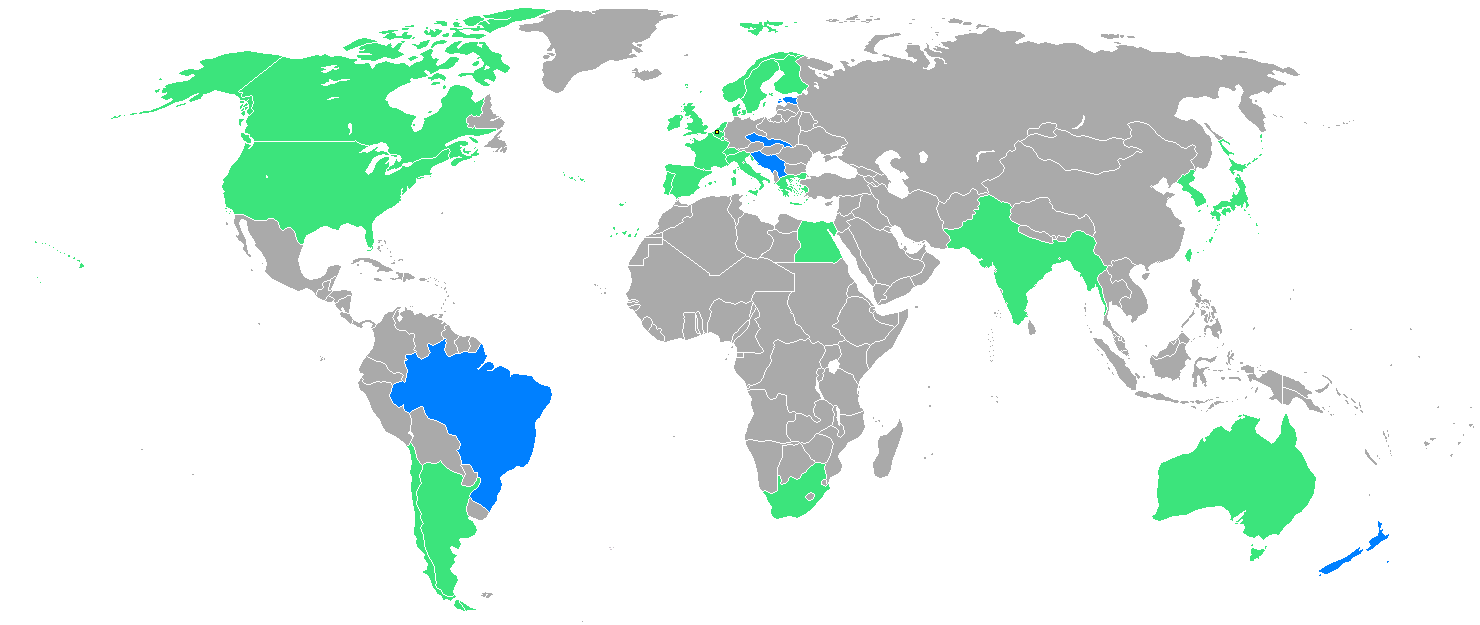
A total of 29 nations participated in the Antwerp Games, only one more than in 1912, as Germany, Austria, Hungary, Bulgaria and Turkey were not invited, having lost World War I and sanctioned for starting it. From the newly created European states, only Estonia took part, as Czechoslovakia succeeded Bohemia and the Kingdom of Serbs, Croats and Slovenes succeeded Serbia, with both nations had sent athletes prior to World War I (in the case of Bohemia as part of the Austrian Empire). Soviet Russia was busy with the Polish-Soviet War and therefore was unable to form an Olympic team (Poland in turn, had never participated in the games before, only doing so in later editions). Brazil and Monaco competed as nations at the Olympic Games for the first time. New Zealand, which had competed as part of a combined team with Australia in 1908 and 1912, competed on its own for the first time. The games marked the return of Argentina and India to the competitions.
At the time, Australia, New Zealand, Canada, India and South Africa were all part of the British Empire. Egypt was a British protectorate (a state not part of the British Empire but nonetheless administered by the United Kingdom).
| Participating National Olympic Committees |
|---|
- The Dominion of Newfoundland had one competitor, Eric Robertson. But as the dominion had no official Olympic committee, his nationality could not be confirmed and he represented Great Britain.
As the local Olympic Organizing Committee went bankrupt during the Antwerp 1920 Games, no official report of the Games was ever produced. The documents of the Games were archived at the Belgium Olympic Committee headquarters in Brussels.
Number of athletes by National Olympic Committees
| Country | Athletes |
|---|---|
| BEL | 336 |
| FRA | 304 |
| USA | 288 |
| SWE | 260 |
| GBR | 235 |
| NOR | 194 |
| ITA | 174 |
| DEN | 154 |
| NED | 146 |
| TCH | 121 |
| SUI | 77 |
| FIN | 63 |
| GRE | 57 |
| CAN | 53 |
| RSA | 39 |
| ESP | 32 |
| LUX | 25 |
| EGY | 22 |
| BRA | 19 |
| JPN | 15 |
| EST | 14 |
| AUS | 13 |
| POR | 13 |
| YUG | 12 |
| IND | 5 |
| MON | 4 |
| NZL | 4 |
| CHI | 2 |
| ARG | 1 |
| **Total** | **2,682** |
Medal count
_(cropped).jpg)
Main article: 1920 Summer Olympics medal table
These are the top ten nations that won medals at the 1920 Games. These were the first Olympics where the host nation did not win the most medals overall.
Notes
References
- (2004). "Encyclopedia of the Modern Olympic Movement". Greenwood.
- (13 September 2013). "Factsheet - Opening Ceremony of the Games f the Olympiad". International Olympic Committee.
- Renson, Roland. (1996). "The Games Reborn. The VIIth Olympiad Antwerp 1920". Pandora.
- Renson, Roland. (1996). "The Games Reborn. The VIIth Olympiad Antwerp 1920". Pandora.
- (2021-04-28). "Olympisch Stadion - Olympic News".
- Home, John. (2012). "Understanding the Olympics". Taylor & Francis.
- Renson, Roland. (1996). "The Games Reborn. The VIIth Olympiad Antwerp 1920". Pandora.
- Renson, Roland. (1996). "The Games Reborn. The VIIth Olympiad Antwerp 1920". Pandora.
- "Antwerp 1920: a symbol of peace and unity 100 years after the Games".
- Renson, Roland. (1996). "The Games Reborn. The VIIth Olympiad Antwerp 1920". Pandora.
- Renson, Roland. (1996). "The Games Reborn. The VIIth Olympiad Antwerp 1920". Pandora.
- "Antwerp 1920 Olympic Games".
- Renson, Roland. (1996). "The Games Reborn. The VIIth Olympiad Antwerp 1920". Pandora.
- "Antwerp 1920 Olympic Games".
- B. A., History. "What Was Interesting About the 1920 Olympics in Antwerp?".
- IOC. (2018-04-25). "Antwerp 1920 Summer Olympics - Athletes, Medals & Results".
- {{IOC games
- "1920 Summer Olympics". Sports Reference.
- "Diving at the 1920 Summer Olympics". Sports Reference.
- "Swimming at the 1920 Summer Olympics". Sports Reference.
- "Water Polo at the 1920 Summer Olympics". Sports Reference.
- "Archery at the 1920 Summer Olympics". Sports Reference.
- "Athletics at the 1920 Summer Olympics". Sports Reference.
- "Boxing at the 1920 Summer Olympics". Sports Reference.
- "Cycling Road at the 1920 Summer Olympics". Sports Reference.
- "Cycling Track at the 1920 Summer Olympics". Sports Reference.
- "Equestrian Dressage at the 1920 Summer Olympics". Sports Reference.
- "Equestrian Eventing at the 1920 Summer Olympics". Sports Reference.
- "Equestrian Jumping at the 1920 Summer Olympics". Sports Reference.
- "Equestrian Vaulting at the 1920 Summer Olympics". Sports Reference.
- "Fencing at the 1920 Summer Olympics". Sports Reference.
- "Hockey at the 1920 Summer Olympics". Sports Reference.
- "Figure Skating at the 1920 Summer Olympics". Sports Reference.
- "Football at the 1920 Summer Olympics". Sports Reference.
- "Artistic Gymnastics at the 1920 Summer Olympics". Sports Reference.
- "Ice Hockey at the 1920 Summer Olympics". Sports Reference.
- "Modern Pentathlon at the 1920 Summer Olympics". Sports Reference.
- "Polo at the 1920 Summer Olympics". Sports Reference.
- "Rowing at the 1920 Summer Olympics". Sports Reference.
- "Rugby at the 1920 Summer Olympics". Sports Reference.
- "Sailing at the 1920 Summer Olympics". Sports Reference.
- "Shooting at the 1920 Summer Olympics". Sports Reference.
- "Tennis at the 1920 Summer Olympics". Sports Reference.
- "Tug of War at the 1920 Summer Olympics". Sports Reference.
- "Weightlifting at the 1920 Summer Olympics". Sports Reference.
- "Wrestling at the 1920 Summer Olympics". Sports Reference.
- "Korfball at the 1920 Summer Olympics". Sports Reference.
- "Football at the 1920 Antwerpen Summer Games {{!}} Olympics at Sports-Reference.com".
- (12 August 1920). "1920 Summer Olympics cycling individual road race". Sports-reference.com.
- (12 August 1920). "1920 Summer Olympics cycling team road race". Sports-reference.com.
- "1920 Summer Olympics boxing". Sports-reference.com.
- "1920 Summer Olympics wrestling". Sports-reference.com.
- "profile of Tennis at the 1920 Summer Olympics". Sports-reference.com.
- "Shooting overview of the 1920 Summer Olympics". Sports-reference.com.
- "1920 Summer Olympics rowing website". Sports-reference.com.
- [https://web.archive.org/web/20200418124621/https://www.sports-reference.com/olympics/summer/1920/SAI/mixed-12-foot.html Sports-Reference.com 1920 Summer Olympics sailing mixed 12-foot results.].
- "profile of the 1920 Summer Olympics fencing events". Sports-reference.com.
- link. (1 February 2009 – accessed 6 October 2010.)
- "1920 Summer Olympics archery profile". Sports-reference.com.
- "1920 Summer Olympics athletics". Sports-reference.com.
- "1920 Summer Olympics equestrian". Sports-reference.com.
- "1920 Summer Olympics men's field hockey". Sports-reference.com.
- "1920 Summer Olympics football". Sports-reference.com.
- "1920 Summer Olympics gymnastics". Sports-reference.com.
- "1920 Summer Olympics modern pentathlon". Sports-reference.com.
- "1920 Summer Olympics rugby union". Sports-reference.com.
- "1920 Summer Olympics tug of war". Sports-reference.com.
- (29 August 1920). "1920 Summer Olympics weightlifting". Sports-reference.com.
- "1920 Summer Olympics polo". Sports-reference.com.
- "1920 Summer Olympics sailing". Sports-reference.com.
- "profile of Figure skating at the 1920 Summer Olympics". Sports-reference.com.
- "profile of the men's Ice Hockey at the 1920 Summer Olympics". Sports-reference.com.
- "profile of Diving at the 1920 Summer Olympics". Sports-reference.com.
- "profile of Swimming at the 1920 Summer Olympics". Sports-reference.com.
- "profile of Men's water polo at the 1920 Summer Olympics". Sports-reference.com.
- "profile of Cycling at the 1920 Summer Olympics". Sports-reference.com.
- "Newfoundlanders and Olympic Connections".
- "Olympic Games Official Report 1920".
- "Olympic Analytics". olympanalyst.com.
This article was imported from Wikipedia and is available under the Creative Commons Attribution-ShareAlike 4.0 License. Content has been adapted to SurfDoc format. Original contributors can be found on the article history page.
Ask Mako anything about 1920 Summer Olympics — get instant answers, deeper analysis, and related topics.
Research with MakoFree with your Surf account
Create a free account to save articles, ask Mako questions, and organize your research.
Sign up freeThis content may have been generated or modified by AI. CloudSurf Software LLC is not responsible for the accuracy, completeness, or reliability of AI-generated content. Always verify important information from primary sources.
Report