From Surf Wiki (app.surf) — the open knowledge base
1914 Armenian reforms
Reform plan devised by the European powers between 1912 and 1914

Reform plan devised by the European powers between 1912 and 1914
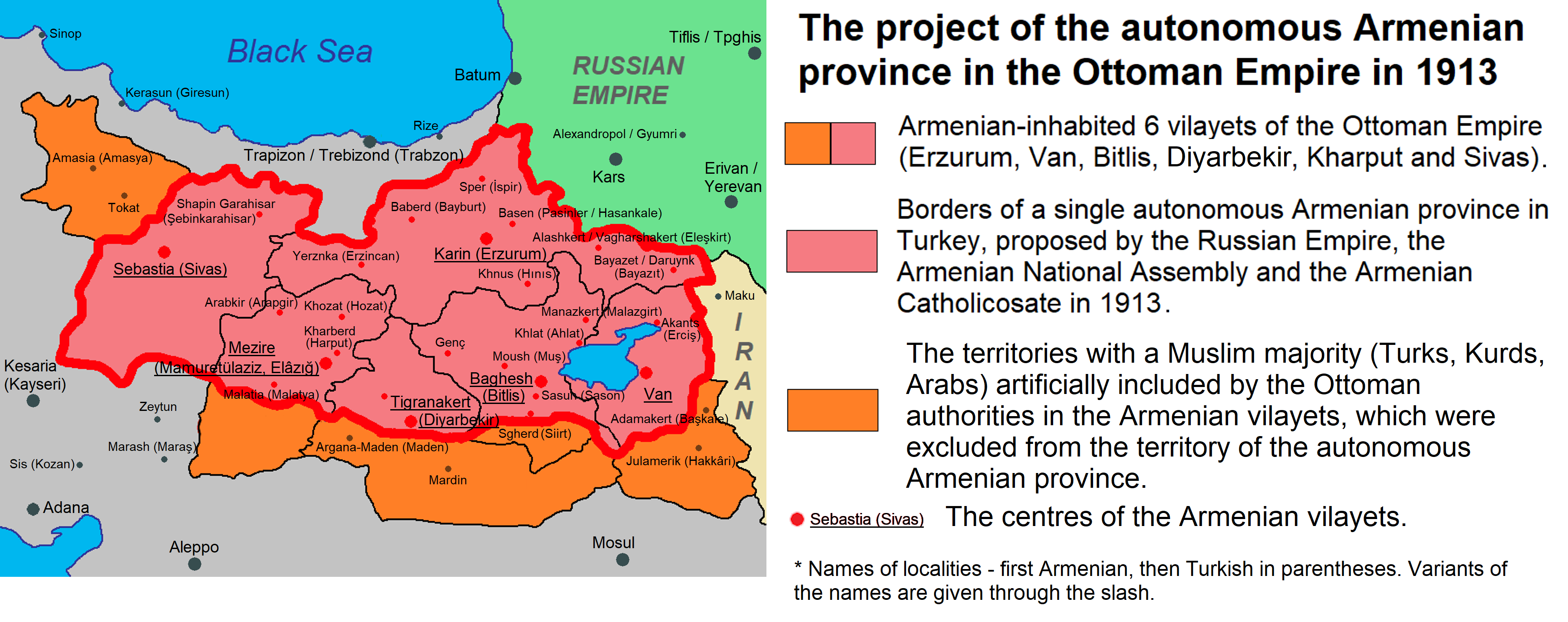
The Armenian reforms, also known as the Yeniköy accord, was a reform plan devised by European powers between 1912 and 1914 that envisaged the creation of two provinces in Ottoman Armenia placed under the supervision of two European inspectors general, who would be appointed to oversee matters related to the Armenian issues. The inspectors general would hold the highest position in the six eastern vilayets (provinces), where the bulk of the Armenian population lived, and would reside at their respective posts in Erzurum and Van. The reform package was signed into law on February 8, 1914, though it was ultimately abolished on December 16, 1914, several weeks after Ottoman entry into World War I.
Background
The Balkan Wars had created an opportunity for the revival of new plans to improve the conditions of the Ottoman Armenians which were persecuted. The French, British and Italians were anxious to limit German influence in the Ottoman Empire. In addition, the Russian government encouraged the Catholicos of Armenia to appeal through the viceroy of the Caucasus to the Ottoman government for intervention in favor of reforms in Armenian-inhabited vilayets. This project was prepared by André Mandelstam, the dragoman at the Russian Embassy in Istanbul, and representatives from the Armenian national assembly. It was introduced and discussed in Constantinople at a meeting of the ambassadors of France, Britain and Italy.
The project suggested the formation of a two large provinces from six vilayets (Erzurum, Van, Bitlis, Diyarbakır, Kharput and Sivas) under either an Ottoman Christian or a European governor general. The governor general was to be appointed by the Powers for the ensuing five years. Germany opposed the project and succeeded in obtaining significant modifications, including splitting the region into two provinces.
Plan
The reform package was signed on February 8, 1914, between the Ottoman Empire (represented by Grand Vezir Said Halim Pasha) and Russia. Louis Constant Westenenk, an administrator for the Dutch East Indies, and Nicolai Hoff, a major in the Norwegian Army, were selected as the first two inspectors. Hoff was in Van when the war broke out, just as Westenenk was preparing to depart for his post in Erzurum.
Historian Margaret Lavinia Anderson states:
References
References
- Davison, Roderic H. "[https://www.jstor.org/discover/10.2307/1840566?uid=3739560&uid=2&uid=4&uid=3739256&sid=21101125321511 The Armenian Crisis, 1912-1914]," ''[[The American Historical Review]]'' 53 (Apr., 1948), pp. 481-505.
- {{in lang. hy Karapetyan, N. V. (1981). "Հայկական բարենորոգումների խնդիրը 1912-14 թվականներին" [The Issue of the Armenian Reforms in the Years 1912-14] in ''Հայ Ժողովրդի Պատմություն'' [History of the Armenian People], eds. [[Tsatur Aghayan]] et al. Yerevan: Armenian Academy of Sciences, vol. 6, pp. 520-35.
- Hovannisian, Richard G.. (1967). "Armenia on the Road to Independence, 1918". University of California Press.
- Akçam, Taner. (2012-04-15). "The Young Turks' Crime against Humanity". Princeton University Press.
- Reynolds, Michael A. (2011). ''Shattering Empires: The Clash and Collapse of the Ottoman Empires, 1908-1918''. Cambridge: Cambridge University Press, pp. 73-77.
- Şeyhun, Ahmed. "Said Halim and the Armenian Reform Project of 1914," ''Journal of the Society for Armenian Studies'' 19/2 (2010), pp. 93-108.
- Kévorkian, Raymond (2011). ''The Armenian Genocide: A Complete History''. London: I. B. Tauris, p. 171.
- Hovannisian. ''Armenia on the Road to Independence'', p. 39.
- L. C. Westenek, "Diary Concerning the Armenian Mission," ''[[Armenian Review]]'' 39 (Spring 1986), pp. 29-89.
- (2013). "Taner Akçam, The Young Turks' crime against humanity: the Armenian genocide and ethnic cleansing in the Ottoman Empire (Princeton, NJ: Princeton University Press, 2012)". Journal of Genocide Research.
This article was imported from Wikipedia and is available under the Creative Commons Attribution-ShareAlike 4.0 License. Content has been adapted to SurfDoc format. Original contributors can be found on the article history page.
Ask Mako anything about 1914 Armenian reforms — get instant answers, deeper analysis, and related topics.
Research with MakoFree with your Surf account
Create a free account to save articles, ask Mako questions, and organize your research.
Sign up freeThis content may have been generated or modified by AI. CloudSurf Software LLC is not responsible for the accuracy, completeness, or reliability of AI-generated content. Always verify important information from primary sources.
Report