From Surf Wiki (app.surf) — the open knowledge base
1903 Clemson Tigers football team
American college football season

American college football season
| Field | Value |
|---|---|
| year | 1903 |
| team | Clemson Tigers |
| sport | football |
| image | 1903 Clemson Tigers football team (Oconeean 1904).png |
| image_size | 285 |
| conference | Southern Intercollegiate Athletic Association |
| short_conf | SIAA |
| record | 4–1–1 |
| conf_record | 2–0–1 |
| head_coach | John Heisman |
| hc_year | 4th |
| captain | Hope Sadler |
| stadium | Bowman Field |
| champion | SIAA co-champion |
The 1903 Clemson Tigers football team represented Clemson Agricultural College—now known as Clemson University—as a member of the Southern Intercollegiate Athletic Association (SIAA) during the 1903 college football season. Led by John Heisman in his fourth and final season as head coach, the Tigers compiled an overall record of 4–1–1 with mark of 2–0–1 in SIAA play.
The team competed in an early conference championship game, tying the Cumberland Bulldogs, 11–11; in the contest. The Tigers thrashed Georgia Tech, 73–0, leading to Heisman's job offer at Tech. Clemson played all its games on the road.
Before the season
For the 1903 season, point values were different from those used in contemporary games. In 1903 a touchdown was worth five points, a field goal was worth five points and a conversion (PAT) was worth one point.
The team's captain was Hope Sadler. This was the last season with both Sadler and Carl Sitton at ends. One writer recalls, "Sitton and Hope Sadler were the finest ends that Clemson ever had perhaps."
Schedule
|{{CFB schedule entry | w/l = w |{{CFB schedule entry | w/l = w |{{CFB schedule entry | w/l = w |{{CFB schedule entry | w/l = l |{{CFB schedule entry | w/l = w |{{CFB schedule entry | w/l = t
Game summaries
Week 1: at Georgia
The season opened with a defeat of the Georgia Bulldogs 29–0. Clemson fumbled on a number of plays.
The starting lineup was Sitton (left end), Forsythe (left tackle), McKeown (left guard), Garrison (center), Derrick (right guard), Cogburn (right tackle), Sadler (right end), Maxwell (quarterback), Furtick (left halfback), Wood (right halfback), Hanvey (fullback).
Week 2: at Georgia Tech
The Bulldogs offered Clemson a bushel of apples for every point over 29 it scored against rival Georgia Tech. Clemson won 73 to 0 on a mud-soaked field, leading to Heisman's later job at Tech. Sitton had to sit out the game.
Clemson as a team rushed for 615 yards, and fullback Jock Hanvey rushed for 104 yards in the first half. The first score came on a 20-yard run by Hanvey.
The starting lineup was Ellison (left end), Cogburn (left tackle), Derrick (left guard), Garrison (center), Forsythe (right guard), McKeown (right tackle), Sadler (right end), Maxwell (quarterback), Furtick (left halfback), Wood (right halfback), Hanvey (fullback).
Week 3: North Carolina A&M
In the third week of play, North Carolina A&M was beaten by Clemson 24 to 0. While A&M gained much using conventional football, Clemson had to use many trick plays. Oliver Gardner played for A&M. Heisman got married soon after the game.
Week 4: at North Carolina
The North Carolina Tar Heels handed Clemson its only loss of the season, 11–6. Carolina's Newton scored first, with a bloody nose.
The starting lineup was Sitton (left end), Cogburn (left tackle), Derrick (left guard), Garrison (center), Forsythe (right guard), McKeown (right tackle), Sadler (right end), Maxwell (quarterback), Wood (left halfback), Furtick (right halfback), Hanvey (fullback).
Week 5: at Davidson
Charlotte, North Carolina Clemson won easily over Davidson, 24–0. One writer noted "Clemson playing against eleven wooden men, would attract attention."
The starting lineup was Sitton (left end), Cogburn (left tackle), Derrick (left guard), Garrison (center), Forsythe (right guard), McKeown (right tackle), Sadler (right end), Maxwell (quarterback), Wood (left halfback), Furtick (right halfback), Hanvey (fullback).
Postseason
"SIAA championship game"
Clemson tied Cumberland 11–11 in a game billed as the "SIAA Championship Game." Cumberland rushed out to an early 11–0 lead. Wiley Lee Umphlett in Creating the Big Game: John W. Heisman and the Invention of American Football writes, "During the first half, Clemson was never really in the game due mainly to formidable line play of the Bridges brothers–giants in their day at 6 feet 4 inches–and a big center named "Red" Smith, was all over the field backing up the Cumberland line on defense. Clemson had been outweighed before, but certainly not like this."
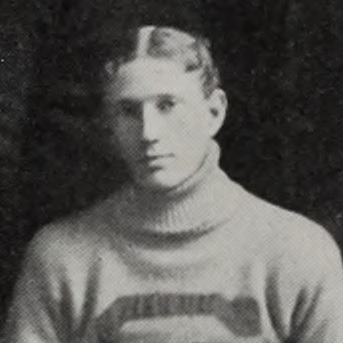
A contemporary account reads "The Clemson players seemed mere dwarfs as they lined up for the kickoff. To the crowd on the sidelines it didn't seem that Heisman's charges could possibly do more than give a gallant account of themselves in a losing battle." Guard M. O. Bridges kicked the extra point. Halfback J. A. Head made another touchdown, but Bridges missed the try. After halftime, Clemson quarterback John Maxwell raced 100 yards for a touchdown. Clemson missed the try. Cumberland fumbled a punt and Clemson recovered. Cumberland expected a trick play when Fritz Furtick simply ran up the middle and scored. One account of the play reads "Heisman saw his chance to exploit a weakness in the Cumberland defense: run the ball where the ubiquitous Red Smith wasn't. So the next time Sitton started out on one of his slashing end runs, at the last second he tossed he ball back to the fullback who charges straight over center (where Smith would have been except that he was zeroing in on the elusive Sitton) and went all the way for he tying touchdown." Jock Hanvey kicked the extra point and the game ended in an 11–11 tie.
.png)
The winning team was to be awarded the ball. Captain W. W. Suddarth of Cumberland wanted captain Hope Sadler of Clemson to get the ball, and Sadler insisted Suddarth should have it. Some ten minutes of bickering was resolved when the ball was given to patrolman Patrick J. Sweeney, for warning the media and fans to stay down in front and allow spectators to see the game. Heisman pushed for Cumberland to be named SIAA champions at year's end. It was Heisman's last game as Clemson head coach, who was hired at Georgia Tech.
The starting lineup was Sitton (left end), Cogburn (left tackle), Derrick (left guard), Garrison (center), Forsythe (right guard), McKeown (right tackle), Sadler (right end), Maxwell (quarterback), Wood (left halfback), Furtick (right halfback), Hanvey (fullback).
Florida coaches
Marvin Bridges and Clemson players Jock Hanvey and Jack Forsythe all coached at Florida colleges the next season. Bridges coached at the University of Florida at Lake City, and Forsythe was the head coach of the Florida State College with Hanvey as his assistant. Forsythe went on in 1906 to be the first coach of the Florida Gators.
Personnel
Depth chart
The following chart provides a visual depiction of Clemson's lineup during the 1903 season with games started at the position reflected in parentheses. The chart mimics the offense in a T formation
| LE |
|---|
| Carl Sitton (4) |
| Gil Ellison (1) |
|
| LT | LG | C | RG | RT |
|---|---|---|---|---|
| H. L. Cogburn (4) | Puss Derrick (1) | Bill Garrison (5) | Pee Wee Forsythe (4) | Max McKeown (4) |
| Pee Wee Forsythe (1) | J. A. McKeown (1) | Puss Derrick (1) | H. L. Cogburn (1) |
|
| RE |
|---|
| Hope Sadler (5) |
|- |
| QB |
|---|
| John Maxwell (5) |
|- |
| LHB | FB | RHB |
|---|---|---|
| L. S. Wood (3) | Jock Hanvey (5) | Fritz Furtick (3) |
| Fritz Furtick (2) | L. S. Wood (2) |
| } |
|---|
| - |
|}
Line
Backfield
| L. S. Wood | halfback | 5 |
|---|
References
Books
References
- (2016). "2016 Football Media Guide". Clemson Athletics.
- John de Saulles. (1904). "Foot Ball in the South". Spalding's Football Guide.
- "Scoring values". University of Alabama Department of Intercollegiate Athletics.
- (January 21, 1915). "Vetter Sitton Clemson Coach". The Anderson Daily-Intelligencer.
- (October 12, 1903). "Clemson won". The Birmingham News.
- (October 18, 1903). "Tremendous score piled up by Clemson against Techs yesterday". The Savannah Morning News.
- (October 29, 1903). "Clemson Tigers again victorious". The State.
- (November 15, 1903). "N. Carolina is victor over Clemson". The Atlanta Journal.
- (November 22, 1903). "Clemson defeats Davidson". The Charlotte Observer.
- (November 27, 1903). "Right royal football game between Cumberland–Clemson resulted in tie". The Montgomery Advertiser.
- "1903 Clemson Tigers Schedule and Results".
- (October 11, 1903). "Clemson Tigers Win In A Walk". The Atlanta Constitution.
- {{Harvnb. Woodruff. 1928
- Mandle Parrish. (October 31, 2000). "Clemson-Georgia Tech Series".
- Sam Blackman. (October 8, 2015). "Tiger-Tech Tales".
- Foster Senn. (October 17, 1987). "This Day in Tiger Football". Clemson University Football Programs – Clemson Vs Duke.
- (October 18, 1903). "Tech Slaughtered By Clemson Tigers". The Atlanta Constitution.
- (October 29, 1903). "Eighteen To Naught". News and Observer.
- {{Harvnb. Blackman. 2016
- (November 15, 1903). "For Carolina The Tide Has Turned". News and Observer.
- (November 22, 1903). "Clemson Defeats Davidson". The Charlotte Observer.
- Sam Blackman. (December 15, 2014). "Clemson's "First Bowl Game"".
- {{Harvnb. Sahadi. 2014
- {{Harvnb. Umphlett. 1992
- "Football".
- (May 17, 2013). "Cumberland Blues".
- {{Harvnb. Langum. 2010
- {{Harvnb. Heisman. 2012
- "Clemson Tigers Tie Cumberland". The Atlanta Constitution.
- "2008 Clemson Football".
This article was imported from Wikipedia and is available under the Creative Commons Attribution-ShareAlike 4.0 License. Content has been adapted to SurfDoc format. Original contributors can be found on the article history page.
Ask Mako anything about 1903 Clemson Tigers football team — get instant answers, deeper analysis, and related topics.
Research with MakoFree with your Surf account
Create a free account to save articles, ask Mako questions, and organize your research.
Sign up freeThis content may have been generated or modified by AI. CloudSurf Software LLC is not responsible for the accuracy, completeness, or reliability of AI-generated content. Always verify important information from primary sources.
Report