From Surf Wiki (app.surf) — the open knowledge base
1903 Australian federal election
Election for the 2nd Parliament of Australia
Election for the 2nd Parliament of Australia
| Field | Value | |
|---|---|---|
| election_name | 1903 Australian federal election | |
| country | Australia | |
| flag_year | 1903 | |
| type | parliamentary | |
| ongoing | no | |
| previous_election | 1901 Australian federal election | |
| previous_year | 1901 | |
| next_election | 1906 Australian federal election | |
| next_year | 1906 | |
| outgoing_members | Members of the Australian House of Representatives, 1901–1903 | |
| elected_members | Members of the Australian House of Representatives, 1903–1906 | |
| registered | 1,893,586 93.62% | |
| turnout | 739,402 (39.05%) | |
| (12.34 pp) | ||
| seats_for_election | All 75 seats in the House of Representatives | |
| 38 seats were needed for a majority in the House | ||
| 19 (of the 36) seats in the Senate | ||
| election_date | ||
| <!-- Protectionist Party --> | image1 | Image:Alfred_Deakin_crop.jpg |
| image_size | 190x190px | |
| leader1 | Alfred Deakin | |
| leader_since1 | ||
| party1 | Protectionist Party | |
| leaders_seat1 | Ballaarat (Vic.) | |
| swing1 | 1.71% | |
| last_election1 | 32 seats | |
| seats_needed1 | 6 | |
| seats1 | **26 seats** | |
| popular_vote1 | 210,738 | |
| percentage1 | 29.23% | |
| seat_change1 | 6 | |
| <!-- Free Trade Party --> | image2 | Image:George Reid crop.jpg |
| leader2 | George Reid | |
| leader_since2 | 11 May 1901 | |
| party2 | Free Trade Party | |
| leaders_seat2 | East Sydney (NSW) | |
| swing2 | 1.48% | |
| last_election2 | 25 seats | |
| seats_needed2 | 13 | |
| seats2 | 24 seats | |
| popular_vote2 | **228,721** | |
| percentage2 | **31.73%** | |
| seat_change2 | 1 | |
| <!-- Australian Labour Party --> | image4 | Image:ChrisWatsonBW_crop.jpg |
| leader4 | Chris Watson | |
| leader_since4 | 20 May 1901 | |
| party4 | Labour | |
| color4 | DE3533 | |
| leaders_seat4 | Bland (NSW) | |
| swing4 | 11.53% | |
| last_election4 | 16 seats | |
| seats_needed4 | 22 | |
| seats4 | 22 seats | |
| popular_vote4 | 214,713 | |
| percentage4 | 29.78% | |
| seat_change4 | 6 | |
| <!-- Revenue Tariff Party --> | image5 | Image:WMcWilliams.JPG |
| leader5 | William McWilliams | |
| leader_since5 | 1903 | |
| color5 | FFDB58 | |
| party5 | Revenue Tariff | |
| leaders_seat5 | Franklin (Tas.) | |
| swing5 | 0.49% | |
| last_election5 | *New party* | |
| seats_needed5 | 38 | |
| seats5 | 1 seat | |
| popular_vote5 | 3,546 | |
| percentage5 | 0.49% | |
| seat_change5 | 1 | |
| <!-- Independents --> | image7 | **IND** |
| leader7 | *N/A* | |
| leader_since7 | *N/A* | |
| party7 | Independents/Other | |
| leaders_seat7 | *N/A* | |
| popular_vote7 | 63,218 | |
| percentage7 | 8.77% | |
| swing7 | 12.24 | |
| last_election7 | 2 seats | |
| seats7 | 2 | |
| seat_change7 | 2 | |
| colour7 | ||
| map_image | 1903 Australian federal election.svg | |
| map_size | 350px | |
| map_caption | Results by division for the House of Representatives, shaded by winning party's margin of victory. | |
| title | Prime Minister | |
| posttitle | Subsequent Prime Minister | |
| before_election | Alfred Deakin | |
| before_party | Protectionist Party | |
| after_election | Alfred Deakin | |
| after_party | Protectionist Party |
(12.34 pp) 38 seats were needed for a majority in the House 19 (of the 36) seats in the Senate
The 1903 Australian federal election was held in Australia on 16 December 1903. All 75 seats in the House of Representatives, and 19 of the 36 seats in the Senate were up for election. The incumbent Protectionist Party minority government led by Prime Minister Alfred Deakin retained the most House of Representatives seats of the three parties and retained government with the parliamentary support of the Labour Party led by Chris Watson. The Free Trade Party led by George Reid remained in opposition.
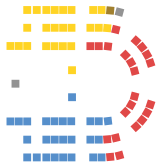
The election outcome saw a finely balanced House of Representatives, with the three parties each holding around a third of seats − the Protectionists on 26, the Free Traders on 24 and Labour on 22. This term of parliament saw no changes in any party leadership but did see very significant and prolonged debates, with three changes in government: the Protectionist minority government fell in April 1904 to be replaced by a minority Labour government, which lasted until August 1904, before falling in turn. Labour was replaced by a minority Free Trader government, which finally fell in July 1905 to be replaced by the Protectionists, who continued until the 1906 election and beyond. The Free Traders remained in opposition throughout this eventful period with the exception of Labour forming the opposition for the first time during the period of the Free Trader minority government. Additionally, the Watson government was the world's first Labour Party government at a national level.
Despite a break in prime ministerships in 1904-1905 and 1908–1909, this is the first of three consecutive elections in which Deakin was the sitting prime minister.
Issues
The wreck of outside Port Phillip Bay in late November prompted the government's handling of the White Australia policy to become a campaign issue. Shipwrecked Asian sailors were denied entry to Australia and forced to stay on a crowded tugboat for several days, leading The Argus, Daily Telegraph and The Sydney Morning Herald to accuse the government of cruelty and harming Australia's international reputation. The Age and The Bulletin sided with the government. The issue was "constantly raised" at election meetings, particularly in Victoria and Tasmania.
Results
House of Representatives
| Party | Votes | % | Swing | Seats | Change | Formal votes | Informal votes | Total | Registered voters / turnout | |
|---|---|---|---|---|---|---|---|---|---|---|
| Free Trade | 228,721 | 31.73 | −1.48 | 24 | 1 | |||||
| Labour | 214,713 | 29.78 | +11.53 | 22 | 6 | |||||
| Protectionist | 166,176 | 23.05 | −4.47 | 24 | 8 | |||||
| National Liberal Union | 44,562 | 6.18 | +6.18 | 2 | 2 | |||||
| Revenue Tariff | 3,546 | 0.49 | +0.49 | 1 | 1 | |||||
| Independents/Other | 63,218 | 8.77 | −12.24 | 2 | ||||||
| 720,936 | 97.50 | |||||||||
| 18,466 | 2.50 | |||||||||
| 75 | ||||||||||
| 1,893,586 | 39.05 | −12.34 |
Senate
| Party | Votes | % | ± | Seats | Seats | ||||||
|---|---|---|---|---|---|---|---|---|---|---|---|
| won | Seats | ||||||||||
| after | Seat | ||||||||||
| change | Formal votes | Total | Registered voters / turnout | ||||||||
| Free Trade | 986,030 | 34.33 | −5.11 | 4 | 12 | 3 | |||||
| Labour | 784,859 | 27.33 | +13.83 | 10 | 14 | 4 | |||||
| Protectionist | 503,586 | 17.53 | −27.33 | 3 | 8 | 3 | |||||
| National Liberal Union | 136,727 | 4.76 | +4.76 | 0 | 0 | ||||||
| Socialist Labor | 69,769 | 2.43 | +1.41 | 0 | 0 | ||||||
| Revenue Tariff | 25,310 | 0.88 | +0.88 | 1 | 1 | 1 | |||||
| Independent | 365,851 | 12.74 | −8.60 | 1 | 1 | 1 | |||||
| 2,872,132 | |||||||||||
| 1,893,586 | 46.86 |
Significance
The election saw the Labour party make significant gains outside New South Wales and Victoria.
As a result of Labour's gains, the numbers of the three parties in Parliament were very close to equal, leading to unstable governments: Alfred Deakin would describe it as a parliament of "three elevens" (three cricket teams). Although the Protectionists were able to retain their minority government with the qualified support of the Labour Party, the equal numbers would see a record three changes of government over the course of the Parliamentary term, with each of the three parties holding office at least once during the term of the Parliament.
The three parties that contested the 1901 election also contested the 1903 election, with only the Protectionists changing leaders: Alfred Deakin was chosen as a result of Edmund Barton's appointment as an inaugural judge of the newly constituted High Court of Australia. The Free Trade Party was again led by George Reid, with the only significant difference in policy between the parties on trade issues: the Protectionists sought to protect Australian industry and agriculture by placing tariffs on imports.
The Free Traders downgraded the view they had last election of having no tariffs to campaigning on minimal tariffs, while the other major party contesting the election was the Labour Party.
This election also saw a minor party, the Tasmanian Revenue Tariff Party, gain an MHR and one Senator. Prior to the 1901 election, the Free Trade Party had been known as the Revenue Tariff Party in some states. However, in 1903 a separate Revenue Tariff Party competed against the FTP in Tasmania. Nevertheless, both of the Revenue Tariff Party members elected joined the Free Trade Party, when the new parliament began sitting.
Like the 1901 election, voting was voluntary and candidates were elected by the first-past-the-post system. The Commonwealth Franchise Act 1902 gave women the vote and the right to stand for federal Parliament, leading to a significant increase in the number of votes cast in the 1903 federal election. Four women stood at the 1903 election – Selina Anderson (Dalley) in the House of Representatives and Vida Goldstein (Victoria), Nellie Martel (New South Wales), and Mary Moore-Bentley (New South Wales) in the Senate. All four stood as independents and all were unsuccessful.
Electorates
Candidates were contesting all 75 House of Representatives and 19 of the 36 Senate seats, a number unchanged from the 1901 election. The House of Representative seats were determined by the population of each state, giving 26 seats to New South Wales, 23 to Victoria, nine to Queensland, seven to South Australia and five to both Western Australia and Tasmania. In 1901, the South Australian and Tasmanian colonial parliaments had not legislated for single member electorates, so their House of Representative members were elected from a single statewide electorate. This had since changed and there were now single member electorates in both states. The newly created seats were Adelaide, Angas, Barker, Boothby, Grey, Hindmarsh and Wakefield (South Australia) and Bass, Darwin, Denison, Franklin and Wilmot (Tasmania).
Each state elected six Senators regardless of population. The Senate was elected by bloc voting rather than the current single transferable vote system. Half the Senators retired as their terms expired, and there was one casual vacancy.
Seats changing hands
| Seat | Pre-1903 | Swing | Post-1903 | Party | Member | Margin | Margin | Member | Party | ||
|---|---|---|---|---|---|---|---|---|---|---|---|
| Adelaide, SA | *new division* | 100.0 | Charles Kingston | Protectionist | |||||||
| Angas, SA | *new division* | 100.0 | Paddy Glynn | Free Trade | |||||||
| Barker, SA | *new division* | 100.0 | Langdon Bonython | Protectionist | |||||||
| Bass, Tas | *new division* | 6.7 | David Storrer | Protectionist | |||||||
| Boothby, SA | *new division* | 100.0 | Lee Batchelor | Labour | |||||||
| Brisbane, Qld | Protectionist | Thomas Macdonald-Paterson | 7.6 | 9.7 | 2.1 | Millice Culpin | Labour | ||||
| Capricornia, Qld | Independent | *Alexander Paterson* | 1.0 | 8.6 | 9.6 | David Thomson | Labour | ||||
| Corangamite, VIC | Protectionist | Chester Manifold | 22.2 | 35.2 | 2.2 | Gratton Wilson | Free Trade | ||||
| Cowper, NSW | Protectionist | Francis Clarke | 2.4 | 15.4 | 13.0 | Henry Lee | Free Trade | ||||
| Darwin, Tas | *new division* | 0.7 | King O'Malley | Labour | |||||||
| Denison, Tas | *new division* | 0.2 | Philip Fysh | Protectionist | |||||||
| Franklin, Tas | *new division* | 4.6 | William McWilliams | Revenue Tariff | |||||||
| Fremantle, WA | Free Trade | Elias Solomon | 10.3 | 21.6 | 11.3 | William Carpenter | Labour | ||||
| Grey, SA | *new division* | 100.0 | Alexander Poynton | Labour | |||||||
| Gwydir, NSW | Protectionist | George Cruickshank | 12,9 | 24.3 | 11.4 | William Webster | Labour | ||||
| Hindmarsh, SA | *new division* | 16.7 | James Hutchison | Labour | |||||||
| Hunter, NSW | Protectionist | *Edmund Barton* | 100.0 | 59.3 | 13.3 | Frank Liddell | Free Trade | ||||
| Kalgoorlie, WA | Free Trade | John Kirwan | 14.1 | 30.7 | 26.6 | Charlie Frazer | Labour | ||||
| New England, NSW | Protectionist | William Sawers | 0.6 | 2.5 | 1.9 | Edmund Lonsdale | Free Trade | ||||
| Riverina, NSW | Protectionist | John Chanter | 3.5 | 3.5 | 0.0 | Robert Blackwood | Free Trade | ||||
| Wakefield, SA | *new division* | 100.0 | Frederick Holder | Independent | |||||||
| Wilmot, Tas | *new division* | 4.9 | Edward Braddon | Free Trade |
- Members listed in italics did not contest their seat at this election.
Post-election pendulum
| Swan (WA) | John Forrest | PROT | unopposed |
|---|
| Wakefield (SA) | Frederick Holder | IND SPEAKER | unopposed |
|---|
Notes
References
References
- Carr, Adam. "1903 legislative election: House of Representatives, Queensland".
- Foster, Leonie. (2014). "Shipwrecks and the White Australia policy". The Australian Association for Maritime History.
- "House of Representatives election 1903". The University of Western Australia.
- Carr, Adam. "1903 legislative election: House of Representatives, Queensland".
- (25 October 2007). "AEC.gov.au". AEC.gov.au.
This article was imported from Wikipedia and is available under the Creative Commons Attribution-ShareAlike 4.0 License. Content has been adapted to SurfDoc format. Original contributors can be found on the article history page.
Ask Mako anything about 1903 Australian federal election — get instant answers, deeper analysis, and related topics.
Research with MakoFree with your Surf account
Create a free account to save articles, ask Mako questions, and organize your research.
Sign up freeThis content may have been generated or modified by AI. CloudSurf Software LLC is not responsible for the accuracy, completeness, or reliability of AI-generated content. Always verify important information from primary sources.
Report