From Surf Wiki (app.surf) — the open knowledge base
1880 United Kingdom general election
none
none
| Field | Value | |
|---|---|---|
| election_name | 1880 United Kingdom general election | |
| country | United Kingdom of Great Britain and Ireland | |
| type | parliamentary | |
| ongoing | no | |
| previous_election | 1874 United Kingdom general election | |
| previous_year | 1874 | |
| previous_mps | List of MPs elected in the United Kingdom general election, 1874 | |
| next_election | 1885 United Kingdom general election | |
| next_year | 1885 | |
| turnout | 3,359,416 | |
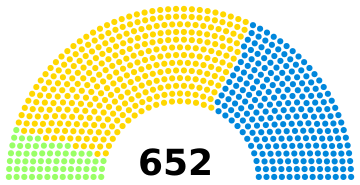
| seats_for_election | All 652 seats in the House of Commons | |
| majority_seats | 327 | |
| election_date | ||
| elected_mps | List of MPs elected in the United Kingdom general election, 1880 | |
| <!-- Liberal --> | image1 | |
| leader1 | Marquess of Hartington | |
| leader_since1 | January 1875 | |
| party1 | Liberal Party (UK) | |
| leaders_seat1 | North East Lancashire | |
| last_election1 | 242 seats, 52.0% | |
| seats1 | **352** | |
| seat_change1 | 110 | |
| popular_vote1 | **1,836,423** | |
| percentage1 | **54.7%** | |
| swing1 | 2.7 pp | |
| <!-- Conservative --> | image2 | |
| leader2 | The Earl of Beaconsfield | |
| leader_since2 | 27 February 1868 | |
| party2 | Conservative Party (UK) | |
| leaders_seat2 | House of Lords | |
| last_election2 | 350 seats, 44.3% | |
| seats2 | 237 | |
| seat_change2 | 113 | |
| popular_vote2 | 1,426,349 | |
| percentage2 | 42.5% | |
| swing2 | 1.8 pp | |
| <!-- Home Rule --> | image3 | |
| leader3 | William Shaw | |
| leader_since3 | May 1879 | |
| party3 | Home Rule League | |
| leaders_seat3 | County Cork | |
| last_election3 | 60 seats, 3.7% | |
| seats3 | 63 | |
| seat_change3 | 3 | |
| popular_vote3 | 95,528 | |
| percentage3 | 2.8% | |
| swing3 | 0.9 pp | |
| map_image | United Kingdom general election 1880.svg | |
| map_size | 380px | |
| map_caption | Colours denote the winning party | |
| title | Prime Minister | |
| posttitle | Prime Minister after the election | |
| before_election | Earl of Beaconsfield | |
| before_party | Conservative Party (UK) | |
| after_election | William Gladstone | |
| after_party | Liberal Party (UK) | |
| map2_image | File:1880 UK GE Composition diagram.svg | |
| map2_caption | Composition of the House of Commons after the election |
The 1880 United Kingdom general election was held from 31 March to 27 April 1880. It saw the Liberal opposition triumph with 352 seats.
Its intense rhetoric was led by the Midlothian campaign of the Liberals, particularly the fierce oratory of Liberal leader William Gladstone. He vehemently attacked the foreign policy of the government of Benjamin Disraeli, Earl of Beaconsfield, as utterly immoral. The endeavours of the Disraeli government in Africa, India, Afghanistan and Europe, which were only partially successful and often accompanied by early, humiliating defeats, gave a good deal of fodder to Gladstone for his attacks. Further, Disraeli's favoured dealing with the Turks, who were responsible for horrendous atrocities against Balkan Christians also laid him open to religious attacks, especially in Gladstone's pamphlet “The Bulgarian Horrors and the Question of the East” (1876). Gladstone's campaign was a synthesis of the two approaches in a populist manner adapted towards liberalism.
Liberals secured one of their largest-ever majorities, leaving the Conservatives a distant second. As a result of the campaign, the Liberal Commons leader, Lord Hartington and that in the Lords, Lord Granville, stood back in favour of Gladstone, who thus became Prime Minister a second time. It was the last general election in which any party other than the Conservatives won a majority of the total votes (rather than a mere plurality), as well the only time (except for 1906) until 1945 in which any party other than the Conservatives won a majority.
Issues
The Conservative government was doomed by the poor condition of the British economy and the vulnerability of its foreign policy to moralistic attacks by the Liberals. William Gladstone, appealing to moralistic evangelicals, led the attack on the foreign policy of Benjamin Disraeli (now known as Lord Beaconsfield) as immoral. Historian Paul Smith paraphrases the rhetorical tone which focused on attacking "Beaconsfieldism" (in Smith's words) as a:{{blockquote|Sinister system of policy, which not merely involved the country in immoral, vainglorious and expensive external adventures, inimical to peace and to the rights of small peoples, but aimed at nothing less than the subversion of parliamentary government in favour of some simulacrum of the oriental despotism its creator was alleged to admire.
Smith notes that there was indeed some substance to the allegations, but: "Most of this was partisan extravaganza, worthy of its target's own excursions against the Whigs."
Disraeli himself was now the Earl of Beaconsfield in the House of Lords, and custom did not allow peers to campaign; this denuded the Conservatives of other important figures such as the Marquess of Salisbury and Lord Cranbrook, and the party was unable to deal effectively with the rhetorical onslaught. Although he had improved the organisation of the Conservative Party, Disraeli was firmly based in the rural gentry, and had little contact with or understanding of the urban middle class that was increasingly dominating his party.
Besides their trouble with foreign policy issues, it was even more important that the Conservatives were unable to effectively defend their economic record on the home front. The 1870s coincided with a long-term global depression caused by the collapse of the worldwide railway boom of the 1870s which previously had been so profitable to Britain. The stress was growing by the late 1870s; prices fell, profits fell, employment fell, and there was downward pressure on wage rates that caused much hardship among the industrial working class. The free trade system supported by both parties made Britain defenceless against the flood of cheap wheat from North America, which was exacerbated by the worst harvest of the century in Britain in 1879. The party in power got the blame, and Liberals repeatedly emphasised the growing budget deficit as a measure of bad stewardship. In the election itself, Disraeli's party lost heavily up and down the line, especially in Scotland and Ireland, and in the urban boroughs. His Conservative strength fell from 351 to 238, while the Liberals jumped from 250 to 353. Disraeli resigned on 21 April 1880.
Results
|votes % = 54.66 |seats % = 53.99 |plus/minus = +2.7 |votes % = 42.46 |seats % = 36.35 |plus/minus = −1.8 |votes % = 2.84 |seats % = 9.66 |plus/minus = −0.9 |votes % = 0.03 |seats % =0 |plus/minus = 0 |}
Voting summary
Seats summary
Regional results
Great Britain
| Party | Seats | Seats change | Votes | % | % change | Total |
|---|---|---|---|---|---|---|
| 334 | 104 | 1,780,171 | 57.3 | 1.9 | ||
| 3 | 1 | |||||
| 214 | 105 | 1,326,744 | 42.7 | 1.9 | ||
| 0 | 1,107 | 0.04 | 0.04 | |||
| 551 | 3,108,022 | 100 |
England
| Party | Seats | Seats change | Votes | % | % change | Total |
|---|---|---|---|---|---|---|
| 251 | 82 | 1,519,576 | 56.2 | 2.4 | ||
| 3 | 1 | |||||
| 197 | 83 | 1,205,990 | 43.7 | 2.5 | ||
| 0 | 1,107 | 0.1 | 0.1 | |||
| 451 | 2,726,673 | 100 |
Scotland
Main article: 1880 United Kingdom general election in Scotland
| Party | Seats | Seats change | Votes | % | % change | Total |
|---|---|---|---|---|---|---|
| 52 | 12 | 195,517 | 70.1 | 1.7 | ||
| 6 | 12 | 74,145 | 29.9 | 1.7 | ||
| 58 | 269,662 | 100 |
Wales
| Party | Seats | Seats change | Votes | % | % change | Total |
|---|---|---|---|---|---|---|
| 29 | 10 | 50,403 | 58.8 | 2.1 | ||
| 4 | 10 | 41,106 | 41.2 | 2.1 | ||
| 33 | 100,509 | 100 |
Ireland
Main article: 1880 United Kingdom general election in Ireland
| Party | Seats | Seats change | Votes | % | % change | Total |
|---|---|---|---|---|---|---|
| 63 | 3 | 95,535 | 37.5 | 2.1 | ||
| 23 | 8 | 99,607 | 39.8 | 1.0 | ||
| 15 | 5 | 56,252 | 22.7 | 4.3 | ||
| 101 | 251,394 | 100 |
Universities
| Party | Seats | Seats change | Votes | % | % change | Total |
|---|---|---|---|---|---|---|
| 7 | 5,503 | 49.2 | ||||
| 2 | 5,675 | 50.8 | ||||
| 9 | 11,178 | 100 |
Notes
References
References
- "Data".
- Roberts, Andrew. (2000). "Salisbury: Victorian Titan". Phoenix.
This article was imported from Wikipedia and is available under the Creative Commons Attribution-ShareAlike 4.0 License. Content has been adapted to SurfDoc format. Original contributors can be found on the article history page.
Ask Mako anything about 1880 United Kingdom general election — get instant answers, deeper analysis, and related topics.
Research with MakoFree with your Surf account
Create a free account to save articles, ask Mako questions, and organize your research.
Sign up freeThis content may have been generated or modified by AI. CloudSurf Software LLC is not responsible for the accuracy, completeness, or reliability of AI-generated content. Always verify important information from primary sources.
Report