From Surf Wiki (app.surf) — the open knowledge base
1872 Canadian federal election
none
none
| Field | Value | ||
|---|---|---|---|
| election_name | 1872 Canadian federal election | ||
| country | Canada | ||
| flag_year | 1868 | ||
| type | parliamentary | ||
| ongoing | no | ||
| party_colour | no | ||
| party_name | no | ||
| previous_election | 1867 Canadian federal election | ||
| previous_year | 1867 | ||
| next_election | 1874 Canadian federal election | ||
| next_year | 1874 | ||
| seats_for_election | 200 seats in the House of Commons | ||
| majority_seats | 101 | ||
| turnout | 70.3%{{cite web | title=Voter Turnout at Federal Elections and Referendums | |
| url | http://www.elections.ca/content.aspx?section=ele&dir=turn&document=index&lang=e | website=Elections Canada | access-date=10 March 2019}} ( 2.8 pp) |
| election_date | July 20–October 12, 1872 | ||
| elected_members | 2nd Canadian Parliament | ||
| outgoing_members | 1st Canadian Parliament | ||
| <!-- Conservative Party --> | image1 | [[File:Macdonald1872 (cropped).jpg | 200x200px]] |
| colour1 | |||
| leader1 | John A. Macdonald | ||
| leader_since1 | July 1, 1867 | ||
| party1 | |||
| leaders_seat1 | Kingston | ||
| last_election1 | 100 seats, 35.0% | ||
| seats1 | **100** | ||
| seat_change1 | 0 | ||
| popular_vote1 | **123,100** | ||
| percentage1 | **38.7%** | ||
| swing1 | 3.7 pp | ||
| <!-- Liberal Party--> | image2 | [[File:Edward Blake (cropped) 2.jpg | 200x200px]] |
| colour2 | |||
| leader2 | Edward Blake *(unofficial)* | ||
| party2 | |||
| leaders_seat2 | Bruce South | ||
| last_election2 | 62 seats, 22.7% | ||
| seats2 | 94 | ||
| seat_change2 | 32 | ||
| popular_vote2 | 110,556 | ||
| percentage2 | 34.7% | ||
| swing2 | 12.0 pp | ||
| <!-- map --> | map_image | Canada 1872 Federal Election.svg | |
| map_size | 380px | ||
| map_caption | 1872 Canadian electoral map | ||
| map2_image | Chambre des Communes 1872.png | ||
| map2_size | 380px | ||
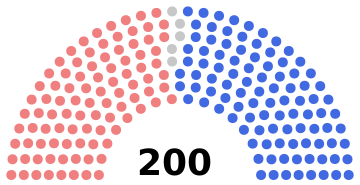
| map2_caption | The Canadian parliament after the 1872 election | ||
| <!-- bottom --> | title | Prime Minister | |
| posttitle | Prime Minister after election | ||
| before_election | John A. Macdonald | ||
| before_party | |||
| after_election | John A. Macdonald | ||
| after_party |
The 1872 Canadian federal election was held from July 20 to October 12, 1872, to elect members of the House of Commons of Canada of the 2nd Parliament of Canada. Prime Minister Sir John A. Macdonald's Conservative Party remained in power, as it took more seats than any other party including the Liberals. The Liberals increased their vote share and their parliamentary representation considerably, while the Conservative vote share and seat count remained mostly static. Macdonald's Conservatives received only six more seats than the Liberals. The election produced the country's first minority government. The support of two independent Conservative MPs functionally gave Macdonald an extremely slim majority that allowed it to survive for two years, until it fell due to the Pacific scandal.
Edward Blake, who had a seat in both the House of Commons of Canada and the Ontario legislature, resigned as Premier of Ontario in order to run in the 1872 federal election as dual mandates had been abolished. Had the Liberals won the election, he likely would have been offered the position of Prime Minister of Canada. The party had no formal leader as such until 1873 when Alexander Mackenzie was given the title after Blake declined due to ill health. Blake was ill during much of the 1872 campaign, and it was Mackenzie who essentially led the Liberal campaign in Ontario, though not outside the province.
The 1872 general election was the first to include the new provinces of Manitoba and British Columbia, which had both joined Canada after the Confederation of 1867. By-elections had been held in both provinces to elect Members of Parliament in the newly created ridings, with Manitoba receiving four seats and British Columbia six. (In 1870 Canada had also expanded to include the North-West Territories, encompassing the current provinces of Alberta and Saskatchewan and the Territories, but no MPs were elected there until 1887.) In 1873, PEI joined Confederation and six more seats were added to the House of Commons, filled by acclamations in by-elections.
Electoral system
Most of the ridings in this election elected just one member through First past the post. The ridings of Ottawa, Victoria, the City and County of St. John, Cape Breton, Pictou, Hamilton, and Halifax elected two members, with each voter casting up to two votes (Plurality block voting).
Results
National
| 2nd Parliament | Party | Party leader | # of candidates | Seats | Popular vote |
|---|---|---|---|---|---|
| [1867](1867-canadian-federal-election) | **Elected** | Change | # | % | Change |
| Total | **367** | **180** | **200** | +11.1 | **320,037** |
| *Source: [Parliament of Canada](https://lop.parl.ca/sites/ParlInfo/default/en_CA/ElectionsRidings/Elections/Profile?election=1872-07-20)* |
Note: 1 Though identifying themselves as Liberal-Conservatives, these MPs and those identifying as Conservatives were both led by Sir John A. Macdonald (himself a Liberal-Conservative) and sat together in the House of Commons.
Acclamations
The following MPs were acclaimed:
- British Columbia: 3 Liberal-Conservatives
- Manitoba: 1 Liberal-Conservative
- Ontario: 3 Conservatives, 3 Liberal-Conservatives, 10 Liberals
- Quebec: 9 Conservatives, 5 Liberal-Conservatives, 5 Liberals
- New Brunswick: 6 Liberals, 1 Independent
- Nova Scotia: 1 Conservative, 4 Liberal-Conservatives, 2 Liberals
Results by province
| Party name | BC | Manitoba | Ontario | Quebec | NB | NS | Total | 6 | 4 | 88 | 65 | 16 | 21 | 200 |
|---|---|---|---|---|---|---|---|---|---|---|---|---|---|---|
| Conservative | Seats | 1 | 1 | 26 | 25 | 2 | 7 | 62 | Popular vote | 4.5 | 29.7 | 25.9 | 31.5 | 8.4 |
| **Total seats** |
Notes
References
References
- Parliamentary Guide 1977, p. 380-381, 418
This article was imported from Wikipedia and is available under the Creative Commons Attribution-ShareAlike 4.0 License. Content has been adapted to SurfDoc format. Original contributors can be found on the article history page.
Ask Mako anything about 1872 Canadian federal election — get instant answers, deeper analysis, and related topics.
Research with MakoFree with your Surf account
Create a free account to save articles, ask Mako questions, and organize your research.
Sign up freeThis content may have been generated or modified by AI. CloudSurf Software LLC is not responsible for the accuracy, completeness, or reliability of AI-generated content. Always verify important information from primary sources.
Report